


The first time you open the OKX trading interface, it looks like someone designed it for a different species entirely. Tabs within tabs, order types you’ve never heard of, funding rates moving every eight hours, and a bot marketplace that might as well be written in a foreign language.
If you’re looking to learn OKX trading bots and actually use them to automate your crypto activity, the path is more structured than it appears. OKX is one of the top three crypto exchanges globally by volume and liquidity, and its built-in bot suite — covering Grid, DCA, Arbitrage, and Slicing strategies — is genuinely the most complete automated trading toolkit available natively inside a single exchange. You don’t need to code, connect APIs to third-party services, or pay for external tools. Everything runs inside the platform.
- The bots work best once you understand the underlying market mechanics — skipping spot and futures basics leads to mis-configured bots and silent losses
- Grid bots profit from sideways volatility, DCA bots from trending markets, Arbitrage bots from funding rates — using the wrong bot in the wrong condition is the single most common mistake
- OKX’s AI strategy mode sets parameters for you, but knowing what those parameters mean is what separates traders who profit from those who get wiped
What OKX Trading Bots Actually Are
An OKX trading bot is an automated strategy engine built directly into the exchange — no external software, no API keys, no subscriptions. You define the parameters (or let the AI set them), and the bot executes orders continuously on your behalf, 24 hours a day, including weekends and public holidays when most manual traders are offline.
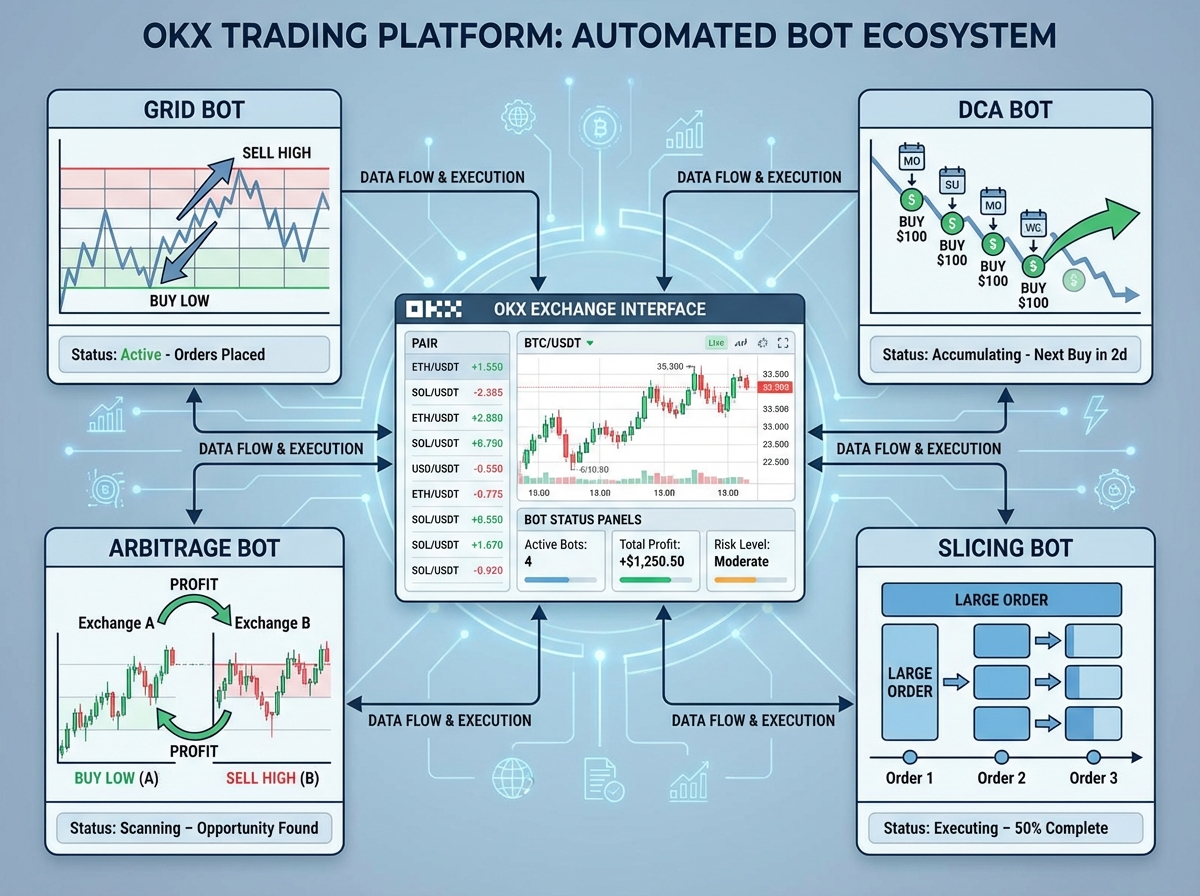
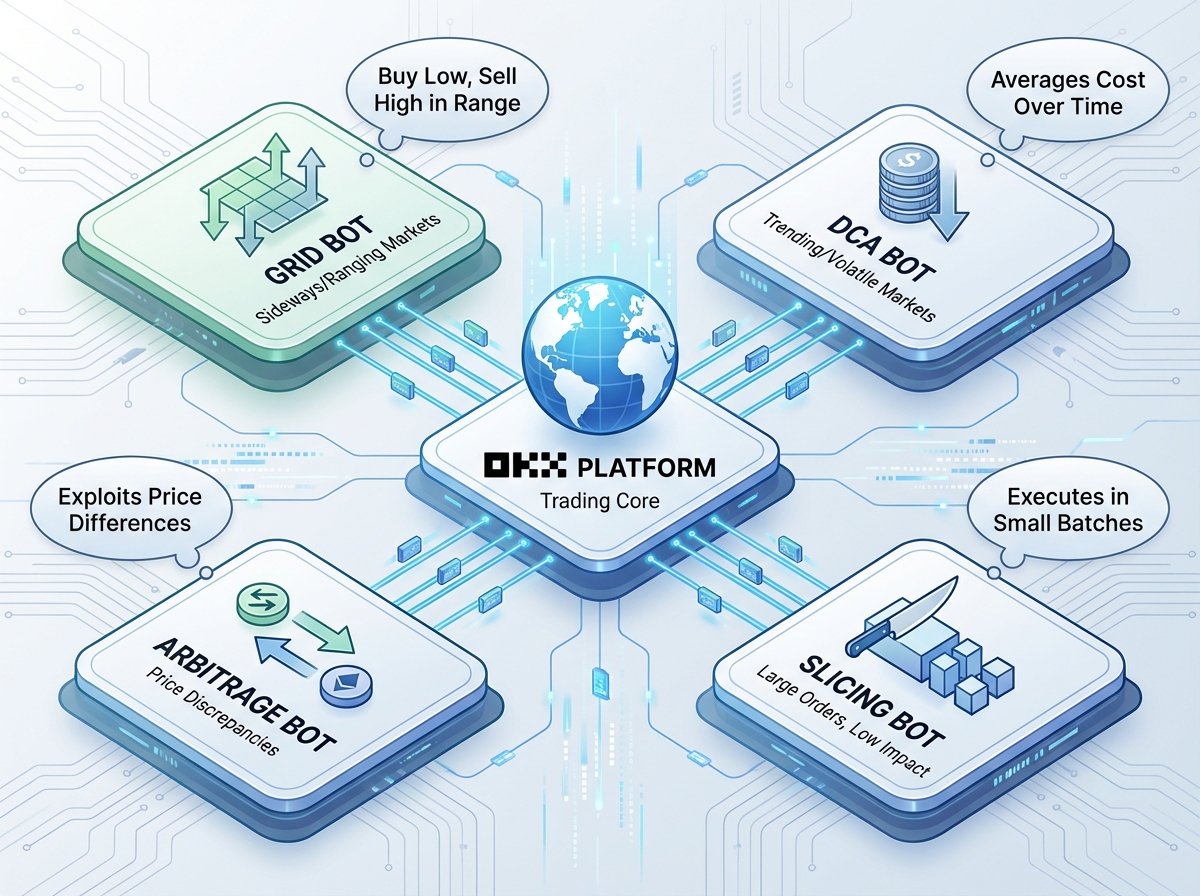
The four core bot families each serve a distinct market condition:
| Bot Type | Best Market Condition | Core Mechanism |
|---|---|---|
| Grid Bot | Sideways / ranging | Buys low, sells high within a fixed price range |
| DCA Bot (Martingale) | Trending with pullbacks | Averages down on dips, exits at a take-profit target |
| Arbitrage Bot | Any (low-risk) | Earns from funding rates and portfolio rebalancing |
| Slicing Bot | Large order execution | Splits big orders into smaller time/price-based chunks |
Each bot type is available in either spot or futures mode, and each has an AI Strategy option that auto-generates parameters based on historical backtesting for the selected trading pair.
Three Things That Will Surprise You Right Away
- Funding rates on futures can pay you without taking a directional position.
- The AI strategy mode on Grid bots uses real backtested data, not generic defaults.
- You can run multiple bots simultaneously on different pairs with no manual supervision.
How Long Getting Comfortable Actually Takes
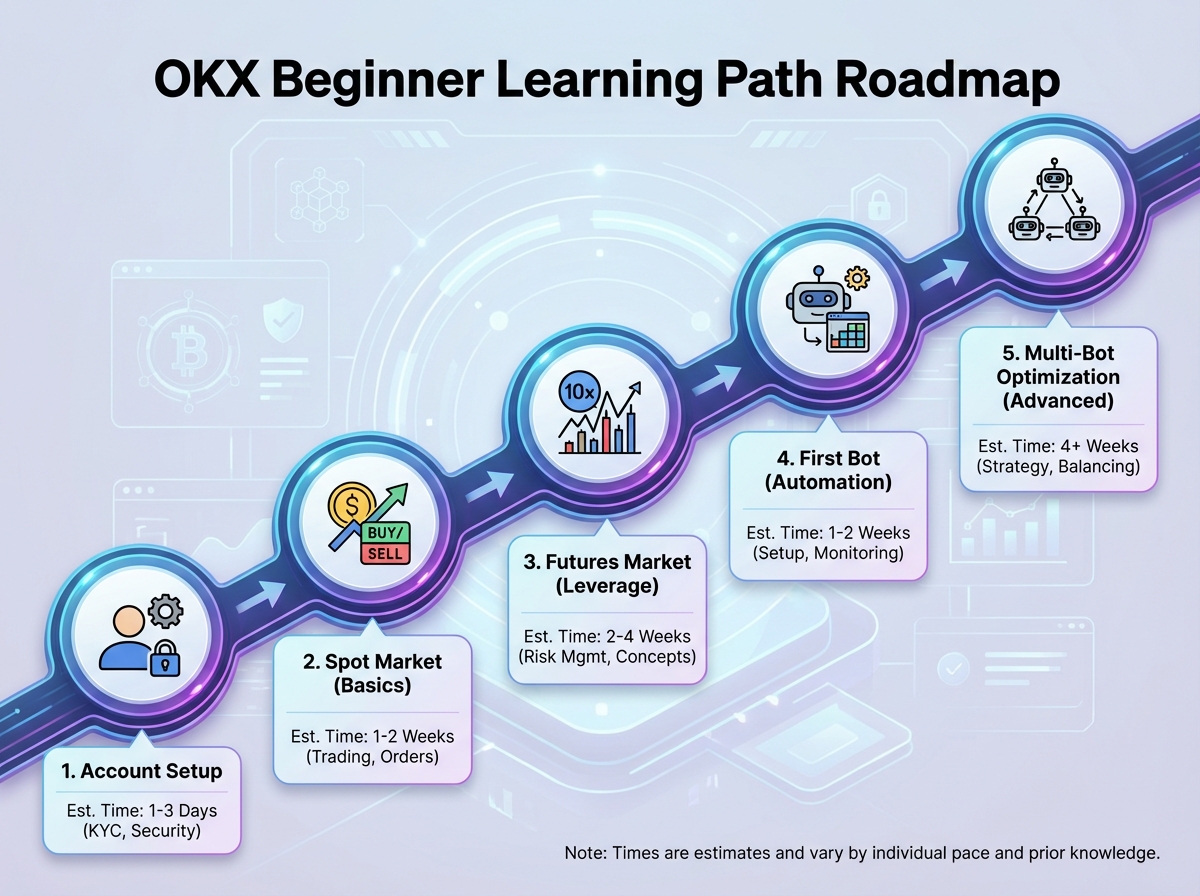
| Stage | What You’re Learning | Realistic Time |
|---|---|---|
| Account setup + deposit | KYC, funding methods, P2P and local exchange options | 1–2 days |
| Spot market fundamentals | Order book, market vs limit orders, take profit / stop loss | 3–5 days |
| Futures market mechanics | Margin, leverage, cross vs isolated, funding rate | 5–7 days |
| First bot deployment | Grid or DCA bot using AI strategy, small capital | 1–2 days |
| Bot tuning and diversification | Manual parameters, multiple bot types running | 2–4 weeks |
| Total | From zero to confident multi-bot trader | 4–6 weeks |
Order matters more than speed here — someone who spends a full week on spot mechanics before touching bots will outperform someone who jumps straight to futures grid bots after two days. If the table above feels slow for you, that’s fine. Most people take six to eight weeks, and the extra time spent understanding funding rates before deploying an arbitrage bot pays for itself almost immediately.
Getting Your Account and Funds in Order
The very first wall most people hit isn’t trading — it’s getting money onto the platform. OKX supports several deposit methods: direct crypto transfer, P2P trading (buying from another user using bank transfer or local payment apps), and local exchange routing where you buy on a smaller regional exchange first and transfer across. Each method has a different speed, fee profile, and availability by country.
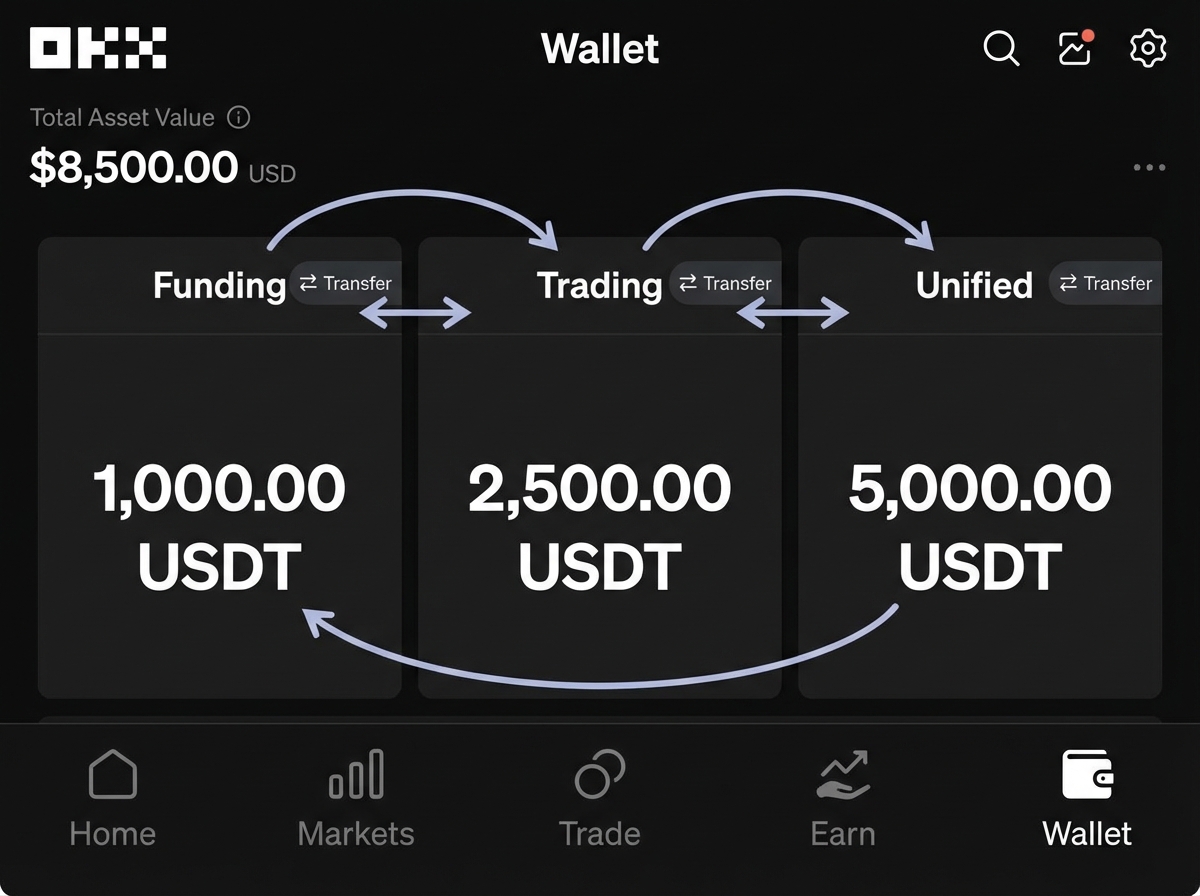
P2P is often the fastest on-ramp if you’re working with fiat currency in Southeast Asia, but it requires verifying the seller’s reputation manually before sending payment. The internal transfer function — moving funds between your funding wallet, trading wallet, and unified account — trips up nearly every new user at least once. You place an order and nothing happens because your funds are in the wrong sub-wallet. Check the wallet before blaming the trade.
Withdrawal works the same way in reverse, and understanding the difference between on-chain withdrawal (slower, fee-dependent, network-specific) and internal transfer (instant, free, only between OKX accounts) saves time and money from day one.
The Spot Market Is the Foundation Everything Else Breaks Without
The biggest mistake people make when learning OKX trading bots is skipping spot market mechanics to get to the bots faster. This is the mistake. Every bot on the platform — whether it’s a DCA bot buying dips or a grid bot cycling through price levels — is executing spot or futures orders under the hood. If you don’t understand what a limit order actually does versus a market order, you won’t understand why your bot bought at a worse price than expected, or why it didn’t trigger at all.
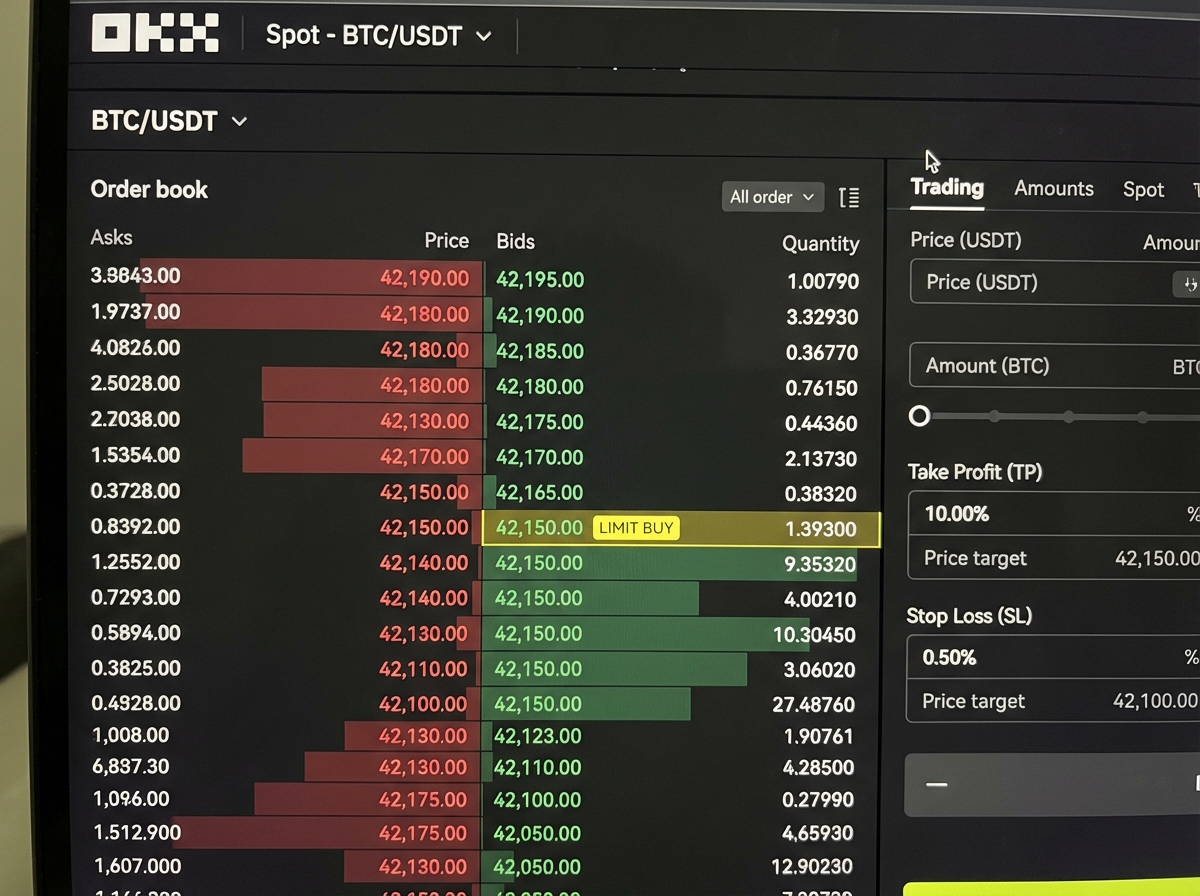
The order book is the thing that makes spot trading click. Watching live bids and asks move in real time, seeing how large market orders eat through limit orders on one side, understanding why the spread widens during low-liquidity hours — this context transforms bot parameter-setting from guesswork into reasoning. When you’re setting a grid bot’s price range later, you’re essentially building a structured set of limit orders inside that range. Understanding the order book first means you’re building it intentionally.
Take profit and stop loss in the spot market are also where most beginners under-invest attention. Setting a take profit sounds obvious until you realize it doesn’t protect you if the price gaps past your level. Getting familiar with these mechanics on small manual trades before automating them at scale is the difference between losing a small amount and losing a large amount in the same scenario.
Futures and Leverage Are a Separate Language
Futures on OKX introduce concepts that don’t exist in spot trading, and treating them as just “spot with more risk” is where accounts get destroyed quickly. Margin is the collateral you post. Leverage is the multiplier on your position size. Cross margin shares your total account balance as collateral across all positions — one bad trade can liquidate others. Isolated margin caps your loss to the funds allocated to that specific position.
For anyone new to OKX crypto trading for beginners, isolated margin is the correct default. It behaves predictably, it caps your downside, and it forces you to think about position sizing deliberately rather than letting a large balance absorb losses you haven’t consciously accepted. The funding rate — a periodic payment between long and short holders — is also critical to understand before running a futures DCA bot or a futures grid, because it directly affects your position’s profitability on an ongoing basis.
The real shift in thinking comes when you realize futures aren’t just for speculation. Used with low leverage and proper stop losses, they let you build directional strategies that aren’t possible in spot. Used correctly inside bots — specifically the Future DCA Martingale — they let you run the same averaging strategy long or short depending on your market outlook.
Grid Bots: Where Most People Finally Get It
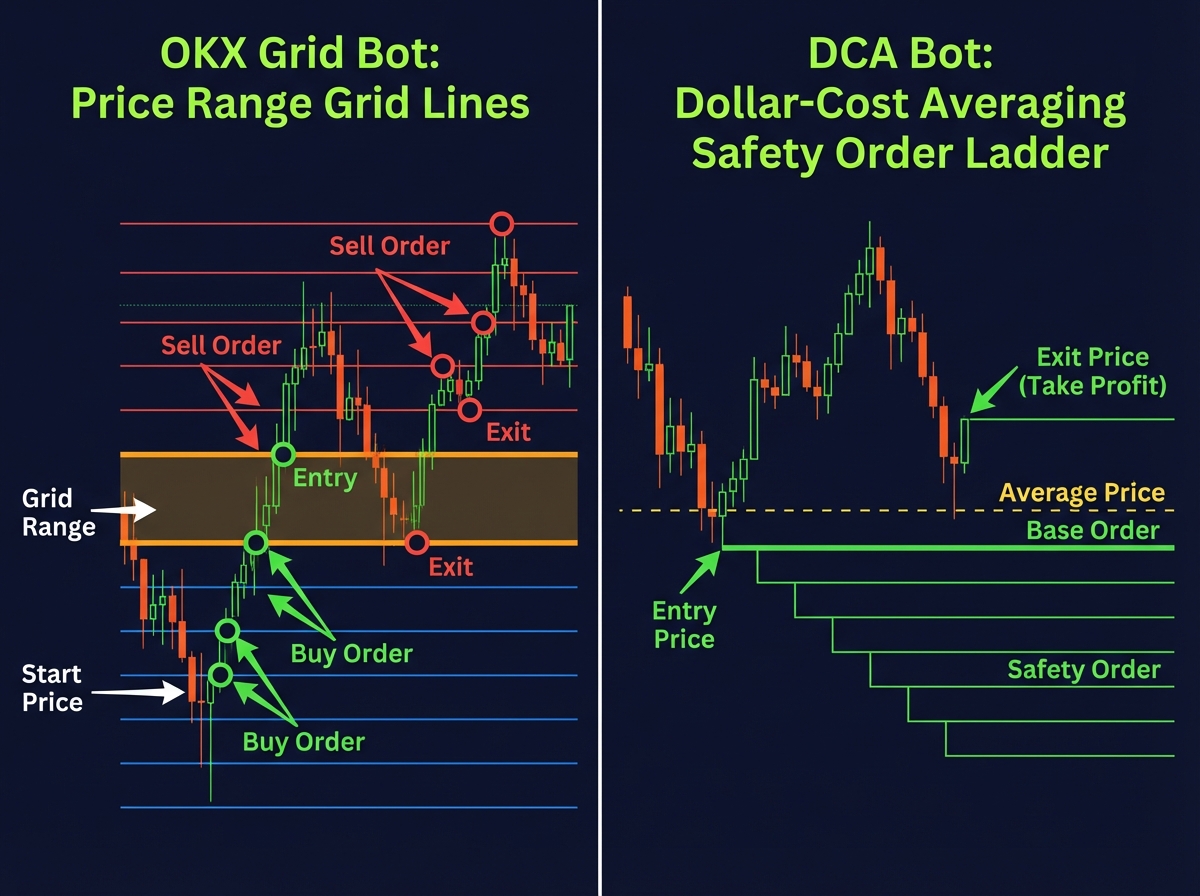
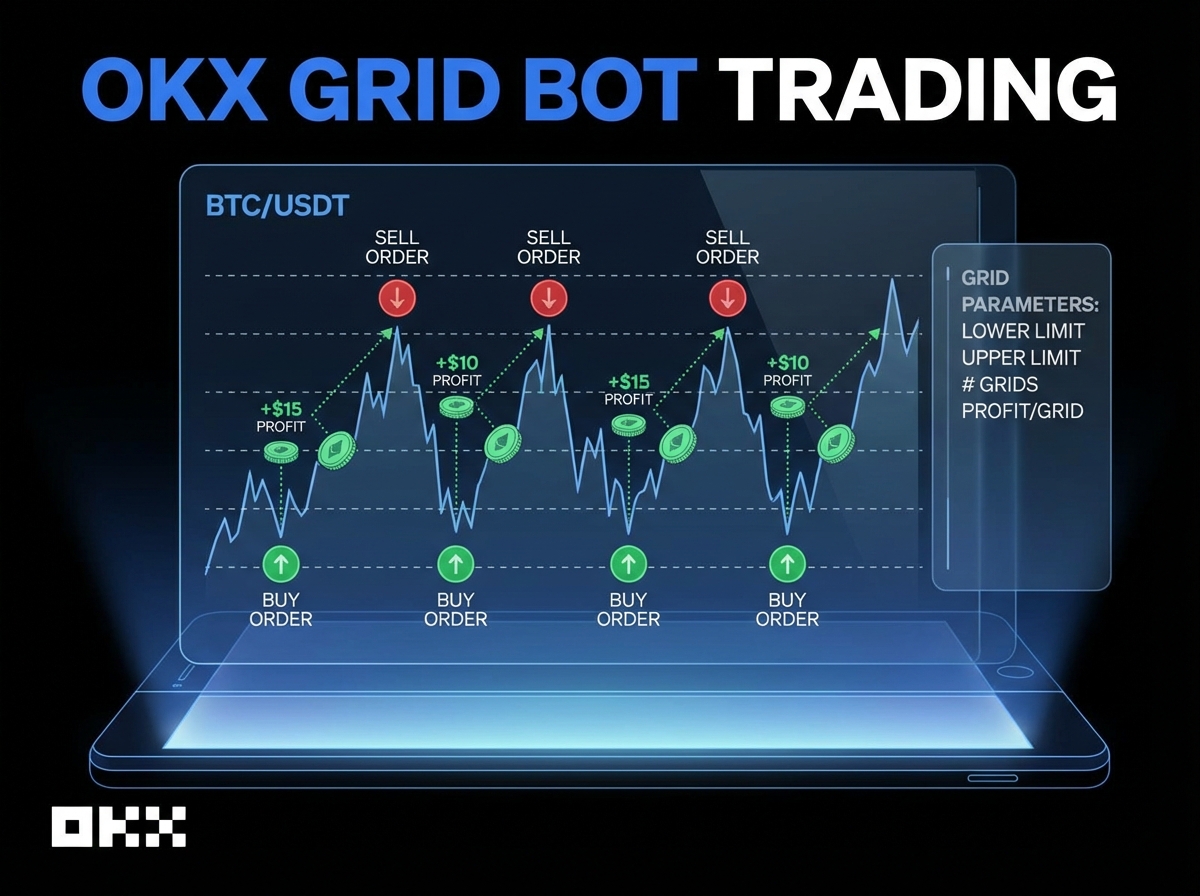
The grid concept is where automated OKX crypto trading stops feeling abstract and starts feeling like something you can actually reason about. You define a price range — say, Bitcoin between $80,000 and $100,000. The bot divides that range into equally spaced grid lines. At each line, it places a buy order below and a sell order above. Every time the price oscillates through a grid, one buy and one sell complete, locking in a small profit. More oscillations equal more profit, regardless of whether the price ends higher or lower than where it started.
The Grid Bot setup requires three inputs that matter most: the price range, the number of grids, and the investment amount. Too few grids and you miss oscillations. Too many and the per-grid profit barely covers trading fees. OKX’s AI Strategy solves this by running a backtest on the selected pair and suggesting parameters that would have performed well historically — not a guarantee, but a far better starting point than guessing. The Infinity Grid variant removes the upper price cap, which makes it suitable for assets you’re broadly bullish on long-term.
DCA and Arbitrage Bots: The Ones That Actually Run Quietly
The Spot DCA Martingale bot is built around one idea: when a trade goes against you, buy more at a lower price, and exit the entire position at a profit once the market recovers. The bot places an initial buy order, then a series of safety orders at configurable price drops below entry. When the average price recovers to your take-profit target, it closes everything and starts the next cycle. It doesn’t require you to predict direction with precision — it requires you to correctly identify an asset that will eventually recover.
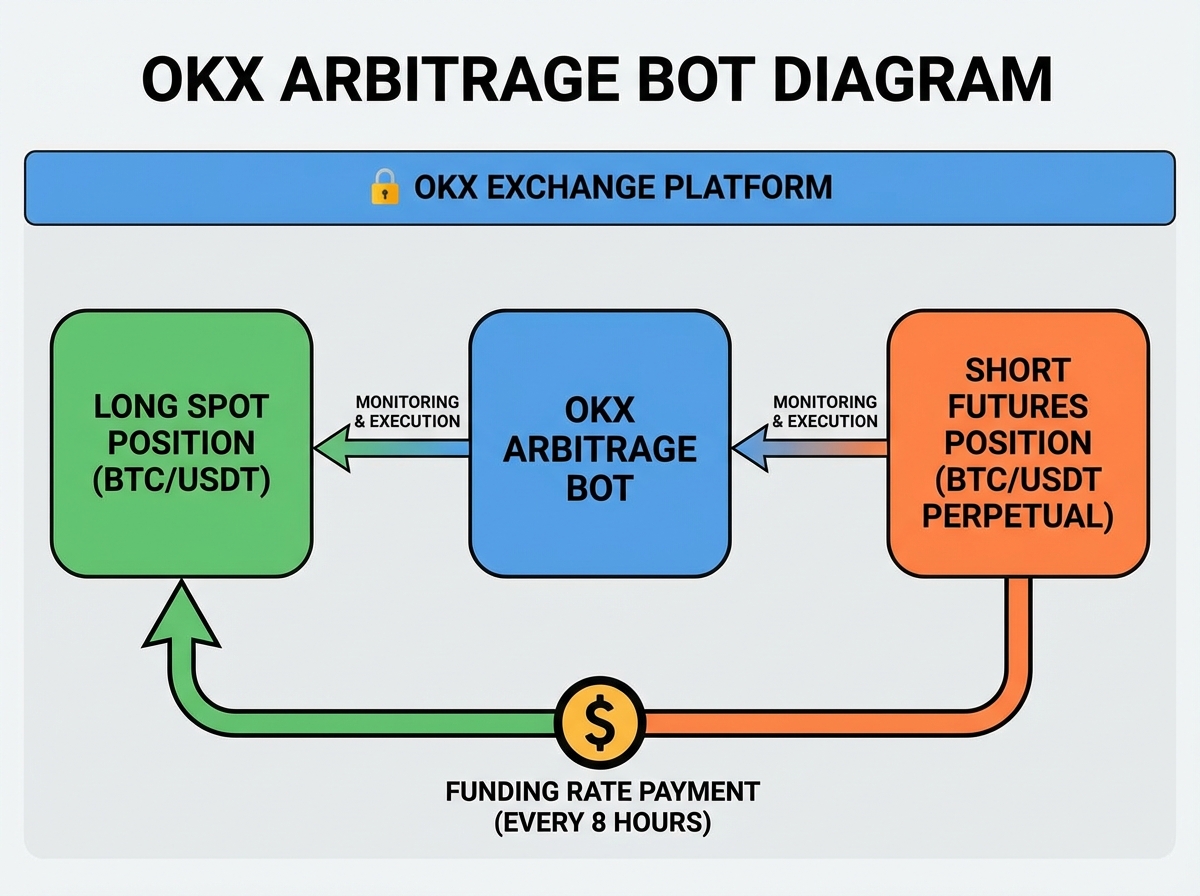
The Arbitrage Bot family is the quietest of the four. Smart Portfolio auto-rebalances your holdings to a target allocation, buying underperformers and selling outperformers continuously. Dip Sniper and Peak Sniper time entries and exits at volatility extremes. The pure Arbitrage Bot earns from funding rate differentials — simultaneously holding a long spot position and a short futures position on the same asset, collecting the funding rate payment that flows between them. It’s as close to market-neutral income as retail crypto trading offers, and it runs without requiring any directional prediction whatsoever.
For anyone interested in automated crypto trading strategies at a more advanced level, understanding funding rate mechanics is what separates the arbitrage bot from all other passive strategies on the platform.
Slicing Bots and Why They Exist
The Iceberg and TWAP bots inside OKX’s Slicing Bot section look like professional institutional tools — because they are. An Iceberg order breaks a large position into smaller visible pieces, showing only a fraction of the total order in the order book at any time to avoid moving the market. TWAP (Time-Weighted Average Price) distributes execution across a time window, buying or selling in equal slices regardless of price.
For most beginners, these aren’t the first bots you’ll use. But understanding why they exist reshapes how you think about large orders. If you’re building a significant position in a lower-liquidity altcoin, placing a single large limit order telegraphs your intent to every other trader reading the order book. The Slicing bot makes your activity invisible, executing at a better average price without the market front-running you.
What You’ll Actually Know on the Other Side
Six weeks in, the platform that looked completely alien starts to feel like a set of tools you’ve chosen deliberately. You know which bot fits which market condition. You know why isolated margin is the right default. You know what a funding rate is and whether it’s working for or against your position at any given moment. You’ve watched a grid bot complete dozens of cycles on a ranging pair and understand viscerally why the price range you chose matters more than the number of grids.
The biggest shift isn’t technical — it’s psychological. You stop trying to predict what the market will do next and start building systems that perform whether it goes up, sideways, or down. That reframe is what every experienced bot trader arrives at eventually, usually after losing money doing the opposite.
Here are the actions that will move you forward fastest:
- Start with a P2P deposit using a verified seller — it’s the fastest fiat on-ramp in most regions and teaches you how platform-level trust mechanisms work before you’re managing real positions.
- Make your first five trades manually in spot before touching any bot — set limit orders, watch them fill (or not fill), cancel and replace them. This is not optional if you want to understand bot behavior later.
- Use isolated margin for every futures position until you’ve run at least ten complete cycles — cross margin punishes mistakes you don’t know you’re making yet.
- Deploy your first Grid Bot with the AI Strategy setting and the minimum viable capital — let it run for two weeks without touching it. The discipline of leaving it alone teaches more than any parameter adjustment.
- Check the funding rate before deploying any futures bot — a negative funding rate environment pays shorts and charges longs; running a long futures DCA bot in that environment means the position bleeds fees continuously, even when the price doesn’t move against you.
- Run the Spot DCA Martingale only on assets you’d hold long-term anyway — the bot averages down, which means if the asset goes to zero, so does your capital. Conviction in the underlying asset is a prerequisite.
- Review bot performance weekly, not daily — daily checking leads to premature stops. Most profitable cycles take longer than they feel comfortable.
- Use OKX’s demo trading mode to test parameter changes before applying them to live bots — it runs on real market data with simulated funds, which means you can validate a new grid range without risking capital.
Leave a Reply