The first time the Rust compiler rejected my code, I didn’t feel frustrated. I felt like I’d been caught by something smarter than me — and I was right.
If you’re looking to learn Rust programming, the honest answer is that it rewards a different kind of patience than most languages. You don’t just write code and run it. You argue with a compiler that has an opinion about every variable you touch. And the strange thing is — after a while — you start to agree with it.
Rust forces you to be explicit about memory before you write a single function — and that upfront cost pays off every time you run code that just works
If you come from Python or JavaScript, the hardest adjustment isn’t the syntax — it’s accepting that the compiler is always right about ownership
The ownership model doesn’t slow you down once it clicks; it eliminates an entire category of bugs you’d otherwise spend days hunting
What Rust Actually Is (And Why the Hype Is Real)
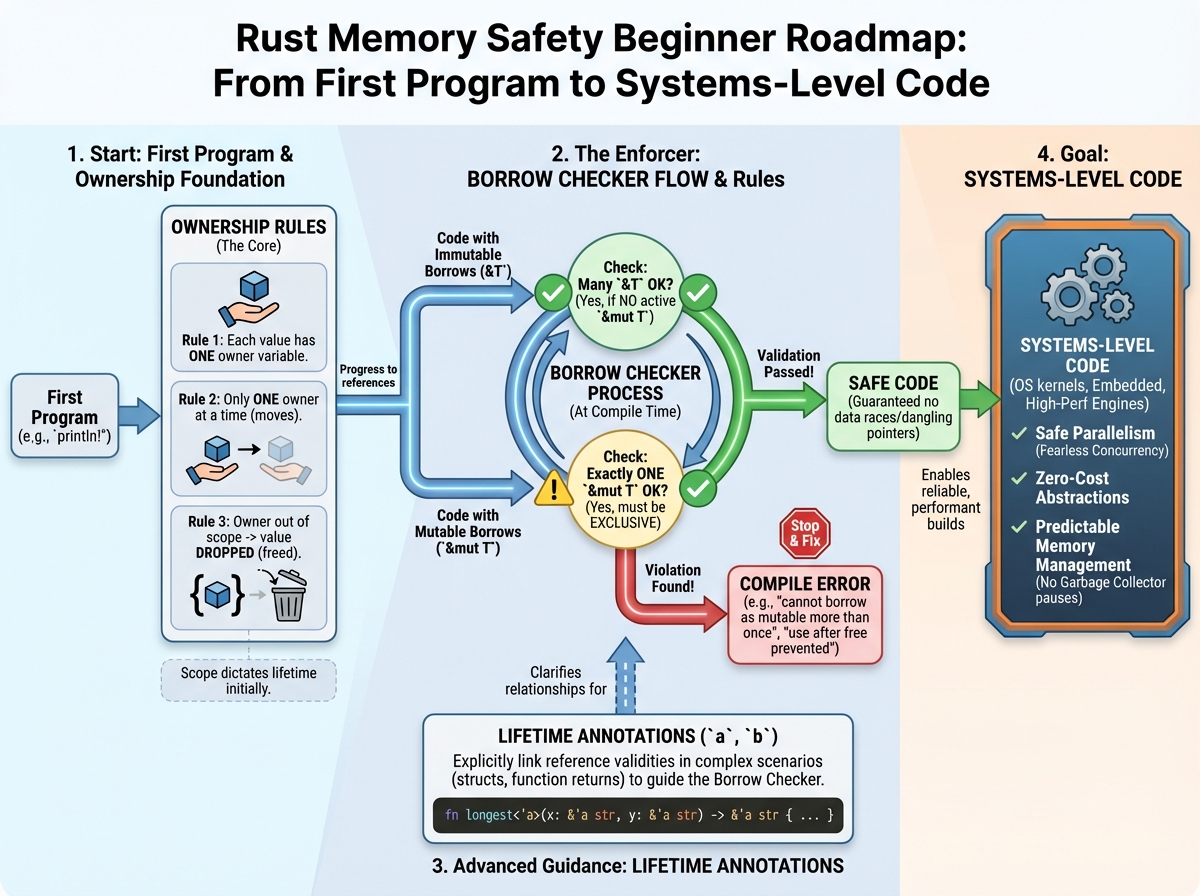
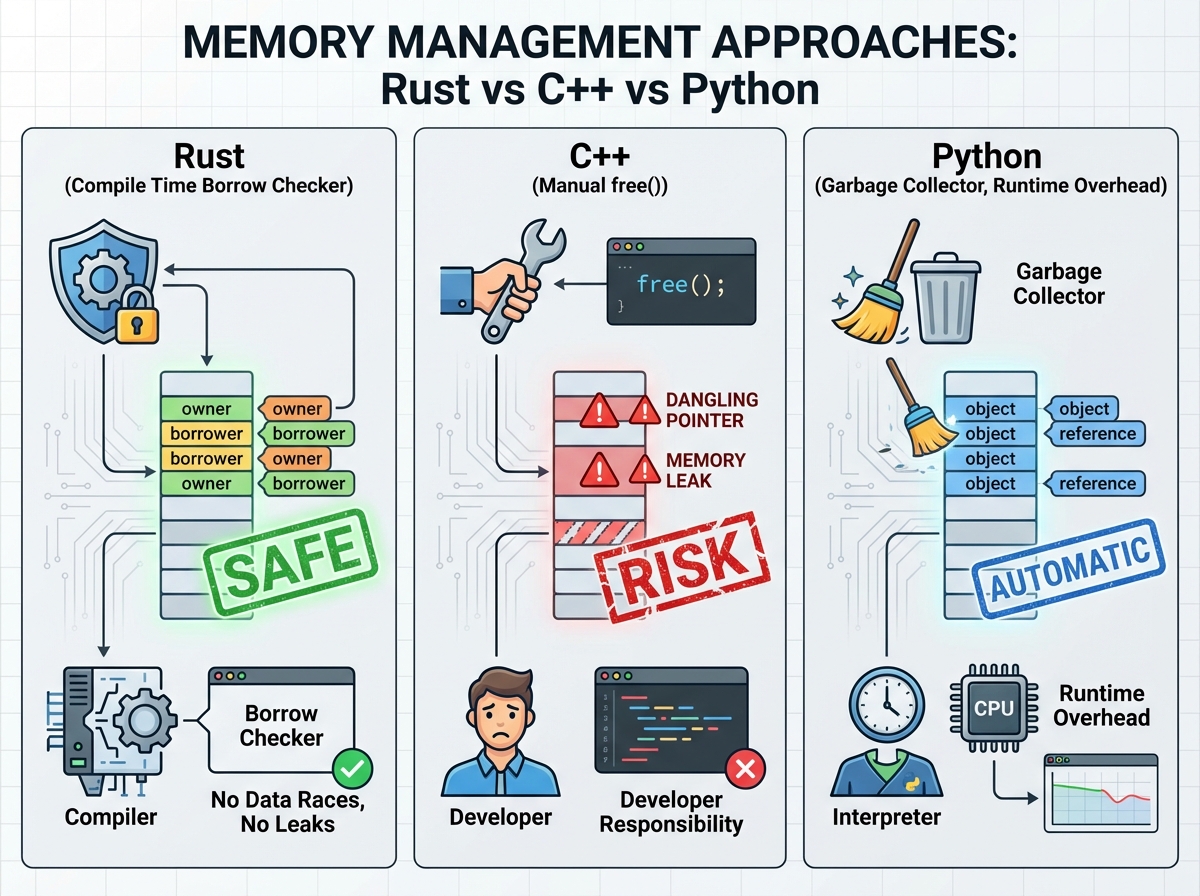
Rust is a systems programming language that enforces memory safety at compile time — no garbage collector, no runtime checks, no surprises in production. Every value has exactly one owner, and when that owner goes out of scope, the memory is freed. That’s it. Three rules, enforced religiously by a compiler that won’t let you ship broken code even if you try.
For a complete beginner, that description means almost nothing. Here’s the version that matters: Rust is the language where the compiler is your most annoying and most helpful collaborator. It catches use-after-free bugs, data races, and null pointer exceptions before your code ever runs. Languages like C give you the control but leave the safety to you. Rust gives you both.
What distinguishes Rust from other modern languages isn’t just the ownership model — it’s that the model scales. The same rules that govern a 30-line beginner script are the rules running in production at companies like Dropbox and in the Linux kernel itself.
Sharp Observations for Rust Beginners
Immutable variables are the default, and that choice prevents more bugs than any linter
You can have multiple readers or one writer — never both at the same time
clone() is not a fix; it’s a signal that you haven’t understood ownership yet
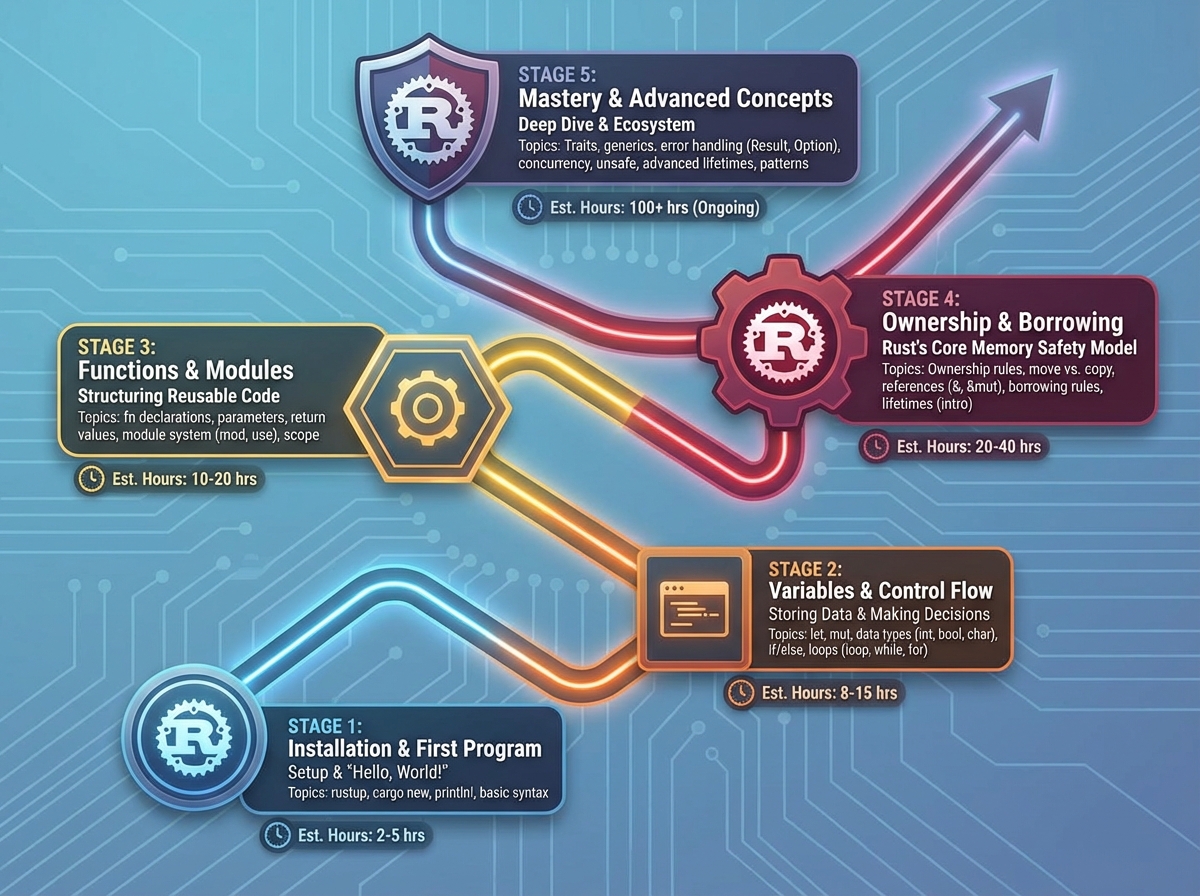
How Long Does Learning Rust Actually Take?
Stage
Content
Time
Setup and first program
Installing rustup, fn main(), println! macro
1–2 hours
Variables and types
let, mut, shadowing, integers, floats, String vs &str
3–5 hours
Control flow
if/else, match expressions, Option and Result types
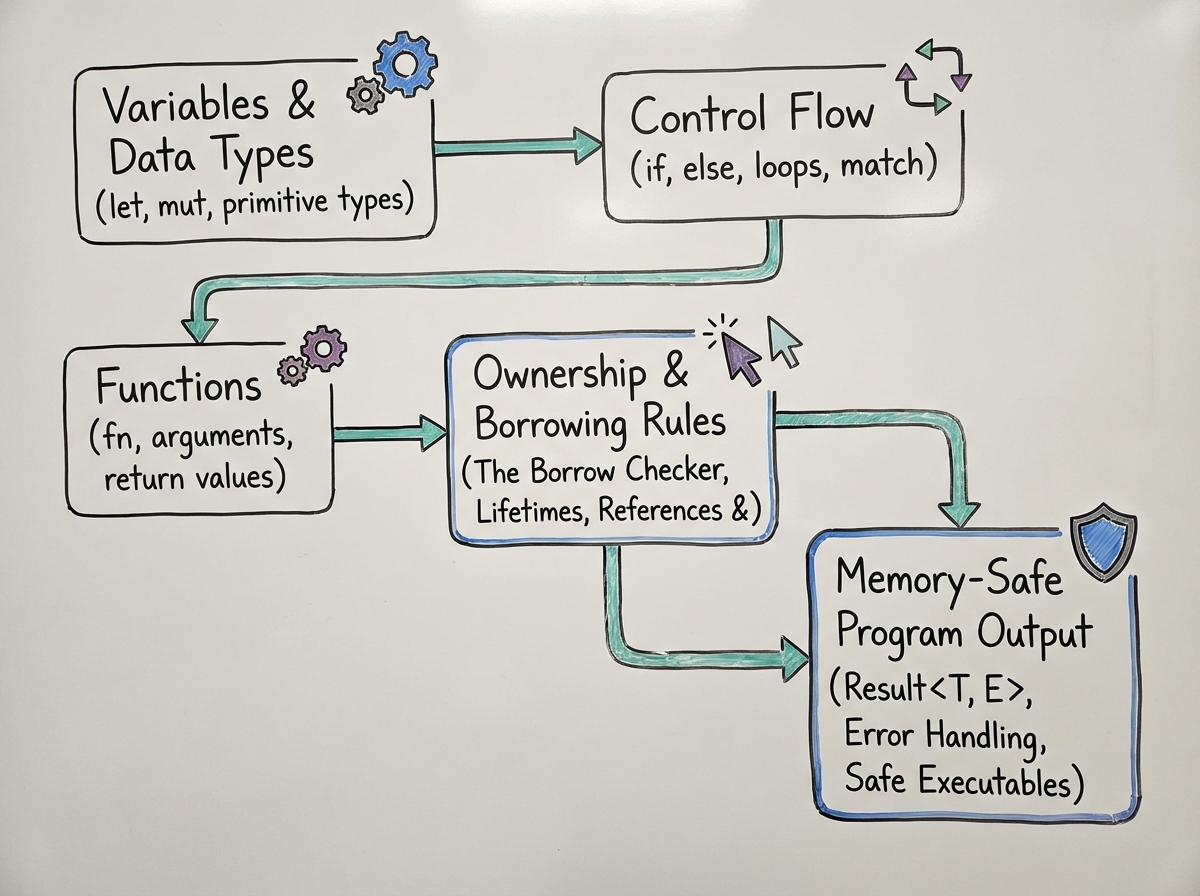
The order of these stages matters more than how fast you move through them — skipping directly to ownership without understanding functions is like trying to understand why a recipe failed before you’ve cooked it once. And if it takes you twice as long as the estimate, that’s not a sign you’re slow. It’s a sign you’re actually thinking about what the compiler is telling you.
Your First Rust Program Will Feel Almost Too Simple
Installing Rust via rustup takes about two minutes. Writing fn main() and using println! to output something to the terminal takes another three. And then you stare at the screen thinking: that’s it? For a language with a reputation like Rust’s?
Yes, that’s it — at the surface. The println! macro with its format placeholders ({} for display, {:?} for debug output) is approachable. The fn main() entry point is clean. The documentation comments and inline comments feel familiar if you’ve used any language before. Nothing here tells you what’s coming.
What the first program actually teaches you isn’t syntax — it’s trust. You learn that the tooling works, that Cargo (Rust’s build tool) handles everything, and that the compiler messages are readable. That trust becomes important later when the compiler starts saying no.
Variables in Rust Don’t Work Like You Think
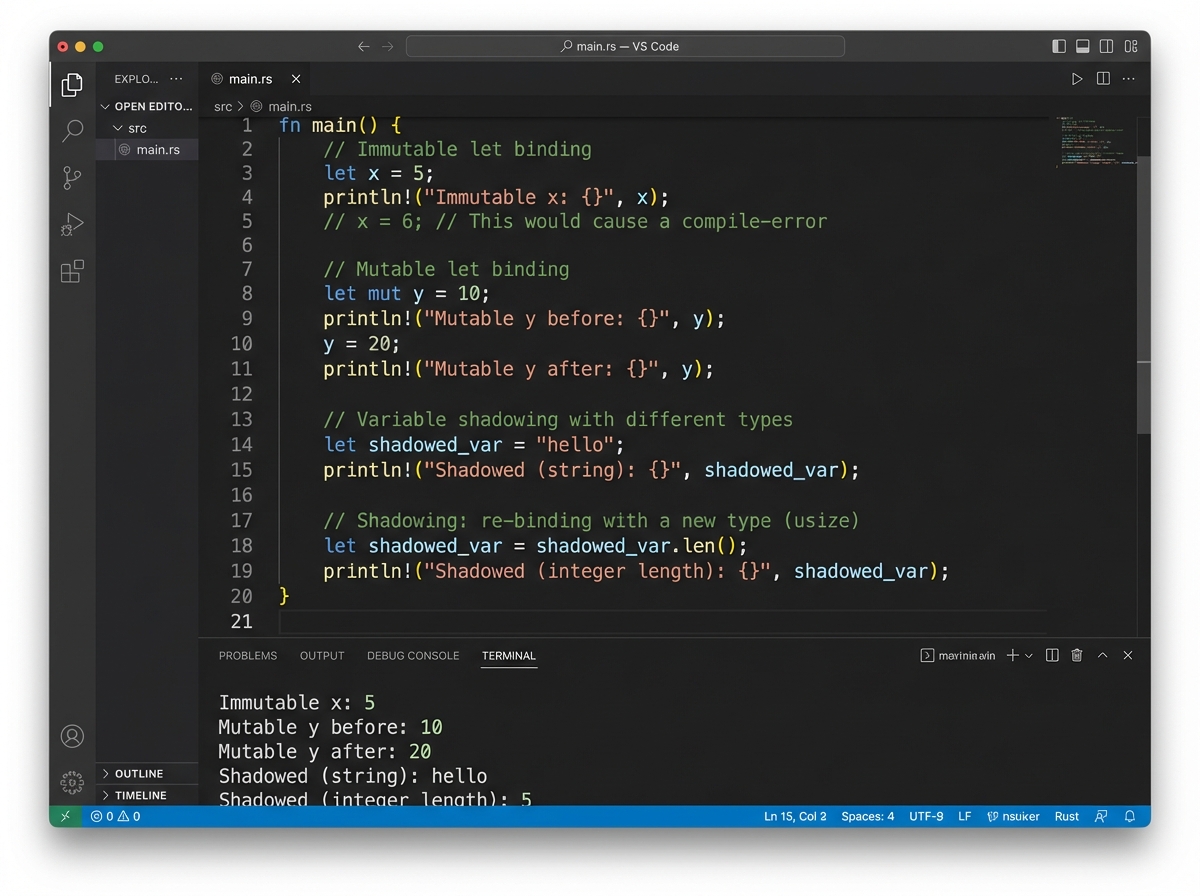
The single biggest mistake beginners make when learning Rust is treating mut as a minor detail. They declare everything mutable by default the way they would in Python, and then wonder why the compiler is warning them constantly. Mutability in Rust is a deliberate statement, not a convenience toggle.
By default, every variable you declare with let is immutable. You can read it. You cannot change it. If you want to change it, you add mut — and that addition is visible to every person who reads your code afterward. It signals intent. It tells the reader: this value is expected to change here, pay attention.
Shadowing compounds this in an interesting way. You can re-declare a variable with the same name using a new let binding — and you can even change its type in the process. This isn’t mutation; it’s replacement. The old binding ceases to exist. It sounds like wordplay until you realize it lets you do things like parse a string into an integer while reusing the same variable name, keeping the code clean without introducing mut.
The Type System Is Trying to Tell You Something
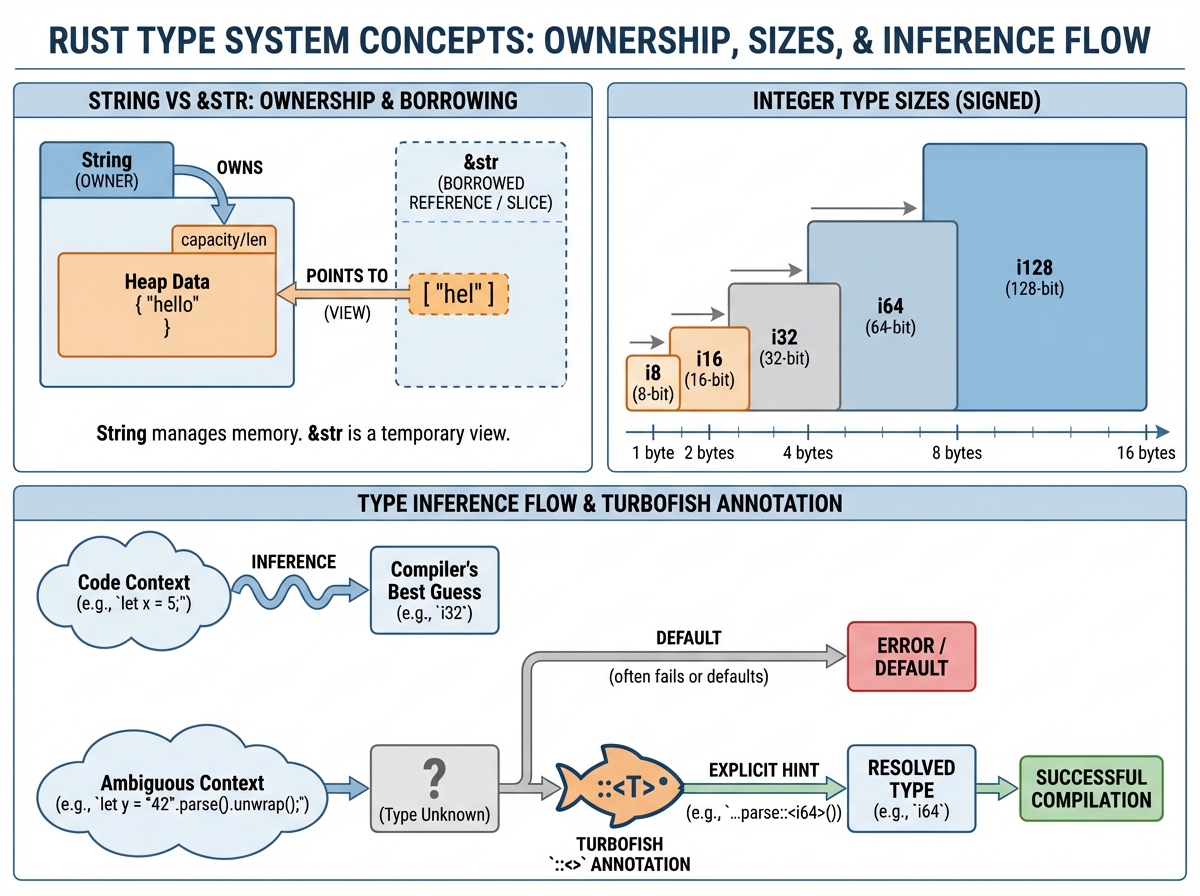
Rust’s type system is verbose compared to what Python developers are used to — and that verbosity is load-bearing. When you declare an integer, you choose between i8, i16, i32, i64, i128 and their unsigned equivalents. When you use floating-point numbers, you pick f32 or f64. These aren’t arbitrary choices. They’re memory layout decisions that affect performance, precision, and safety.
The floating-point precision trap catches almost everyone. You write 0.1 + 0.2 and expect 0.3. You don’t get 0.3. This isn’t a Rust problem — it’s IEEE 754, the standard governing how every modern computer represents decimal numbers in binary. Rust just doesn’t hide it from you.
For strings, the dual system of String (heap-allocated, owned, mutable) and &str (a borrowed reference to string data) confuses beginners until they connect it to the ownership model. A &str is a window into string data owned by someone else. A String is the data itself. Understanding that distinction early saves hours of compiler errors later when writing functions that accept text.
Type inference reduces the verbosity in practice — Rust can often deduce types without explicit annotations. When it can’t, or when you need to guide it, the turbofish syntax (::<>) is your lever. It looks strange the first time. By the time you’ve used it twice, it feels natural.
Control Flow in Rust Is More Powerful Than You Expect
If statements in Rust aren’t interesting. Match expressions are. When you first encounter match, it looks like a more structured switch statement from C or Java. Then you write a pattern guard. Then you destructure a tuple inside a match arm. Then you use it on an `Option
` and suddenly the entire concept of null-safe programming shifts.
Rust’s `Option
` type is the replacement for `null`. A value is either `Some(thing)` or it’s `None` — and the compiler forces you to handle both cases when you consume it. There is no `NullPointerException` in Rust because there are no null pointers. The match expression (or `if let`, or `unwrap_or`, or the `?` operator) is how you extract the value safely.
`Result` extends the same idea to error handling. A function that can fail returns either `Ok(value)` or `Err(error)`. The `?` operator lets you propagate errors up the call stack without nested `match` blocks. Once you internalize this pattern — and you will, because Rust won’t let you ignore it — you start wondering how you ever tolerated silent error swallowing in other languages.
For loops, the iterator system deserves attention early. `enumerate()` gives you both the index and the value. `zip()` pairs two collections. `iter()`, `iter_mut()`, and `into_iter()` control whether you borrow, mutably borrow, or consume the collection. These aren’t advanced features — they’re the standard way to loop in idiomatic Rust.
## Functions Are Where Ownership Gets Personal
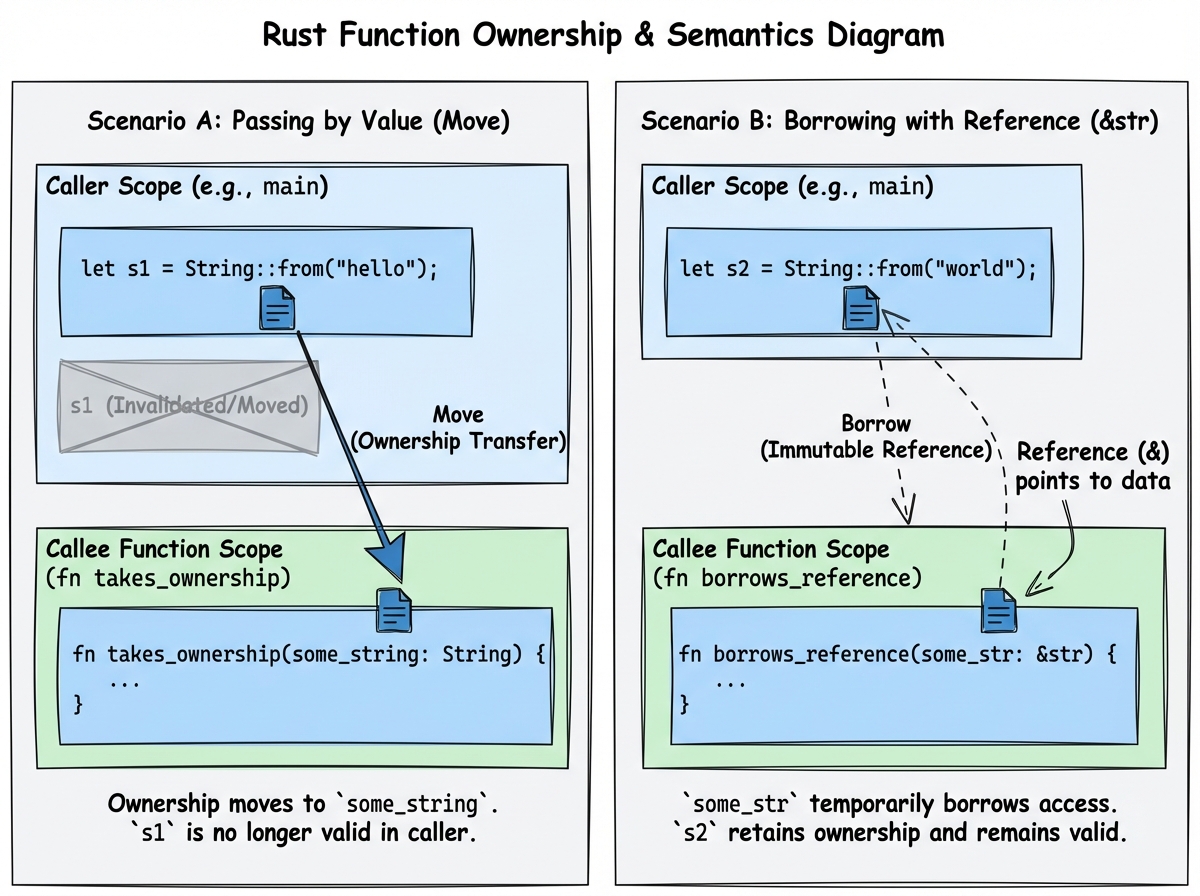
Defining a function in Rust feels normal until you try to pass a value to it and then use that value again. If you pass ownership of a heap-allocated value into a function, that value is gone from the calling scope — moved, not copied. The function took it. This is move semantics, and it stops beginners cold.
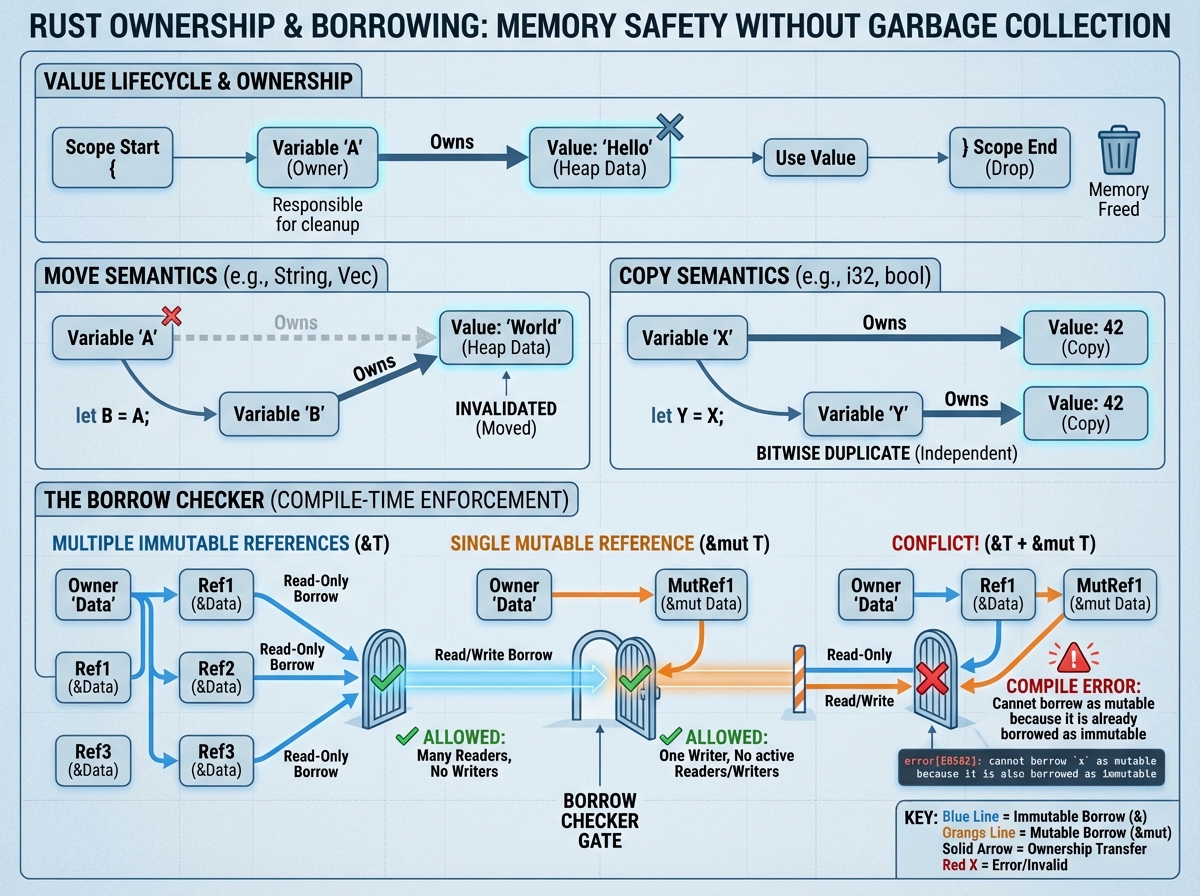
The fix, most of the time, isn’t `clone()`. It’s references. You pass `&value` instead of `value`, giving the function a borrow — a temporary read-only view — without transferring ownership. If the function needs to modify the value, you pass `&mut value`. But here’s the rule: you can have as many immutable references to a value as you want, or exactly one mutable reference. Never both at the same time.
That restriction exists because a mutable reference guarantees exclusivity. No other code can read or write the value while the mutable reference exists. This is how Rust eliminates data races at compile time — not by detecting them at runtime, but by making the code that would cause them impossible to express.
Modules clean up everything that functions start to complicate. `mod` creates a namespace. `pub` makes things visible outside it. `use` imports names into scope. Re-export patterns with `pub use` let you create clean public APIs while keeping the internal structure private. This is how large Rust codebases stay manageable.
## Ownership Is the Whole Point — and Also the Hard Part
Everything before ownership is preamble. Ownership is why Rust exists.
The three rules are deceptively simple: every value has one owner, there can only be one owner at a time, and when the owner goes out of scope the value is dropped. From these three rules, the entire memory safety model follows. No garbage collector needed. No runtime overhead. The compiler handles it all at compile time.
Move semantics handle heap-allocated data like `String` and `Vec
`. When you assign one variable to another, ownership moves — the old variable is invalidated. If you genuinely need two independent copies, you call `.clone()`, which is explicit and visible. For stack-allocated types like integers, booleans, and tuples of primitive types, Rust implements the `Copy` trait automatically — assignment duplicates the value without invalidating the original.
Lifetime annotations — the apostrophe syntax you see in function signatures like `’a` — are the part that most beginners dread and most beginners never actually need in day-to-day code. Rust infers lifetimes in the vast majority of cases. You only need explicit annotations when a function returns a reference and the compiler can’t determine which input reference it’s tied to. When you do need them, the mental model is straightforward: a lifetime annotation is a promise that a reference won’t outlive the data it points to.
## What You Can Build Once the Model Clicks
Once ownership genuinely makes sense — not intellectually, but instinctively, at the level where you naturally reach for `&` instead of fighting the compiler — Rust stops feeling like a restriction. It starts feeling like a description of how memory actually works.
Systems programming becomes approachable: you can write a fast web server confident that there are no memory leaks hiding in the request handler. You can write embedded code that runs on hardware with no OS and no heap allocator. You can write concurrent code where the type system prevents data races by construction, not convention. The same language serves all of these use cases, with the same core model.
For developers coming from higher-level languages, the [Python OOP and object-oriented programming mental model](https://shcgrowth.com/python-oop-object-oriented-programming-beginners/) shares some DNA with Rust’s approach — both languages care deeply about where data lives and who owns it. But Rust takes that care to its logical conclusion, enforcing it at compile time rather than leaving it to convention.
—
## What to Actually Do Right Now
**Install Rust with `rustup` and run the default Hello World immediately.** Seeing the toolchain work end-to-end before you read a single concept eliminates setup anxiety and lets you focus on the language.
**Write every beginner exercise twice — once with owned values, once with references.** The contrast teaches you more about ownership than any explanation, because you feel the compiler’s different responses in your hands.
**When the borrow checker rejects your code, read the error message fully before searching for a fix.** Rust’s compiler errors often contain the exact solution. Skipping to Stack Overflow before reading the error is the most common way beginners miss the lesson the compiler is giving them.
**Use `match` instead of `if let` for your first few weeks, even when `if let` would be simpler.** Exhaustive matching builds the mental habit of accounting for every case — a habit that pays off immediately when you hit `Result` in real code.
**Treat `clone()` as a code smell until you’ve been writing Rust for at least a month.** Every time you reach for `.clone()`, ask whether a reference would work. Usually it will. This forces you to learn borrowing instead of working around it.
**Write functions that accept `&str` instead of `String` from the start.** It teaches you the owned vs. borrowed distinction in a context where the type mismatch error is small and recoverable, not buried in a complex codebase.
**Read error messages from the bottom up when the compiler gives you a chain of them.** The root cause is almost always at the bottom. Starting from the top leads you to fix symptoms instead of the actual problem.
**Annotate your own lifetimes in at least one function before you decide they’re too hard.** One intentional attempt — even a wrong one that the compiler corrects — demystifies the syntax faster than any blog post about it.




Leave a Reply