


There’s a specific kind of frustration that comes with wanting to start something real — a business you can actually touch, scale, and profit from — but not knowing which of the hundred things on your list to do first. That’s where most people get stuck before they even begin.
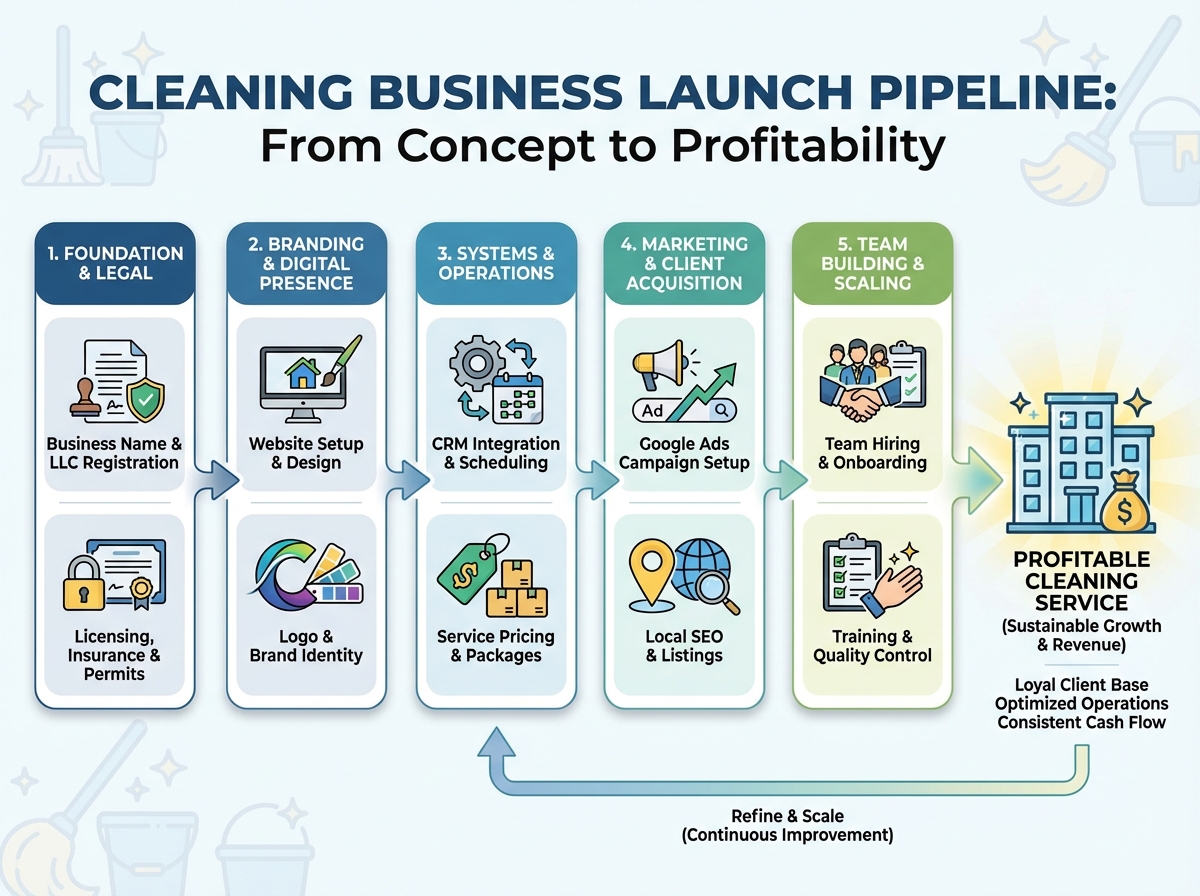
If you’re looking to learn how to start a cleaning business, the honest answer is that the operational side is simpler than most people assume — it’s the setup sequence that trips everyone up. The cleaning industry is one of the few service businesses where you can go from zero to paying clients within weeks, using a lean digital stack and a handful of smart decisions made early. What separates businesses that gain traction from ones that stall is whether the founder built the infrastructure first or tried to get clients before having anywhere to send them.
- Starting a cleaning business requires less capital than most service businesses — the real investment is in your digital systems, not your equipment.
- Recurring clients are the engine of profitability; one-time jobs pay the bills, but monthly contracts build the business.
- Most early-stage cleaning businesses fail at the handoff from solo operator to managed team — not at getting the first client.
What “Starting a Cleaning Business” Actually Means
A cleaning business, at its core, is a recurring-revenue service operation. You’re not selling a product — you’re selling reliability, consistency, and the feeling that someone’s space is taken care of without them having to think about it. Residential cleaning targets homeowners and renters on weekly or bi-weekly schedules. Commercial cleaning targets offices, retail spaces, and facilities on contracts. Both are viable, but they require different sales approaches, pricing structures, and staffing models.
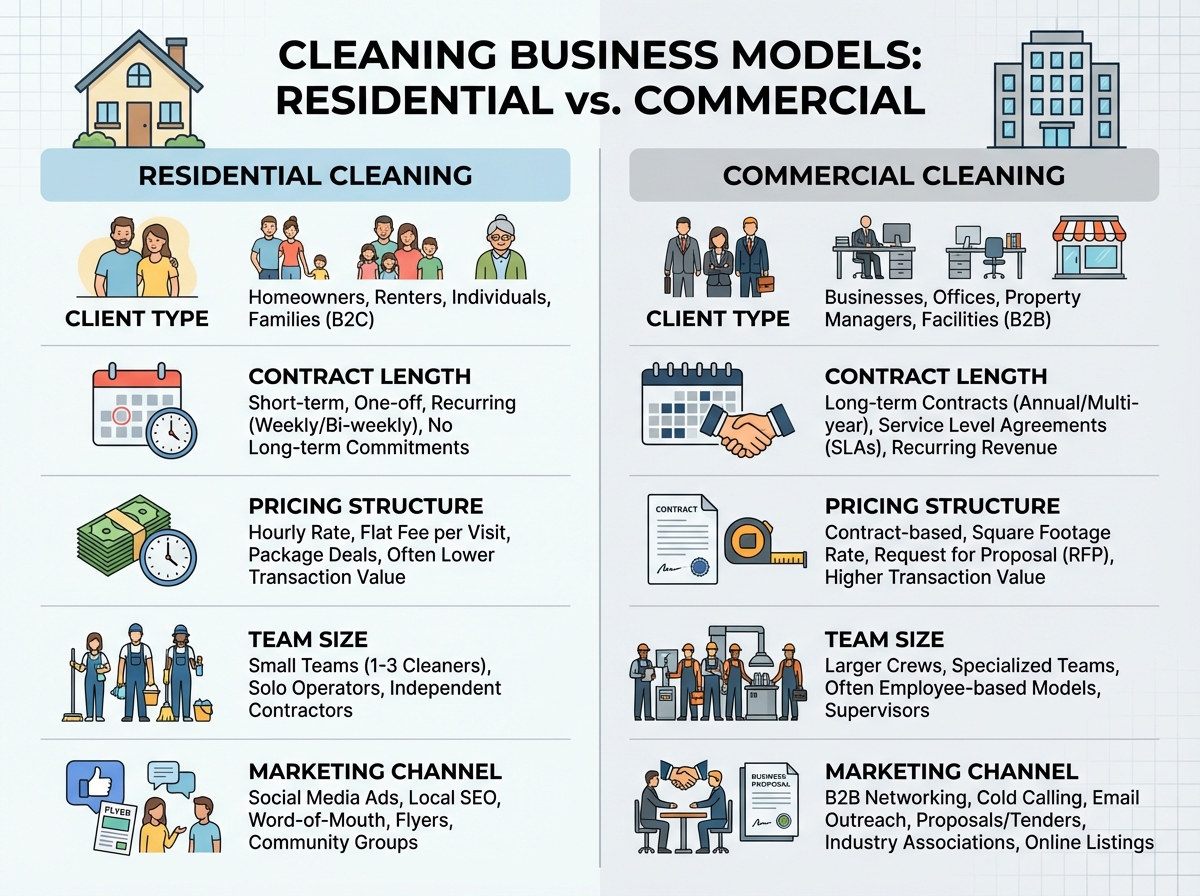
The modern version of this business also runs on a digital layer — a website that auto-quotes, a CRM that tracks leads and follow-ups, a scheduling tool that handles bookings without phone tag, and a Google Business profile that generates inbound calls. Skipping any of these isn’t lean — it’s a liability.
Three things that define a profitable cleaning business:
- Recurring clients on automated billing, not one-off jobs you chase manually
- A booking system that converts website visitors without you picking up the phone
- A team that can deliver consistent service quality so you’re running the business, not cleaning the houses
Sharp Observations Before You Go Further
- Naming your business too specifically to “residential” locks you out of commercial contracts later.
- A Google Business profile with 20+ reviews outperforms a $500/month ad budget in local search.
- The biggest operational bottleneck in most cleaning businesses isn’t clients — it’s scheduling conflicts.
How Long It Actually Takes to Launch
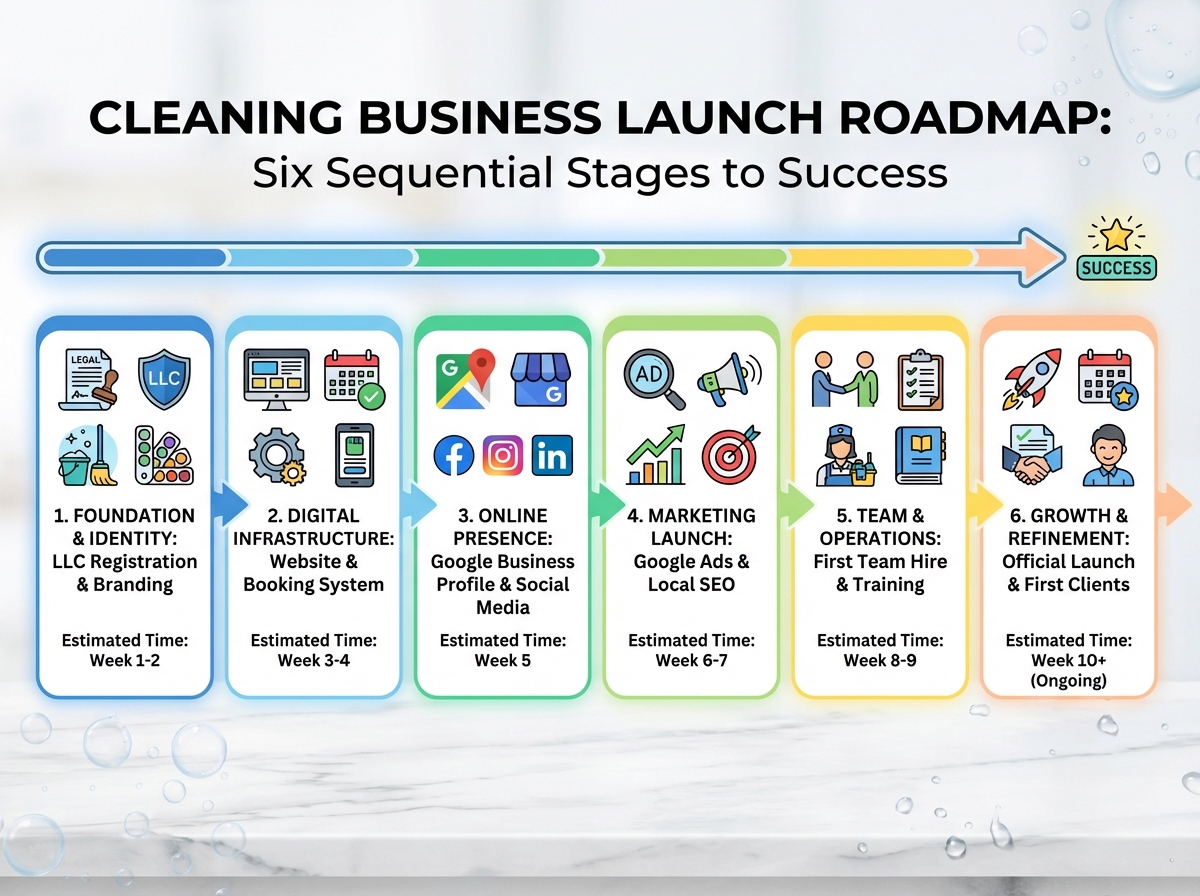
| Stage | Content | Time |
|---|---|---|
| Foundation | Business name, LLC, EIN, insurance, domain | 3–5 days |
| Digital Setup | Website, email, phone system, CRM | 4–7 days |
| Brand & Presence | Visual identity, Google My Business, Stripe | 3–5 days |
| Operations | Scheduling, quoting system, voicemail, forms | 2–4 days |
| Marketing | Google Ads campaign live, review strategy | 3–5 days |
| First Hire | Job listing, interviews, background check, payroll | 1–3 weeks |
| Total | From zero to operational with first client | 4–6 weeks |
The order matters more than the speed — someone who sets up their CRM before their website will waste time re-entering data and patching workflows later. If your timeline runs longer than six weeks, that’s normal — most people are doing this alongside a job or family obligations, and slowing down on legal setup is far better than rushing it.
The Naming and Branding Stage Nobody Takes Seriously Enough
Most people pick a business name the way they name a pet — something that feels right in the moment without thinking about how it’ll look on a Google search result, a job listing, or a client invoice three years from now. The name has to work across every surface: your domain, your Google Business listing, your uniforms, your Stripe payment description. If it’s too generic, you’ll drown in local competition. If it’s too clever, no one will know what you do.
The validation step is simple but most people skip it entirely: search the name in your state’s business registry, check if the .com domain is available, run it through Google to see what else comes up. Five minutes of checking saves weeks of rebranding after you’ve already printed business cards.
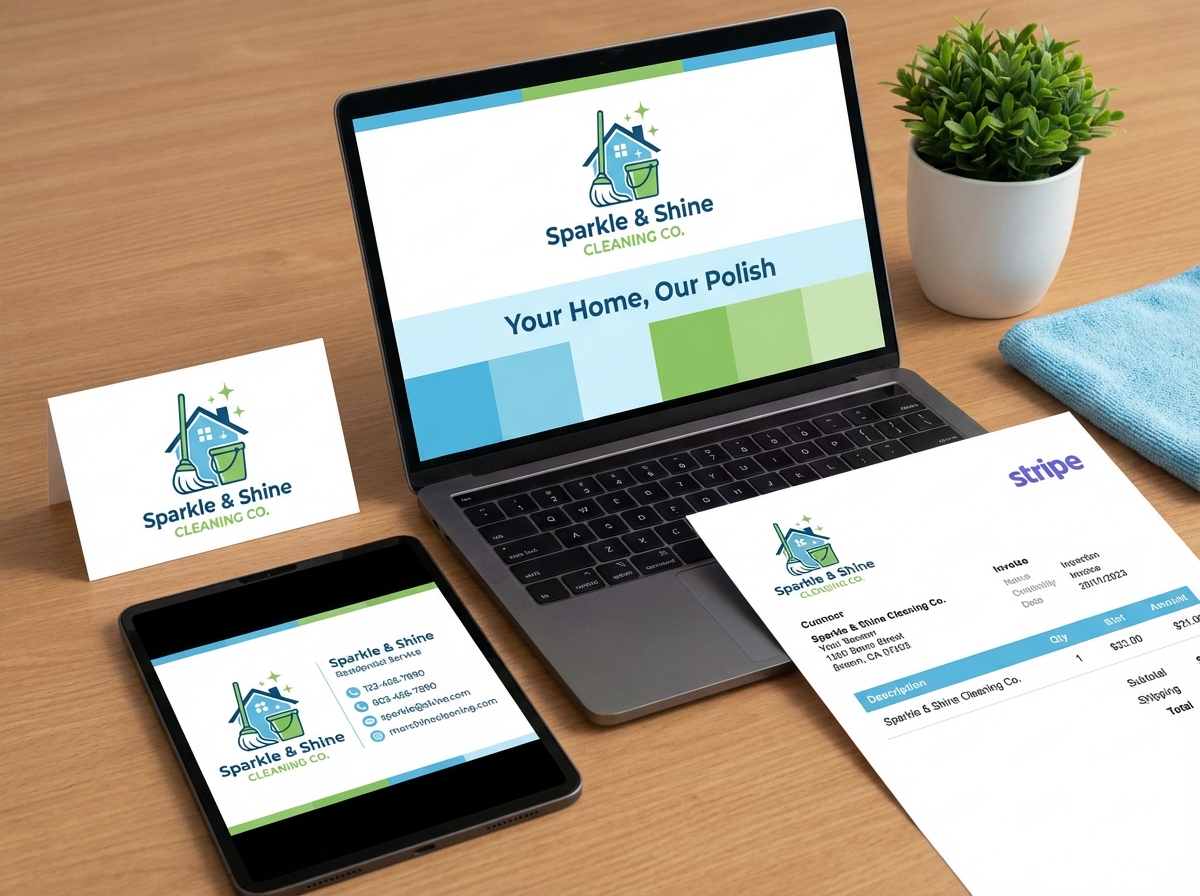
Your visual brand — logo, colors, fonts — doesn’t need to be expensive, but it does need to be consistent. The moment a client sees a mismatched logo on your website versus your invoice, a small seed of doubt gets planted. Consistency signals that you’re organized, and in a service business where someone is letting you into their home, organized is exactly what they need to believe you are.
Building the Digital Foundation That Actually Converts
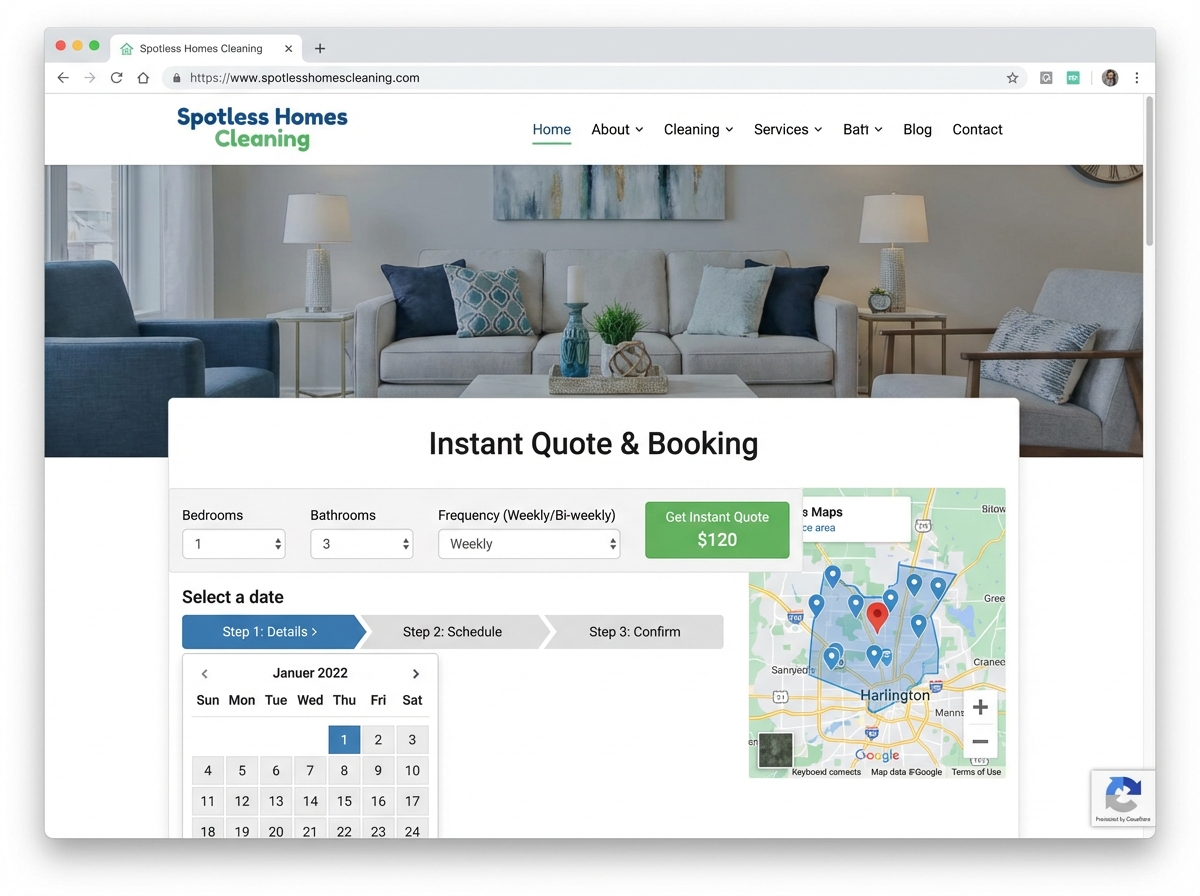
The biggest mistake people make when starting a cleaning business is treating the website like a brochure — something you build once to prove you’re real, then forget about. That thinking kills conversion. Your website’s one job is to turn a visitor into a booked appointment without you being involved in the process at all.
That means an instant quote calculator, not a “contact us for a quote” form. It means an online booking flow that sends a confirmation email automatically. It means Cloudflare for speed and security, because a slow website in a mobile-first local search environment loses clients to competitors before you even know they visited. Every day your website can’t book a client on its own is a day you’re leaving money on the table.
The phone system and professional email exist for one reason: perception. A Gmail address and a personal cell number tell clients you’re a side hustle. A branded email and a business number with a proper voicemail greeting tell them you’re a company. That perception gap has a direct effect on whether someone calls back after leaving a voicemail or just moves on to the next result on Google Maps.
Legal and Financial Setup — The Part That Feels Boring Until It Isn’t
Registering an LLC and getting an EIN feels like paperwork until the moment a client’s property gets damaged, an employee gets injured on the job, or the IRS needs a record of your business income. At that point, the 45 minutes you spent filing online becomes the most valuable 45 minutes you’ve ever spent. Skipping this step doesn’t make you lean — it makes you personally liable.
Business insurance for cleaning services specifically covers property damage and theft allegations — both of which are genuine risks when your team is inside someone’s home. Some commercial contracts won’t even open a conversation with you until you can send a certificate of insurance. Getting insured isn’t a cost of doing business; it’s a sales tool.
Stripe for payment processing and a simple bookkeeping setup round out the financial layer. The ability to charge a card on file for recurring clients — automatically, on a set date, with a receipt sent by email — is what makes recurring revenue feel like recurring revenue instead of a monthly collections exercise.
How CRM Integration Changes the Way You Operate
Before setting up a CRM, most early-stage cleaning business owners manage their clients in a spreadsheet, their follow-ups in their head, and their scheduling in a group text thread. That system works until you have six clients. After that, it starts costing you clients you forgot to follow up with and jobs you double-booked.
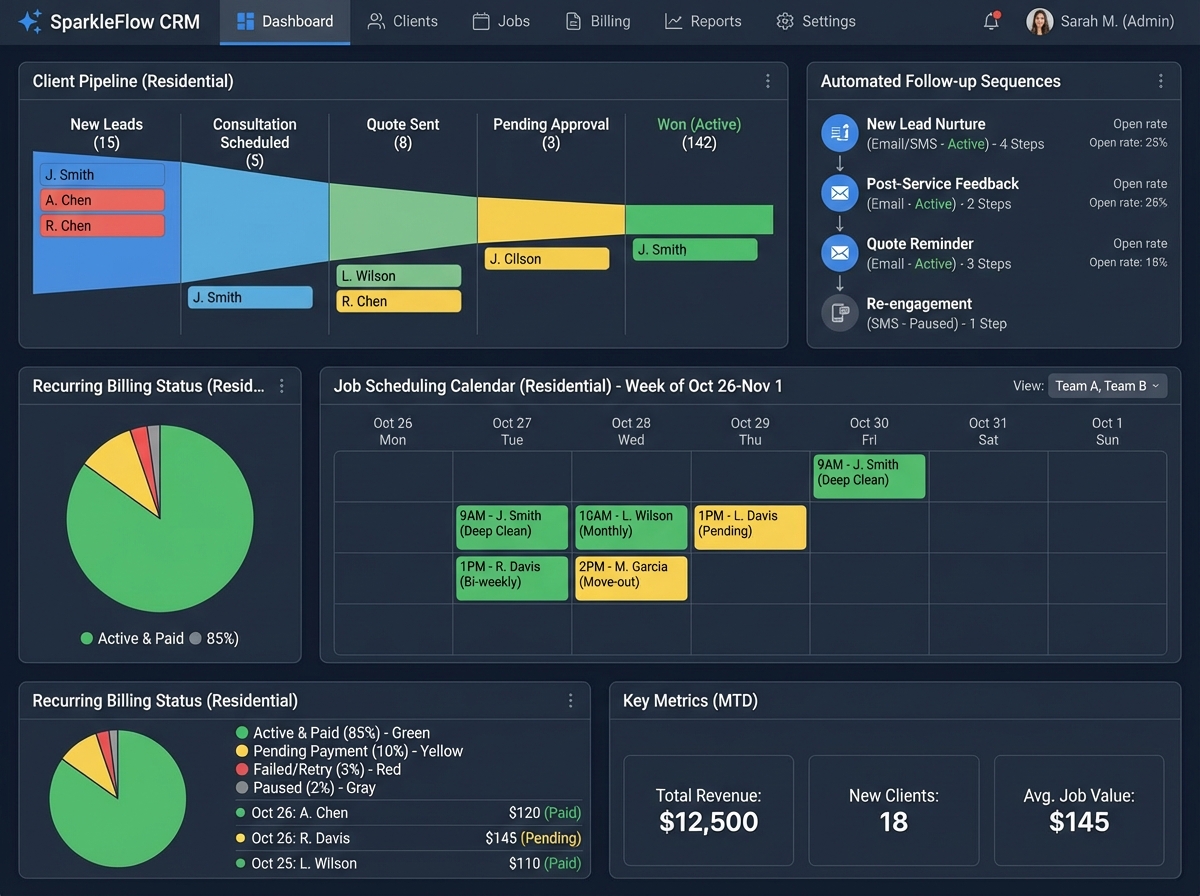
A CRM maps every client interaction — the first inquiry, the quote sent, the booking confirmed, the follow-up after the first clean, the review request sent two days later. That sequence, automated and consistent, is what separates businesses that grow from ones that plateau. You’re not just storing contact info; you’re building a system that moves people through a pipeline without you manually pushing them.
The scheduling module inside a CRM also solves the two-person team problem before it becomes a problem. When you expand from solo to a team, the complexity doesn’t double — it multiplies. Who’s assigned to which job, at what time, at which address, with what supplies, for how long? A scheduling system with staff management built in handles all of that. Without it, you’ll spend more time managing logistics than actually growing.
Getting Found on Google: The Local Marketing Layer
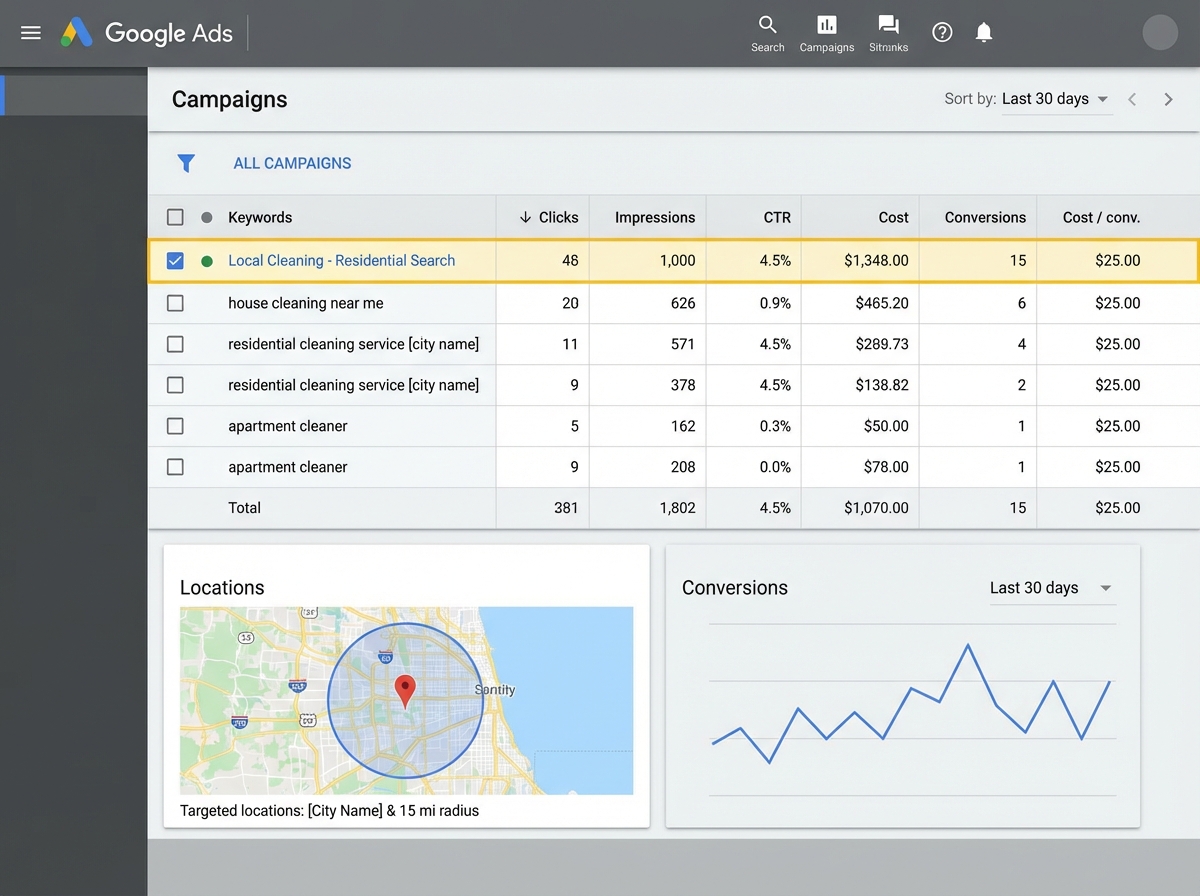
Google Ads for a local cleaning business is not the same as Google Ads for an e-commerce store. You’re not running broad campaigns and hoping for volume. You’re running tightly geo-targeted campaigns on high-intent search terms — phrases like “house cleaning service near me” or “recurring house cleaner [city]” — and sending that traffic to a landing page that converts. The difference between a campaign that wastes $300/month and one that returns $2,000 in new recurring contracts is almost always the match between the ad copy and the landing page.
Your Google Business profile, however, is the channel that compounds. A profile with a complete service list, 25 or more reviews, and regular photo updates ranks in the local 3-pack for most residential cleaning queries — and that traffic is free. The review-building strategy isn’t complicated: you ask every satisfied client, once, at the right moment (immediately after a clean, when the dopamine of a clean home is still fresh), with a direct link that takes them straight to the review form. Most people will do it if you make it one tap.
For a deeper look at how paid digital marketing works alongside organic presence in a service business, Facebook Marketing and Paid Ads: From Zero to First Profitable Campaign covers the underlying logic of campaign structure and audience targeting that applies across channels.
Hiring, Background Checks, and the Trust Problem
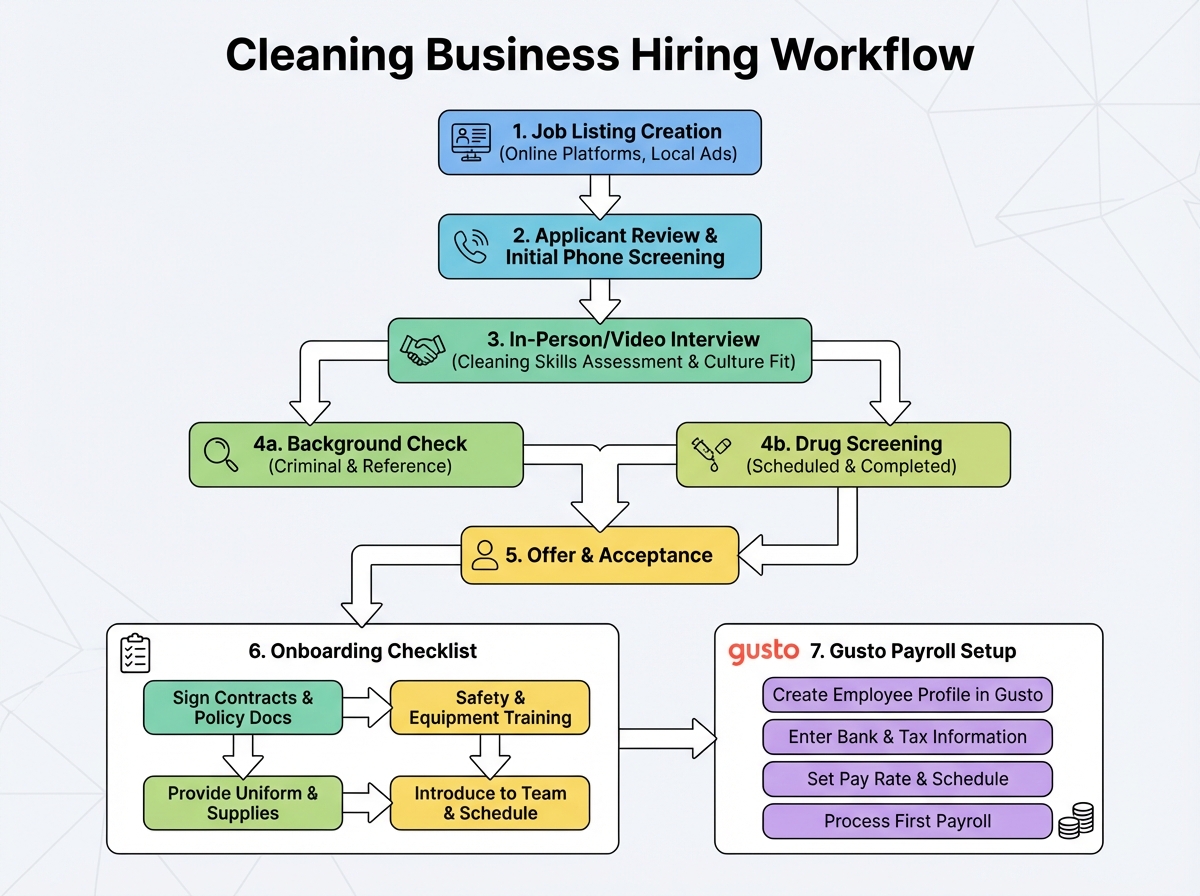
The single biggest mistake people make when expanding their cleaning business is hiring fast to fill capacity. You get a contract, you need another cleaner, you post a job listing and take the first person who seems fine in a 20-minute call. Two weeks later, a client calls to say something is missing from their home, and you have no documentation, no background check on file, and no clear policy to point to. The fallout from one bad hire — even if the person is cleared — can cost you three recurring clients who heard about it.
Background checks and drug screenings are not bureaucratic overhead. In a business where your staff has unsupervised access to private residences, they are the minimum credible signal to clients that you take safety seriously. More importantly, they’re a filter that self-selects for candidates who expect a professional workplace — which is exactly the kind of team you want to build.
Payroll setup through a dedicated tool like Gusto matters the moment you have a second employee. Misclassifying employees as independent contractors is one of the most common and costly legal errors in service businesses. Getting the payroll and classification structure right from the start — with automatic tax withholding, direct deposit, and compliant records — keeps you out of trouble as you scale.
The AI Layer Most New Owners Underestimate
Using AI tools in a cleaning business startup isn’t about being technical — it’s about compressing the time it takes to get professional-quality outputs without hiring specialists. AI can draft your job listings, write your Google Ads copy, generate your service descriptions, help you respond to negative reviews with the right tone, and produce your client email sequences. None of that requires a background in tech.
The founders who leverage this well aren’t using AI to replace thinking — they’re using it to eliminate the bottlenecks that slow down execution. Every hour you spend staring at a blank job posting or rewriting the same follow-up email is an hour you’re not spending on client acquisition or operational improvement. That’s the real value of the AI layer: not intelligence, but speed.
For people already comfortable with the business side who want to understand how digital tools connect to business infrastructure more broadly, How to Launch Your Own Business From Scratch and Make It Last covers the systems thinking that makes any service business scalable beyond the founder.
Looking Back at What Actually Mattered
The people who build profitable cleaning businesses aren’t the ones who had the best equipment or the catchiest name. They’re the ones who got the infrastructure right early — the legal setup, the digital booking system, the CRM, the review engine — and then went and got clients. The cleaning itself is the easy part. The business architecture is what most people avoid because it feels like setup work rather than real work. It is real work. It’s the work that determines whether you’re still operating two years from now.
Apply these immediately:
- Register your LLC before your first paid client. Operating unregistered exposes your personal assets the moment anything goes wrong on a job.
- Set up an instant-quote form on your website before running any ads. Traffic sent to a static page with a contact form converts at a fraction of the rate of an interactive quoting tool.
- Create a Google Business profile on day one and add photos of your team and supplies. Profiles with real photos rank higher and convert better than text-only listings.
- Build your review request into your post-service workflow, not as an afterthought. A direct link to your Google review form sent within two hours of completing a job catches clients at peak satisfaction.
- Use a CRM from your first client, not your tenth. Migrating from a spreadsheet to a CRM mid-growth means re-entering data and losing visibility into your pipeline during the transition.
- Run background checks on every hire regardless of referral source. A personal recommendation doesn’t transfer legal or reputational protection to you.
- Set pricing based on recurring contract value, not hourly rate. A client who books weekly at $150/visit is worth over $7,500 per year — price accordingly and acquire them like it.
- Separate your business and personal finances from the first dollar. A dedicated business bank account and Stripe for billing makes tax season tractable and presents a professional image on every client receipt.
For those building a service-based operation and thinking about how digital storefronts and online marketplaces can expand client acquisition beyond local search, How to Start Selling on Fiverr: Set Up Your Profile, Gig, and Get Sales offers a parallel framework for understanding how service listings and client trust signals work in a competitive digital marketplace.
Leave a Reply