


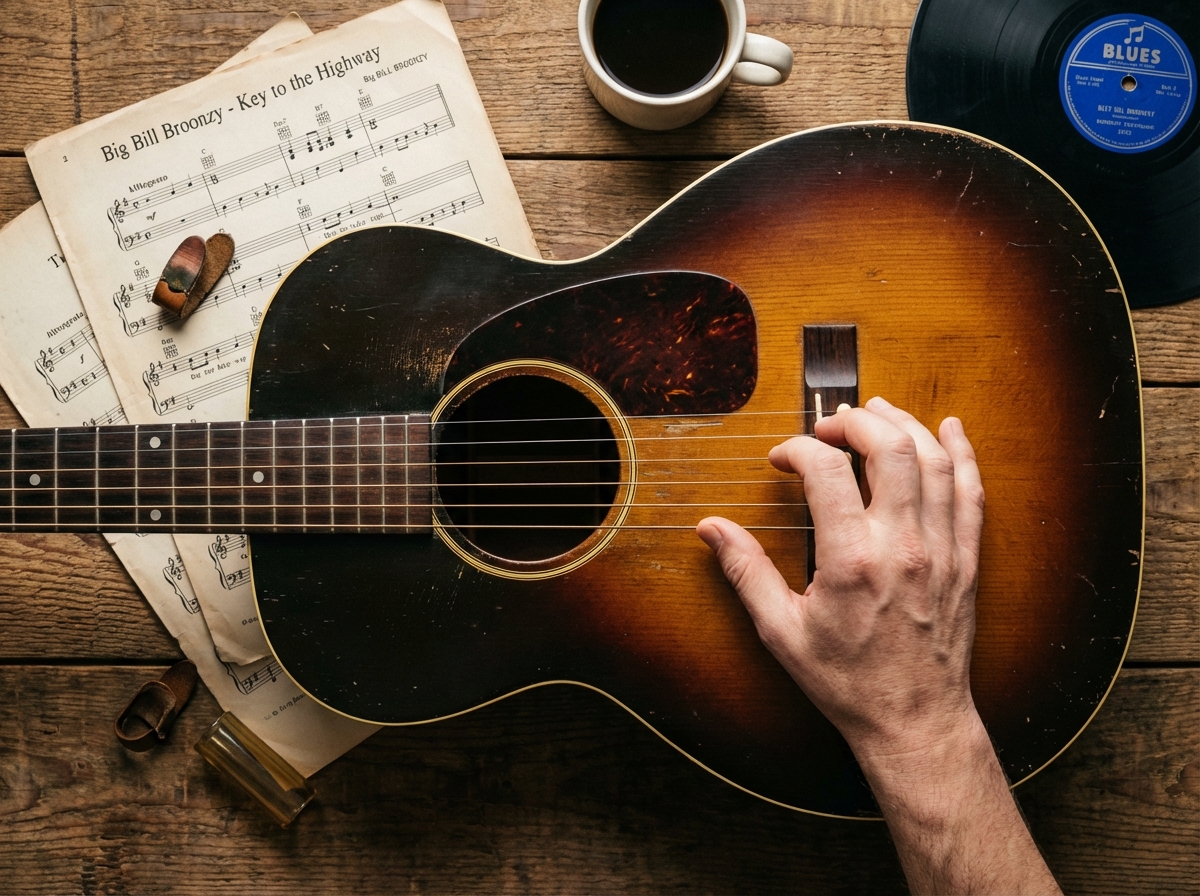
The first time you try to play the way Big Bill Broonzy plays, you’ll stare at your own hands like they belong to someone else. The groove is right there — you can hear it — but your thumb won’t stay locked, your fingers keep chasing the bass, and the whole thing falls apart before you even get to the turnaround.
If you’re looking to learn swing acoustic blues guitar, the fastest path is studying how Broonzy and Brownie McGhee built everything around a locked monotonic bass thumb while the fingers handled the melodic freight above it. That combination — steady bass, free fingers, a shuffle underneath — is what separates this style from Delta slide playing or alternating-bass Piedmont ragtime. Once you understand the architecture, the songs stop feeling mysterious.
- Works best if you already finger-pick in any style — the technique builds on what you know, not from zero
- The biggest shift is mental: stop thinking of this as “two hands playing separately” and start thinking of the thumb as your rhythm section
- Once the thumb locks, songs like Key to the Highway and Glory of Love open up fast
What “Swing Blues Guitar” Actually Means
Swing blues guitar sits between the rawness of Delta slide and the mathematical precision of Piedmont ragtime. It uses standard chord progressions — 12-bar and 8-bar forms in E, A, and C — but adds a rhythmic lilt that pushes notes slightly ahead of or behind the strict beat. Think of it as the sound juke joints ran on before amplification changed everything. Broonzy and McGhee both came from country blues roots and evolved toward this swinging groove that sounds almost like early rock and roll when played right.
| Style | Bass Technique | Rhythmic Feel | Common Keys |
|---|---|---|---|
| Delta blues | Open tuning / slide | Slow, heavy | Open E, Open D |
| Piedmont / Ragtime | Alternating bass (2–3 strings) | Precise, bouncy | C, G, D |
| Swing acoustic blues | Monotonic bass (1 string) | Driving, grooved | E, A, C |
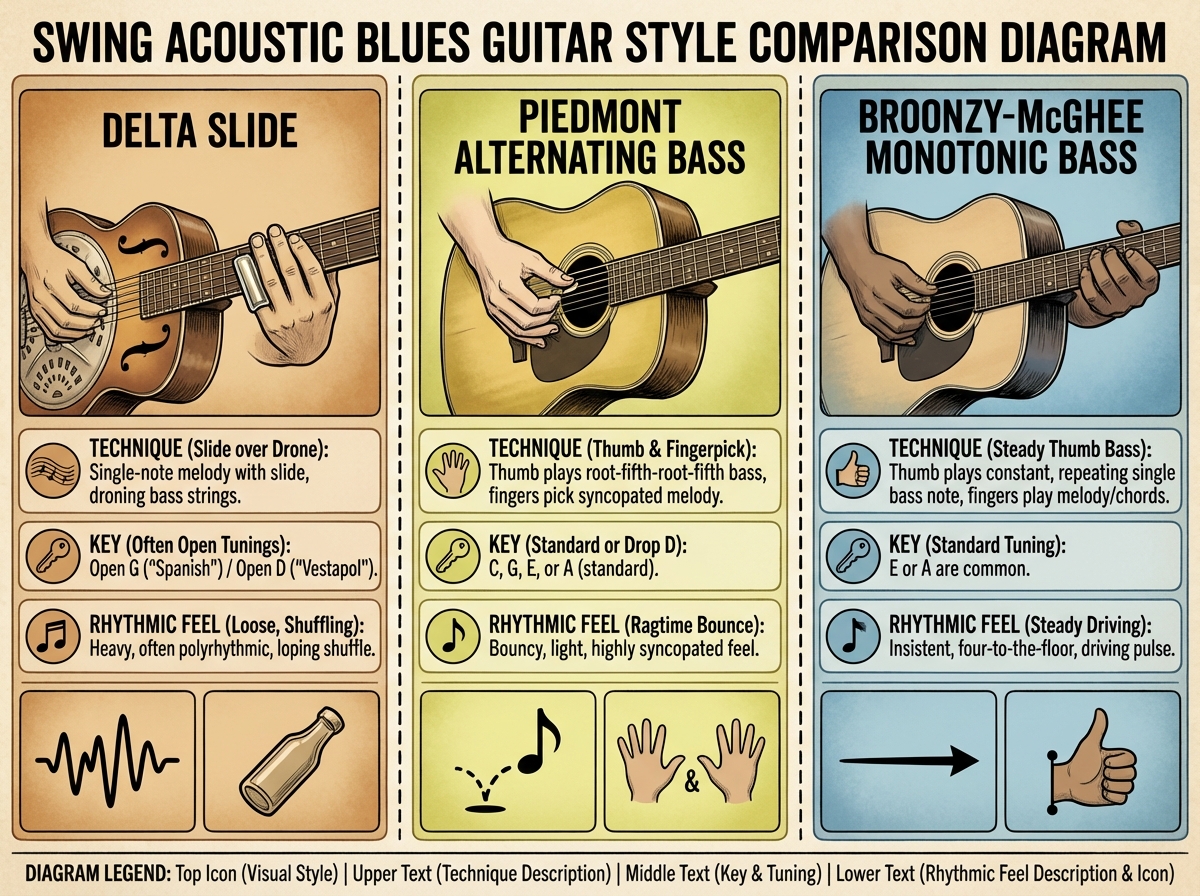
Monotonic bass means your thumb hits a single open bass string on every beat — no alternating between the E and A strings like Mississippi John Hurt does. It sounds simpler on paper, but it creates a heavier, more hypnotic forward momentum that actually makes it harder to stay loose in the fingers while the thumb drives.
Sharp observations:
- Palm damping changes the entire character of a chord — without it, Broonzy’s open E voicings sound sloppy, not swinging
- The 8-bar blues form in Key to the Highway catches most intermediate players off-guard — they assume it’s 12-bar and the turnaround hits them wrong
- Playing in the key of C with a monotonic bass requires a thumb stretch that feels unnatural until the third week, then feels automatic
How Long It Actually Takes
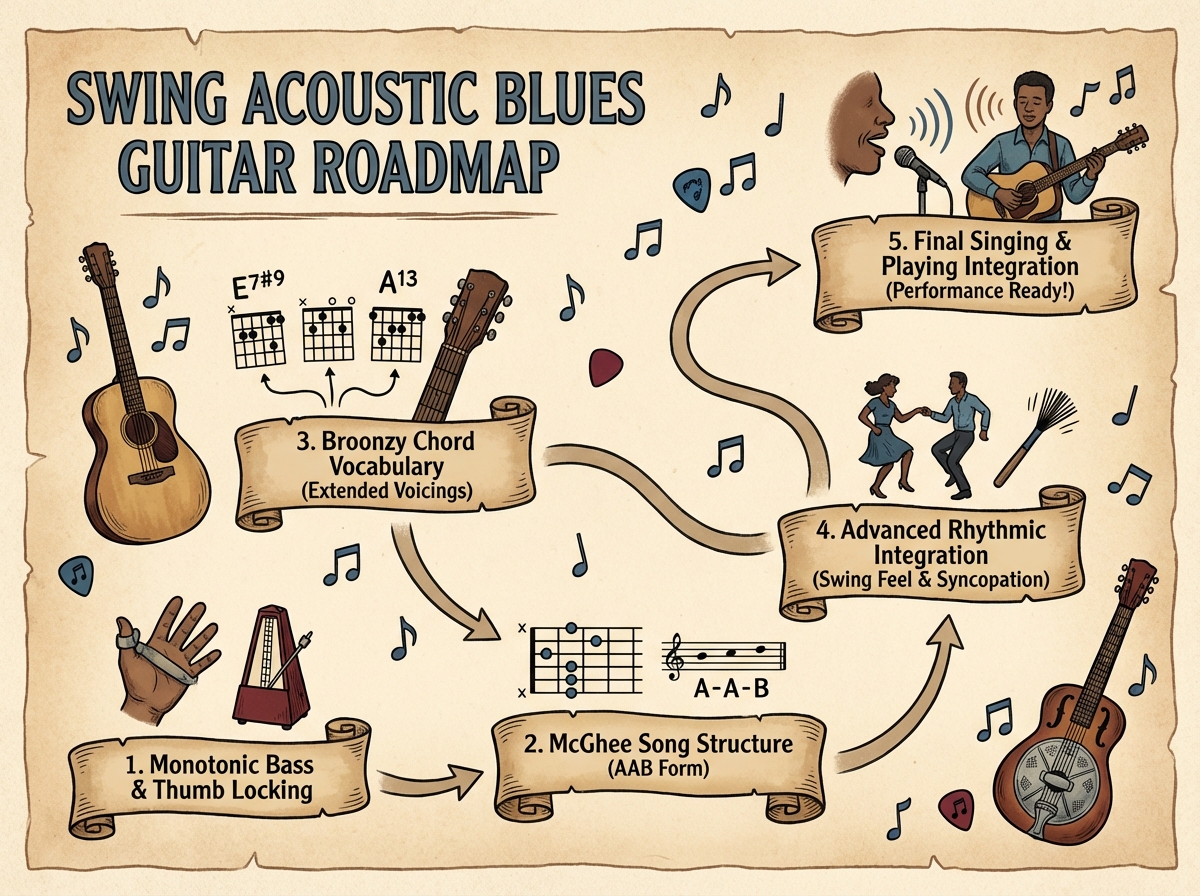
| Stage | What You’re Working On | Time |
|---|---|---|
| Locking the thumb | Keeping monotonic bass steady on open E without watching your hand | 1–2 weeks |
| First full song (Livin’ With The Blues) | McGhee’s simpler picking structure, chord shapes in E | 2–3 weeks |
| Palm damping + tight sound | Right-hand damping so the bass doesn’t ring out loose | 1 week |
| Broonzy’s chord vocabulary | 8-bar form, C and A shapes, walking bass additions | 2–3 weeks |
| Singing and playing simultaneously | Freeing your mental bandwidth enough to phrase with your voice | 2–4 weeks |
| Total | Full approach with 4–5 songs playable | 8–13 weeks |
Order matters far more than speed here — locking the thumb before touching chord structure is the only sequence that works. If you spend six weeks instead of three on the bass thumb, that time is never wasted.
The Thumb Is the Whole Game
Every beginner who comes to swing acoustic blues guitar makes exactly the same mistake: they try to coordinate their thumb and fingers at the same time, right from the start, and when it falls apart they assume the style is just hard. It isn’t hard — it’s sequential. The thumb has to be automated before the fingers get involved.
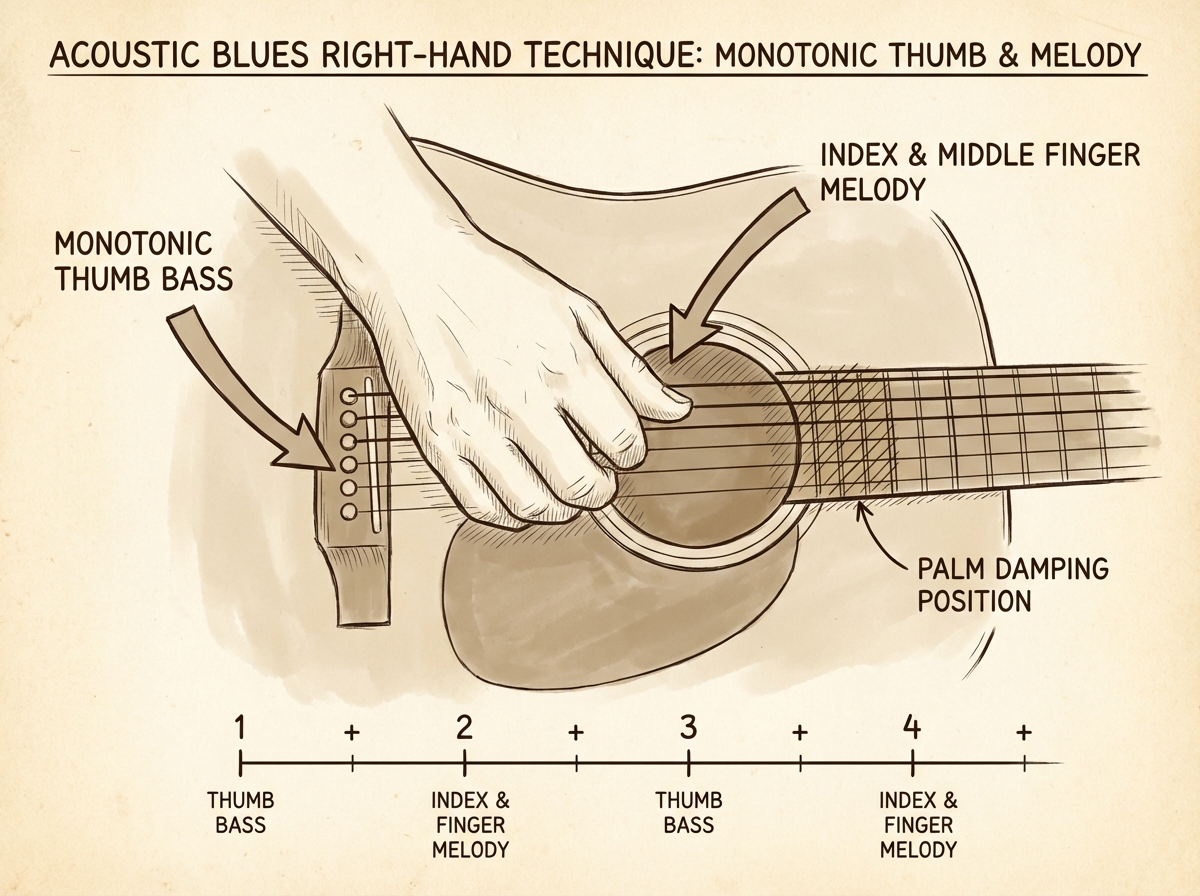
The way to build that automation is brutal in the best sense. Play a single open E chord. Set a slow metronome to 60 BPM. Thumb the low E string on every beat for five minutes. That’s it. No melody notes. No chord changes. Just the thumb. You’ll want to add something — resist it. The thumb has to run on autopilot before your fingers can have any creative freedom above it.
Once that clicks, something changes in how you hear the style. You start noticing that Broonzy’s melodic phrases aren’t fighting the bass — they’re floating over it. The thumb creates a tidal pull, and the fingers ride the wave. That’s the groove everyone hears on recordings and can’t figure out how to replicate.
Palm Damping: The Detail Nobody Mentions
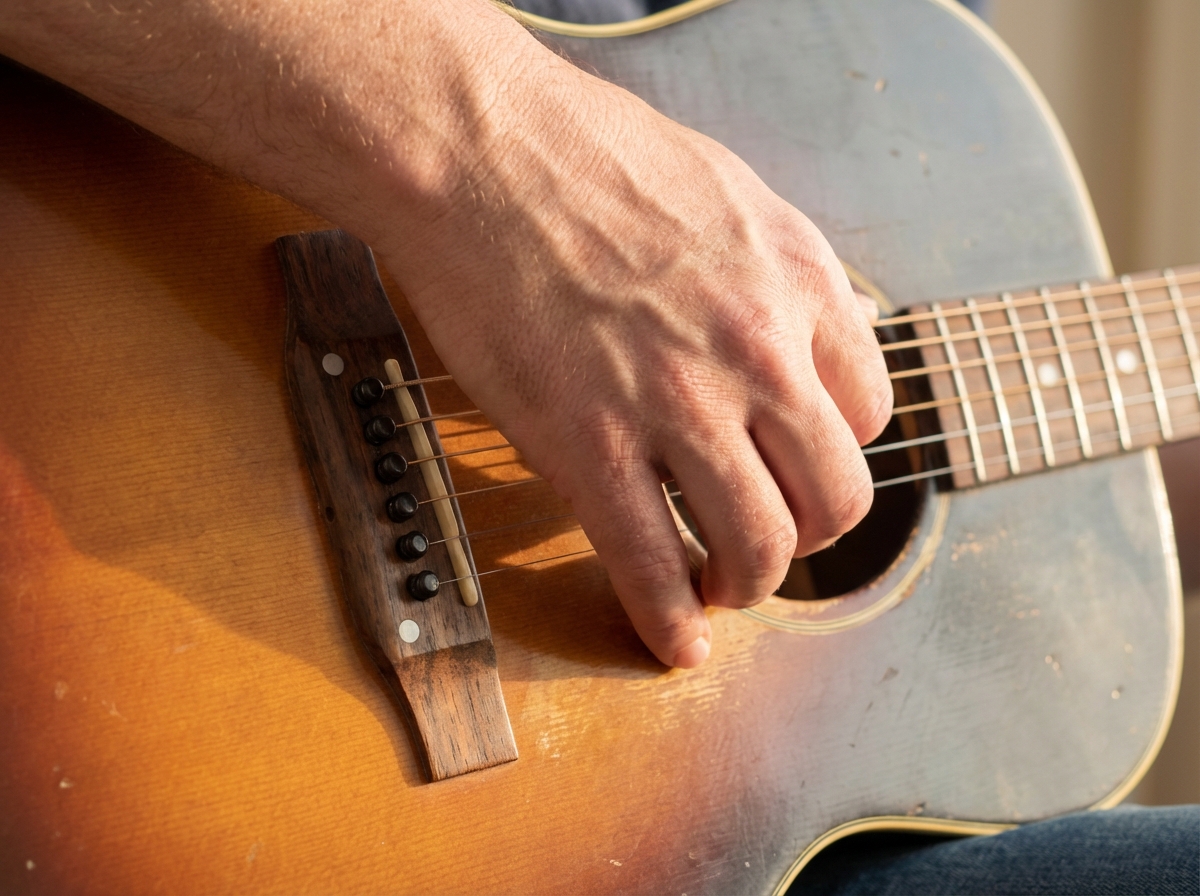
You can play every note of Hey Hey correctly and it still won’t sound like Broonzy. The difference is almost always palm damping. Lay the heel of your right hand lightly across the bass strings near the saddle, just enough to shorten the sustain without completely muting the string. That light contact transforms an open ringing bass note into something tight, punchy, and rhythmically decisive.
Getting the damping pressure right takes longer than most people expect. Too much pressure and the bass dies completely — you lose all the resonance that gives the style its warmth. Too little and the strings ring out into each other, turning a clean groove into a wash. The sweet spot is somewhere in between, and it shifts depending on how hard your thumb strikes. Broonzy’s recordings have that slightly muffled, authoritative bass thump that comes entirely from this technique.
Practice it by isolating it: damp-thumb only, no melody, until you can vary the pressure consciously. Then add it back when you’re playing full phrases. You’ll immediately hear why the songs sound like they do.
Learning Brownie McGhee First Is the Right Call
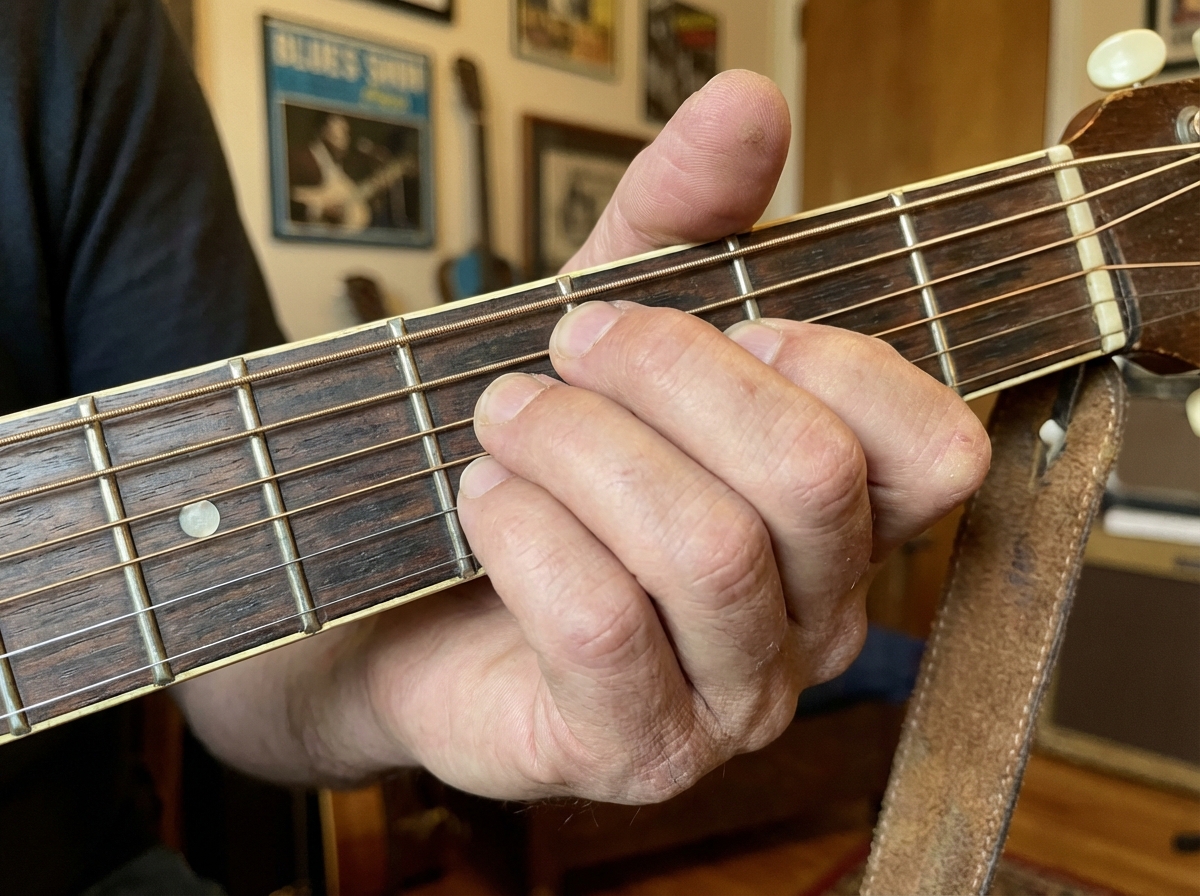
Livin’ With The Blues is the best entry point into this whole style, and the reason is structural: McGhee’s picking pattern is more regular than Broonzy’s. The thumb-to-finger relationship in that song is predictable enough that you can actually hear what’s happening and copy it measure by measure. McGhee shares strings between thumb and fingers in a way that feels almost logical once you slow it down.
McGhee and Broonzy both used monotonic bass, but McGhee’s melodic phrasing tends to sit closer to the chord tones — there’s less chromatic movement, fewer passing notes, and a simpler call-and-response between bass and treble. That regularity makes it the ideal sandbox for training your hands to operate independently.
Once you can play Livin’ With The Blues cleanly at a medium tempo, Broonzy’s songs feel like a natural step up rather than a completely different challenge. The thumb technique transfers directly. You’re just adding rhythmic complexity in the upper voice.
Broonzy’s Chord Vocabulary in E, A, and C
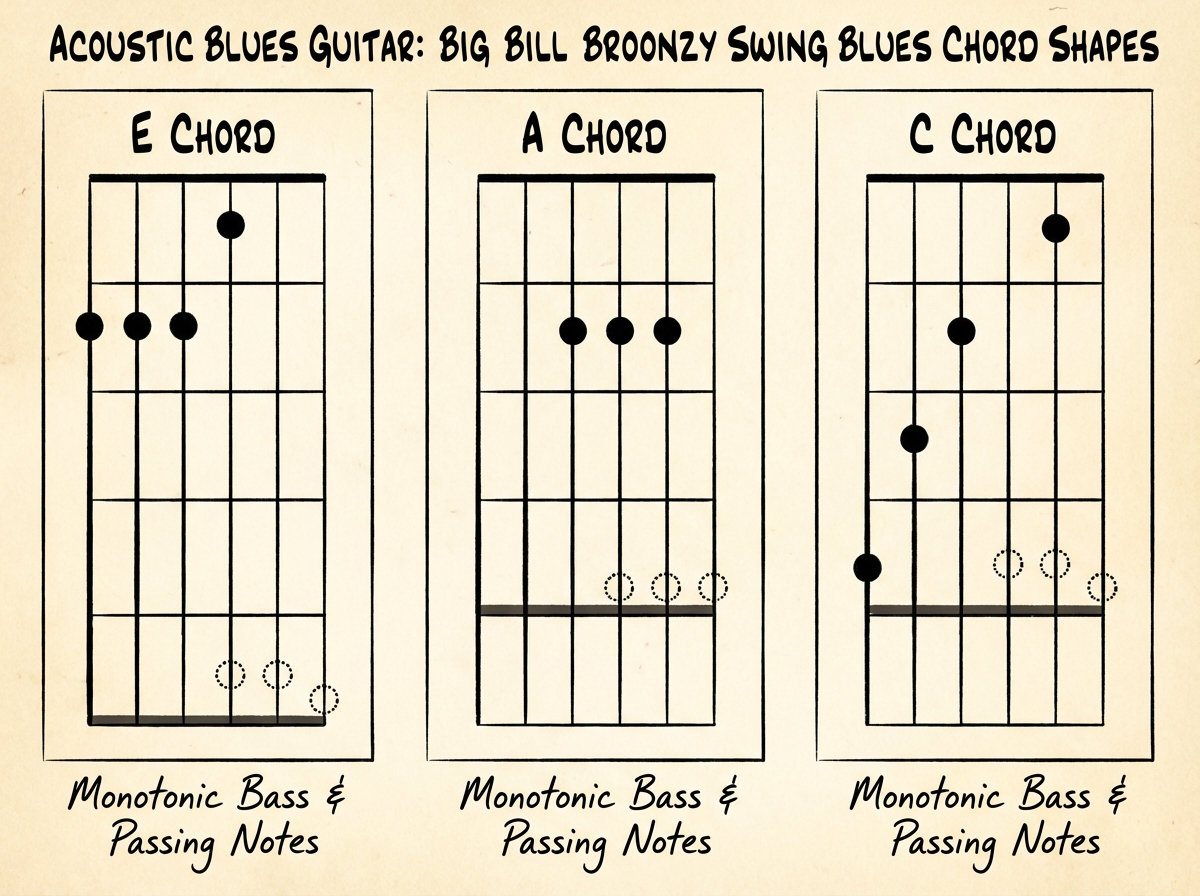
The three keys Broonzy worked most are E, A, and C — and each one teaches you something different about swing blues guitar. E is where you start because the open strings do most of the bass work. A extends that logic with a slightly different thumb position. C is where the style shows its teeth, because there’s no convenient open bass string to lean on and your thumb has to reach down to the A string while your fingers navigate a closed chord shape.
Key to the Highway in E is where most players encounter the 8-bar blues form for the first time. The standard 12-bar assumption gets you into trouble at bar 7 — the turnaround arrives two bars earlier than your muscle memory expects. That moment of stumbling is actually useful: it forces you to listen rather than autopilot through chord changes. Broonzy’s songs consistently reward the player who listens first, plays second.
Worryin’ You Off My Mind introduces the walking bass — a brief descending run in the bass strings that connects chord changes. It sounds simple when you hear it on the recording, but executing it while keeping the melodic phrases going above is a coordination jump that takes real time. Don’t rush past it. Getting that walking transition clean is what makes the song sound like Broonzy instead of like someone covering Broonzy.
When You Can Finally Sing Over It
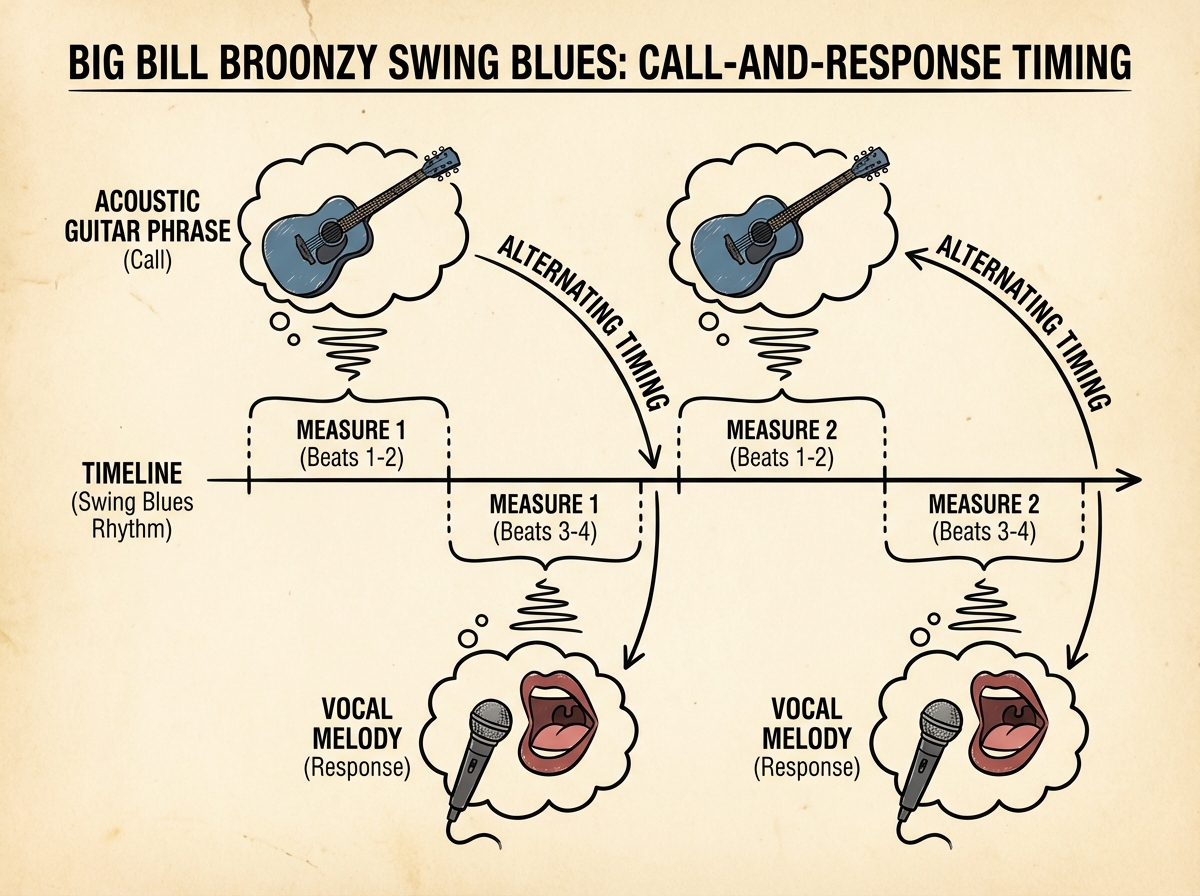
The hardest part of this style has nothing to do with the guitar. It’s finding enough mental space to phrase a vocal over the top of a moving, grooved guitar pattern. Most intermediate players who get their swing blues fingerpicking technically solid still fall apart the moment they try to add words.
The reason is that singing and playing feel like two simultaneous cognitive tasks until they become one physical habit. Broonzy’s voice moves in conversation with the guitar — call and response, not parallel tracks. The guitar phrases end, the voice fills the space, the guitar answers back. Understanding that architecture — rather than treating it as “guitar plus vocals” — changes how you practice it.
The practical fix is to sing on a single pitch first. Don’t try to nail the melody. Just hum the rhythm of the lyric over the guitar part until your hands stop responding to the vocal rhythm as interference. Then introduce the actual pitches. Glory of Love has enough space in the guitar part to make this transition manageable — it’s a good final song to work on for exactly that reason.
What Changes When You Get It Right
The first time a song actually swings — not just technically correct, but swinging — something shifts in how you understand all acoustic blues guitar. You realize that the groove isn’t created by playing more notes or playing faster. It’s created by the consistent relationship between the bass pulse and the space above it. The swing comes from what you don’t fill.
That understanding travels. Once you’ve felt it in Key to the Highway, you start hearing it everywhere — in how Blind Blake’s ragtime figures float over his alternating bass, in how Robert Johnson’s slide lines breathe between the chord changes. The Broonzy-McGhee style is a very specific corner of acoustic blues, but learning it properly resets your ear for the whole tradition.
Here’s what to work on immediately:
- Isolate the thumb for five minutes before every practice session — it resets the automation that slips when you haven’t played for a day or two
- Learn Livin’ With The Blues at 70% speed first — McGhee’s pattern at full tempo hides the thumb-finger coordination; slow reveals it
- Practice palm damping separately from melody — combine them only after each element is solid on its own
- Memorize the 8-bar form by counting aloud — don’t trust your muscle memory until you’ve talked yourself through the bar structure at least twenty times
- Play Hey Hey with just thumb and no melody notes first — you need to hear the bass groove of that song before you add anything above it
- Work the C key last — trying it too early, before the E and A patterns are fluent, creates bad thumb habits that take weeks to unlearn
- Record yourself and listen back at half speed — the timing gaps between thumb and finger strokes are invisible to you in real time but obvious in a recording
- When adding voice, hum before singing words — remove the lyric memory problem from the coordination problem, solve them in sequence
Leave a Reply