


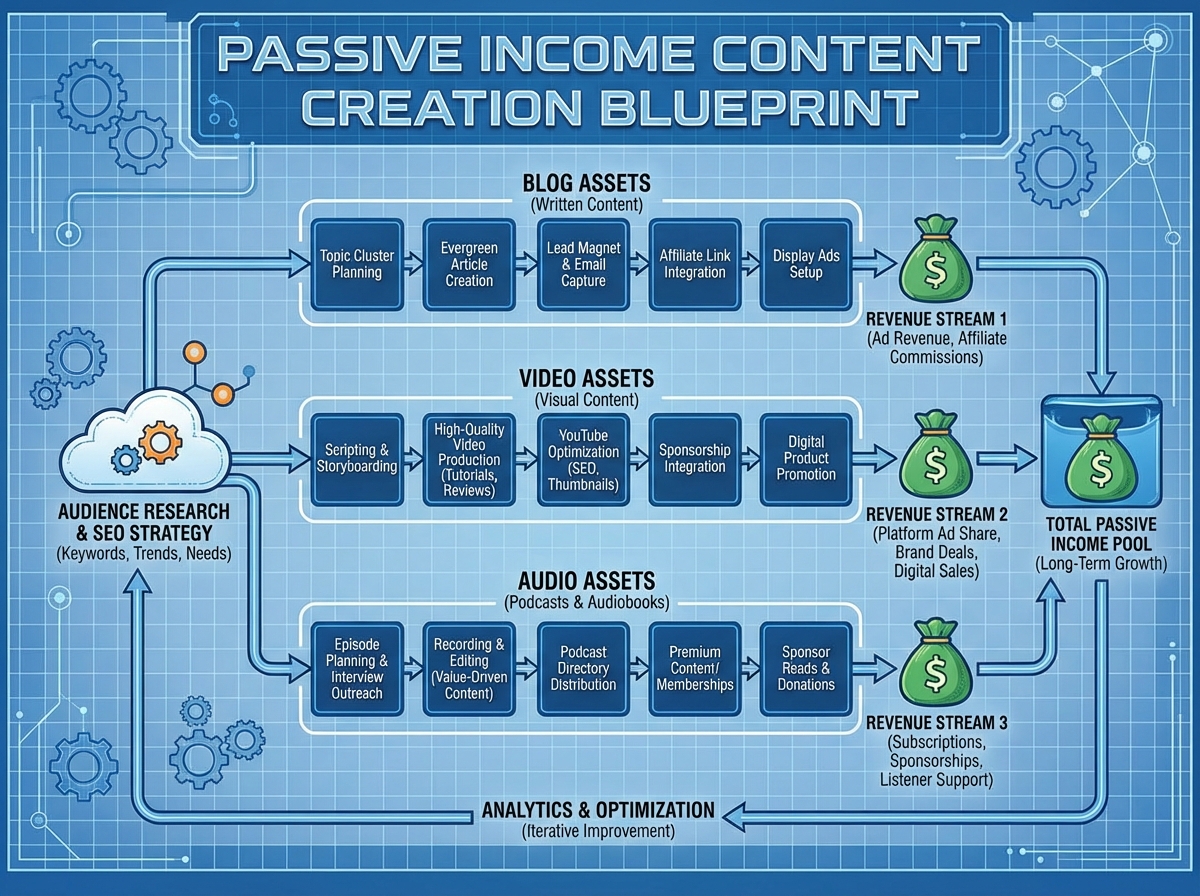
The first piece of content I ever published got exactly four views. Two of them were me.
If you’re looking to learn passive income content creation, the honest answer is that it works — but not the way most people imagine it when they start. The income becomes passive only after a front-loaded period of very active, intentional work: choosing the right platform, understanding your audience at a granular level, building a content system, and measuring what actually earns versus what just gets clicks. Skip any of those stages and the income never materializes.
- Content creation generates passive income only when the content is built around a clearly defined audience problem — not around what you personally enjoy making.
- The platforms that pay you most consistently reward content that solves a specific recurring search query, not content that performs once and disappears.
- Most people fail not because their content is bad, but because they never figure out who they’re making it for.
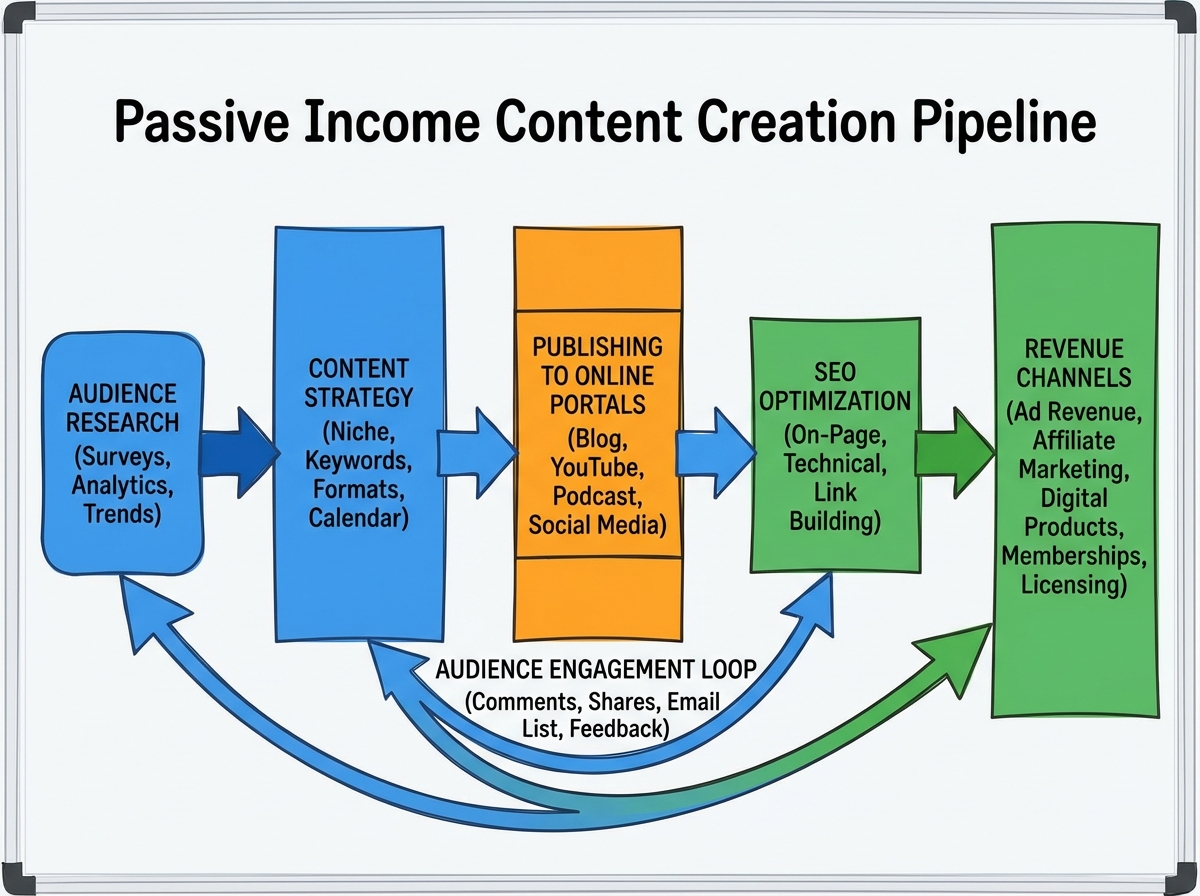
What Passive Income Content Creation Actually Means
Passive income from content creation means building assets — articles, videos, audio, infographics — that continue generating revenue through ads, affiliate links, sponsorships, or licensing long after you stop actively promoting them. The content does the work. You get paid while you sleep, in theory.
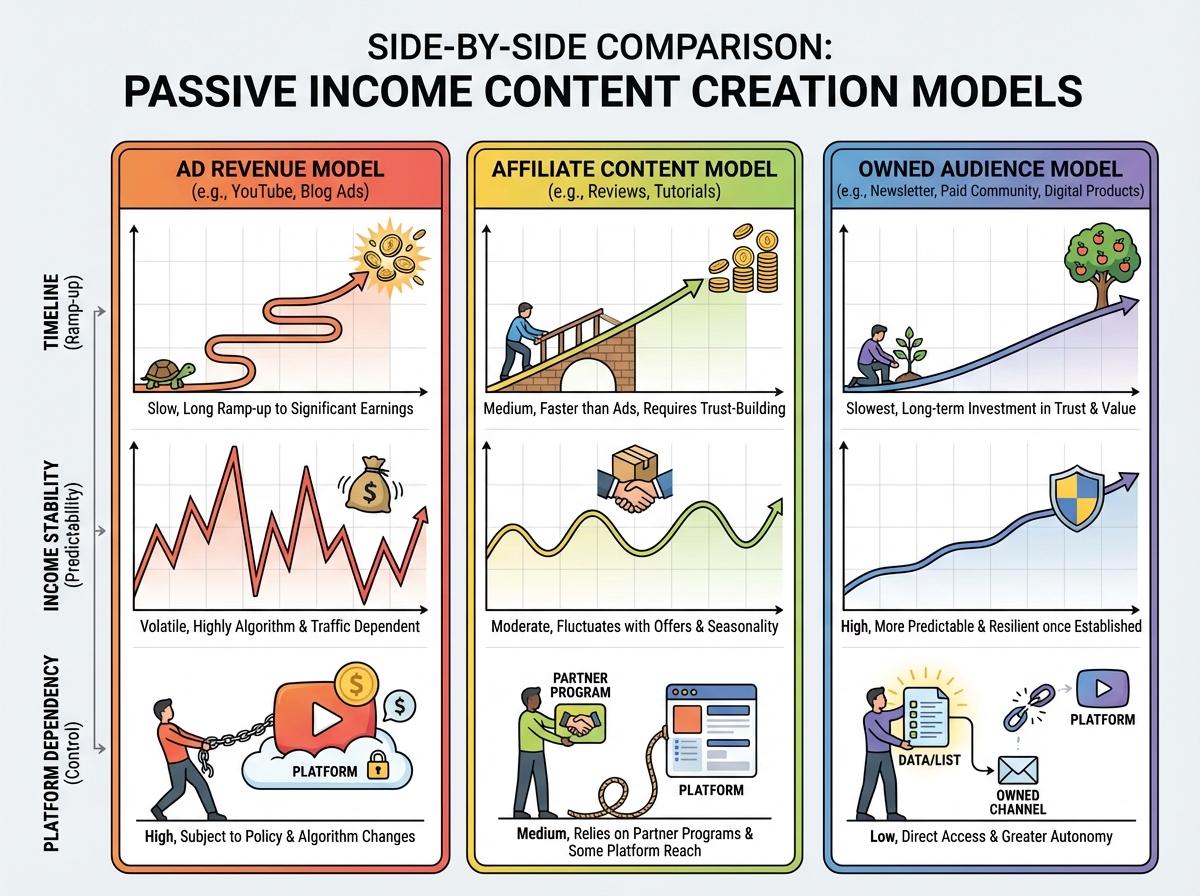
In practice, there are three distinct models, and they behave very differently:
| Model | How Income Is Generated | Time to First Revenue | Longevity |
|---|---|---|---|
| Ad-supported content | Platform pays per view/click | 3–12 months | High if SEO-driven |
| Affiliate content | Commission on product referrals | 1–6 months | Medium, depends on niche |
| Owned audience (email/community) | Direct monetization, sponsorships | 6–18 months | Highest, most stable |
Most beginners default to ad-supported because it feels like the obvious path. It’s also the most competitive and slowest. Affiliate content, particularly written content optimized for search, tends to be the fastest route to real passive returns for someone starting from scratch.
Three Things That Are Genuinely Surprising About This
- Your best-performing content will rarely be the content you liked making most.
- An article written once can outperform a weekly video channel within 18 months.
- Audience size matters far less than audience specificity — 500 loyal readers beat 50,000 passive ones.
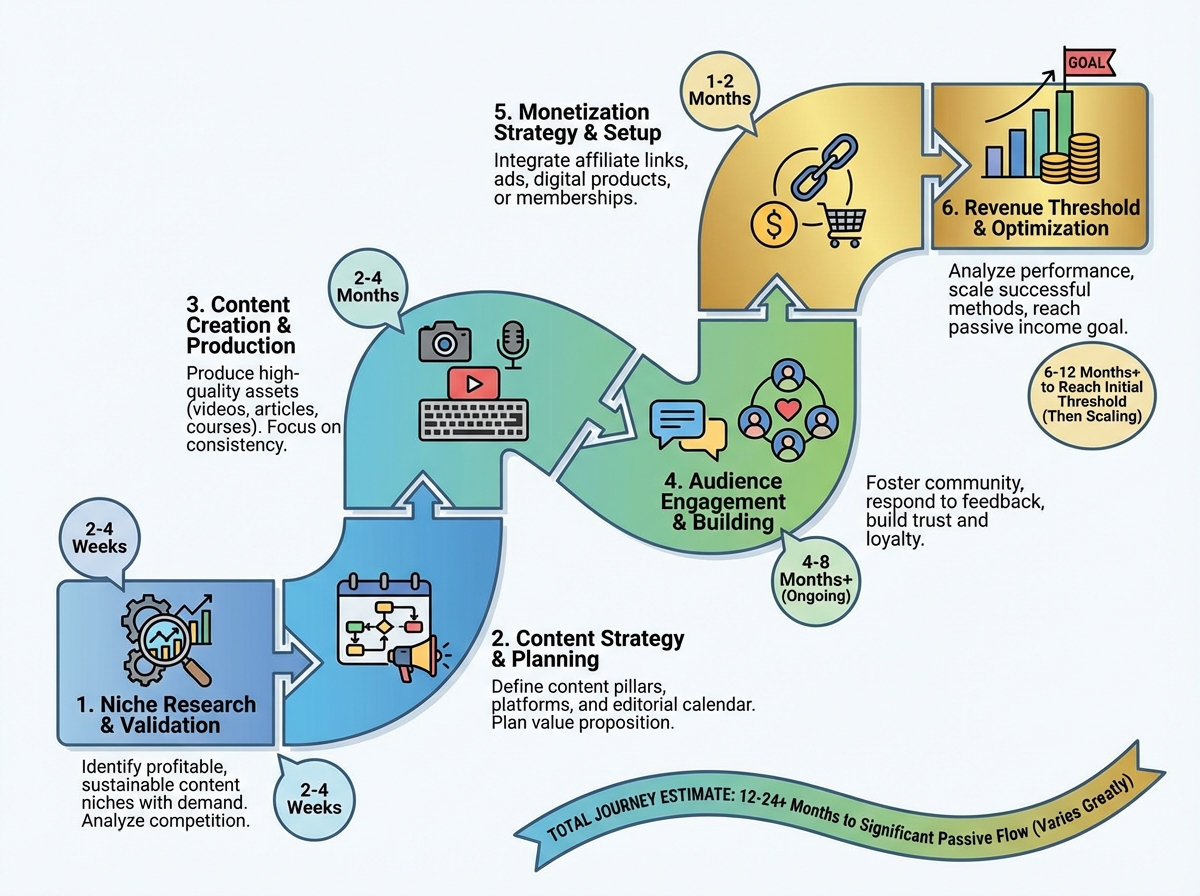
How Long It Actually Takes to Build Passive Income from Content
| Stage | What You’re Doing | Estimated Time |
|---|---|---|
| Foundation | Niche selection, platform choice, audience research | 1–2 weeks |
| Content system setup | Brand voice, content types, publishing workflow | 1–2 weeks |
| Initial publishing | First 10–20 pieces, no monetization yet | 4–8 weeks |
| SEO traction | Content begins ranking, organic traffic grows | 2–4 months |
| Monetization activation | Ads, affiliates, or sponsorships enabled | Month 3–6 |
| Passive income threshold | Revenue requires minimal active effort to maintain | Month 6–18 |
| Total | From zero to sustainable passive income | 6–18 months |
The order of those stages matters more than the speed at which you move through them. Rushing to monetize before you have consistent traffic is the most common reason people give up — they see a trickle of income and assume the model is broken. It’s not. The foundation just wasn’t set properly yet.
If it’s taking you longer than these estimates, that’s completely normal. Niche difficulty, starting platform, and publishing frequency all shift the timeline significantly.
The First Problem Nobody Warns You About
Most people start with what they want to say. The actual work starts with who needs to hear it.
This feels like a small distinction until you’ve published twenty pieces of content and watched all of them flatline. You chose a topic you’re passionate about. You wrote well. You hit publish. And nothing happened — not because the content was bad, but because you built it for yourself instead of for a specific person with a specific problem they’re actively searching to solve.
The audience research stage is where content creation for passive income either gets a foundation or doesn’t. This means going deep enough to understand not just the broad topic your audience cares about, but the exact friction they’re experiencing right now. What do they type into Google at 11pm when they’re frustrated? What question do they keep asking in forums? What do they buy that doesn’t quite solve the problem? That specificity is what makes content rank, get clicked, and convert.
Once you map that out, everything else — your content format, your platform, your publishing cadence — becomes a set of decisions rather than guesses. The people who build genuine passive income streams from content are rarely the most talented writers or the most charismatic video creators. They’re the ones who did the audience work first.
What Makes Content Actually Succeed
The biggest mistake people make when learning to create content for passive income is treating quality as the only variable. They pour hours into production value — better thumbnails, longer articles, cleaner audio — while ignoring the one thing that determines whether anyone finds the content at all: whether it answers a question people are actually asking.
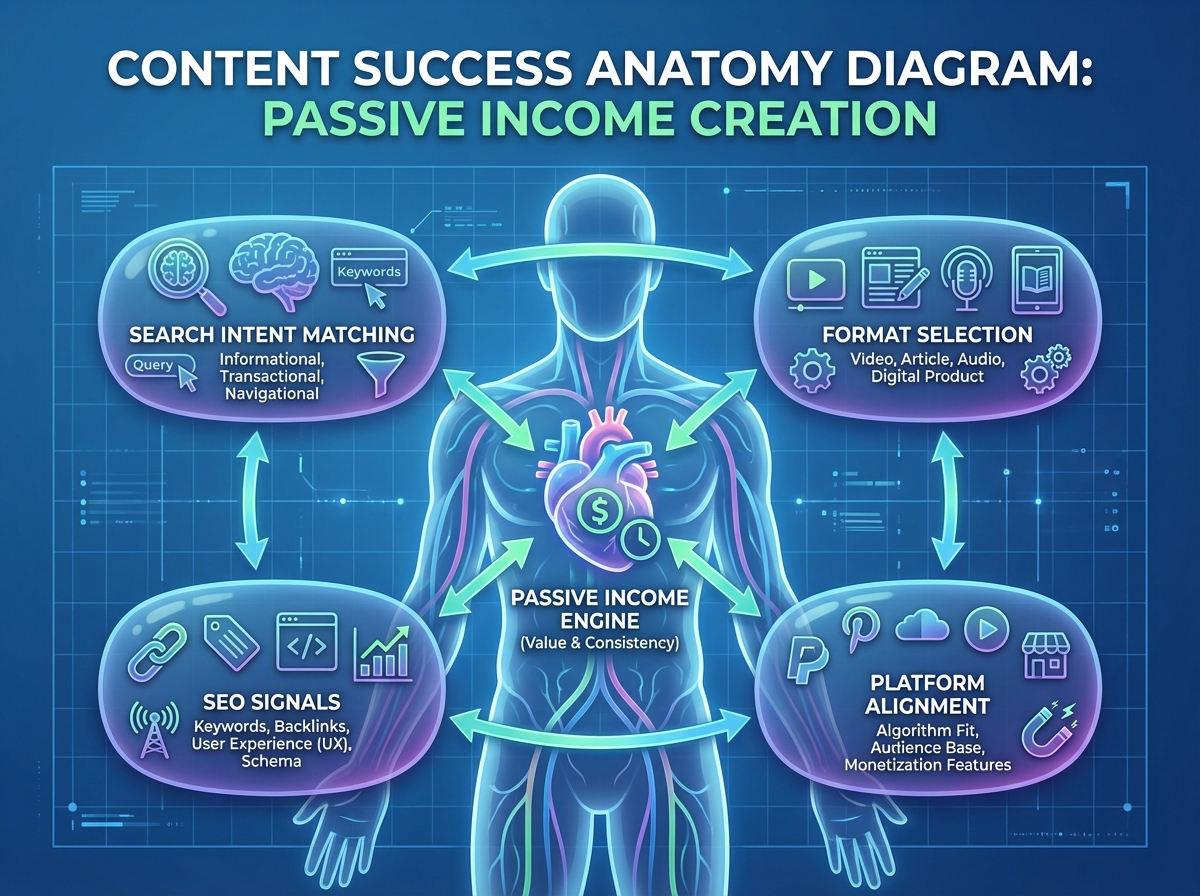
Content that succeeds in a passive income context has a specific anatomy. It targets a search query with clear intent. It delivers a complete answer, not a teaser. It matches the format the audience expects — a how-to article versus a listicle versus a comparison piece aren’t interchangeable, even if the topic is identical. And it’s published on a platform where the audience already spends time, not on a platform you chose because you prefer it.
The SEO layer is not optional, even for video content. Every title, every description, every tag is a signal that tells search engines and platform algorithms who to show your content to. Getting that targeting wrong means the content exists but never gets discovered. Getting it right means a single piece of content can generate clicks, referrals, and revenue for years with no further work from you.
For those building written content that works for SEO and passive income, the underlying principle is the same whether you’re writing or coding: the output only performs if the inputs were correctly specified.
Building a Content Strategy That Holds Together
A content strategy isn’t a content calendar. That’s a common confusion, and it costs people months of wasted effort.
A content calendar tells you what to publish and when. A content strategy tells you why those pieces connect, what each one does for your audience at a specific stage of awareness, and how they collectively build toward a monetization outcome. Without the strategy layer, you’re just producing content — volume without direction, which is exhausting and rarely profitable.
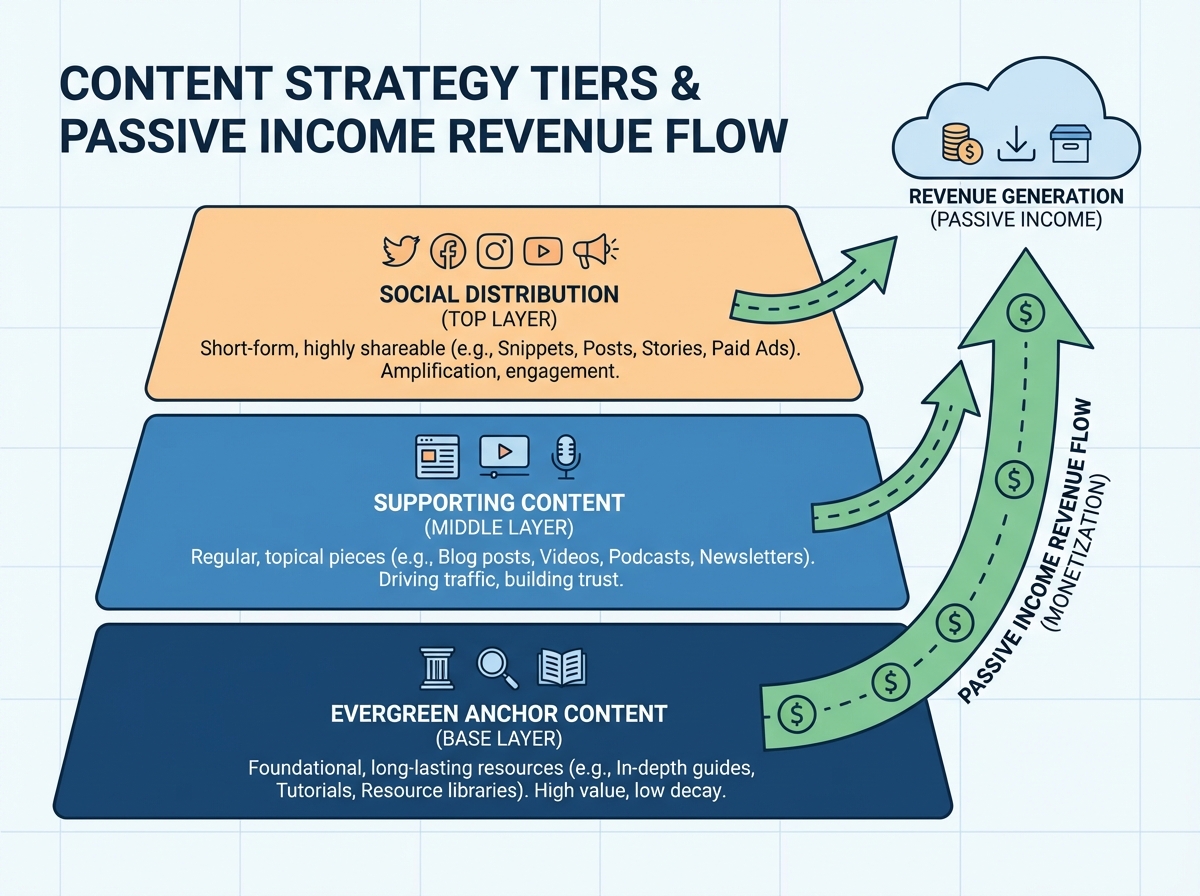
For passive income specifically, the most functional strategy structures your content in tiers. At the base are your evergreen anchor pieces — long-form, search-optimized content that targets high-intent queries and ranks steadily over time. These are your income engines. Around them, you build supporting content that feeds traffic to the anchors — shorter pieces, social media posts, email sequences — that catch people at earlier stages of awareness and funnel them toward the content that converts.
The brand voice piece matters here more than most beginners expect. When someone reads one of your pieces and then finds another, they should feel like they’re in the same room with the same person. Inconsistency in tone breaks trust subtly but decisively. Readers who trust your voice come back. Readers who don’t, don’t.
Multimedia Content Creation and Where Beginners Get It Wrong
At some point you’ll need to decide whether to go deep on one format or spread across several. The default instinct is to spread — write articles, make videos, record a podcast, build a newsletter. Cover everything. Reach everyone.
That instinct will drain you and produce mediocre results across all channels simultaneously.
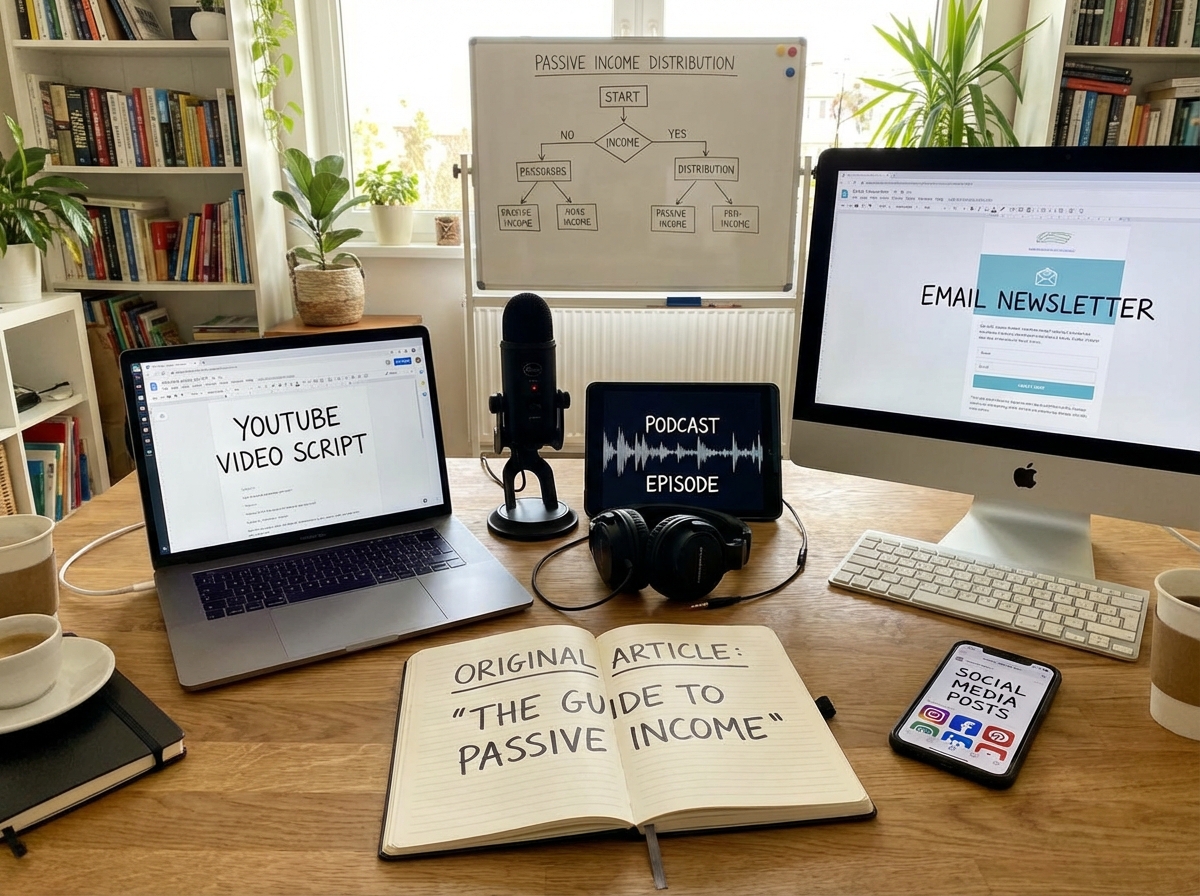
The smarter path, especially early, is to go deep on one format until you understand what makes that format work, then repurpose outward. A long-form article can become a video script, a podcast episode outline, an email sequence, and five social media posts. But that only works once you understand the article format well enough to build something worth repurposing. If the source material is weak, everything downstream from it is also weak.
Video and audio content have a different set of demands than written content. The passive income timeline is longer because platform algorithms take longer to surface new creators, and production workflows are more complex. Written content, particularly SEO-optimized articles and guides, tends to produce passive returns faster for beginners — especially those who can write with specificity and structure.
How to Use Social Media Without Letting It Use You
Social media is a distribution channel, not a passive income source. This sounds obvious but it’s one of the most expensive confusions in the content creation space — people spend 80% of their time optimizing for social engagement and 20% building the actual income-generating assets.
Social platforms don’t pay you for time spent. They pay reach, and only certain platforms pay it at all. More importantly, social media algorithms are designed to keep people on the platform, not to send them to your monetized content. Every post that generates likes and shares without clicking through to your actual content is engagement theater — it feels like progress but it isn’t.
The role of social media in a passive income content strategy is specific: it widens your top of funnel by exposing new people to your brand voice, then moves them to channels you own — your website, your email list, your YouTube channel. Once they’re in those owned channels, you have leverage. Until then, you’re renting attention on someone else’s platform.
For creators building social media content strategies that actually grow a business, the key insight is that the platform is not the business — your content library is the business.
The Audience Feedback Loop Nobody Talks About
The content that’s making you passive income six months from now is not the content you’re writing today. It’s the content you’ll write after you understand what your audience is actually responding to versus what you assumed they would.
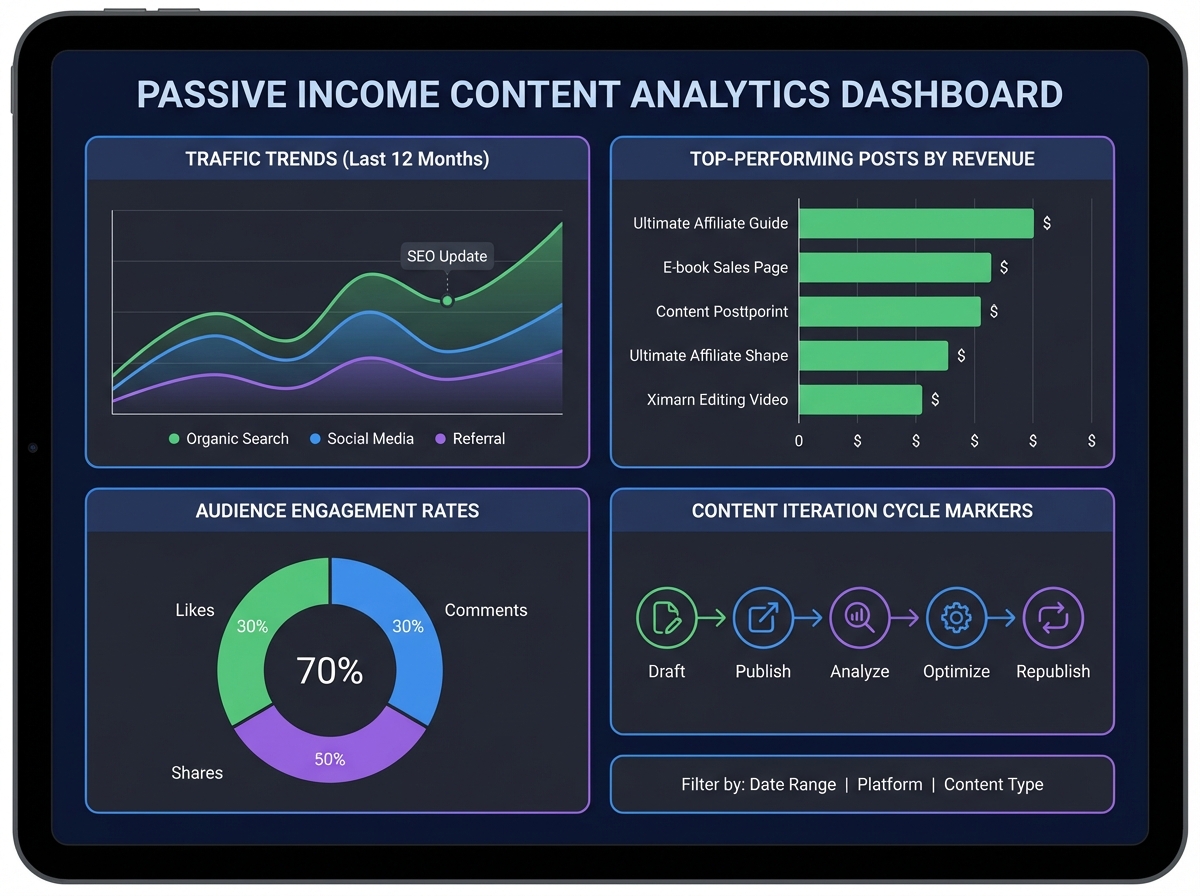
This is where most content creators plateau. They publish, they measure views, they move on. What they miss is the diagnostic layer underneath the metrics — why did that piece outperform everything else? Was it the topic, the format, the headline, the depth of the answer, the timing? Without that analysis, growth becomes random. With it, you can systematically replicate your best results.
The audience interaction piece isn’t just about collecting comments or answering questions, though both matter. It’s about treating your audience as a live feedback signal that continuously tells you how to make your content more valuable to them. The creators who build sustainable passive income are almost always the ones who got genuinely curious about their audience’s behavior early — and who adjusted their content strategy based on what the data kept telling them, even when it meant abandoning formats or topics they personally preferred.
Learning to read those signals and update your content strategy accordingly is a skill, and like all skills it gets faster with repetition. The first time you audit your analytics and rebuild a content plan around what you find, it feels slow and uncomfortable. By the third time, it’s the most natural thing in your workflow.
What to Do Right Now
Looking back at the full journey, the income never came from publishing more. It came from getting specific — about the audience, the problem, the format, the platform — and then building a system around those specifics.
Here’s what actually moves the needle, applied immediately:
- Identify one niche within your topic and write it on paper as a specific person’s problem. Vague niches produce vague content that ranks for nothing and earns nothing.
- Research five search queries your target audience is already using and rank them by commercial intent. The highest-intent queries are your first content targets, not the most interesting ones.
- Choose one primary platform and one content format before you publish anything. Platform and format confusion is the most common reason early content libraries have zero coherence.
- Build your first piece of content around a complete answer to a single question — not a broad overview, not a “beginner’s guide to everything,” but a direct, specific, completable answer.
- Set up a basic analytics view before your first piece goes live. If you can’t measure it from day one, you can’t improve it systematically.
- Write your brand voice in one sentence — who you are, who you’re for, and what you consistently deliver — and check every piece of content against it before publishing.
- Plan your monetization structure before you need it. Affiliate relationships, ad network requirements, and sponsorship positioning all take setup time. Building that infrastructure while your traffic is growing means you’re ready to earn the moment the threshold is reached.
- Audit your five best-performing pieces every 90 days and ask what they have in common. That pattern is your replicable edge — most creators never identify it, which is why their growth feels random even when it isn’t.
For anyone building their foundation in writing and publishing content online, the same principle applies: the roadmap only works if you actually follow the sequence.
Leave a Reply