


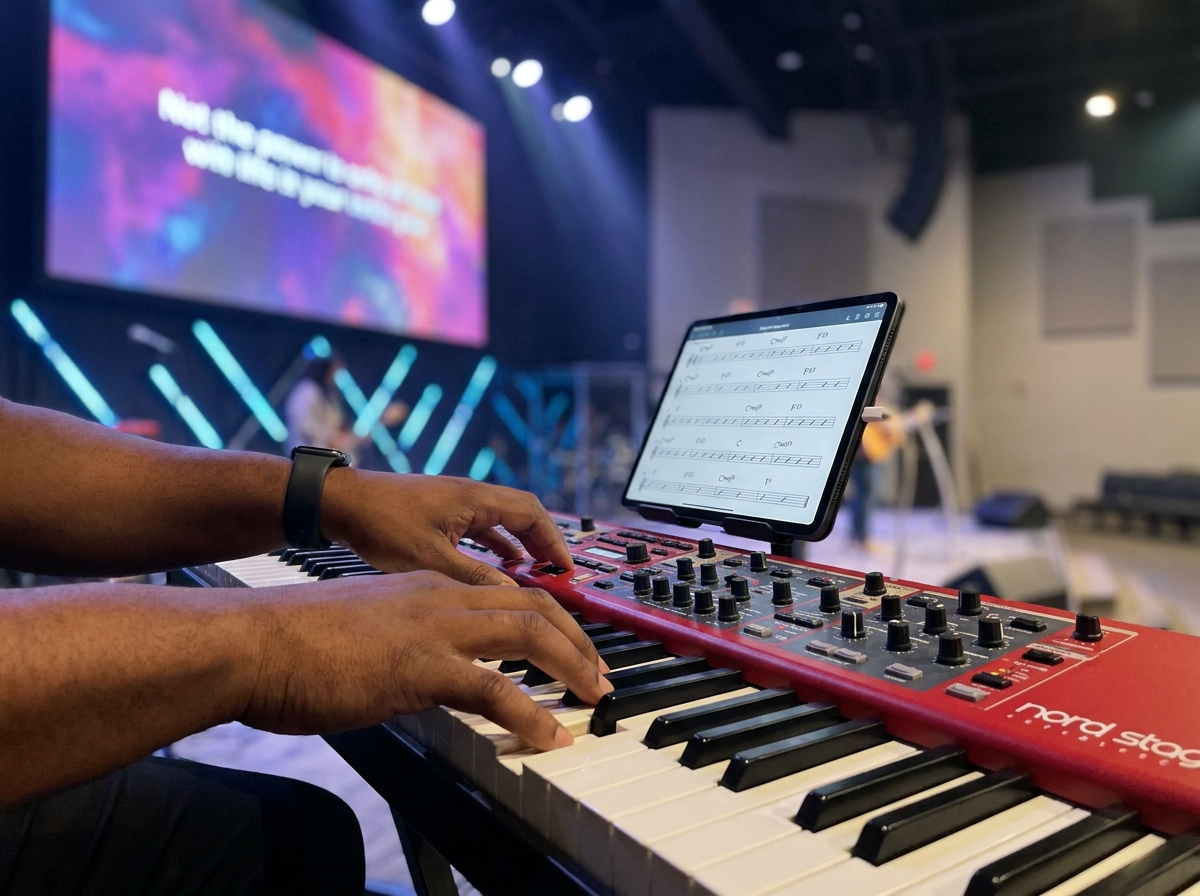
There’s a specific kind of frustration that hits intermediate pianists who try to learn contemporary gospel music on their own. You can play your scales. You’ve worked through chord progressions. But when you sit down and try to replicate what you hear in a live worship setting — that thick, layered sound with the moving bass line and the chords that seem to float — it just doesn’t come out right. Something is missing, and you’re not sure what it is.
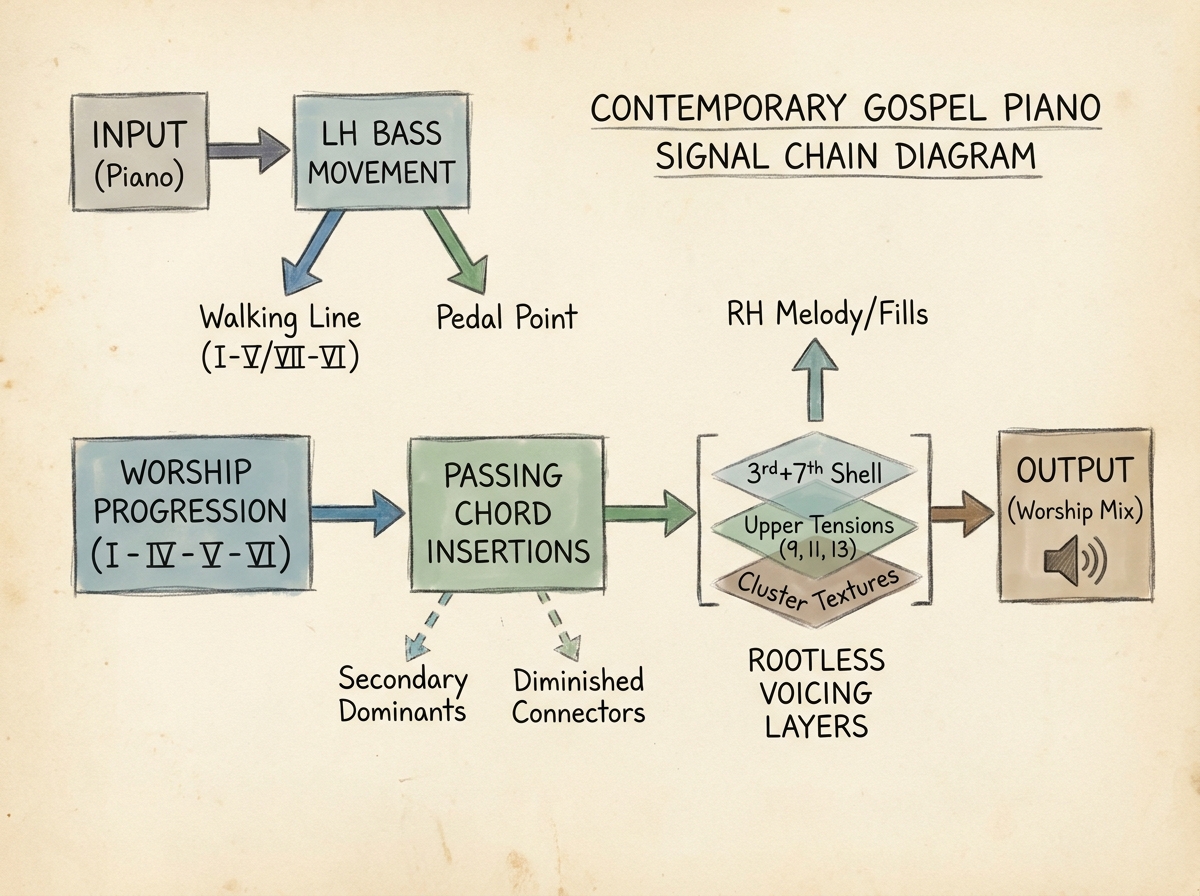
If you’re looking to learn contemporary gospel piano, the honest answer is that you already have most of the raw material — what’s missing is a set of specific harmonic and technical concepts that are almost never taught in standard piano instruction. The gap between playing chords and playing gospel is not about more practice. It’s about understanding the vocabulary: rootless voicings, passing chords, and the particular way the left hand carries harmonic motion in this genre. Once those three things click, the sound you’ve been chasing becomes reachable.
- Contemporary gospel piano is built on a specific harmonic language — rootless voicings and passing chords — that classical and pop piano teaching doesn’t cover.
- If you already play at an intermediate level, the concepts are learnable within weeks, not years.
- The left hand is where most players fall short — and fixing it changes everything about how your right hand is perceived.
What “Contemporary” Actually Means at the Piano
Classical piano instruction teaches you to voice chords with the root in the bass. Modern pop instruction teaches you to follow the chord chart. Contemporary gospel does neither of those things cleanly — it occupies a harmonic space that sits between jazz voicing, R&B feel, and worship-music intention. Understanding this distinction up front saves an enormous amount of confusion.
In contemporary gospel piano, “contemporary” refers not just to era but to a specific set of tonal choices. The chords used in modern worship music — the ones you hear in songs that have that lush, atmospheric quality — lean heavily on extended harmonies: ninths, elevenths, and suspended tones. These are not ornaments. They are the core sound.
| Approach | Chord Voicing Style | Left Hand Role | Characteristic Sound |
|---|---|---|---|
| Classical | Root-position triads | Alberti bass or octaves | Full, grounded |
| Pop/Rock | Open power chords or block chords | Root doubling | Direct, punchy |
| Contemporary Gospel | Rootless voicings, extended harmony | Moving bass lines, passing motion | Warm, layered, floating |
| Jazz | Shell voicings, altered extensions | Walking bass or comp patterns | Sophisticated, rhythmic |
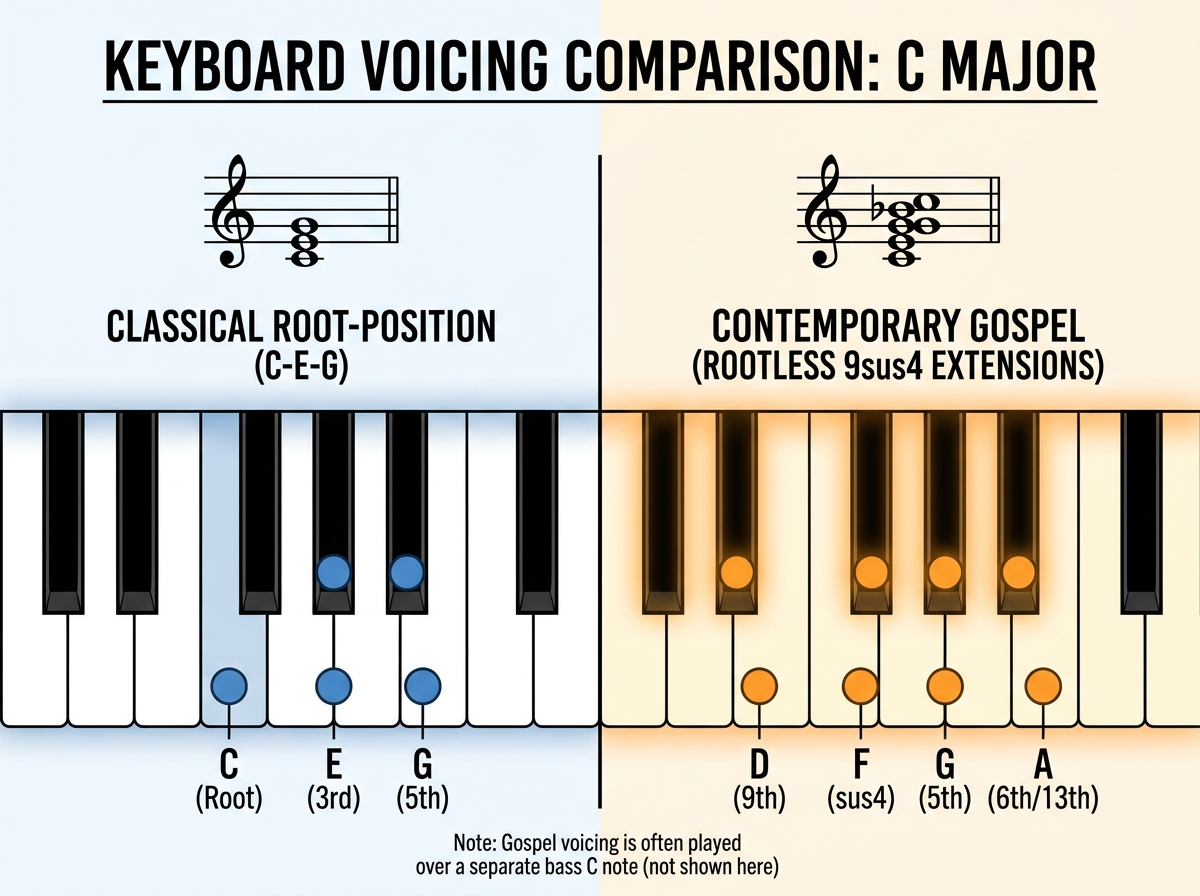
The moment you understand that contemporary gospel sits in its own lane — not jazz, not classical, not simple worship strumming — you stop trying to force old frameworks onto new sounds.
Three Observations That Took Me Too Long to Learn
- Rootless voicings sound “wrong” in isolation but correct the moment the bass note arrives.
- Passing chords are not decorative — they carry the harmonic story between the chords that matter.
- Your left hand is playing a completely different instrument from your right hand, and treating it otherwise is the single biggest mistake.
How Long It Actually Takes
| Stage | Content | Time |
|---|---|---|
| Tonal Foundation | Understanding the tones used in contemporary worship, intervals, chord colors | 1–2 weeks |
| Chord Vocabulary | Contemporary chord types, extended harmonies, suspended chords | 2–3 weeks |
| Left Hand Mastery | Left hand techniques, left hand chord voicings, independence | 2–4 weeks |
| Passing Chord Logic | Where passing chords go, how to choose them, voice leading | 1–2 weeks |
| Song Application | Applying all concepts to full contemporary worship songs | 3–5 weeks |
| Total Estimated Time | Full working fluency with contemporary gospel piano | 9–16 weeks |
The order matters more than the speed — someone who tries to learn passing chords before understanding left hand independence will build habits that actively fight them later. If you move slower than the estimate, that’s not failure — that’s how musical language actually gets absorbed.
The Sound Starts With the Tones You Choose
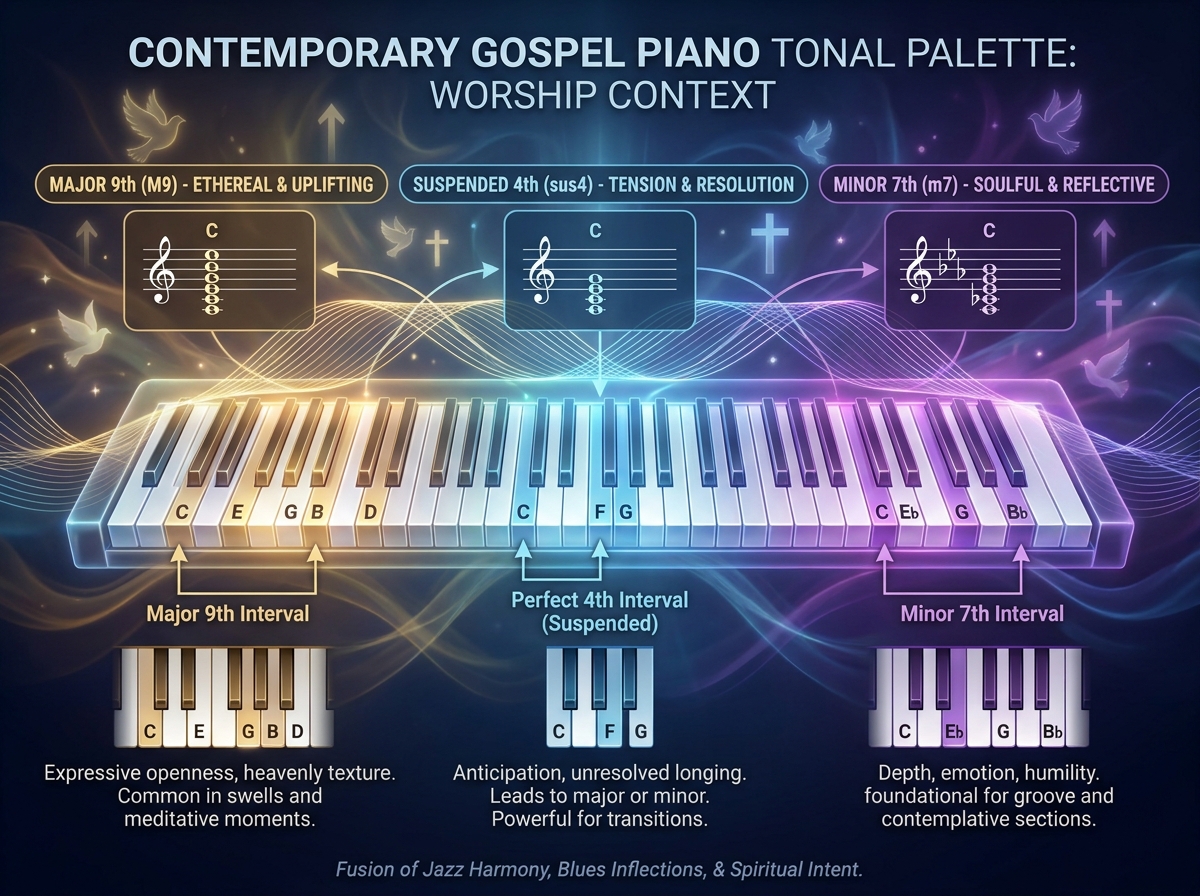
Before any technique makes sense, you have to understand what makes contemporary gospel music sound the way it does at the harmonic level. This genre has a tonal signature — certain intervals and chord colors that appear again and again in worship music. Learning to hear them and reproduce them is the foundation everything else sits on.
Most intermediate players approach gospel by taking the chords they already know and adding notes. That’s backwards. The correct mental model is: contemporary gospel has a palette of tones that feel right in a worship context, and your job is to learn that palette first, then build chords from inside it. The difference sounds subtle on paper and enormous in practice.
The tones that define contemporary gospel lean toward warmth and openness — major 9ths, minor 7ths, suspended 2nds and 4ths. When these appear together in a voicing, the chord stops sounding like a textbook exercise and starts sounding like something you’d hear in an actual service. That shift in recognition — “oh, that’s the sound I’ve been hearing” — happens faster than most people expect once you’ve internalized the tonal vocabulary.
Styles of Play and Why They Exist
Contemporary gospel piano isn’t one style — it’s several that overlap and reference each other depending on context. There are moments in a worship service that call for a driving, rhythmic approach, and moments that call for something sparse and harmonic. Knowing which style fits when is a skill that gets developed through exposure, not theory alone.
The mistake most players make here is locking into one style and applying it everywhere. You’ve probably heard this at a church service — the pianist who plays the same dense, full-chord approach whether the song is quiet and meditative or high-energy and celebratory. It doesn’t read as skilled; it reads as limited. The players who sound professional move between modes of expression fluently.
The styles themselves — whether you call them contemporary hymn playing, modern worship ballad, or high-energy praise — all share the same harmonic DNA. What shifts is density, rhythm, and how much space you leave. Learning to control those variables is ultimately what separates a player who sounds competent from one who sounds like they belong on stage.
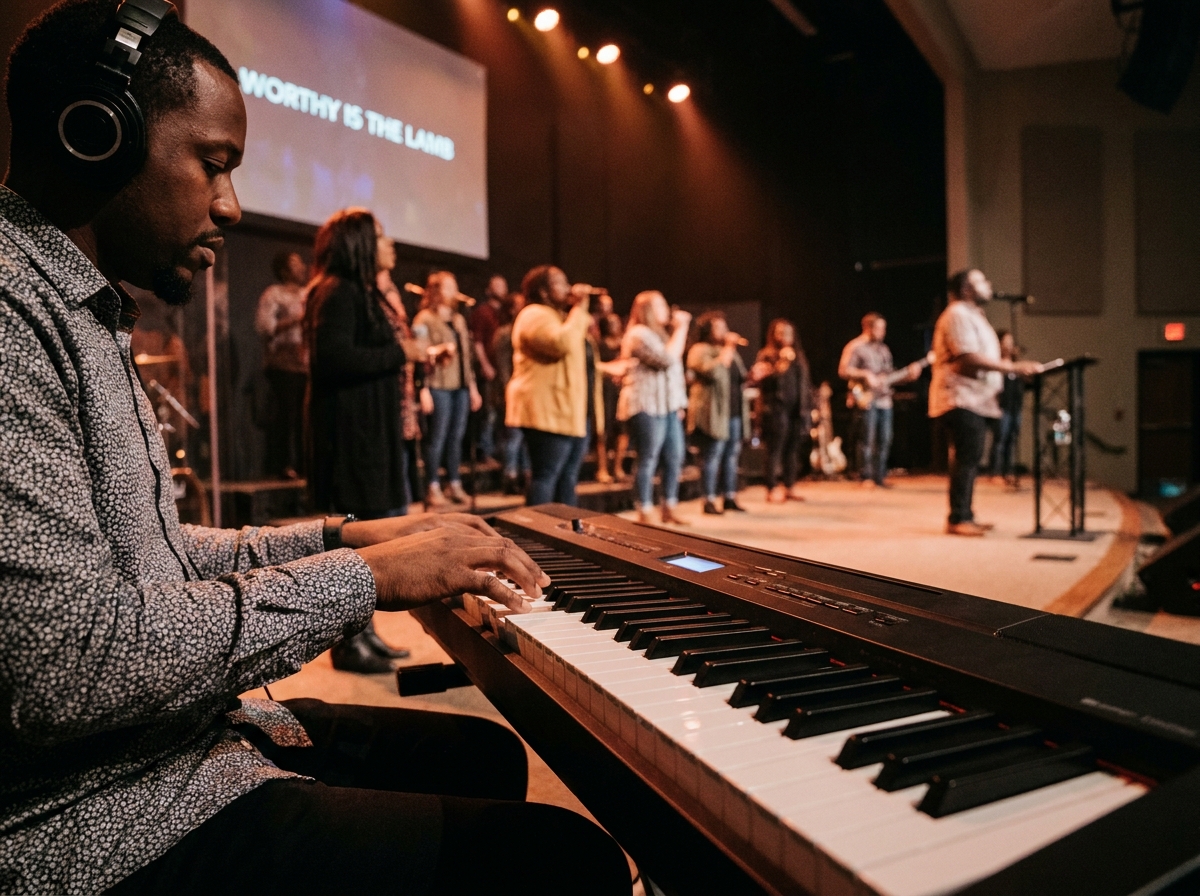
The Left Hand Problem Nobody Talks About
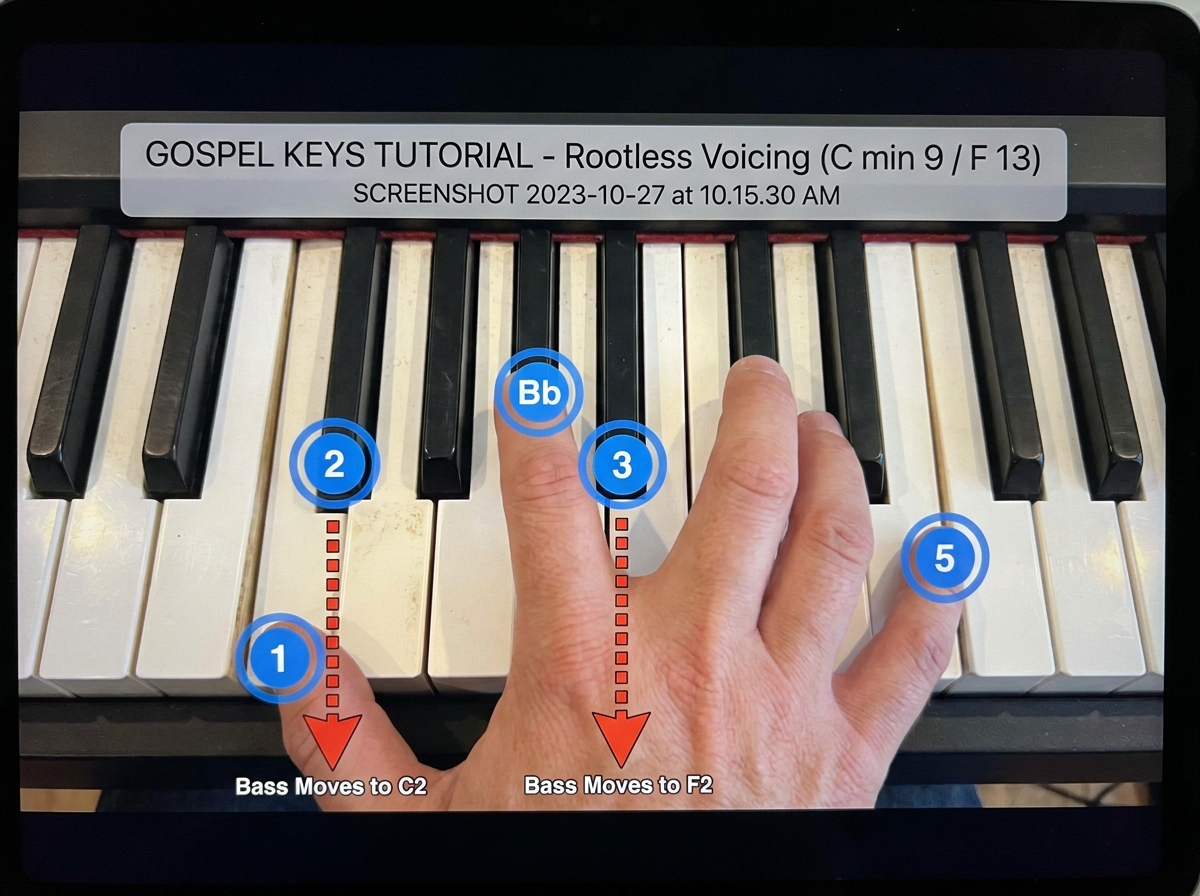
If there is a single place where intermediate pianists stall when learning contemporary gospel piano, it is the left hand. Not because left hand technique is mysteriously difficult, but because every instinct built from standard piano instruction actively works against what contemporary gospel requires.
In classical training, the left hand’s job is to support. In contemporary gospel, the left hand has an independent harmonic and rhythmic role. It moves. It creates passing motion. It voices chords in ways that don’t follow root-position logic. And it does all of this while staying out of the way of the right hand’s melodic or improvisational function. That’s a completely different cognitive task from “play the bass note on beat one.”
Left hand chords in this style are often played without the root — or with the root in a position that creates harmonic ambiguity until the full voicing resolves. The first time you play one of these patterns in isolation it sounds unresolved, almost wrong. But put it in context with the right hand and suddenly you understand why jazz and gospel pianists have been doing this for decades. It creates space. It creates motion. It makes the harmony breathe instead of sit.
The physical technique matters here too. Contemporary gospel left hand patterns often involve wider stretches and quicker lateral movement than classical playing demands. Building that independence — where the left hand can hold a rhythmic pattern while the right hand does something harmonically unrelated — takes focused, intentional practice. Not more practice. Different practice.
Passing Chords: The Secret Connective Tissue
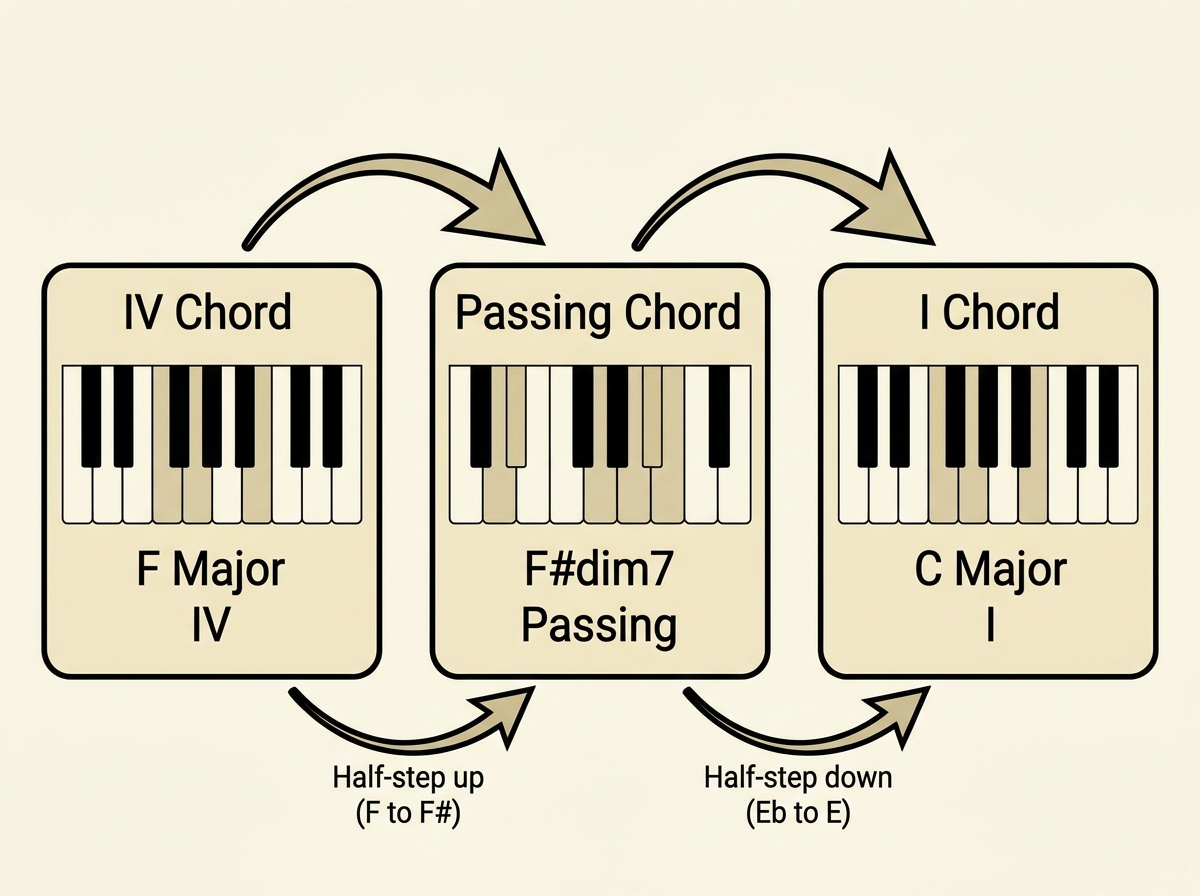
Passing chords are what make contemporary gospel piano sound like it’s moving even when you’re holding a single harmony. They are the harmonic glue between the chords that matter — and understanding them changes how you hear every song you’ve ever played.
The concept is simple enough to state: a passing chord is a chord that exists to connect two other chords smoothly, usually by moving one or two voices by a half step or whole step. But the application is where things get interesting. Because passing chords in gospel don’t always follow the rules of classical voice leading. They follow the ear. They follow the feeling of where the music wants to go.
Learning to place passing chords correctly — knowing which moment in a phrase is asking for one, and which chord to use — is where contemporary gospel piano starts to feel like a language rather than a set of techniques. This is also the point where players who’ve studied jazz will feel familiar ground, and players who haven’t will have a genuine breakthrough moment. The logic of chromatic passing motion, once it lands, makes you hear harmony differently. You stop hearing chords as fixed points and start hearing them as destinations — and that changes what you play in between.
For a deeper look at how harmonic pattern logic applies across genres, exploring piano rhythm patterns and chord progressions will reinforce the rhythmic dimension of what passing chords do in motion.
Applying Everything to Real Songs
There is a significant gap between understanding a concept and executing it inside a song, in real time, with both hands doing different things simultaneously. Most players underestimate this gap and get discouraged when the techniques they’ve studied don’t immediately appear in their playing. This is not a failure of understanding — it’s the normal friction of integration.
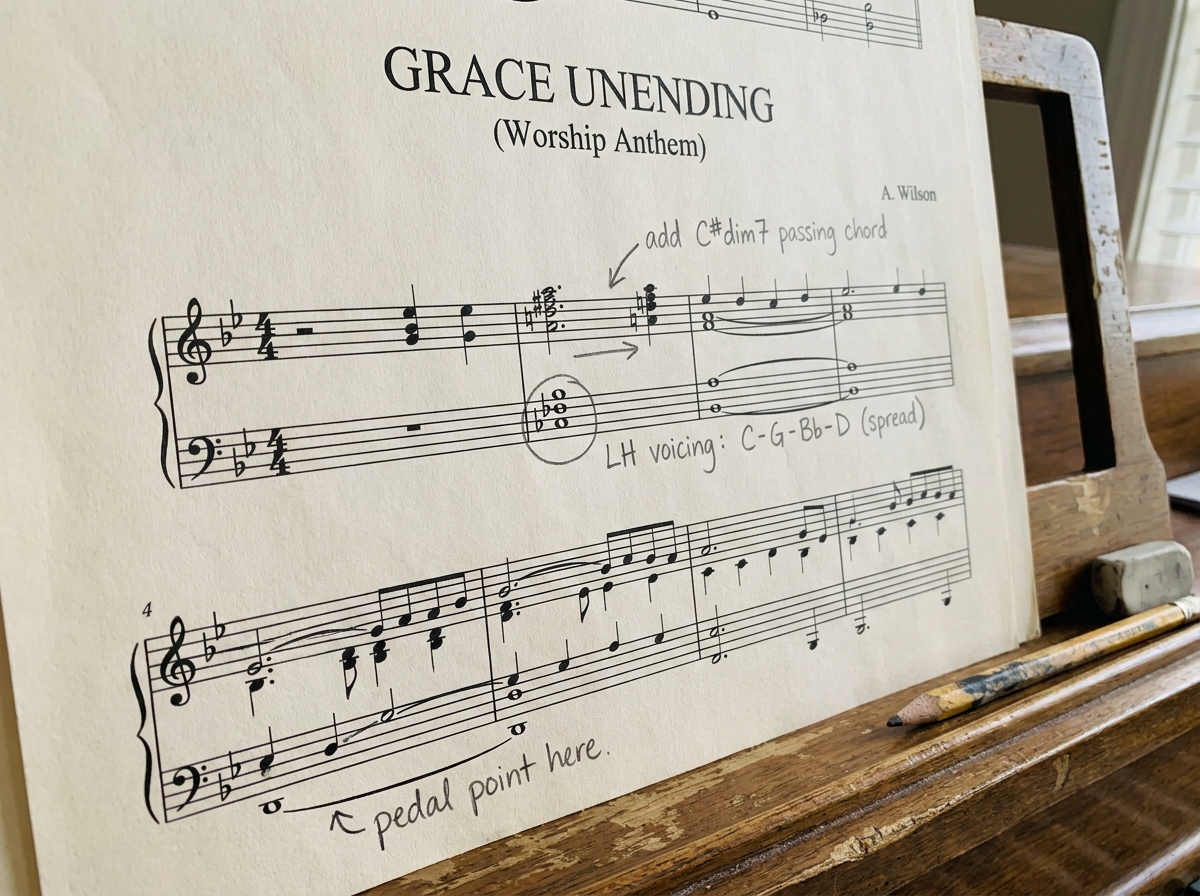
The way to close that gap is to work through songs that are specifically designed to demonstrate the concepts in context. When you hear passing chords in action inside a real worship song — not as a isolated exercise but as part of a phrase that moves and resolves — the concept shifts from intellectual to physical. You feel where it goes. And that proprioceptive memory is what eventually makes the technique automatic.
Songs like “I Have Decided to Follow Jesus” and “I Need Your Glory” are particularly useful here not because they are simple, but because their harmonic structure sits directly in the contemporary gospel vocabulary. They give you a familiar melodic frame inside which to practice unfamiliar harmonic moves. By the time you can play those songs with full contemporary chord treatment — rootless left hand voicings, passing chords in the transitions, extended harmonies throughout — you’ve stopped practicing techniques in isolation and started playing gospel.
The skills you develop in this process are not genre-locked. The harmonic thinking behind contemporary gospel — rootless voicings, chromatic passing motion, independent left hand — transfers directly into jazz, R&B, and neo-soul. If you’ve ever wanted to understand how those genres work harmonically, learning gospel piano is a remarkably efficient path there.
What Playing Contemporary Gospel Piano Actually Feels Like After It Clicks
There’s a specific moment that happens — usually a few weeks into working with the full vocabulary — where the techniques stop feeling like techniques and start feeling like musical instincts. You’re playing through a chord progression and your left hand moves to a passing chord without you consciously deciding to. Your voicing opens up because your hands have found the shape. The music sounds like you meant it.
That moment is what the whole process has been building toward. Not perfection. Not speed. The ability to sit at a piano in a worship context and sound like you belong there — like the harmonic language of contemporary gospel is native to you, not something you’re approximating from the outside.
This is also when you start noticing things in recordings you couldn’t hear before. The way a professional gospel pianist moves through a key change. The specific passing chord they chose for a particular transition. The left hand pattern that makes a quiet moment feel enormous. Your ears have been trained by your hands, and vice versa. That reciprocal education is what makes this genre — and the skills it builds — genuinely transferable to anything else you want to play.
For players who want to extend this harmonic thinking into blues-adjacent acoustic styles, the fingerpicking and chord movement principles explored in swing acoustic blues guitar offer a useful parallel perspective on how passing motion works in a different instrumental tradition.
Here are eight things you can apply immediately to accelerate your development in contemporary gospel piano:
- Isolate your left hand for the first 15 minutes of every practice session. The left hand never catches up to the right if you always practice both together from the start.
- Learn one rootless voicing per chord in your key before adding passing chords. Mixing concepts before internalizing the foundation creates confusion that’s hard to untangle later.
- Sing the passing chord as you play it. Hearing the chromatic movement vocally locks in the harmonic logic faster than visual or physical repetition alone.
- Transcribe 30-second sections of contemporary worship recordings by ear. Active listening with a keyboard in your hands teaches you to hear passing chords in context before you can explain them in theory.
- Practice left hand patterns at 60% speed until they feel automatic. Speed before independence produces tension in the hand that limits both technique and musicality.
- Apply new voicings to a song you already know before tackling new repertoire. Familiar melodic context lets you focus entirely on the harmonic change without splitting your attention.
- Record yourself playing every two weeks and listen back without playing along. Hearing your own playing without the physical sensation of producing it is the fastest way to identify where your left hand is still defaulting to old habits.
- Use contemporary gospel piano techniques in at least one non-gospel context per week. Playing a pop or R&B song with rootless voicings and passing chords confirms that what you’re learning is a harmonic language, not a genre-specific trick.
Leave a Reply