


There’s a specific kind of exhaustion that hits when you’ve been posting consistently, running ads, sending emails, and still feel like your marketing is going nowhere. Not because you’re doing it wrong — but because you’re doing too much of the wrong things for the wrong reasons.
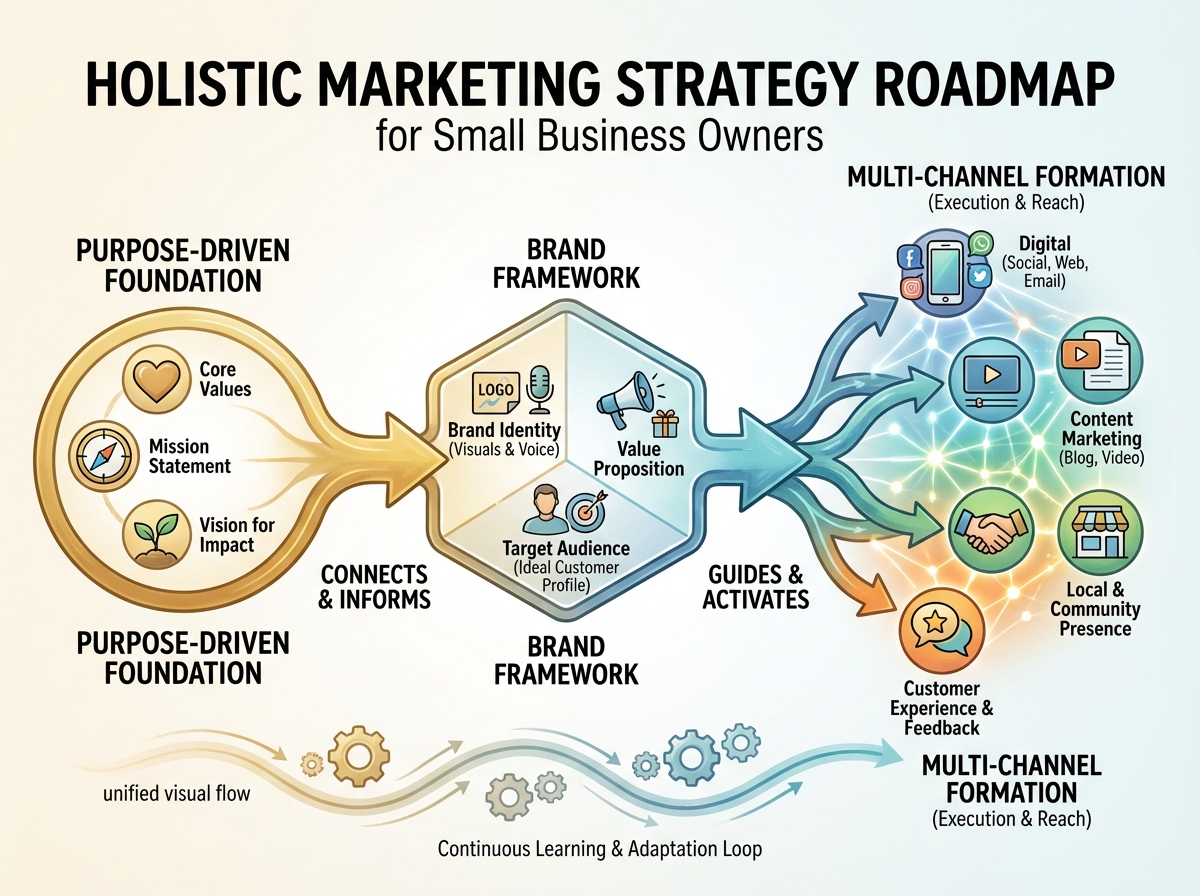
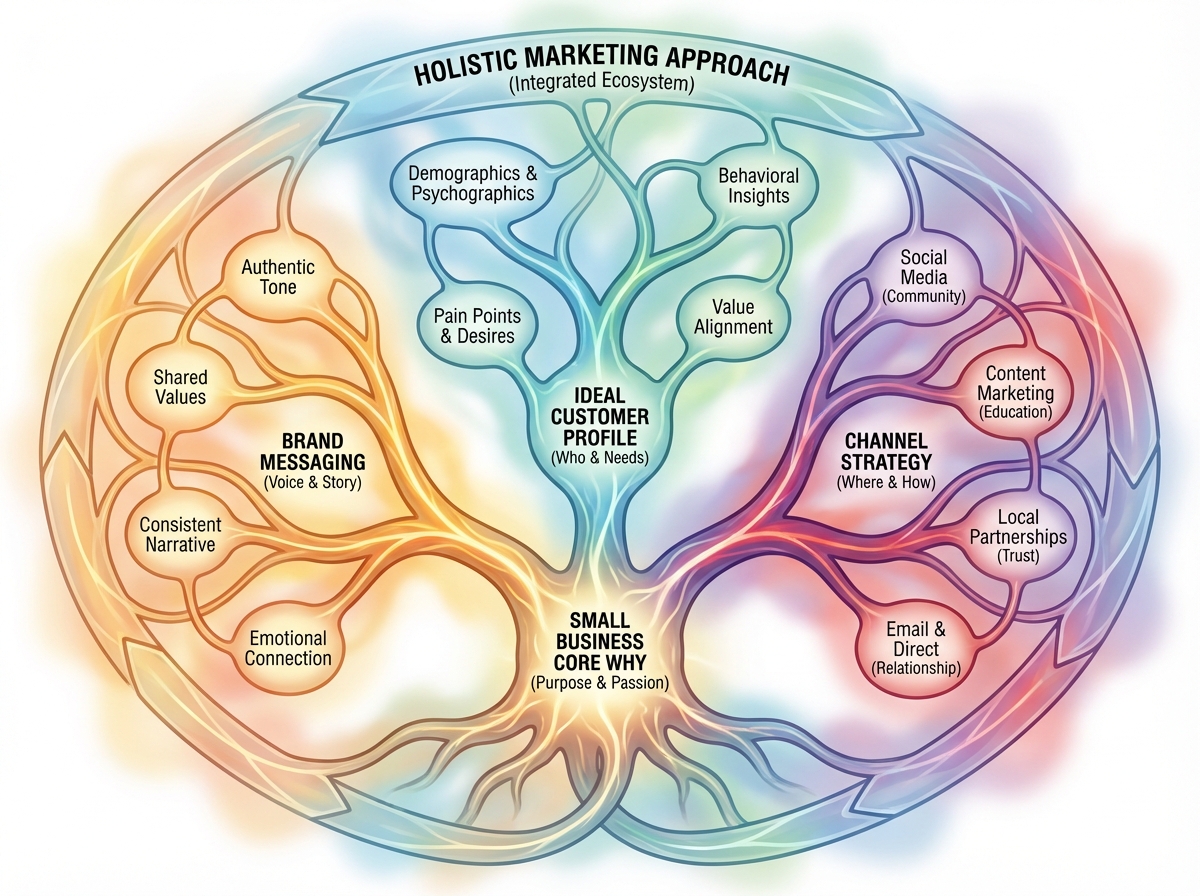
If you’re looking to learn holistic marketing strategy, the short answer is this: it starts by stopping. Stopping the reflex to replicate what everyone else is doing, and building something rooted in why your business exists in the first place. A holistic marketing strategy connects your purpose, your audience, and your channels into one coherent system — instead of a collection of disconnected tactics that exhaust you and confuse your customers.
- Works best for entrepreneurs and small business owners who feel scattered across too many platforms
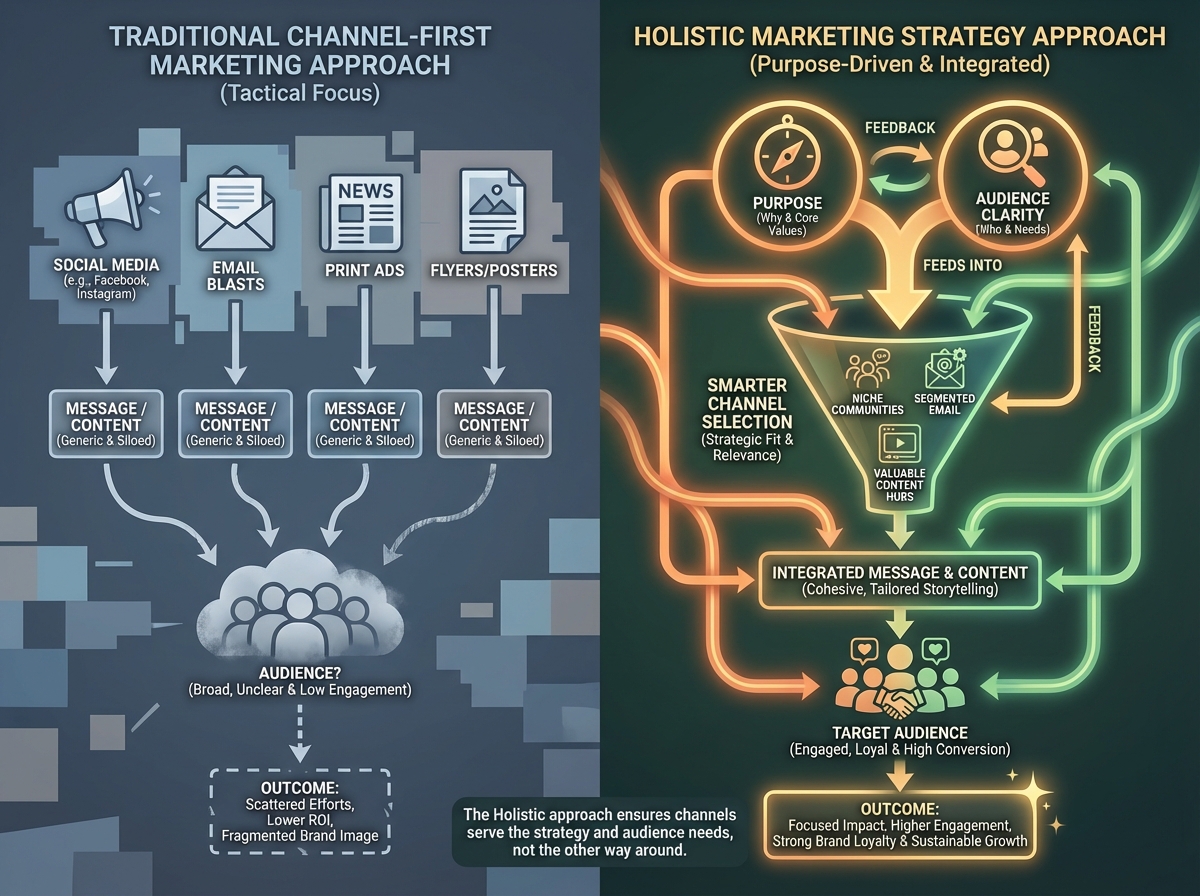
- The goal is alignment first, tactics second — channel selection follows clarity, not the other way around
- The output is a strategy document you can actually follow, not a generic marketing plan you abandon in week two
What Holistic Marketing Actually Means for Small Businesses
Holistic marketing isn’t a buzzword for doing everything. It’s the opposite. It’s a philosophy that says your marketing only works when every part of it — your message, your channels, your content, your metrics — is pulling in the same direction, anchored to the same core intention.
For a solo entrepreneur or small business owner, this matters more than it does for a large brand. You don’t have a team of twelve to manage six platforms. You have yourself, maybe a part-time contractor, and a few hours a week. A fragmented strategy doesn’t just underperform — it burns you out.
The distinction that changes everything is this: most marketing advice is channel-first. It tells you to “be on Instagram” or “start an email list” before you’ve answered the harder question of who you’re talking to and what you actually stand for. Holistic marketing flips that. Strategy before tactics. Always.
The Three Sharper Truths Nobody Tells You First
- Being on fewer platforms consistently beats being everywhere sporadically.
- Your ideal customer isn’t “everyone who could benefit” — that vagueness is why your content doesn’t convert.
- Your brand story is a strategic asset, not a personal biography.
How Long Does It Take to Build a Holistic Marketing Strategy?
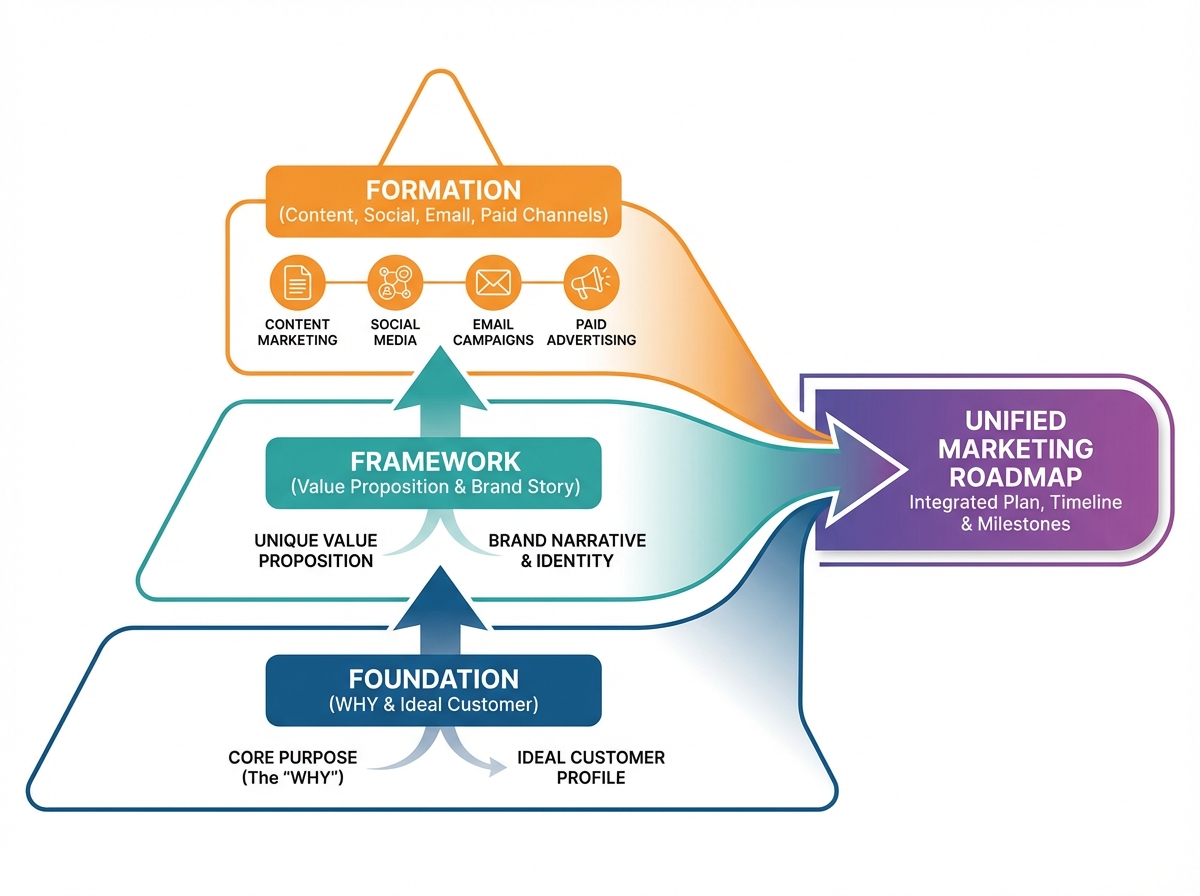
| Stage | Content | Time |
|---|---|---|
| Foundation | Clarify your WHY, define business goals, identify ideal customer | 1–2 weeks |
| Framework | Build value proposition, write brand story, set marketing intentions | 1–2 weeks |
| Formation | Choose and configure channels: content, social, email, opt-ins, paid | 2–3 weeks |
| Integration | Assemble your full holistic marketing roadmap document | 3–5 days |
| Total | From blank page to working strategy | 5–8 weeks |
The order of those stages matters more than the speed you move through them — a shaky foundation makes every tactic above it unstable. And if it takes you ten weeks instead of eight, that’s not a failure. It means you’re actually thinking instead of just filling in templates.
Starting With Your WHY Changes Everything Downstream
Most people treat the “define your purpose” step as a fluffy warm-up before the real marketing work begins. That’s the single biggest mistake people make when learning holistic marketing — and it costs them months of misaligned content, wrong-audience followers, and messaging that never quite lands.
Your WHY isn’t a mission statement you paste into your About page. It’s a decision-making filter. When you’re clear on why your business exists — not what it does, but the change it’s trying to create — every channel decision, every content piece, every campaign becomes easier to evaluate. Does this serve that purpose? If not, cut it.
The exercise that makes this concrete is separating your business goals from your business purpose. Goals are measurable (500 email subscribers by Q3, $8k/month revenue). Purpose is directional (helping independent consultants stop undercharging). Both are necessary. But purpose is what keeps you consistent when the goals feel far away.
When you finally write a piece of content that comes directly from that purpose — not from a trending hashtag, not from copying a competitor — you’ll feel the difference immediately. So will your audience.
The Ideal Customer Profile That Actually Gets Used
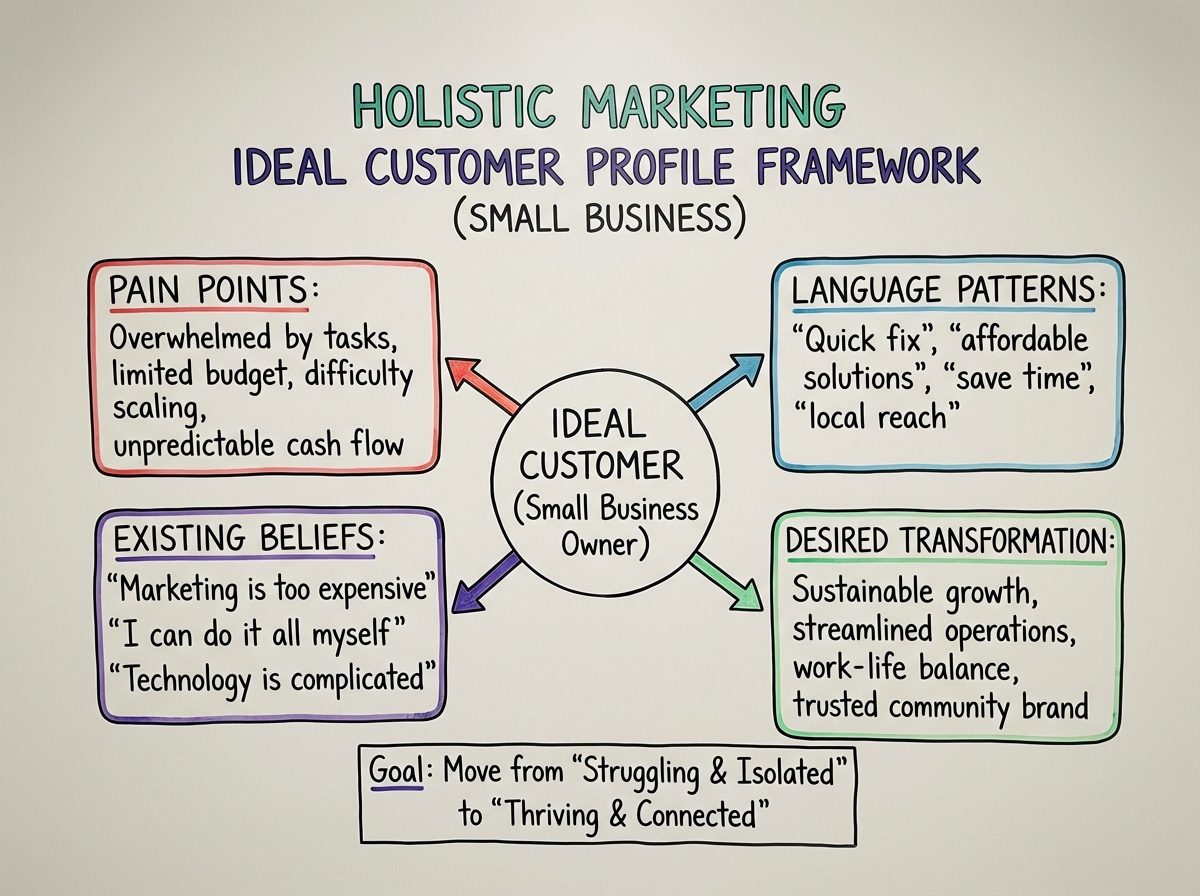
There’s a version of the ideal customer exercise that every marketer has done and then ignored: the detailed persona with a name, a stock photo, a job title, and a list of hobbies. It lives in a Google Doc nobody opens after week one.
The version that actually works is built around friction, not demographics. What does your ideal customer believe that isn’t serving them? What have they already tried that didn’t work? What do they say out loud when they’re frustrated, and what do they quietly feel but never say? Those answers shape your messaging far more than knowing they’re 34 and live in Austin.
For entrepreneurs and personal brand builders, there’s an additional layer: your ideal customer is often a version of who you used to be. That’s not a cliché — it’s a strategic advantage. You know the confusion they’re sitting in because you sat in it. Write from that knowledge, and your content will feel like it was written specifically for them. Because it was.
Once your ideal customer is defined this precisely, your content calendar writes itself. You’re not brainstorming topics anymore — you’re answering the questions the person you described would actually Google.
Building a Value Proposition That Isn’t Vague
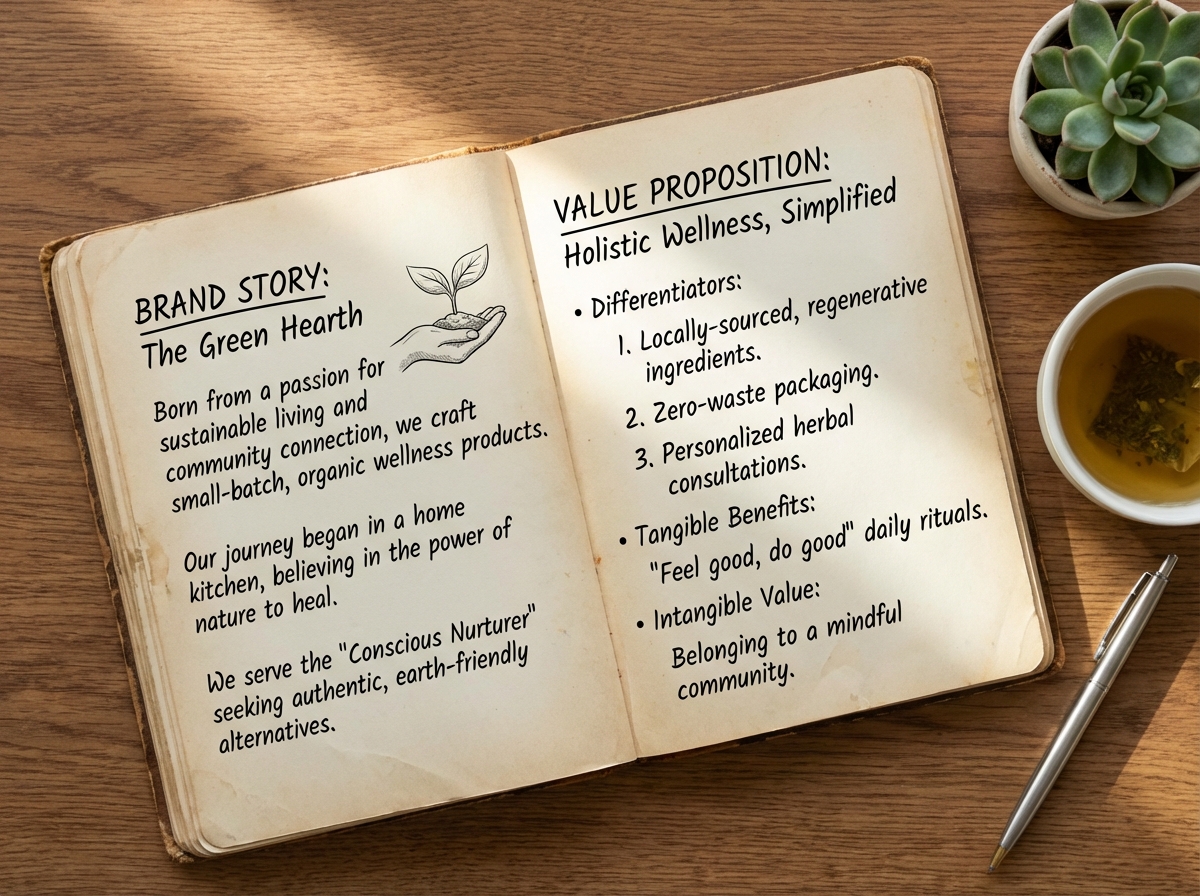
The value proposition is where most small business marketing falls apart. Not because people don’t have one, but because the one they have sounds exactly like everyone else’s in their category. “I help entrepreneurs build their dream business” is not a value proposition. It’s a placeholder.
A real value proposition has three components working together: who you serve (specific), what you help them do (specific outcome, not broad transformation), and what makes your approach different from the alternatives they’ve already considered. That last part is the one people skip — because it requires knowing your competition well enough to honestly contrast yourself against it.
Writing your brand story alongside your value proposition isn’t optional. It’s what turns a positioning statement into something a customer can connect with. The story explains why you do this work the way you do it, which is the part that builds trust before a sale. People don’t buy value propositions. They buy the combination of credibility, resonance, and specificity that a good brand story delivers.
Choosing Channels Without the Guilt of Missing Out
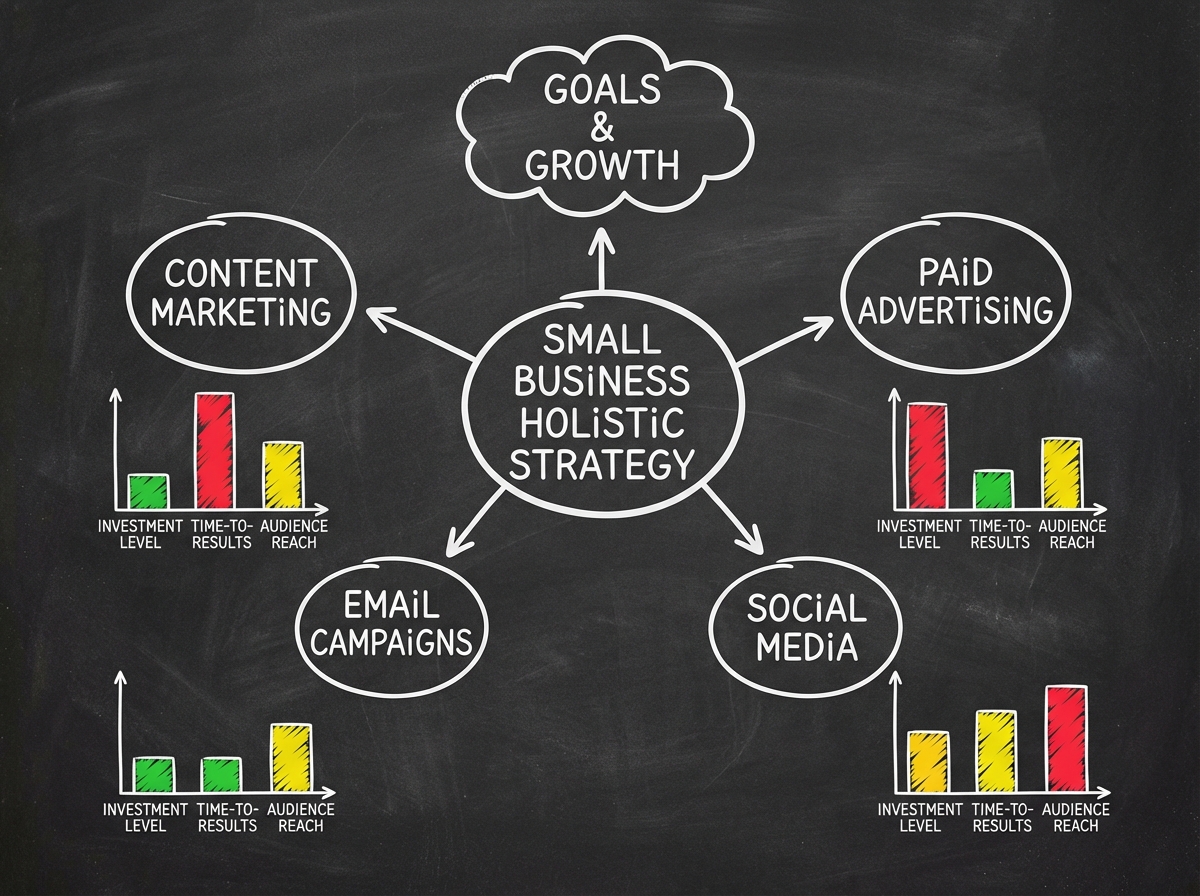
Here’s where the strategy either holds or collapses: channel selection. If your foundation is solid — you know your WHY, your ideal customer, and your value proposition — this step becomes logical rather than emotional. You choose channels where your ideal customer already spends time, where the format matches your natural strengths, and where you can show up consistently given your real-world constraints.
Content marketing, social media, email, opt-ins, and paid advertising aren’t a checklist. They’re options with different investment profiles. Content takes time but compounds. Paid advertising moves fast but stops the moment you stop paying. Email has the highest return per dollar but requires consistent nurturing to work. Knowing those tradeoffs changes how you sequence them.
For most small business owners starting from scratch, the sequence that works is: nail your brand messaging first, build one owned channel (almost always email), then choose one distribution channel (usually the social platform where your ideal customer is most active), and hold that combination until it produces results before adding anything new. The temptation to add a second social platform before the first one is working is real — and resisting it is one of the most strategic decisions you can make.
Metrics That Tell You What’s Actually Working
Most early-stage marketers track the wrong numbers. Follower counts feel good but tell you almost nothing about whether your marketing is working. Impressions are vanity. The metrics that matter connect directly to the business goals you defined in your foundation: email list growth rate, conversion rate on opt-ins, engagement from your actual ideal customer (not bots, not random followers), and revenue attributed to specific channels.
Defining your metrics before you launch your strategy — not after you’ve been running it for three months and wondering why nothing is clicking — is what separates reactive marketing from intentional marketing. If your goal is 500 email subscribers, then email opt-in conversion rate is a metric worth obsessing over. If your goal is booked discovery calls, then the metric is how many calls you’re booking per month, and which content piece or channel is driving them.
The marketing tools you use should serve your metrics, not create new ones. There’s a seductive pull toward more sophisticated tools — automation platforms, analytics dashboards, multi-channel schedulers — before you have enough signal to know what you’re actually measuring. Start simple. A spreadsheet tracking weekly email signups and where they came from will tell you more in the first 90 days than most enterprise analytics tools.

Putting the Full Roadmap Together
The moment everything in a holistic marketing strategy becomes real is when you put it all in one document. Not a slide deck with aspirational language. An actual working document that shows: your WHY, your ideal customer profile, your value proposition, your brand story, the two or three channels you’ve chosen, the metrics you’re tracking, and a 90-day content plan that maps to all of it.
Looking at that document for the first time — seeing how your purpose connects to your channel choices, how your ideal customer shapes your content themes, how your brand story backs up your value proposition — is when the strategy stops being an exercise and starts being a business asset. That’s the shift from scattered to intentional.
The document isn’t a destination. It’s a living reference. The best small business marketers treat it like a constitution: stable enough to keep them focused, flexible enough to be updated when the business or the market changes.
Here’s what to do with this right now:
- Write one sentence that answers “why does my business exist” without mentioning what it sells. If you can’t do it in one sentence, your foundation needs work before any channel strategy.
- Interview three past or current customers about the moment they decided to buy from you. The language they use will give you better messaging than any copywriting framework.
- Audit your current channels against your ideal customer’s actual behavior. Delete or pause any channel where your ideal customer isn’t spending real time.
- Write your value proposition using this structure: I help [specific person] do [specific outcome] by [what makes your approach different]. Then test it on someone outside your business.
- Choose one primary owned channel and commit to it for 90 days before adding another. The compounding effect only shows up if you give it enough time.
- Set three metrics that connect directly to your business goals — not follower counts — and review them weekly.
- Put your full strategy into one document and print it. The physical act of having it in front of you changes how you make daily marketing decisions.
- Schedule a monthly strategy review where you compare what you planned against what you actually did — not to judge yourself, but to learn what’s realistic for your capacity.
Leave a Reply