


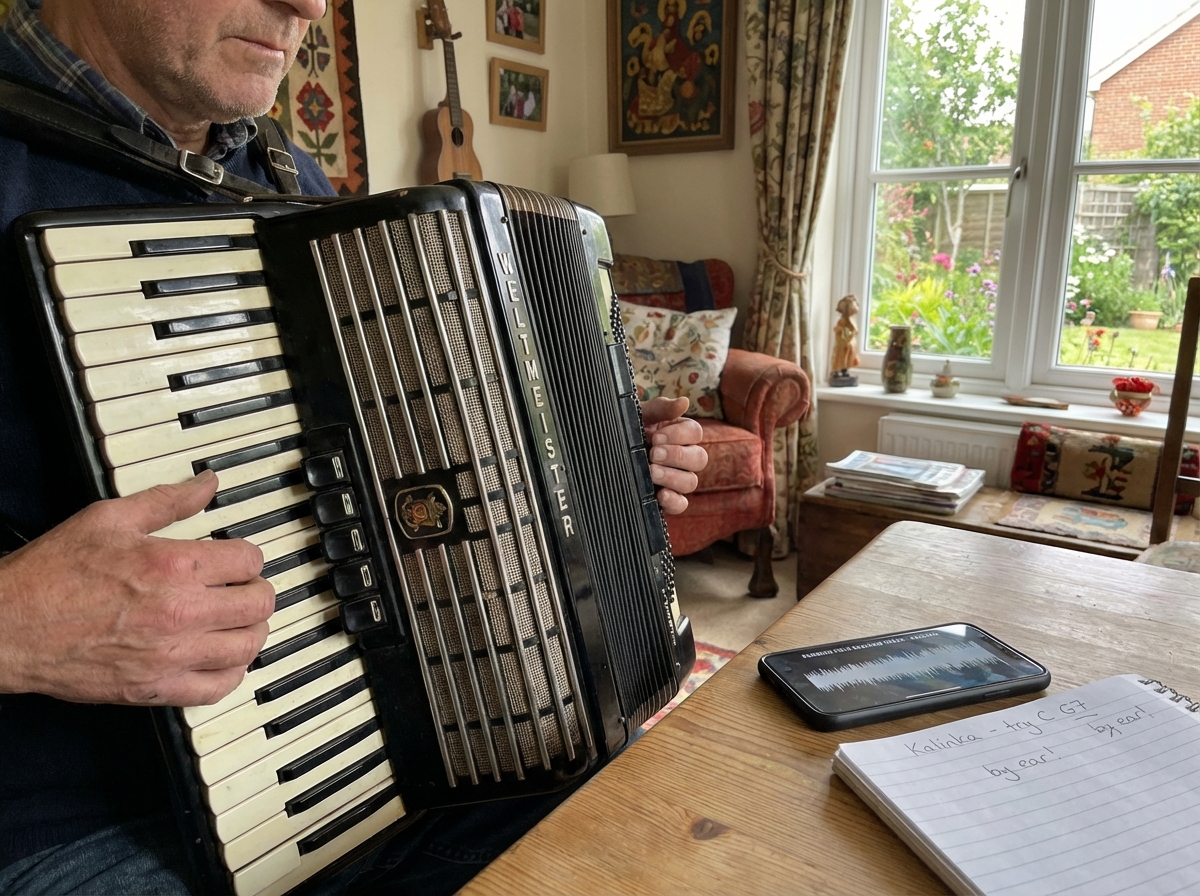
The first time I held an accordion, I did what every beginner does — I went looking for sheet music. I spent two weeks trying to decode notes I couldn’t read for a song I already knew how to hum. That gap between knowing a melody in your head and being able to find it with your fingers is where most people quit.
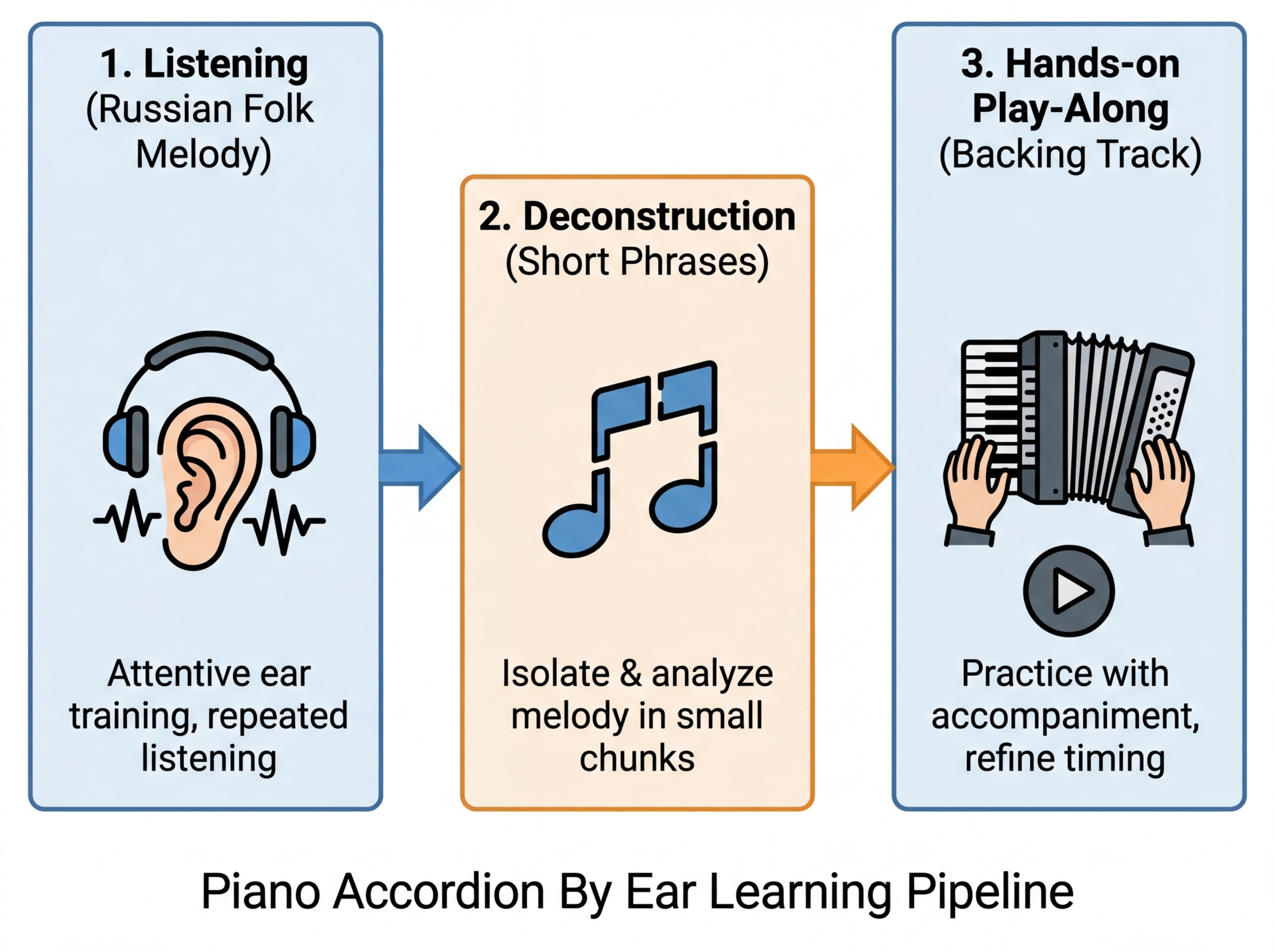
If you’re looking to learn piano accordion by ear, the path that actually works skips sheet music entirely and starts with songs you already recognize. You listen, you isolate a phrase, you find it on the keys, and you repeat. That’s the whole method — and it works faster than any notation-based approach for beginners because your ears already know the destination.
- You don’t need to read music to play accordion — your ear already holds the melody; you just need a method to connect it to your hands.
- Russian folk songs like Kalinka and Katusha are ideal first pieces because their melodic phrases are short, repetitive, and immediately recognizable.
- The single most important skill you build isn’t finger technique — it’s the ability to hear a phrase, pause, and find it before moving on.
What “Playing by Ear” Actually Means on Accordion
Playing by ear doesn’t mean improvising or having perfect pitch. On the piano accordion, it means you hear a short melodic fragment, identify roughly where it sits on the keyboard, and physically locate it through trial and short repetitions. The piano side of an accordion is laid out identically to a piano keyboard — so if you can hum a phrase, you can usually find the first note within a few tries.
The distinction that matters for beginners is between playing a whole song by ear (overwhelming) and playing one phrase at a time by ear (completely doable). Every song you’ll encounter in this style of learning gets broken into four-bar or eight-bar segments. You master one, add the next, then connect them. That’s it.
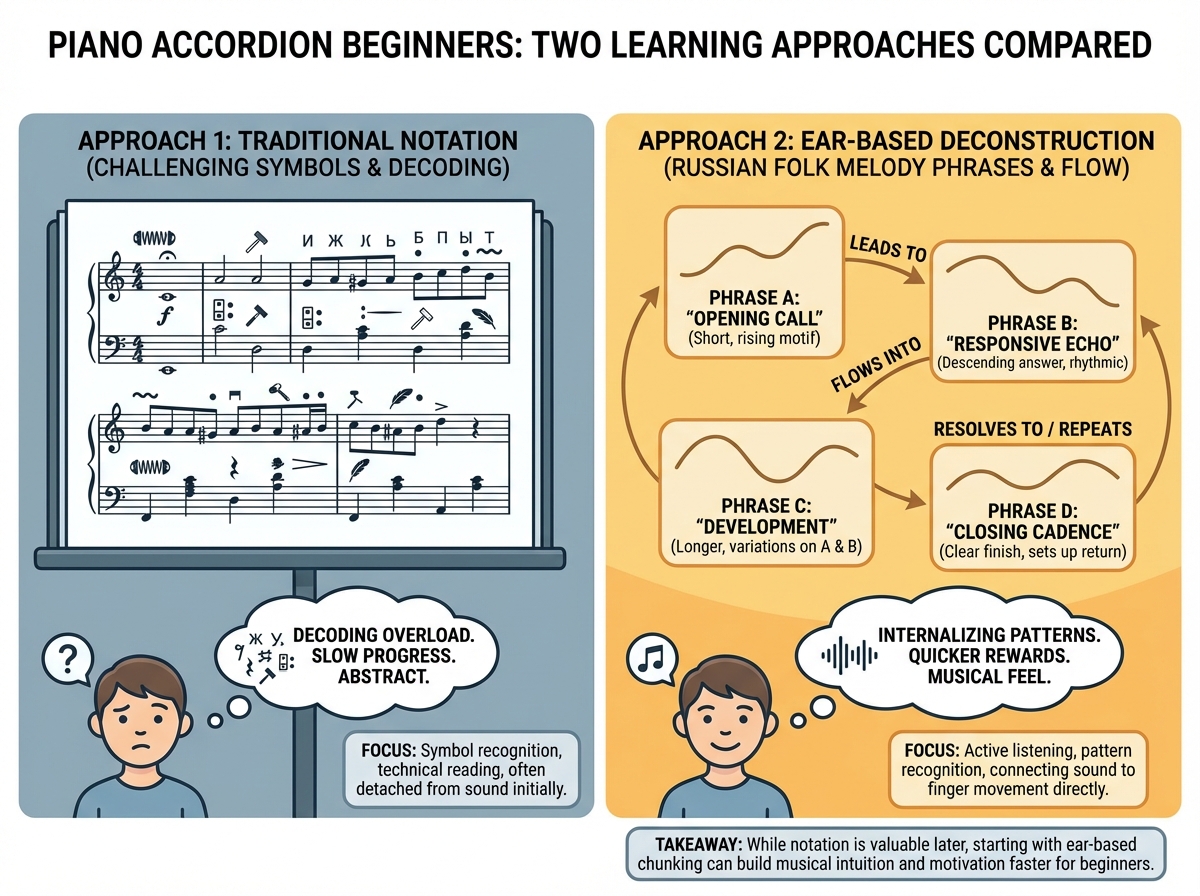
| Approach | What You Need | Time to First Song | Barrier for Beginners |
|---|---|---|---|
| Sheet music reading | Notation literacy, solfège | Weeks to months | High — theory required first |
| Playing by ear | Functional hearing, the instrument | Days | Low — starts with what you know |
| Combined | Both of the above | Variable | Medium — best long-term, harder to start |
Three things playing by ear on accordion is not:
- Guessing randomly until something sounds right
- A shortcut that produces sloppy playing
- Only for people with “natural talent”
Sharp Insights
- Your left hand (bass buttons) can stay almost identical across most Russian folk songs.
- Slowing down a phrase until it feels boring is exactly the right speed to learn it.
- Getting the rhythm right before the notes is faster than doing it the other way.
How Long Does It Actually Take
| Stage | What Happens | Estimated Time |
|---|---|---|
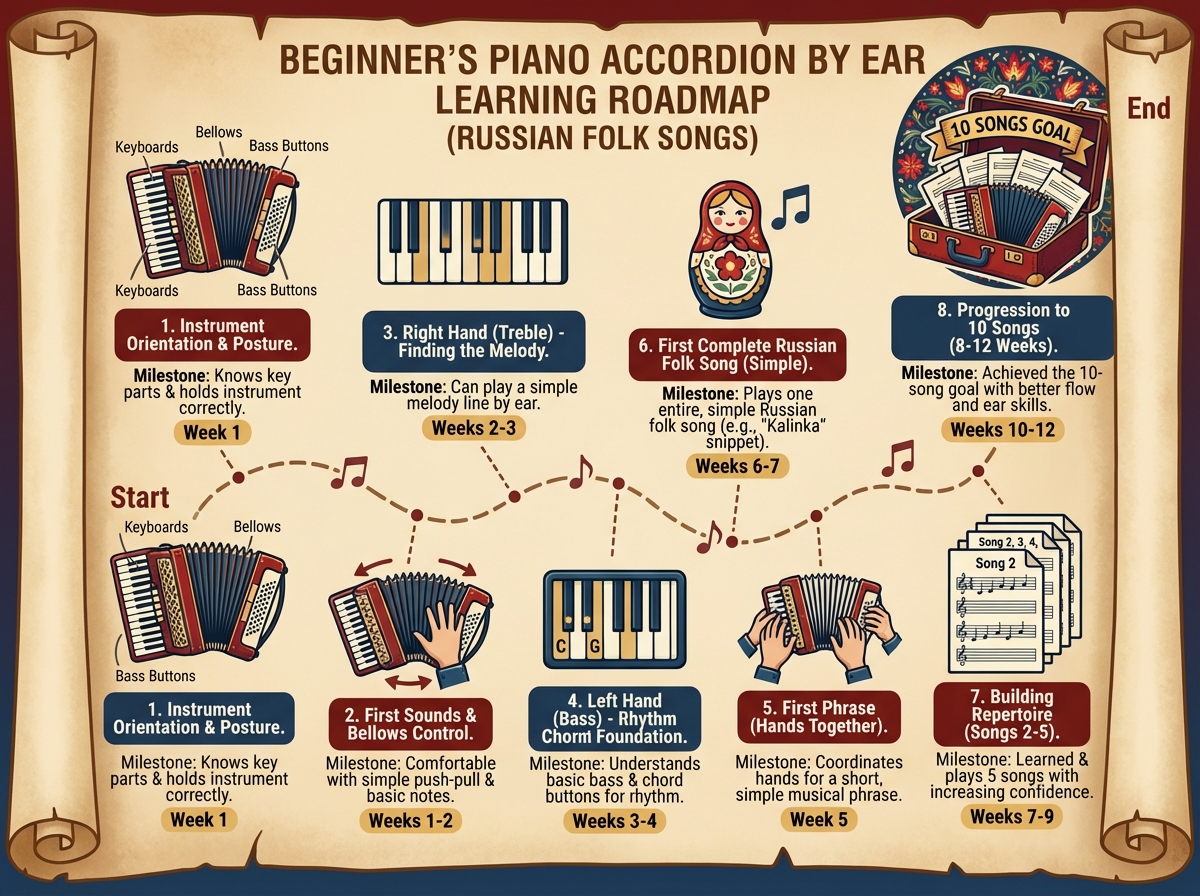
| Instrument orientation | Understanding the keyboard layout, bellows control, basic posture | 1–2 hours |
| First phrase of first song | Finding the opening melodic line of a simple tune | 1–3 sessions |
| First complete song | Connecting all four parts with a backing track | 1–2 weeks |
| Songs 2–5 | Faster acquisition as ear-to-hand connection develops | 2–4 weeks |
| Songs 6–10 | Noticeable fluency — transitions feel natural | 4–8 weeks |
| Total to 10 songs | 8–12 weeks |
The order you learn songs matters more than how fast you move — each one builds a physical and aural vocabulary that makes the next one easier to absorb. If it takes you three weeks to finish your first song instead of one, that’s not falling behind — that’s the ear-to-hand connection forming properly, and it will save you time on every song after.
The First Moment Everything Feels Wrong
The biggest mistake people make when learning piano accordion by ear is trying to play both hands simultaneously from the start. It feels logical — that’s how the music sounds — but it’s the fastest route to frustration. Your right hand is trying to find an unfamiliar melody while your left hand is searching for bass buttons it has never touched. Neither hand can focus.
The fix is almost embarrassingly simple: play the right-hand melody with no left hand at all until you could play it in your sleep. Then add the left hand on its own with a simple drone. Then combine. This sequence feels slower in the first session and dramatically faster by the third.
With a song like “The Moon Shines” — the first real piece most beginners tackle — the melody is only about eight distinct notes across four phrases. Once your right hand owns those eight notes, your left hand has almost nothing to figure out. The two-hand connection clicks in one session instead of five.
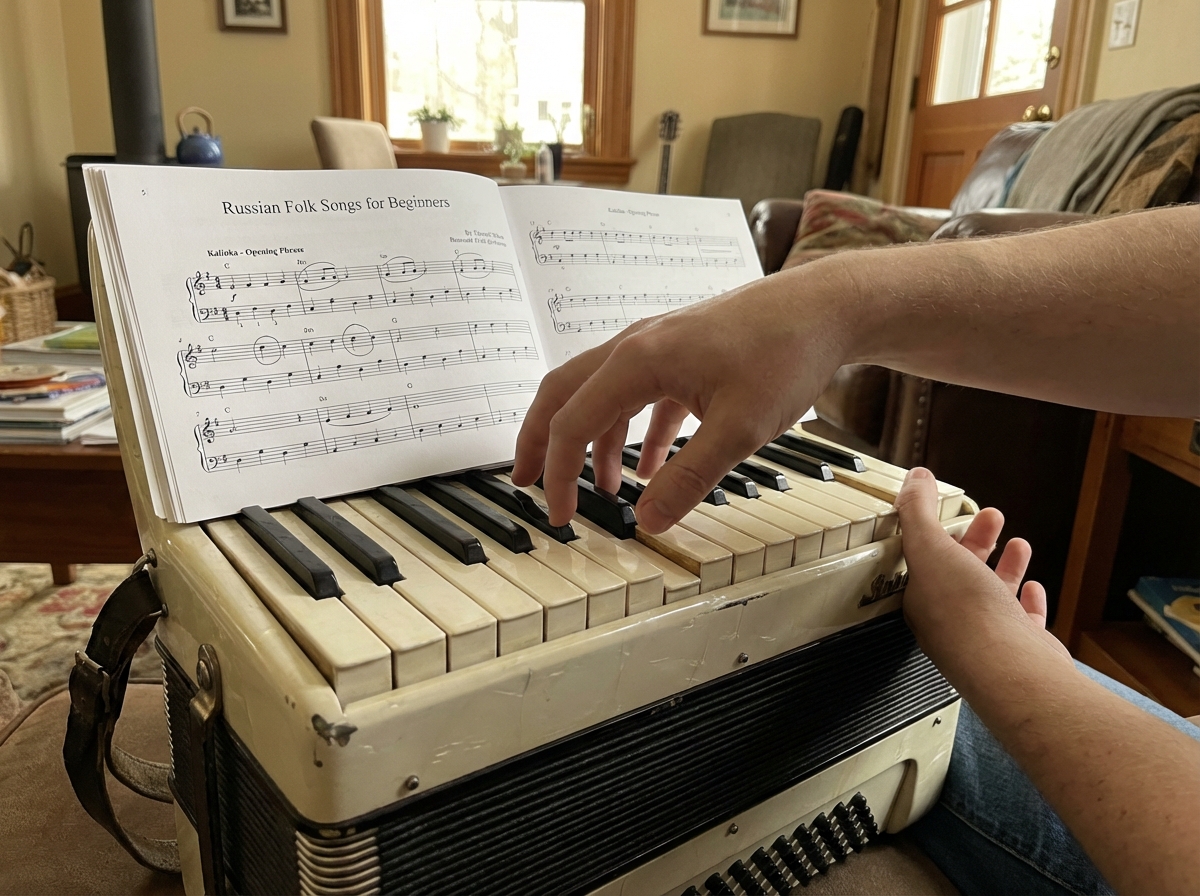
The Deconstruction Method: Why Russian Songs Work So Well
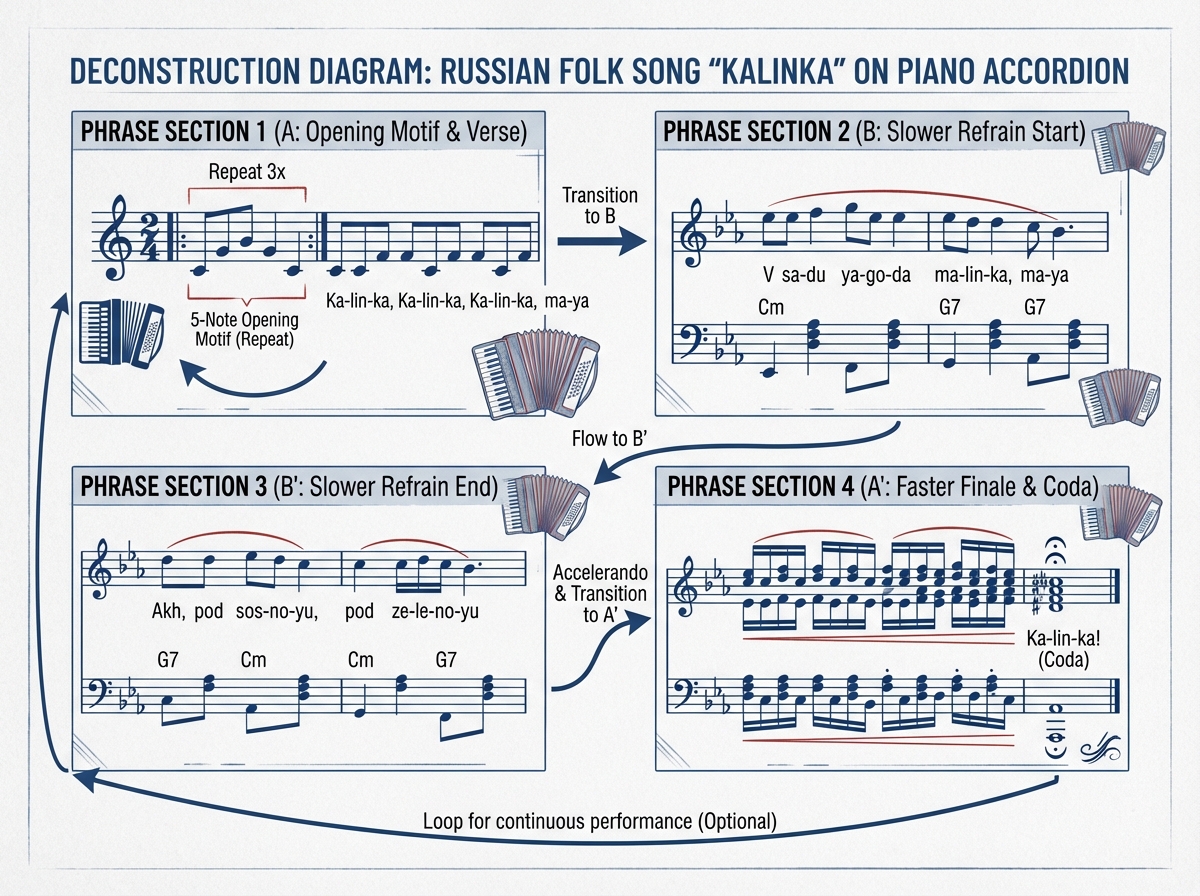
Russian folk songs have a structural quality that makes them perfect for ear-based accordion learning: they’re built from short, self-contained phrases that repeat with slight variation. “Kalinka” is the clearest example — the famous opening descend is only five notes, and it recurs throughout the song. You learn that one phrase and you already sound like you’re playing Kalinka.
The deconstruction process works like this: listen to the full song once to let your ear absorb the shape of it. Then identify the opening phrase — just the first four bars. Find the first note (usually easier than it sounds when you’re humming it). Move outward from that note one step at a time until the phrase matches what you hear internally. Mark where it ends. That’s Part 1 done.
Part 2 usually shares at least one note or interval with Part 1, which means your hand is already halfway there before you start. By Part 4, you’re often surprised to find you’re mostly connecting phrases you already know in a new order. The song isn’t four separate challenges — it’s one idea shown from different angles.
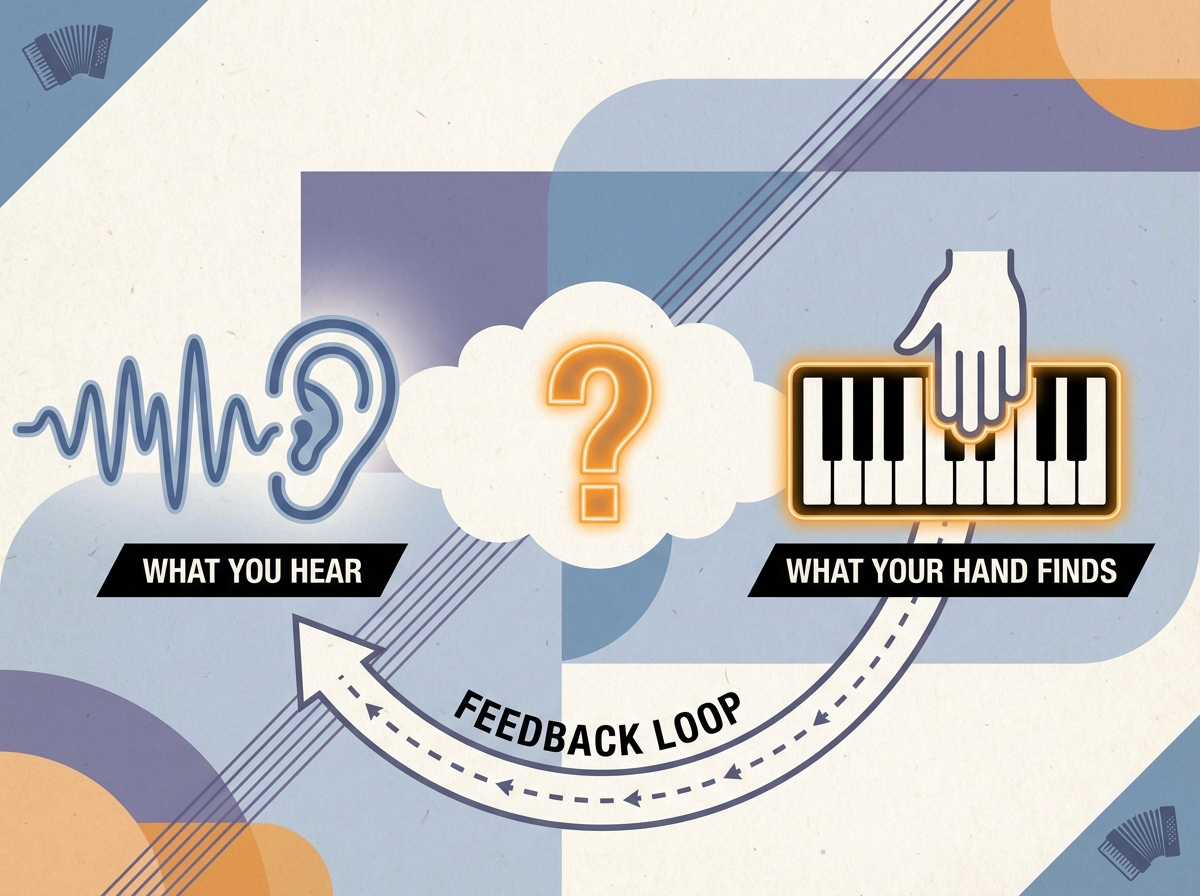
When Your Ear and Your Hand Disagree
There’s a specific moment in learning any accordion song by ear that nobody warns you about: you play a phrase, it sounds almost right, but something is slightly off. Not completely wrong — just one note feels misplaced. This is actually a sign of progress, not failure. Your ear has become precise enough to catch the error. A week ago, you couldn’t hear that it was wrong at all.
The way through this moment is not to start over from the beginning. Play only the section that sounds off. Slow it down until it’s almost comically slow. Listen to the original phrase again — just that fragment. Then play your version again. The note that’s wrong will feel physically different from the correct one, almost like a slight resistance. When you land on the right version, there’s a small but unmistakable sense of resolution.
Songs like “Dark Eyes” and “Moscow Nights” have a few of these moments built in — intervals that aren’t obvious on first hearing but feel completely inevitable once found. These are the moments that build real ear training. Not exercises. Not drills. Just the friction of finding the right note inside a song you care about playing.
Playing Along: Why the Backing Track Changes Everything
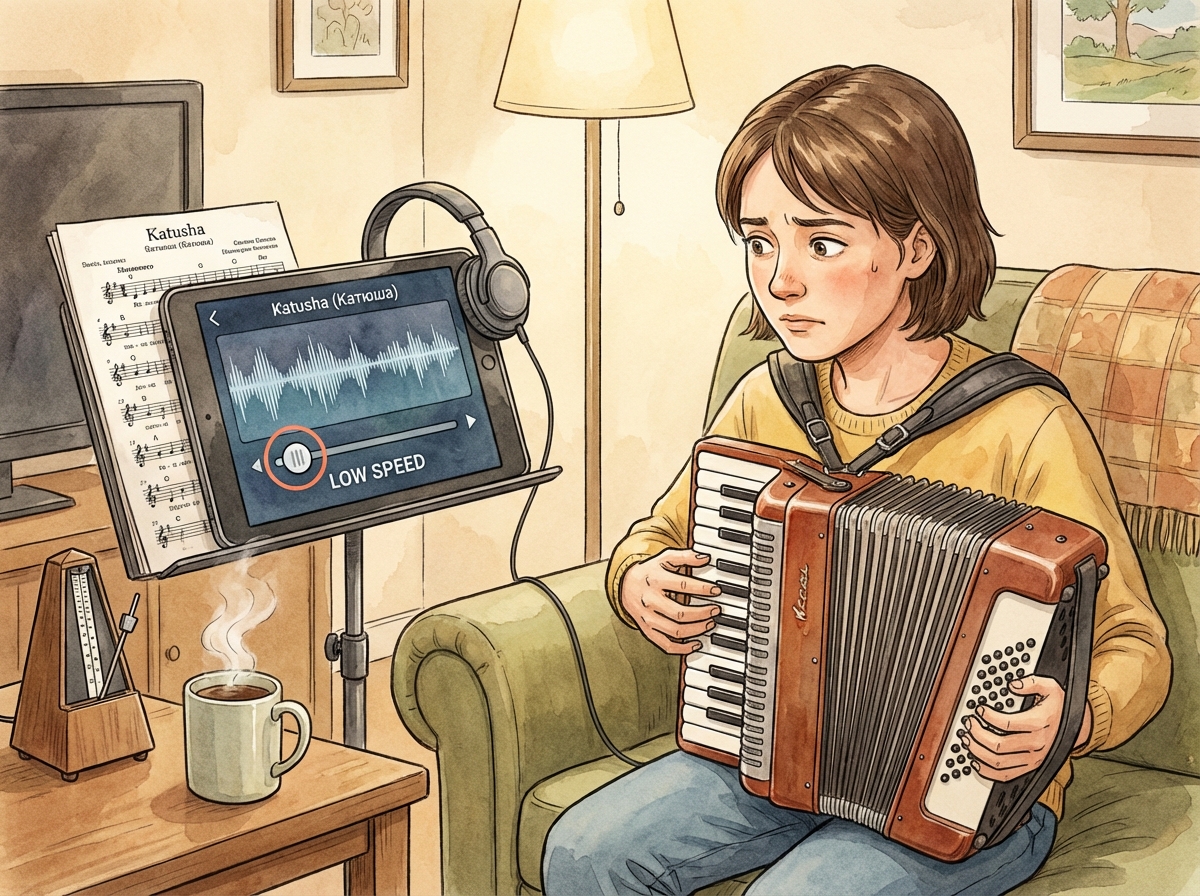
Practicing alone in silence is necessary for learning the notes. But the moment you play along with a backing track — even at half speed — something shifts entirely. Suddenly there’s a pulse. You have to commit to each note on time, not just eventually. The small hesitations you’ve been tolerating become obvious because the track doesn’t wait for you.
This pressure is exactly what you need. It converts isolated phrases into something that feels like music. Songs like “Katusha” and “Korobeiniki” — that Tetris theme almost everyone recognizes — take on a completely different character when played against their proper rhythm and harmony. You stop feeling like someone practicing and start feeling like someone playing.
The practical detail that most people miss: start the backing track at the slowest usable tempo and play the song through even if you make mistakes. Stopping to correct every error trains hesitation. Playing through and correcting only between runs trains flow. The goal of a play-along session isn’t perfection — it’s continuous motion.
The Song That Makes It All Click
Every learner has one song where the method stops feeling like work and starts feeling like playing. For most people working through Russian folk songs, it’s somewhere around the fourth or fifth piece — usually around “Katusha” or “Moscow Nights.” By that point, you’ve internalized the deconstruction process. You hear a new song and your brain automatically starts breaking it into parts. Your fingers start moving toward phrases before you consciously tell them to.
This is when you realize what you’ve actually been building: not a collection of memorized songs, but a way of hearing music. You start noticing phrase shapes in songs you’re not even learning — in music playing in a café, in a melody someone hums nearby. The accordion has given you a physical vocabulary for sounds that previously just passed through you. That’s the thing that doesn’t go away even if you put the instrument down for a month.
“Oi Moroz” and “Yablochko” — the last songs in the series — feel qualitatively different to learn than the first two did. Not because they’re simpler, but because you’re a different player. The ear-to-hand pathway that felt like a narrow trail in week one has become a road.
What You Can Actually Do After 10 Songs
After working through ten Russian folk songs by ear, you have something more durable than the ability to play those ten songs. You have a process. You can sit down with a new melody — any melody — and move through it systematically: listen, isolate, find the first note, build outward, connect parts, add the left hand, play along. That process works on folk music from any tradition, on pop songs, on anything you can hum.
You also have an accordion vocabulary — specific fingerings, transitions between common intervals, and left-hand patterns that recur across most folk and popular music. “Polushko Polye” and “The Steppe Around” both use left-hand accompaniment patterns nearly identical to patterns you’ll find in dozens of other songs. The specifics feel unique; the structures are universal.
The players who get stuck after learning their first batch of songs are usually the ones who memorized the songs rather than the method. The ones who internalized how to deconstruct a phrase can sit down with something unfamiliar and still find their way in.
Here’s what to apply immediately, in order:
- Start with one short phrase, not the full song — pick the opening four bars of the easiest song you know, and don’t move on until that fragment feels automatic under your fingers.
- Mute your left hand completely for the first session — right-hand fluency always comes before two-hand coordination, and the gap between them is smaller than it feels.
- Hum the phrase before you play it — if you can’t hum it accurately, you’re not ready to find it on the keys; your internal reference is the guide your fingers follow.
- Use a backing track at 60–70% speed before you use it at full tempo — the goal is to play through without stopping, not to play correctly at speed; rhythm comes before precision.
- Treat a slightly-wrong note as information, not failure — when something sounds close but off, that friction is your ear becoming more precise; slow down just that note and let the correction come from listening, not guessing.
- Learn “Katusha” as your third or fourth song deliberately — its short repeated phrases and widely recognized melody give you the fastest feedback loop between ear recognition and finger placement.
- Record yourself playing along with the backing track once a week — not to critique yourself, but to hear the distance between week one and week three; that distance is invisible while you’re inside it.
- After every song, play the previous one from memory before starting the next — spaced repetition across songs builds the same ear-to-hand connection that deconstruction builds within a song.
Leave a Reply