


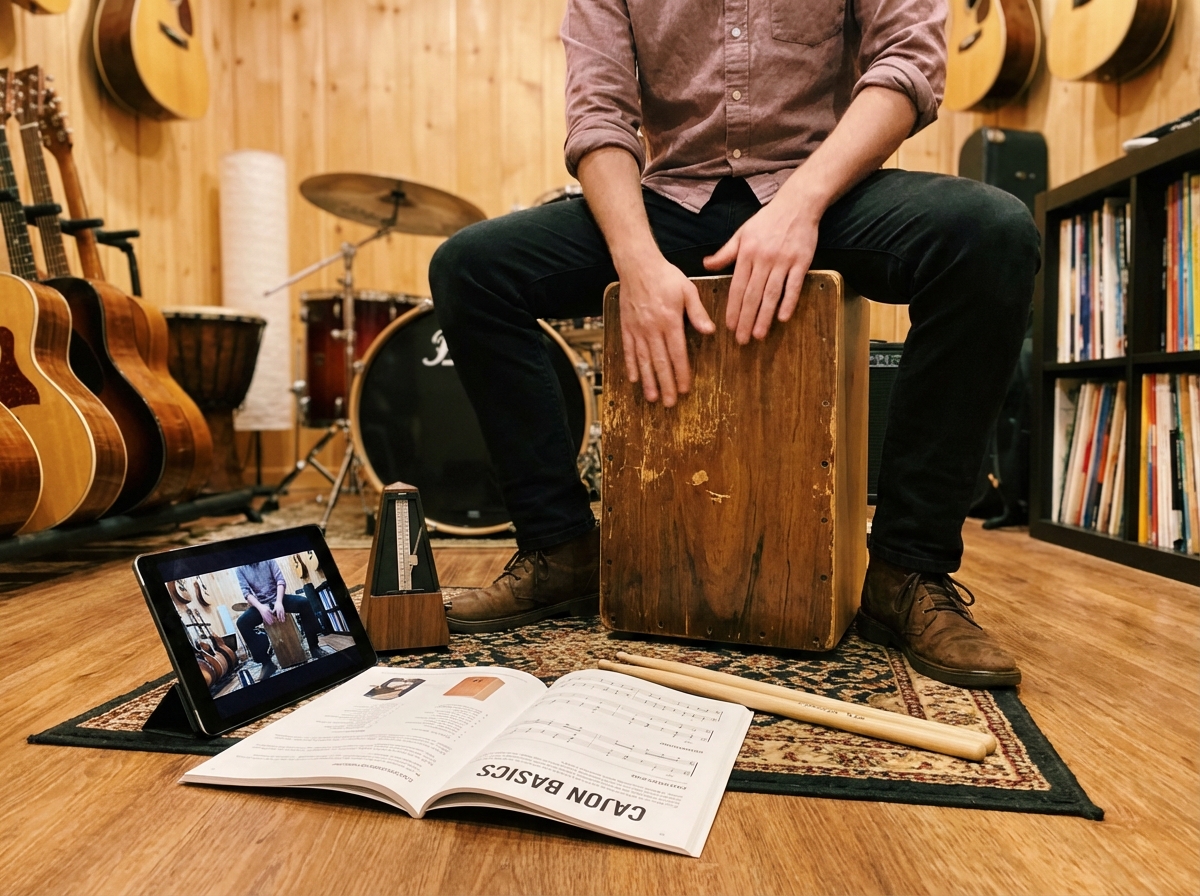
The first time you sit on a cajon and slap the face of it, you get one of two sounds: a dull thud or something that actually resonates. That gap between those two outcomes is where most beginners spend way too long.
If you’re looking to learn cajon, the fastest path forward isn’t watching someone explain music theory — it’s building a vocabulary of rhythms, one beat at a time, until your hands start to think for themselves. Cajon is one of the most accessible percussion instruments alive, but accessible doesn’t mean easy to play well. The difference between someone who noodles on a cajon at a party and someone who actually locks in a groove comes down to how many rhythmic patterns they’ve internalized — and whether they learned them in the right order.
- You only need a cajon and the patience to repeat each rhythm until it stops feeling foreign
- The goal isn’t to memorize 100 beats — it’s to train your body to recognize and reproduce rhythmic patterns on instinct
- Most beginners plateau because they chase songs before building a foundation; rhythm vocabulary is what prevents that plateau
What Is a Cajon and Why Does Rhythm Come Before Everything Else?
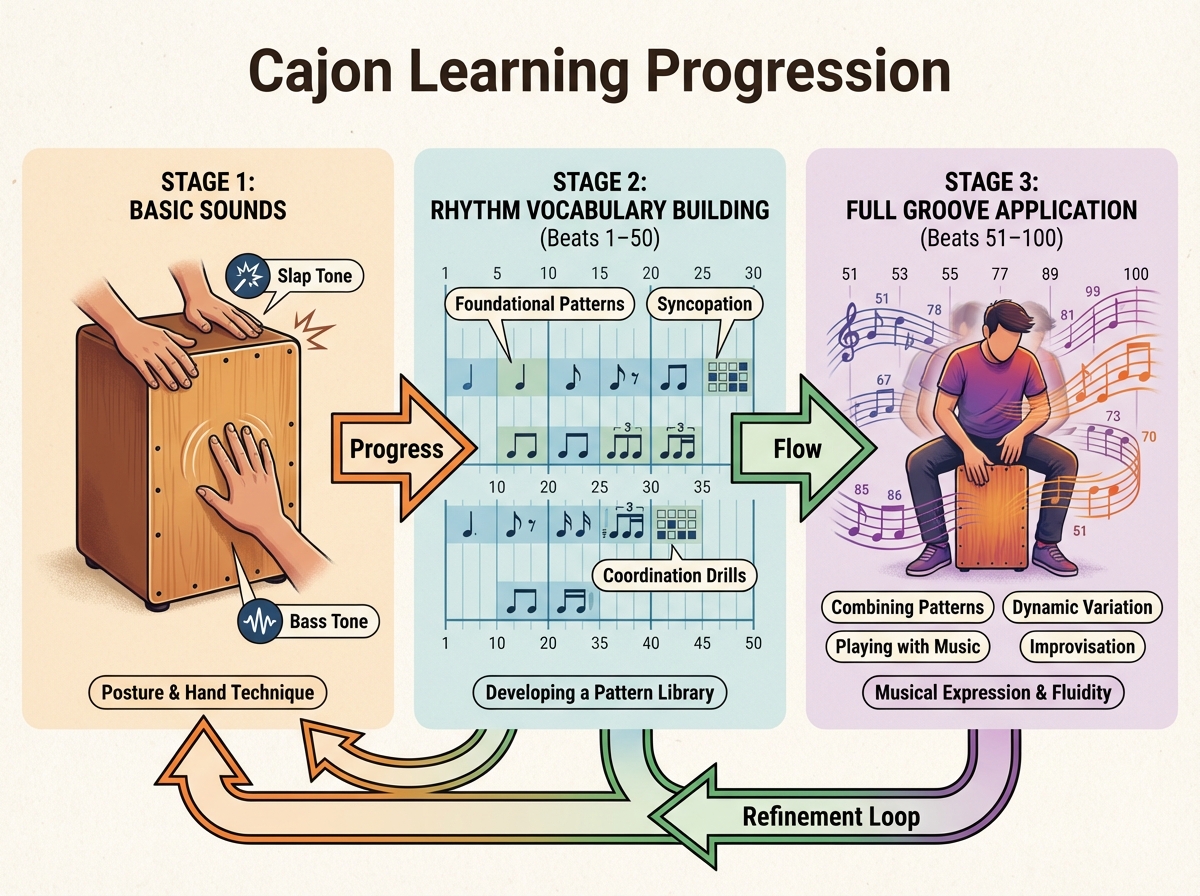
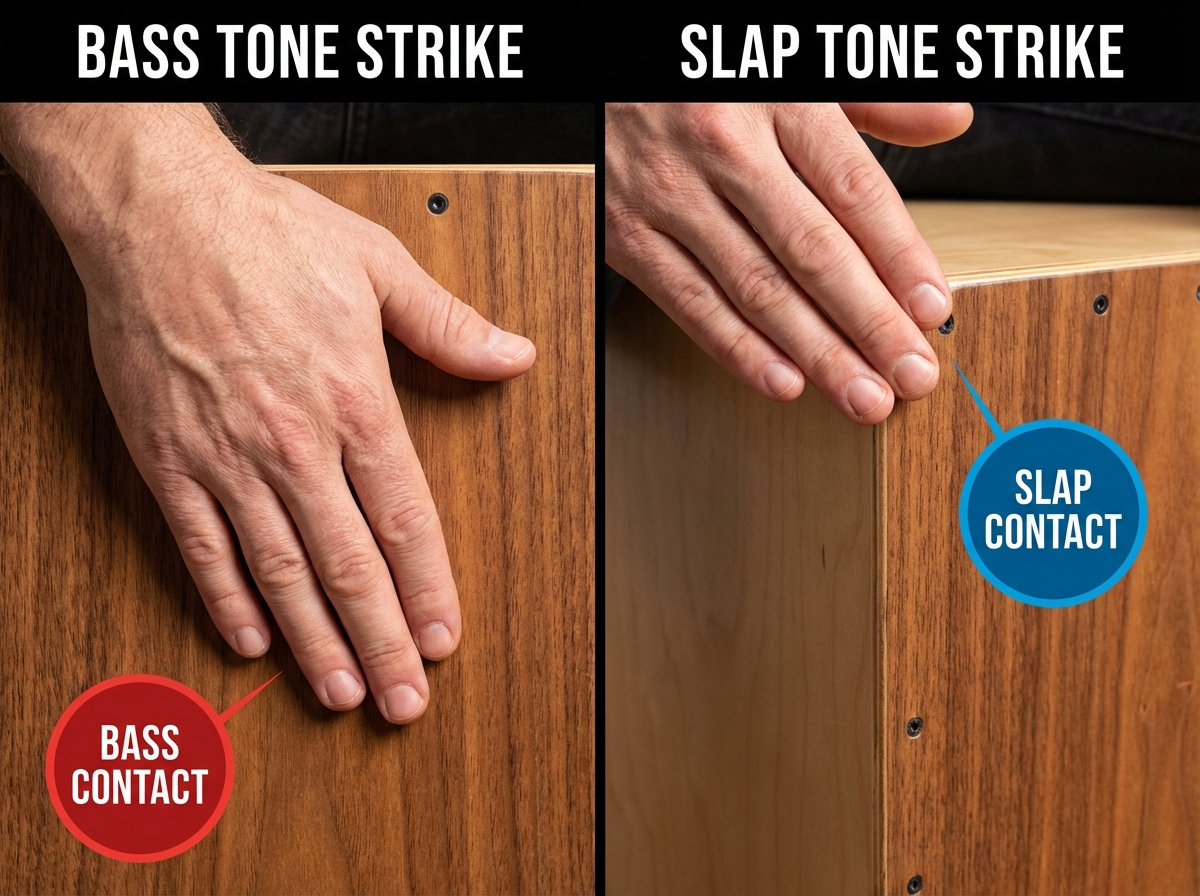
A cajon (pronounced ka-HON) is a box-shaped percussion instrument you sit on while playing — striking the front face with your hands to produce two primary sounds: the bass tone (low center hit) and the slap tone (upper corner hit). Most beginners understand this within five minutes. What takes longer to understand is that these two sounds are all you need to build an enormous rhythmic vocabulary.
Think of it like language. You have 26 letters in English, but the complexity isn’t in the letters — it’s in how you combine them. Cajon works the same way. Bass and slap, combined in different sequences and timing, produce every rhythm from a simple 4/4 rock pulse to a flamenco bulería. The foundation is small. What you build on top of it is not.
- Bass tone: struck in the lower-center of the face, produces a deep resonant thud — this is your kick drum equivalent
- Slap tone: struck near the upper corners, produces a sharp snappy crack — this is your snare equivalent
- Ghost notes and finger rolls: subtle mid-tones that add texture once the basic two are solid
Three things that surprise every beginner:
- Your non-dominant hand will betray you on rhythms 10 through 30
- A slow rhythm played cleanly sounds better than a fast rhythm played messy
- The cajon amplifies tension in your hands — relaxed hands always sound better
How Long Does It Actually Take to Learn Cajon?
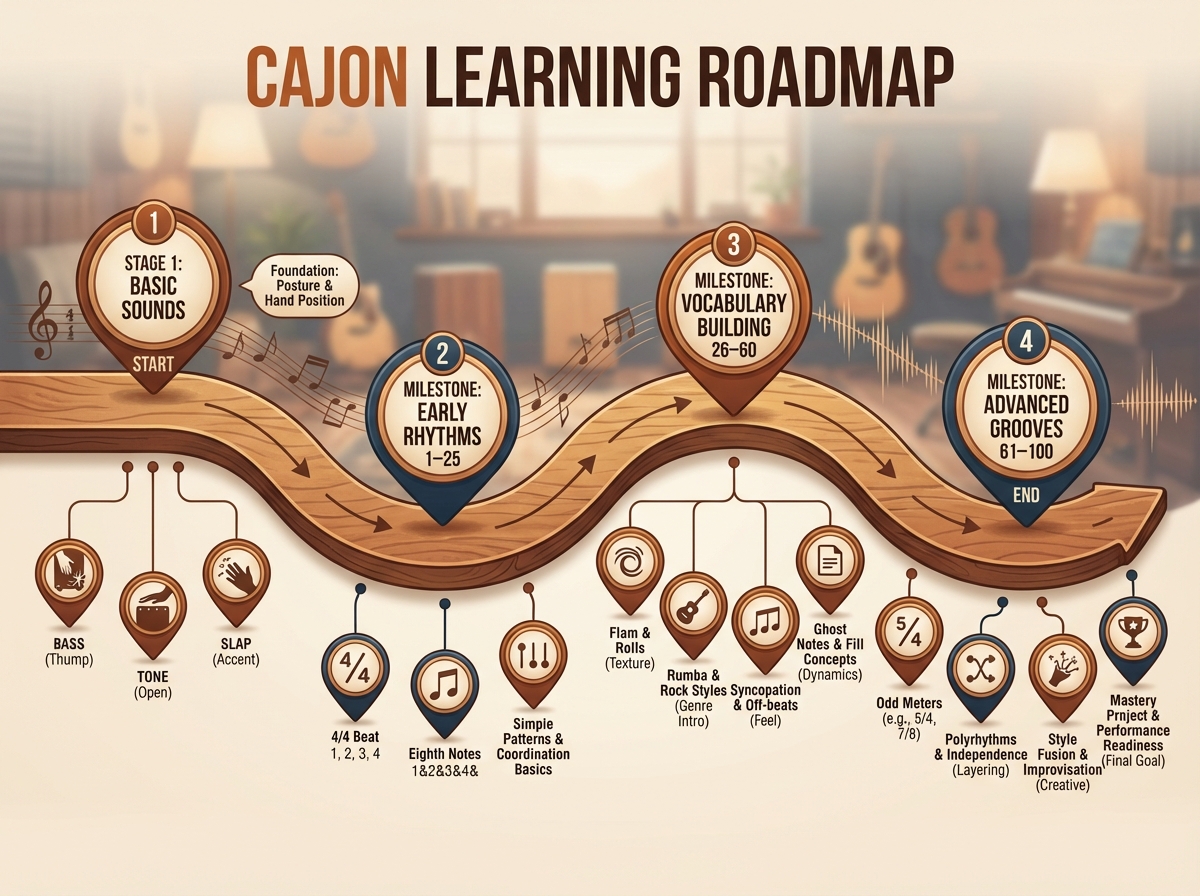
| Stage | Content | Time |
|---|---|---|
| Basic sounds | Bass and slap tone, hand position, posture | 1–2 days |
| Early rhythms (1–25) | Simple 4/4 patterns, single-hand alternation | 1–2 weeks |
| Building vocabulary (26–60) | Syncopation, off-beat slaps, rhythm variations | 3–5 weeks |
| Advanced patterns (61–100) | Complex grooves, fills, genre-specific rhythms | 4–8 weeks |
| Total | 100 rhythms, playable over songs | 8–16 weeks |
The order you learn rhythms matters far more than how fast you move through them. If you rush to rhythm 50 before rhythm 20 is in your muscle memory, rhythm 50 will fall apart under any real tempo.
And if this timeline feels slow for you — good. Most people take longer, and that’s not failure. That’s what it feels like to actually build something in your body instead of just watching it.
The First Wall: Getting Two Clean Sounds Before Anything Else
Most beginners skip this part. They watch someone play, sit down on the cajon, and immediately try to replicate a full rhythm. Within thirty seconds they’re frustrated because it sounds nothing like what they heard. The reason is almost always the same: they haven’t isolated and locked in clean bass and slap tones individually before trying to combine them.
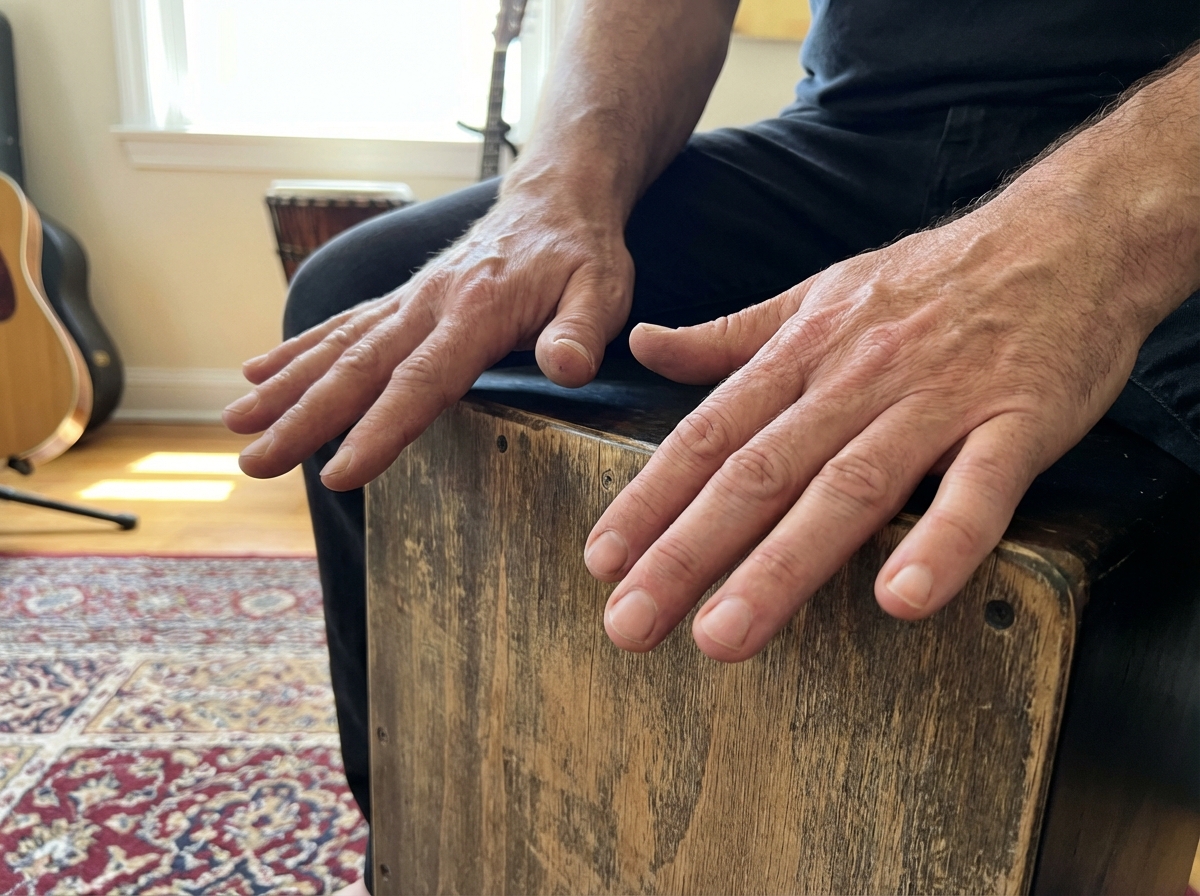
Spend your first sessions doing something that feels almost stupidly simple — alternate bass and slap in a dead-slow, even pulse. Bass. Slap. Bass. Slap. No rhythm yet, no timing pressure, just making sure each hit sounds the way it should. Your bass should boom. Your slap should crack. If either sounds thin or muddy, your hand position is off, and no amount of practice on actual rhythms will fix that.
The breakthrough moment here is physical, not intellectual. One session you’re wrestling your hands into position and the sound is inconsistent. Then something shifts — your palm relaxes slightly, your fingers spread a little differently — and suddenly the slap rings out like it’s supposed to. That’s the moment. Once you feel it, you can reproduce it. Before that moment, you’re just guessing.
After that clicks, everything else has a foundation to land on.
Why the First 25 Rhythms Feel Like Learning a New Alphabet
The biggest mistake people make when learning cajon rhythms is treating each new pattern like a completely separate thing to memorize. It’s not. Every rhythm from 1 through 25 is a variation of the same underlying pulse. The beat positions shift, the accents move around, but the grid stays the same. Once you see that, you stop feeling like you’re starting from zero every time.
Rhythms 1 through 10 or so will feel mechanical — you’re essentially counting out loud and placing hits consciously on specific beats. That’s fine. That’s how it’s supposed to feel. You’re building the internal clock that will eventually run without your attention. The frustrating part is that the clock doesn’t feel reliable until around rhythm 20 or so, when patterns you learned two weeks ago start coming back without effort.
There’s a specific feeling that happens somewhere in this range where you realize you’ve been playing a rhythm for thirty seconds without counting. Your hands just… went. That’s not talent. That’s what repetition at the right pace produces. Every beginner gets there if they don’t rush past the early patterns before they’re truly internalized.
Each of these early rhythms is a brick. You don’t have a wall yet, but you’re laying the foundation that makes one possible.
The Middle Stretch: Where Syncopation Either Breaks or Opens You
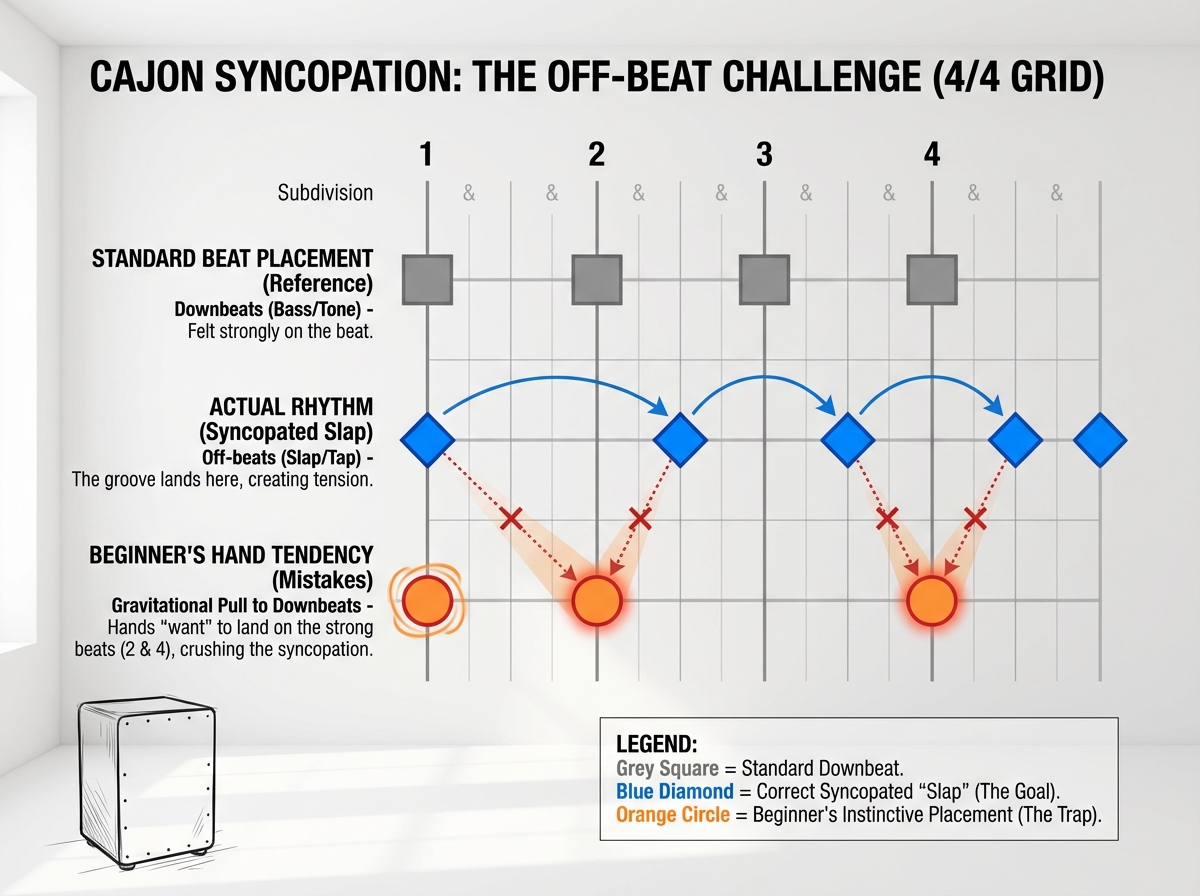
Somewhere around rhythm 30 to 50, the patterns stop being predictable. Slaps start landing on the “and” of beats rather than on the downbeat. The bass and slap relationship that felt stable starts shifting in ways that feel counterintuitive. This is where a lot of people quietly stop practicing.
Syncopation — placing accents off the expected beat — is what makes music feel alive rather than robotic. But learning it on a cajon means your hands have to disagree with what your brain thinks the “natural” landing spot is. The brain wants to put the slap on beat 2 and 4. Some rhythms put it on the “and” of 2 or the “e” of 3. Teaching your hands to trust a different placement takes time and it feels wrong before it feels right.
The way through this isn’t to slow down — it’s to isolate. Take the rhythm in question and strip it to just your right hand, then just your left. Play each part alone until it stops feeling strange. Then put them together. This is a detail most beginners never figure out, and it’s the difference between struggling with syncopated patterns for weeks and cracking them in a couple of sessions.
When syncopation finally feels natural, your whole relationship with listening to music changes. You start hearing the rhythmic skeleton under every song you know.
Rhythms 60–100: When Vocabulary Becomes Voice
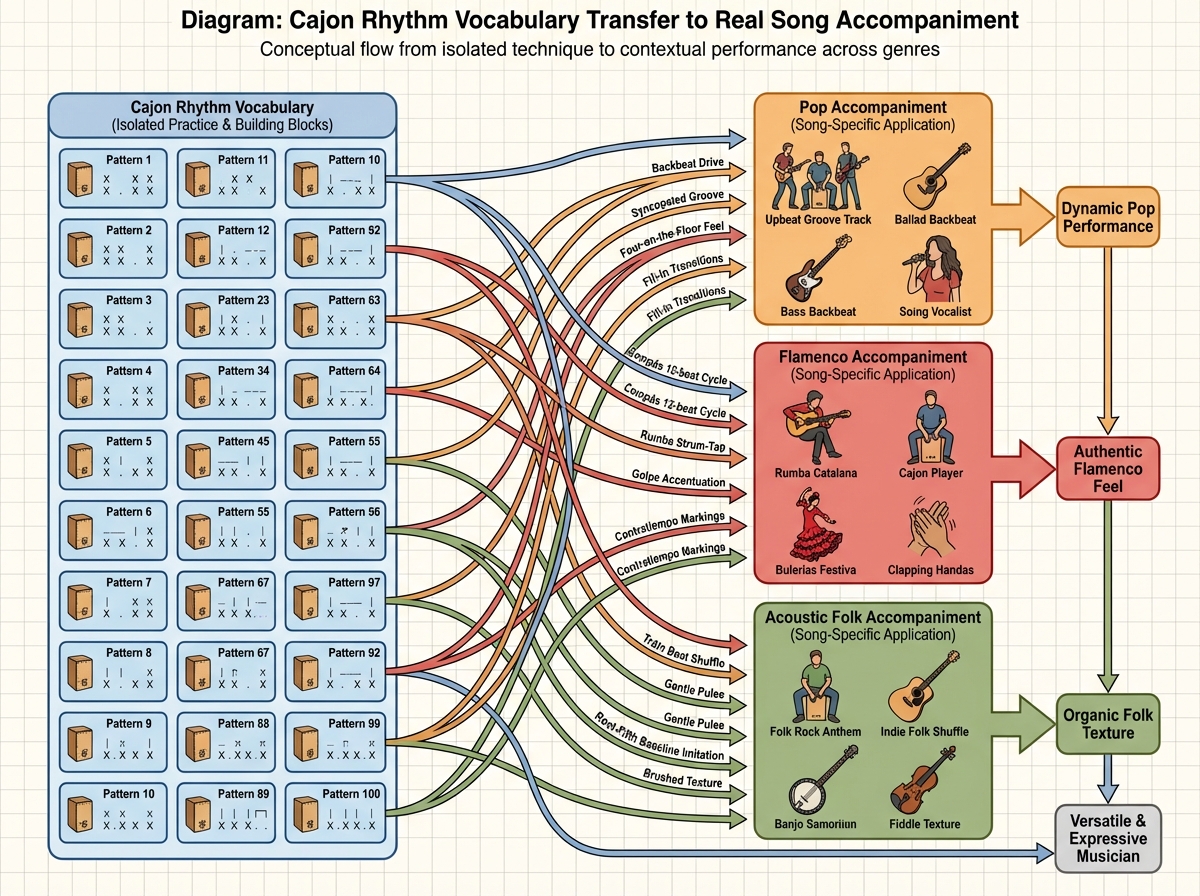
This is where things get genuinely interesting. By the time you’re working through the upper half of 100 rhythms, you’re no longer learning individual patterns — you’re learning how to navigate between them. A rhythm in this range might share its bass pattern with something from the first 30 and its slap pattern with something from the middle stretch. Your brain starts making connections it couldn’t make before because it has enough reference points.
This is also where genre starts to appear. Some rhythms in this range will feel like they belong to specific musical contexts — a certain groove feels like it belongs under a flamenco melody, another feels like it belongs in an acoustic pop setting. You don’t need to name those genres to feel the difference. The rhythms themselves carry the information.
Playing over actual songs becomes realistic here. Not perfectly, not always locked in, but functional. You can sit down with a song you love, find the underlying pulse, and stay with it. That’s not a small thing. That’s the whole point of building the vocabulary in the first place — so that when you hear music, you have something to reach for.
Playing Over Songs: What the Vocabulary Actually Unlocks
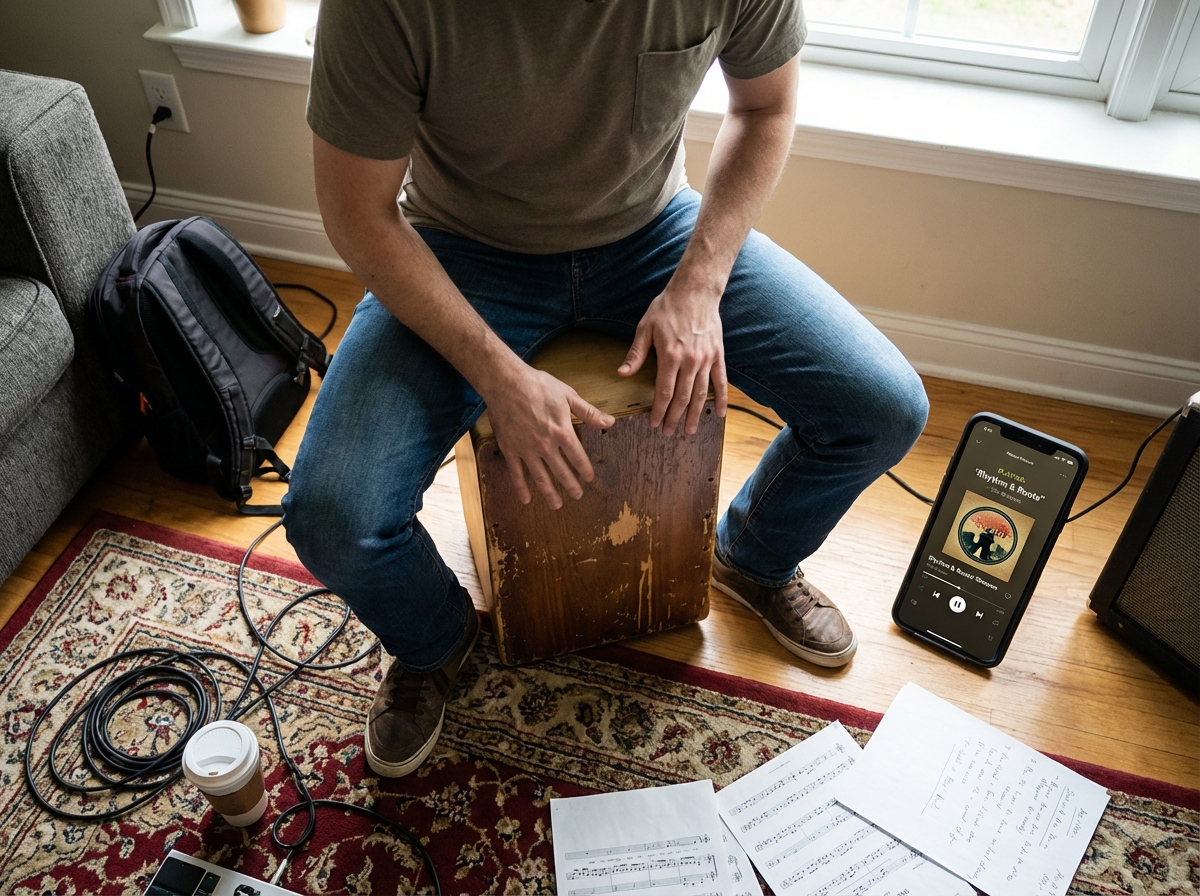
The moment you sit down and play a cajon rhythm that actually fits a song you love — cleanly, without stopping to count — something shifts in how you experience music entirely. You stop being a passive listener. Every song you hear from that point on has an interior structure you can feel and participate in.
This is what rhythm vocabulary does that learning songs one at a time cannot. If you learn to play along to one song, you can play along to one song. If you build 100 rhythmic patterns into your muscle memory, you have the raw material to find the groove in almost anything. The patterns recombine. The variations you learned separately start appearing together inside real music.
The cajon is particularly powerful for this because it mimics the role of a full drum kit — bass, snare, and texture — with two hands on a wooden box. It forces you to be rhythmically self-sufficient in a way that a supporting instrument never does. That self-sufficiency is what makes cajon players unusually good at locking in with other musicians.
When you can hold a steady groove over a song you’ve never played before, you’re not just playing cajon anymore. You’re functioning as a percussionist.
What Actually Sticks After 100 Rhythms
Looking back from the other side of this, what stays with you isn’t the specific patterns — it’s the way of thinking. You stop hearing music as a wall of sound and start hearing it as layered rhythmic decisions. You notice when a drummer is playing it safe and when they’re doing something unusual. You feel tempo differently, both in music and in yourself.
Percussion teaches patience in a way that’s hard to explain until you’ve lived it. Every rhythm that frustrated you eventually became automatic. Every pattern that felt impossible eventually felt obvious. That cycle — friction, repetition, release — is the actual learning, not a detour around it.
Here’s what to carry forward:
- Isolate each tone before combining them — practice bass-only and slap-only for five minutes before touching a full rhythm; clean sounds are the foundation everything else sits on
- Learn each rhythm at a tempo where you can’t make mistakes — then bring the tempo up; rushing past 70% accuracy locks in bad habits permanently
- When a rhythm frustrates you, break it into hands — play the bass part alone, then the slap part alone, then combine; this solves 90% of coordination problems
- Record yourself once a week — your internal sense of how you sound is always more generous than reality; recordings reveal what counting doesn’t
- Play along to real music as early as rhythm 10 — find a song with a simple pulse, mute everything but the drums, and try to match it; this trains real-world application from the start
- Never skip a rhythm because it seems too simple — the easy ones are teaching your body spacing and timing even when your brain is bored
- Practice the transition between two rhythms, not just the rhythms themselves — the ability to shift patterns mid-song is a skill that requires its own rehearsal
- Let the cajon resonate — many beginners tense their hands after the strike, which kills the tone; hit and release, don’t hit and press
Leave a Reply