


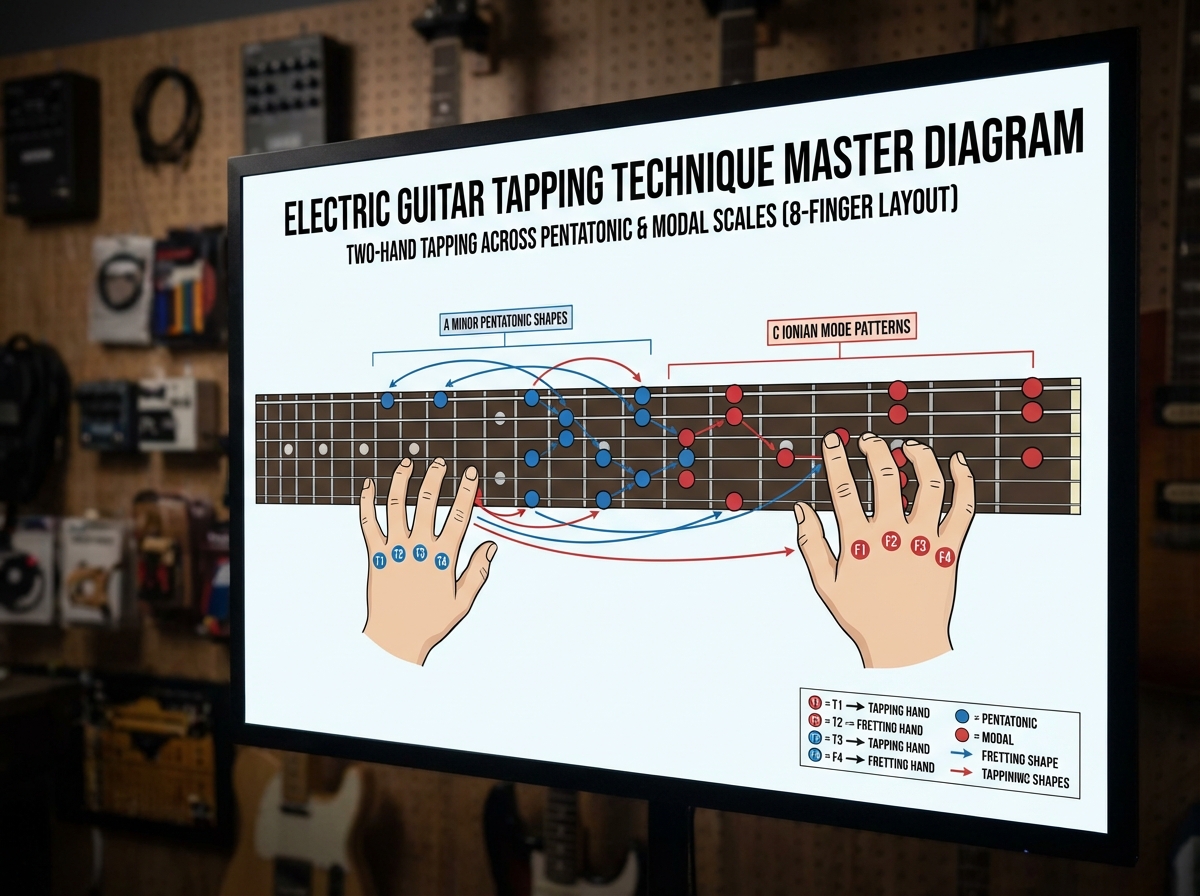
The first time I tried to tap on the guitar, I looked at my picking hand like it had betrayed me. It just sat there, doing nothing useful while my fretting hand did all the work — and now I was supposed to trust it to land cleanly on a fret at high speed and actually make a note ring out? It didn’t go well.
If you’re looking to learn guitar tapping technique, the honest answer is that it’s more accessible than it looks, but only if you approach it in the right order. Two-hand tapping isn’t a trick reserved for shredders with superhuman dexterity — it’s a logical extension of the hammer-on and pull-off mechanics you already know. Once you understand that the picking hand is just doing legato work from the other side of the string, everything reframes.
- Tapping works only when your fretting hand legato is already clean — weak pull-offs will expose every flaw the moment you add a tapping note.
- The pentatonic scale is the fastest path to musical tapping; once those shapes click, modal patterns open up naturally.
- 8-finger tapping sounds impossibly complex but follows the same logic as basic tapping — just with more fingers behaving like a keyboard.
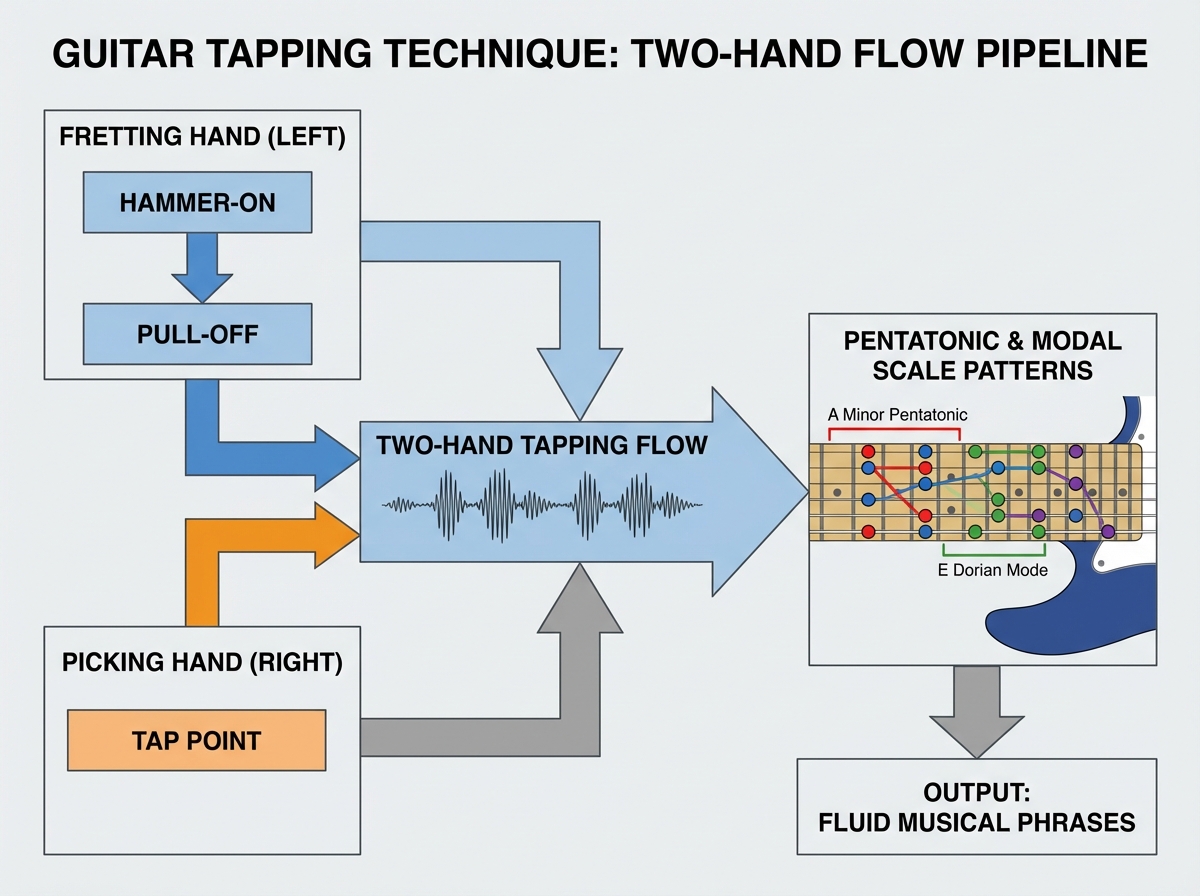
What Guitar Tapping Actually Is (and Isn’t)
Tapping is a technique where both hands fret notes on the guitar neck simultaneously — the picking hand uses one or more fingers to hammer onto the fretboard while the fretting hand handles its usual range of notes. The result is that you can cover intervals impossible to reach with one hand alone, and you can move through scale positions at speeds that feel impossible with standard alternate picking.
It’s worth separating three things people often confuse:
| Type | What It Is | Typical Sound |
|---|---|---|
| Basic two-hand tapping | One picking-hand finger taps a single note above the fretting hand | Fast, flowing three-note patterns |
| Bent tapping | Tapped note is immediately bent upward after contact | Vocal, expressive phrasing within a lick |
| 8-finger tapping | Multiple picking-hand fingers used independently | Dense, piano-like passages across wide intervals |
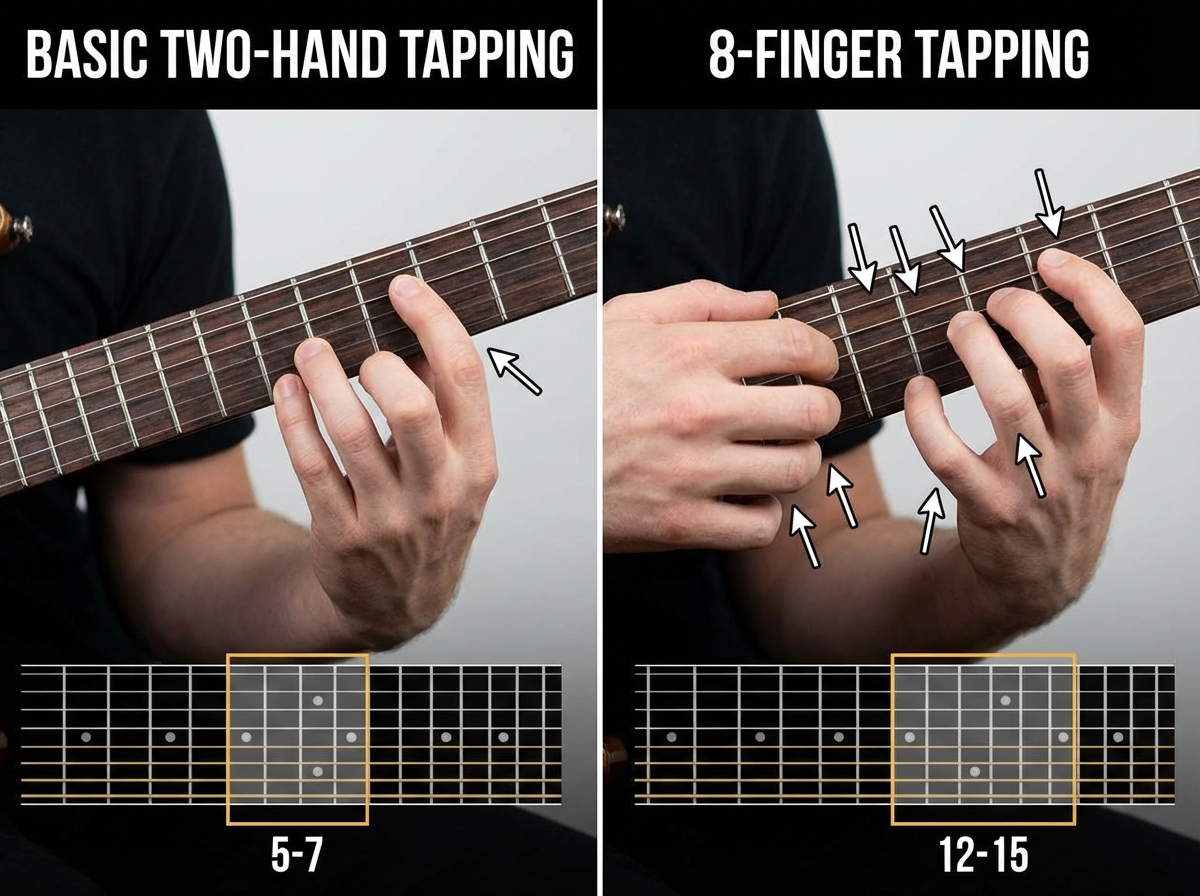
The jump from basic tapping to 8-finger tapping feels enormous — but between them lives a lot of territory that most players skip too quickly.
Three things that surprised me when I really started working on this:
- Your pull-off strength determines the ceiling of your tapping speed before your tap does.
- Tapping in a pentatonic shape and tapping in a mode sound completely different even on the same root note.
- 8-finger tapping is physically easier than it sounds — the hard part is knowing where to put your fingers, not the strength to do it.
How Long It Actually Takes
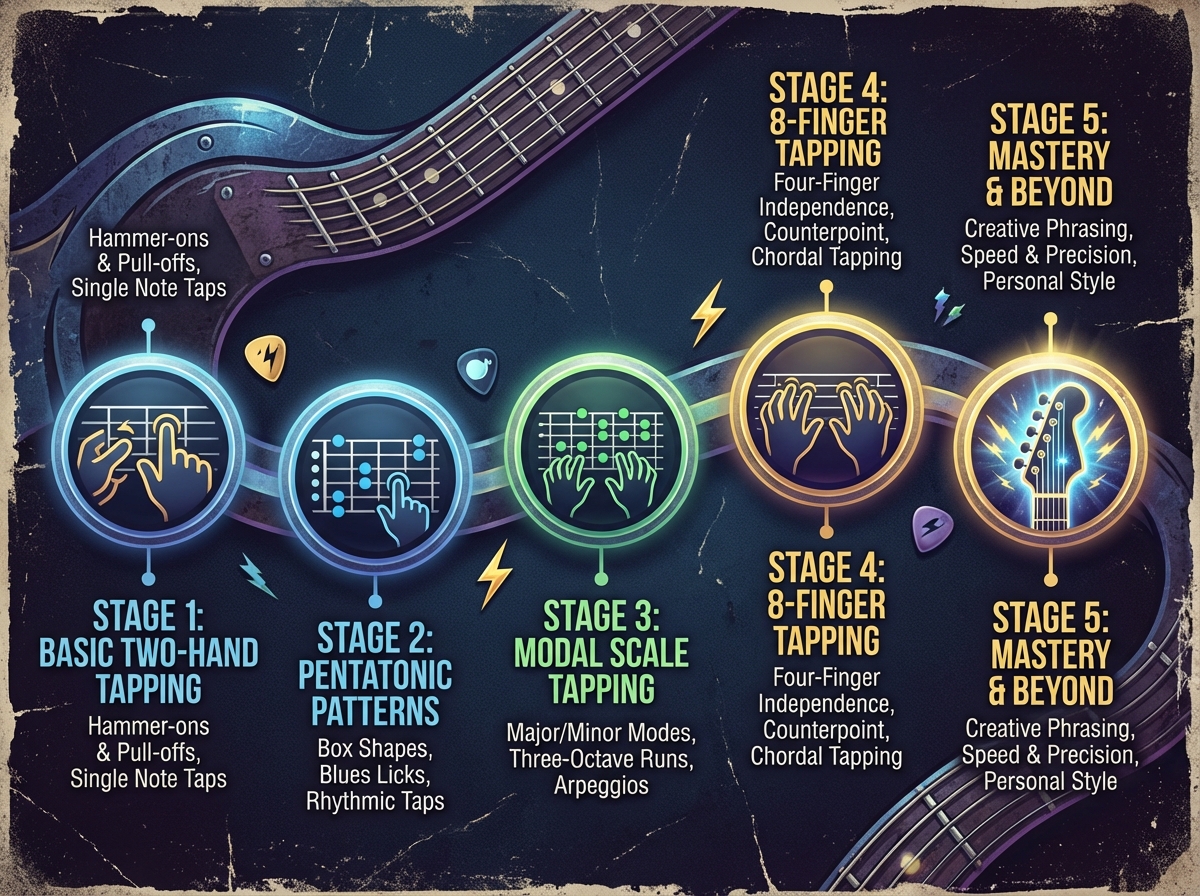
| Stage | Content | Time |
|---|---|---|
| Basic tapping mechanics | Core tap, pull-off, hammer-on cycle; bent tapping | 1–2 weeks |
| Tapping in pentatonic scale | 3-, 4-, 6-note patterns across all five pentatonic shapes | 3–4 weeks |
| Tapping in major scale and modes | 4-, 6-, 8-note patterns in modal context | 4–6 weeks |
| 8-finger tapping in pentatonic | Both hands working independently in pentatonic shapes | 3–5 weeks |
| 8-finger tapping in modes | Full modal coverage with multi-finger independence | 4–6 weeks |
| Total estimated time | From zero tapping to 8-finger modal fluency | ~4–5 months |
The order matters far more than the speed — players who rush past pentatonic tapping to get to 8-finger work almost always come back to fix the same foundational gaps. If you’re moving slower than this, that’s the technique working correctly, not a sign of something wrong.
The First Wall: When Your Tap Sounds Like a Thud
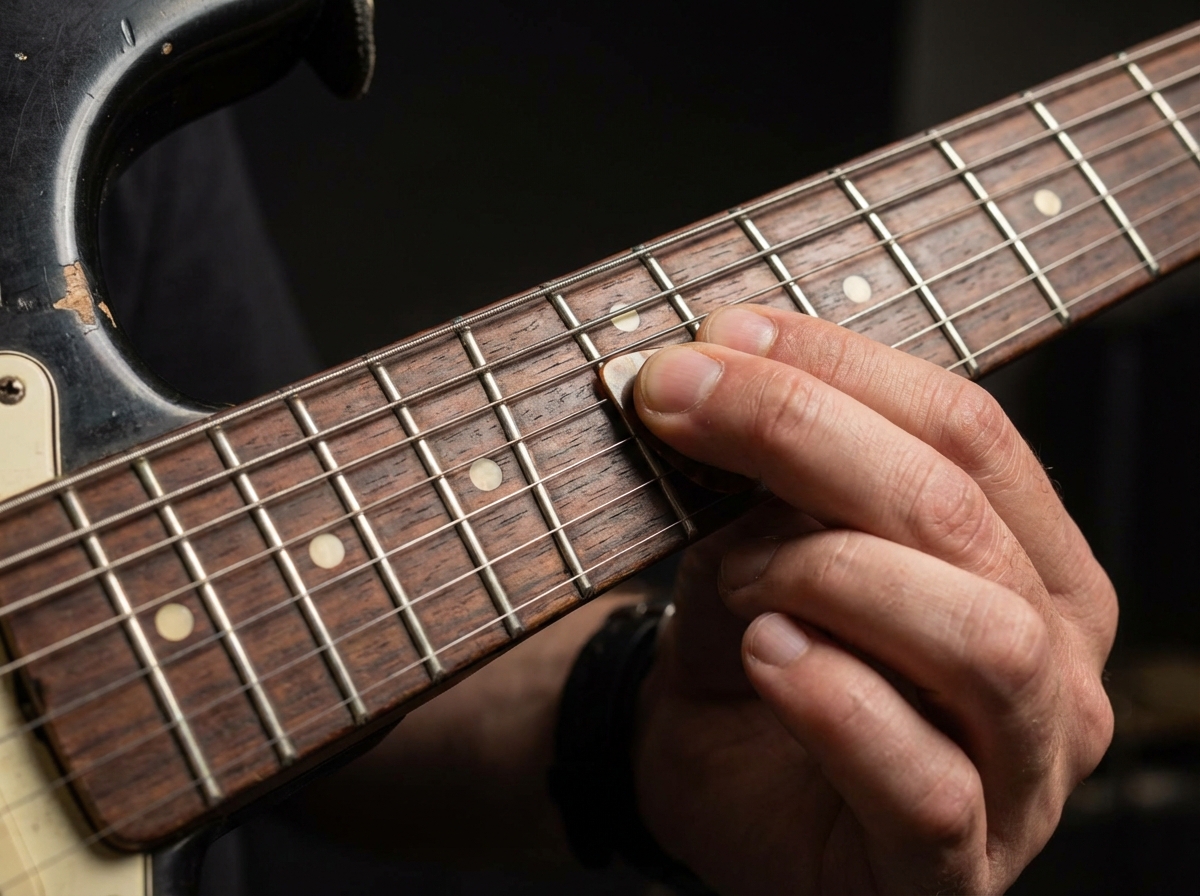
The single biggest mistake people make when learning guitar tapping is treating the tap as a pick stroke. It isn’t. The picking hand finger needs to make firm, percussive contact with the string against the fret — not just touching the string and hoping for the best, and not hammering down with so much force that you pull the string sideways into a bend you didn’t want.
I spent a full week with a sound that was more “thwack” than “note.” The breakthrough came when I stopped thinking about hitting the string and started thinking about pressing it into the fret. The angle changed slightly, the flesh of my finger stopped muffling adjacent strings, and suddenly the note rang out clean.
The bent tapping exercises at this stage exist for a reason that isn’t obvious at first: they teach your tapping finger to control what happens after contact. A basic tap lands and releases. A bent tap lands, moves the string, and releases — and that micro-movement teaches your tapping hand precision it will need for everything that comes later. Skip them and you’re skipping the fine motor control session.
Where Tapping Gets Musical: The Pentatonic Connection
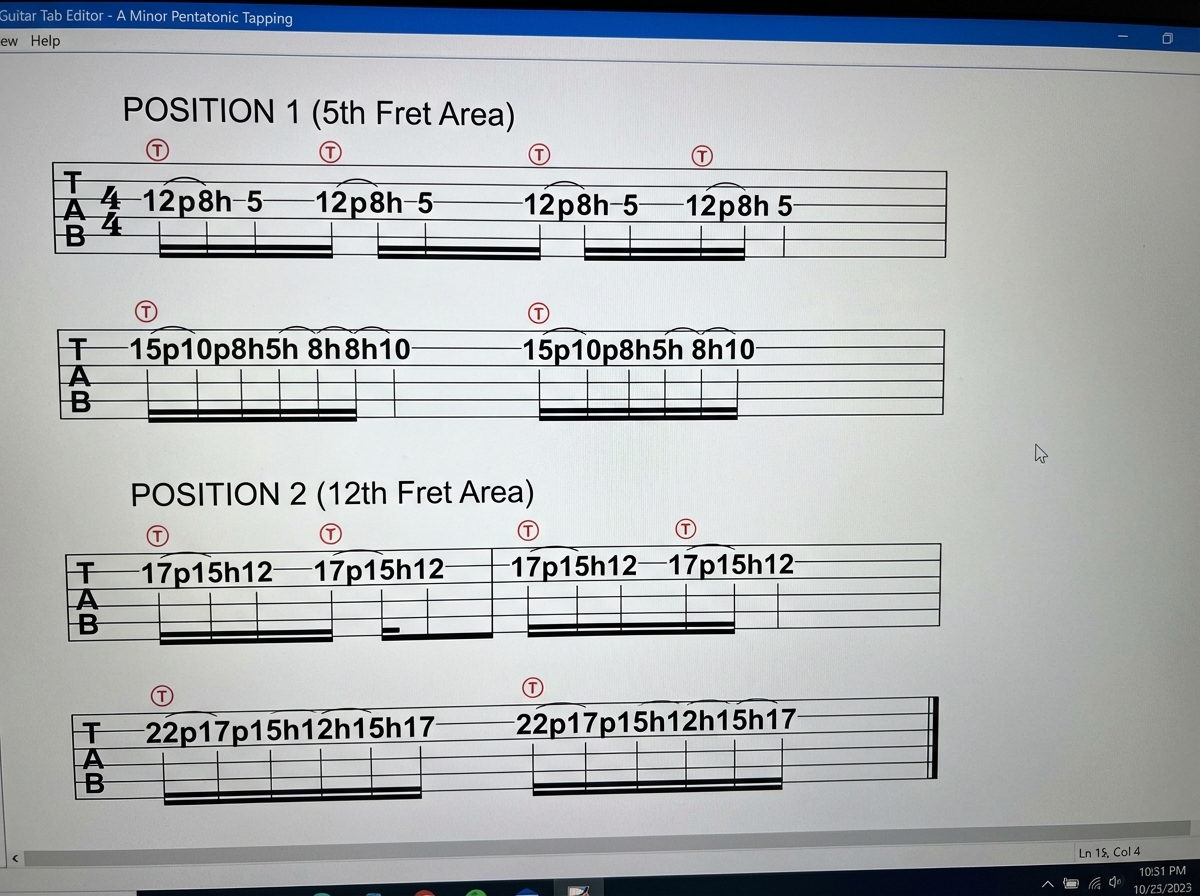
Once the basic mechanics are clean, there’s a moment — usually somewhere in three-note pentatonic patterns — where tapping stops being a technique and starts being music. It happens when you realize the tapping note isn’t just an extra high note bolted onto your lick; it’s completing a pentatonic shape that your fretting hand alone could never reach in one position.
The three-note pattern is the gateway. One tap, one pull-off, one hammer-on, cycling across the pentatonic box. It feels mechanical until it doesn’t — and then you start hearing how the tapping note sits inside the phrase harmonically, not just technically. That shift in perception changes everything about how you practice it.
The four-note and six-note patterns that come after raise the stakes because they demand that your pull-offs get stronger. Three-note tapping is forgiving — the rhythm has room to breathe. Six-note patterns move faster, and any unevenness in your fretting hand legato becomes a glaring rhythmic hole. This is where most intermediate players plateau: they can do the tap, but their fretting hand hasn’t kept pace.
Navigating Modes With Both Hands
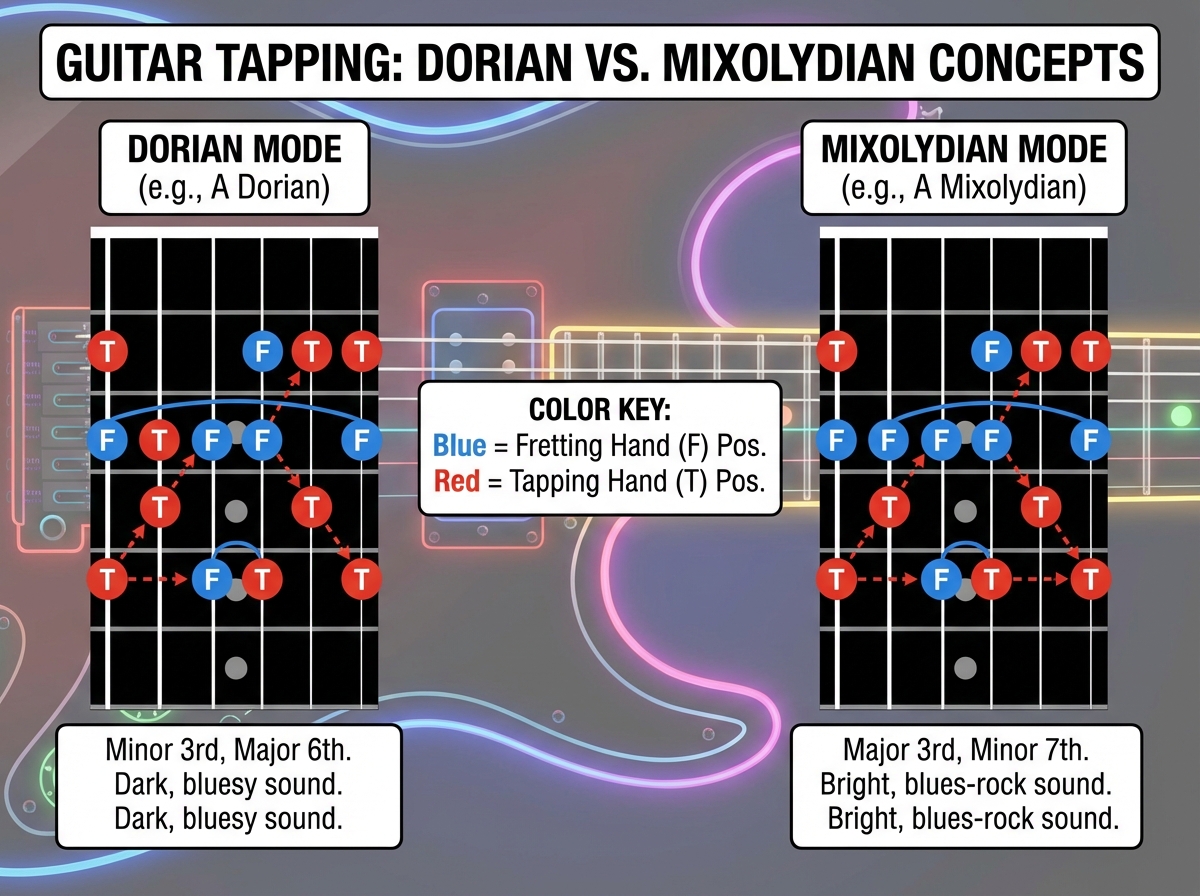
Tapping in the major scale and its modes is a different cognitive challenge than pentatonic tapping. Pentatonic shapes are symmetric and forgiving — modes are not. A Dorian pattern tapped across the neck sounds unmistakably different from the same root in Phrygian, and learning to hear that difference while your hands are doing something physically complex is genuinely hard at first.
The four-note modal tapping pattern is where most players first encounter the problem of thinking in two places at once. Your fretting hand knows its position. Your tapping hand needs to land on a note that belongs to the mode — not just any high note that sounds close. The first few sessions in this territory produce a lot of “almost right” moments where the phrase outlines the wrong chord tone.
The eight-note patterns push into territory where tapping starts to sound like a composed melody rather than a technique demonstration. When you’re covering eight notes per cycle across a modal shape, you’re essentially playing a full melodic phrase in a single position. This is when players who skipped the pentatonic tapping foundation start hitting a wall — because managing eight notes per cycle requires a level of fretting hand independence that pentatonic work was quietly building all along.
The Leap Into 8-Finger Tapping
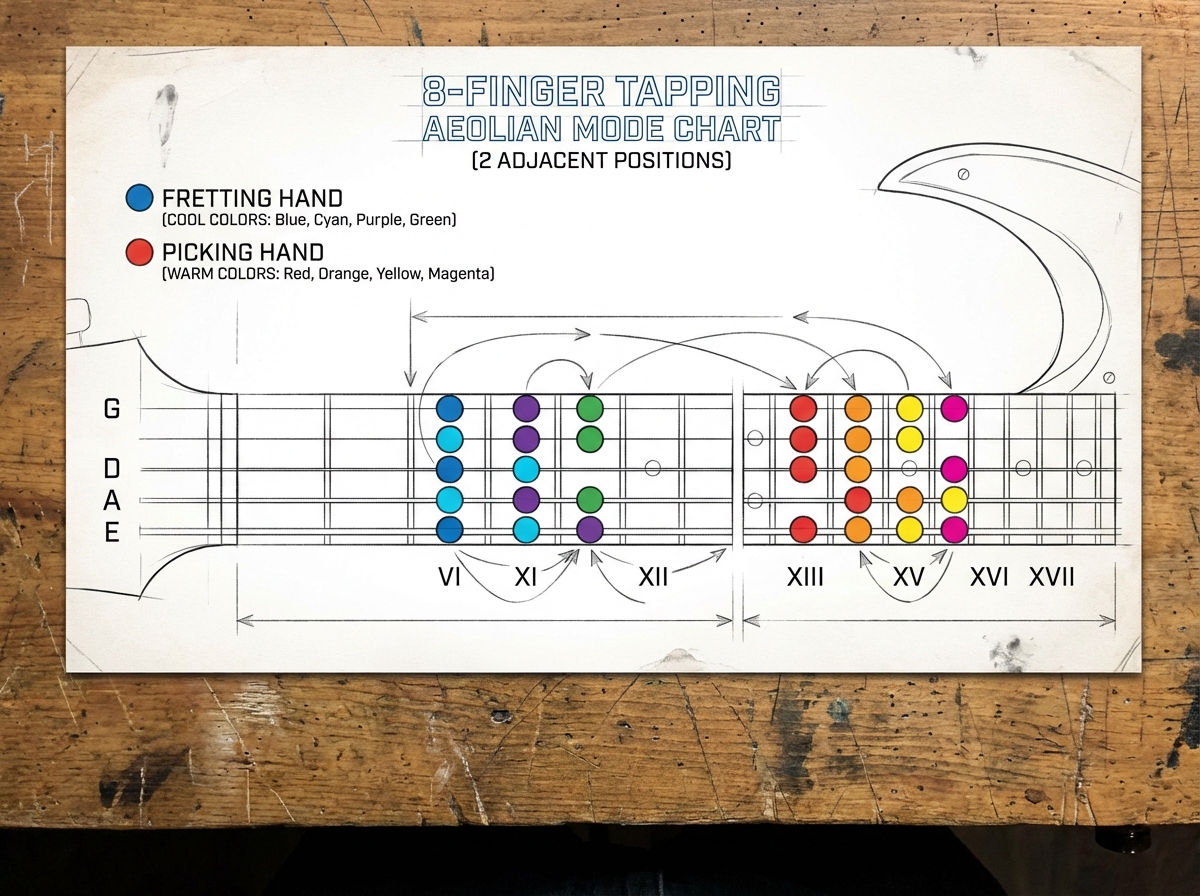
The first time you put two fingers of your picking hand onto the fretboard simultaneously, the whole thing feels like you’re playing a completely different instrument. Your picking hand grip disappears. The pick usually ends up muted under a finger or held awkwardly in your palm. Your brain has no reference point for what “good” feels like yet.
What helped me most was treating the picking hand like a beginner’s fretting hand — which is essentially what it is. You wouldn’t judge your fretting hand after one session on an unfamiliar chord shape, and the same patience applies here. The picking hand has spent years doing nothing but picking; it hasn’t developed the string-pressing intuition the fretting hand has. The early 8-finger tapping exercises build that intuition, not just the mechanics.
The pentatonic 8-finger patterns are deliberately easier than the modal ones because the intervals are wider and more forgiving. You can afford a slight position error in a pentatonic shape and still land on a chord tone. Modal 8-finger tapping is less forgiving — misplace a finger by a fret and you’ve changed the harmony entirely. This is why the curriculum moves through pentatonic 8-finger work first, even if you’re already comfortable with pentatonic tapping from two hands.

When Modes and 8 Fingers Collide
Eight-finger tapping in major scale modes is the point where guitar tapping technique stops being a technique and becomes an approach to composition. The patterns at this level can outline arpeggios across three or four strings simultaneously, suggest implied chord changes without any chords being strummed, and create textures that most listeners can’t even identify as guitar.
The pattern work in modes at this stage demands something the earlier sections were quietly preparing: you need to hear the mode in your head before your hands execute it. If you’re thinking about finger placement while your hands are moving, you’re one step behind. The players who make 8-finger modal tapping sound musical have internalized the shapes enough that the execution is automatic — and the thinking is entirely about phrasing and expression.
The solos at this stage of the journey exist to answer a question that pure exercise-based practice can’t answer: can you make this sound like you? Playing a technically correct 8-finger modal phrase is one thing. Placing it inside a solo with dynamics, space, and intentional note choices is something else entirely. That gap between executing a pattern and performing a phrase is where most of the real work happens — and it only reveals itself when you try to play something musical rather than something correct.
What You Can Actually Do With This Now
Looking back at where tapping started — that first awkward thud of a picking-hand finger missing the fret — and where 8-finger modal work sits, the distance feels enormous. But every stage was earned by the stage before it. Nothing in this journey was a jump; it was always a step.
Here’s what applies immediately, regardless of where you are in this process:
- Record your pull-offs in isolation before adding the tap. If a recorded pull-off sounds weak or uneven, adding a tap on top will make it worse, not better. Fix the foundation first.
- Practice tapping patterns with a metronome starting at a tempo where every note is clean — not the tempo where it’s barely holding together. Speed is a result of clean reps, not the target during them.
- Learn at least one pentatonic tapping lick to completion before moving to modal patterns. A finished, musical phrase teaches your ear what “correct” sounds like, which guides every pattern you learn afterward.
- For 8-finger tapping, anchor one picking-hand finger and add the second only when the first is stable. Trying to place both simultaneously before either is reliable doubles the variables and halves the progress.
- Tap through all five pentatonic shapes, not just box one. The technique needs to be mobile across the neck or it becomes a one-position trick rather than a real tool.
- Apply each new pattern to a backing track before moving to the next one. A pattern practiced over a chord progression reveals rhythmic and harmonic weaknesses that isolated exercise practice hides completely.
- When learning modal tapping, name the mode out loud before you start the phrase. Saying “Dorian” before your hands move activates the harmonic context your ears need to evaluate whether the notes you’re landing on belong there.
- Don’t use distortion as a crutch when learning new tapping patterns. High gain compresses and sustains everything, which makes weak notes sound passable. A clean tone exposes the actual contact quality of every tap and pull-off.
Leave a Reply