


There’s a specific kind of frustration that hits when you’ve run another quarter of solid lead generation numbers — MQLs up, cost-per-click down — and sales still comes back empty-handed. The leads aren’t wrong exactly. They just aren’t the right accounts.
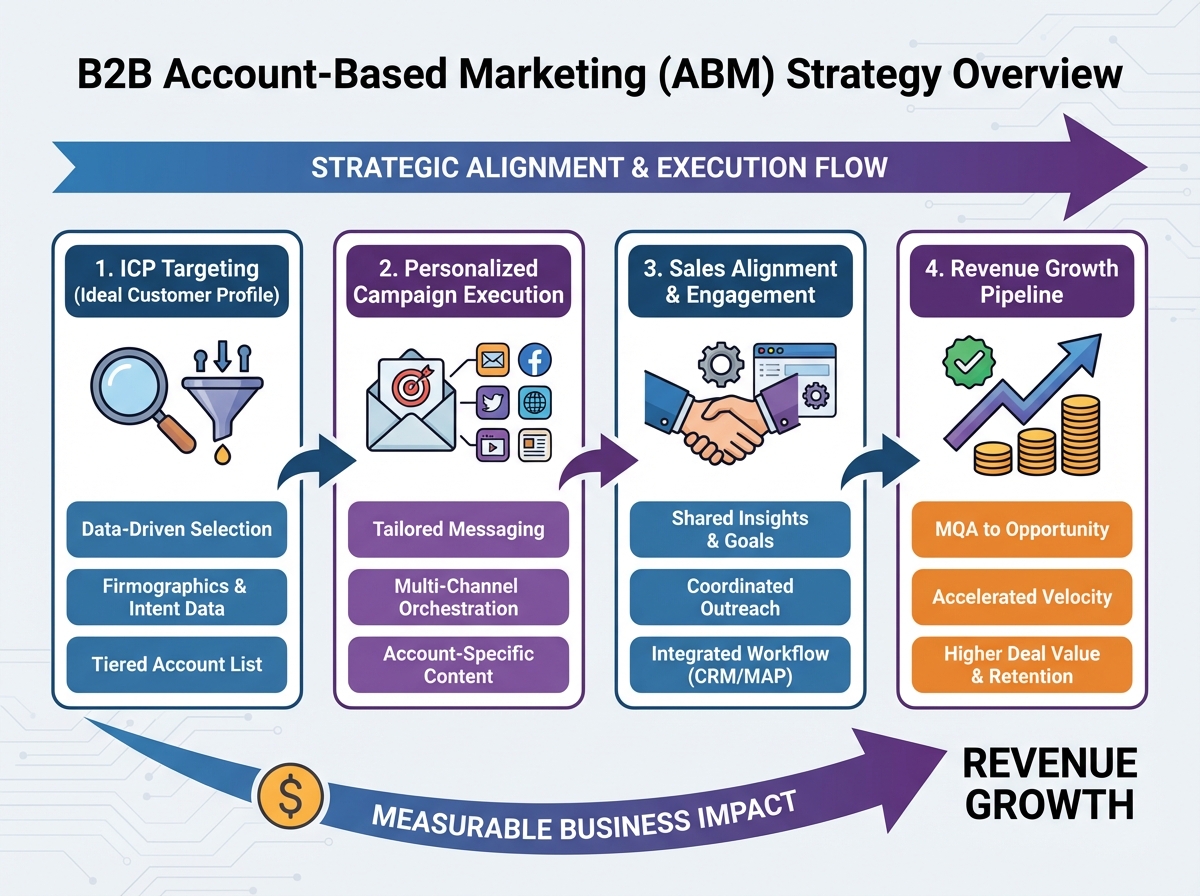
If you’re looking to learn account-based marketing, the core idea is deceptively simple: instead of casting a wide net and hoping the right fish swim in, you identify exactly which accounts you want, and you build everything — messaging, content, outreach, timing — around them. ABM doesn’t replace marketing. It focuses it. And for B2B teams selling into complex, high-value buying committees, that focus is the difference between a pipeline that looks good on a dashboard and one that actually closes.
- ABM works best when your average deal size justifies the investment in personalization — typically $20K+ ACV and multi-stakeholder buying cycles.
- The biggest lift in ABM comes not from technology, but from getting sales and marketing to agree on which accounts matter before any campaign launches.
- You don’t need to start with one-to-one personalization at scale — most teams see results faster by starting with a tight list of 20–50 named accounts.
What Account-Based Marketing Actually Means for B2B
Most definitions of ABM make it sound like a software feature. It’s not. At its core, account-based marketing is a go-to-market philosophy that treats individual companies — not individual leads — as the unit of focus. Instead of nurturing a contact through a funnel, you’re nurturing an entire buying committee inside a specific organization.
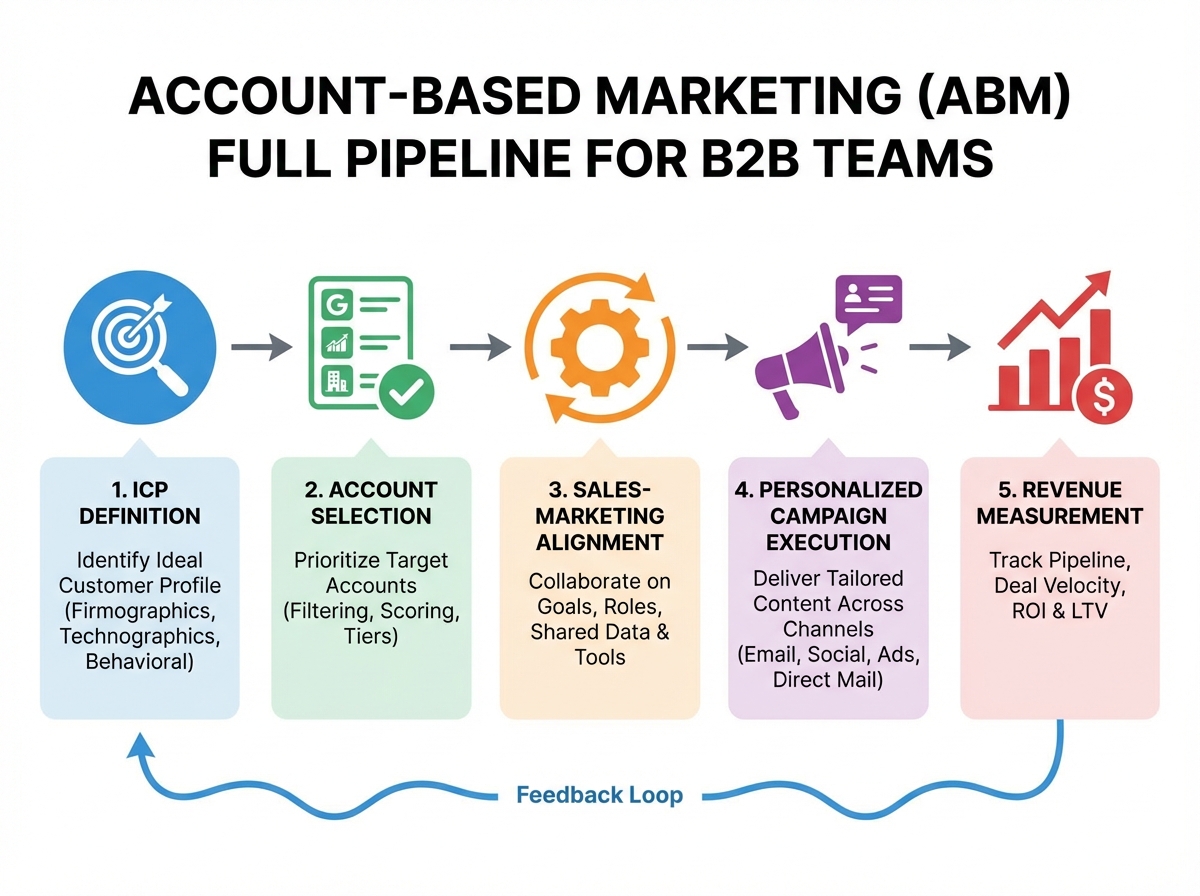
The three models that matter are one-to-one, one-to-few, and one-to-many. One-to-one is exactly what it sounds like: one dedicated program per named account, fully customized. One-to-few clusters accounts by shared characteristics — same industry, same growth stage, same pain — and builds programs for segments of 5–15 accounts. One-to-many applies ABM-style targeting at scale, using intent data and automation to personalize without individual crafting.
| Model | Accounts Targeted | Personalization Depth | Typical Use Case |
|---|---|---|---|
| One-to-One | 1–10 | Full custom | Enterprise, strategic accounts |
| One-to-Few | 10–50 | Segment-level | Mid-market clusters |
| One-to-Many | 50–500+ | Data-driven, automated | Programmatic ABM at scale |
For most teams starting out, one-to-few is the right entry point — specific enough to feel targeted, scalable enough to not require a dedicated headcount per account.
Three things most people get wrong about ABM before they even start:
- ABM is not just retargeting ads at a list of companies.
- An ICP is not the same as a buyer persona — one describes a company, the other describes a person.
- Sales alignment isn’t a kickoff meeting — it’s an ongoing operating model.
Stage | Content | Time
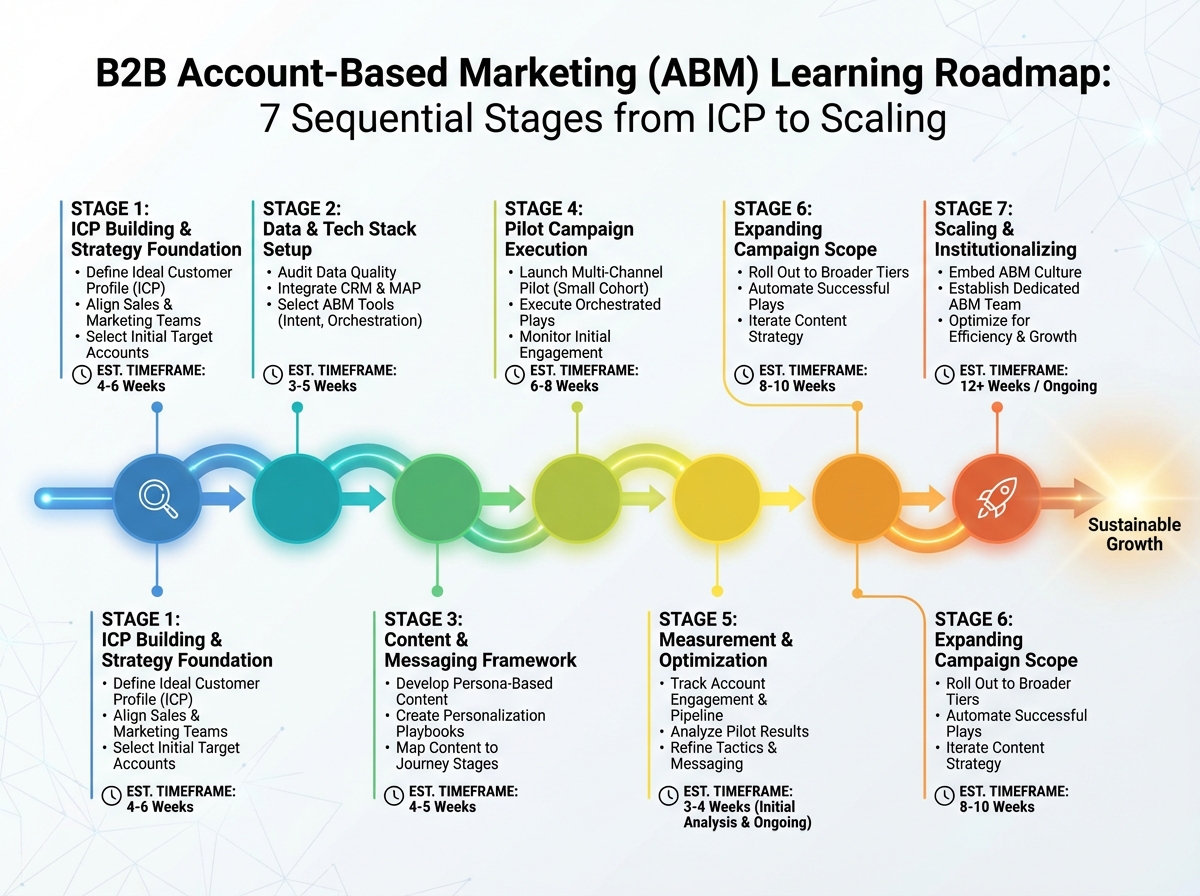
| Stage | Content | Estimated Time |
|---|---|---|
| Foundations | ABM vs. traditional marketing, why it works, core models | 1–2 weeks |
| ICP & Account Selection | Building your ideal customer profile, scoring and prioritizing accounts | 2–3 weeks |
| Sales & Marketing Alignment | Shared definitions, account tiers, handoff protocols | 2–4 weeks |
| Planning & Playbook | ABM plan, frameworks, content strategy | 3–4 weeks |
| Campaign Execution | Tactics, personalization, channel mix, launch | 4–6 weeks |
| Technology & Measurement | CRM setup, automation, KPIs, ROI tracking | 2–3 weeks |
| Scaling & Customer Success Integration | Expanding programs, retention ABM | Ongoing |
| Total | Full ABM program from zero to running | 3–5 months |
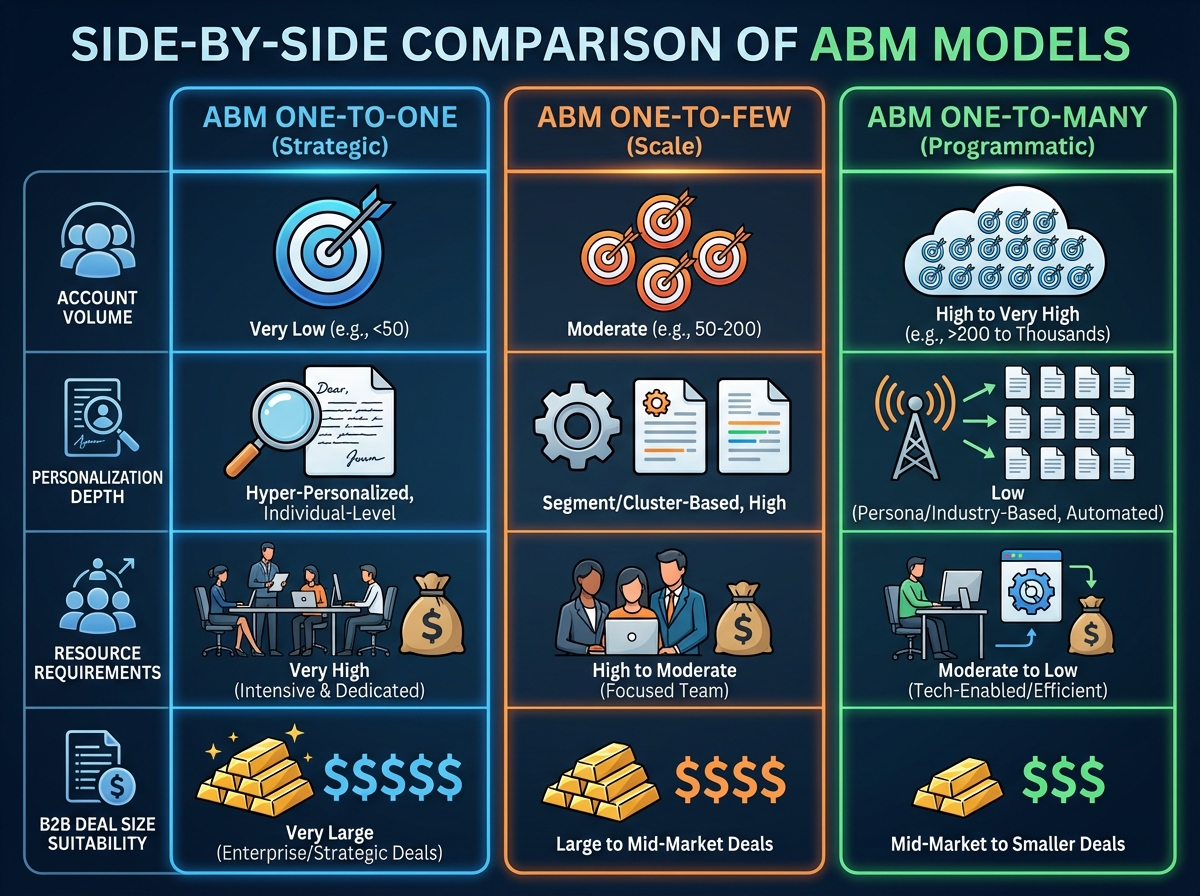
The order matters more than the speed — skipping account selection to jump straight to campaign execution is the single most common way ABM programs fail in the first 90 days. And if it takes you six months instead of three, that’s not failure. A well-built ICP that sales actually trusts is worth more than a fast campaign that targets the wrong companies.
The ICP Isn’t a Document — It’s a Decision
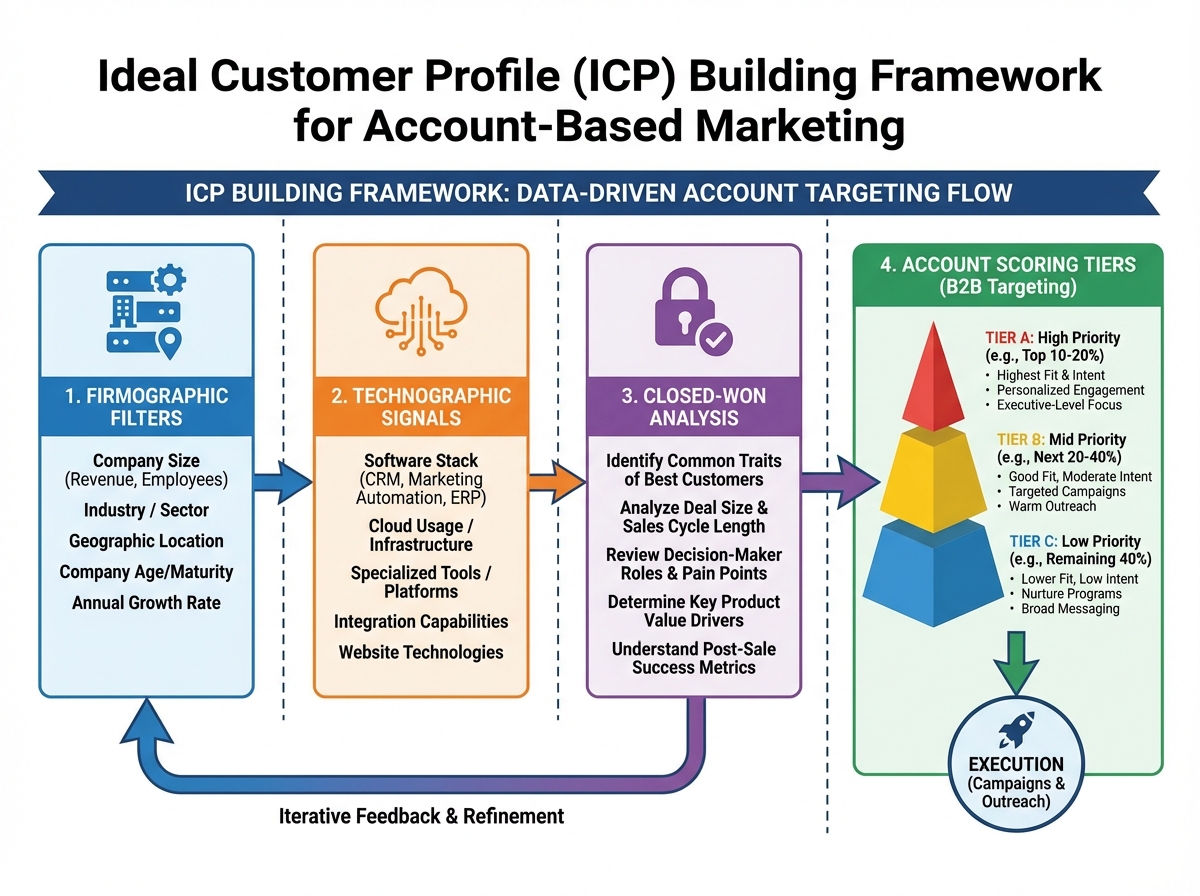
Building an Ideal Customer Profile is usually the first task assigned when a team decides to do ABM. It’s also usually done badly. The typical output is a slide with firmographics: company size, industry, revenue range. That’s not an ICP. That’s a filter.
A real ICP answers a harder question: which companies have the problem we solve, the budget to pay for it, the organizational structure to buy it, and the environment where we’ve actually won before? That last part — where we’ve won before — is the part most teams skip. They build the ICP from hypotheses instead of from closed-won data, and then wonder why their target list doesn’t convert.
The moment this clicked for me was pulling a spreadsheet of the last 30 deals that closed in under 90 days with less than three sales cycles. Overlapping those against the ones that dragged on for six months with endless stakeholder changes. The differences were shockingly consistent: company size mattered less than whether there was a dedicated revenue operations function and whether the CFO was already bought in on category spend. That’s the kind of ICP signal that actually changes which accounts you pursue.
Once the ICP is real, account selection becomes a scoring exercise rather than a debate. You apply the criteria, rank the accounts, and agree on tiers. Tier one gets the one-to-one treatment. Tier two gets segment programs. Everything else stays in demand gen until intent signals indicate otherwise.
Why Sales and Marketing Alignment Is the Actual Product
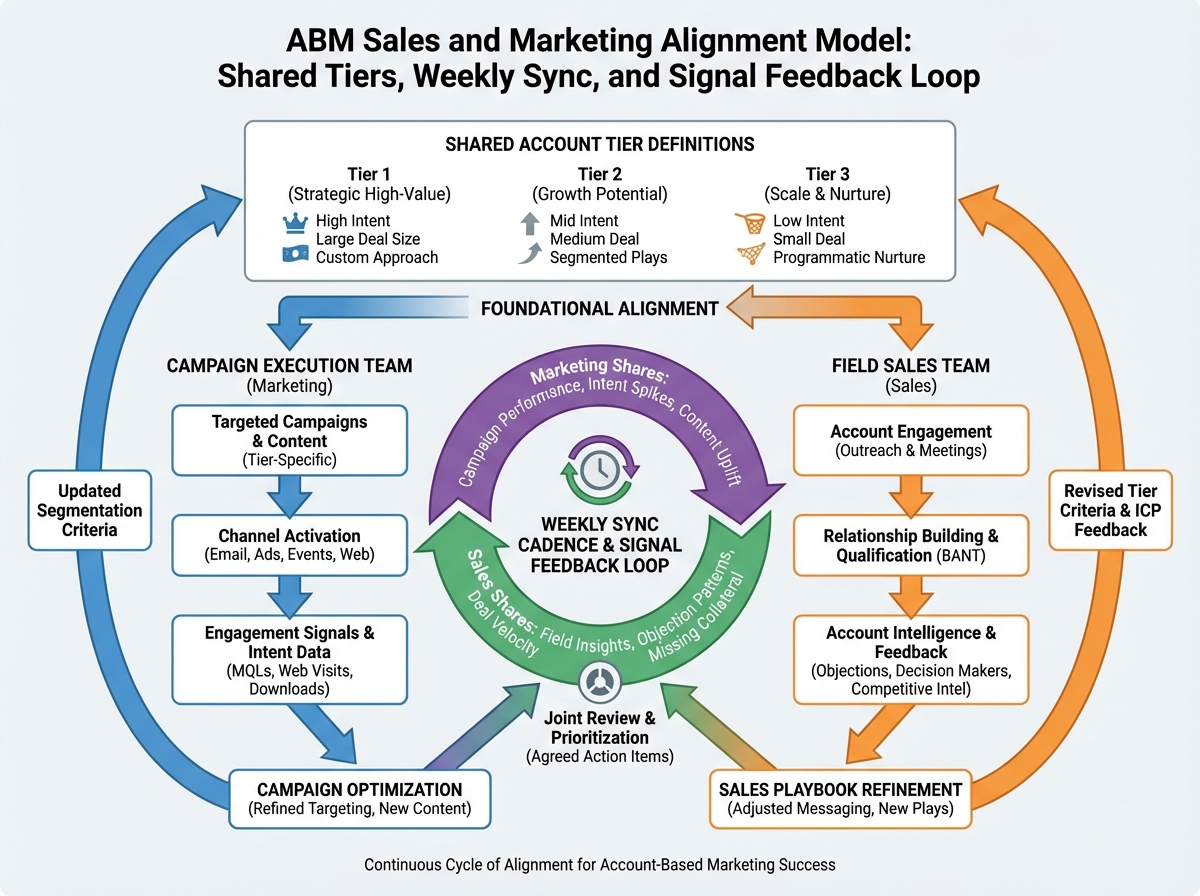
The biggest mistake people make when learning account-based marketing is treating alignment as a prerequisite they check off and move on from. It’s not. Sales and marketing alignment in ABM is the continuous operating system the entire program runs on — and when it breaks down, campaigns don’t just underperform, they actively damage account relationships.
Here’s what misalignment looks like in practice: marketing builds a personalized email sequence for a tier-one account based on the ICP. Sales rep has already been cold-calling that account for three months with a completely different narrative. The account now receives conflicting messages from the same company within the same week. That’s not personalization — that’s noise with a logo on it.
The fix is deceptively simple but requires real discipline: shared account lists reviewed weekly, agreed messaging by account tier, and a clear protocol for who touches an account and when. What it takes to make this work isn’t a new tool — it’s a weekly 30-minute sync where marketing reports what’s being activated and sales reports what’s happening in the actual conversations. That information loop is what makes personalization possible at the account level.
When it works, the effect compounds fast. Sales starts feeding back signals from calls — a CFO mentioned a board priority, a VP just changed jobs — and marketing can spin up a new piece of content or a targeted sequence in days instead of quarters. The account feels like you understand them. Because you actually do.
Building a Playbook That Doesn’t Collect Dust
Every team that commits to ABM eventually builds a playbook. Most of those playbooks live in a Google Drive folder that nobody opens after the first month. The reason is almost always the same: the playbook was built to document what ABM is, not to tell a rep or a marketer what to do next Tuesday.
A useful ABM playbook is operational, not educational. It doesn’t explain one-to-one versus one-to-many. It says: here are our 12 tier-one accounts, here is the message framework for each account’s primary pain, here are the three content assets mapped to each stage of their buying journey, and here is what triggers a handoff from marketing to sales. That level of specificity feels like overkill until the first time a new SDR joins the team and runs their first ABM sequence in three days instead of three weeks.
The frameworks that work in practice tend to be simpler than the ones that look impressive in strategy decks. A basic three-column map — account, current stage in buying journey, next best action — gets more done than a 40-slide ABM architecture diagram. The playbook earns trust when sales actually uses it, and they only use it when it saves them time.
Personalization at Scale Is an Operational Problem, Not a Creative One
This is where most ABM programs stall. The strategy is solid, the account list is agreed upon, the messaging is good — and then the team looks at 200 tier-two accounts and realizes there’s no way to personalize campaigns for all of them by hand. So they either water everything down to generic outreach, or they freeze.
Personalization at scale is an operational problem, not a creative one. The breakthrough is understanding that you don’t personalize every word — you personalize the signal that triggered the outreach. A company just raised a Series B. An executive just published a LinkedIn post about a specific challenge. A job posting just went live for a role that signals a new strategic initiative. You build templates that are 80% fixed and 20% dynamic, and the 20% is driven by a real signal from that specific account.
Content strategy for ABM follows the same logic. You don’t create unique content for every account. You create content at the intersection of your ICP segments — industry-specific case studies, role-specific one-pagers, challenge-specific landing pages — and then you route accounts to the right assets based on their firmographics and behavior signals. A manufacturing CFO and a SaaS CFO have different frames of reference even if the underlying problem is identical. That difference is what content strategy for account-based marketing actually solves.

The Technology Layer: What You Actually Need Versus What Gets Oversold
ABM software is a crowded, expensive, well-marketed space, and the vendor pitch always sounds the same: connect your CRM, layer in intent data, automate personalized outreach across every channel, and watch pipeline fill up. The reality is that most teams buy the platform before they have the process, and then blame the platform when results don’t materialize.
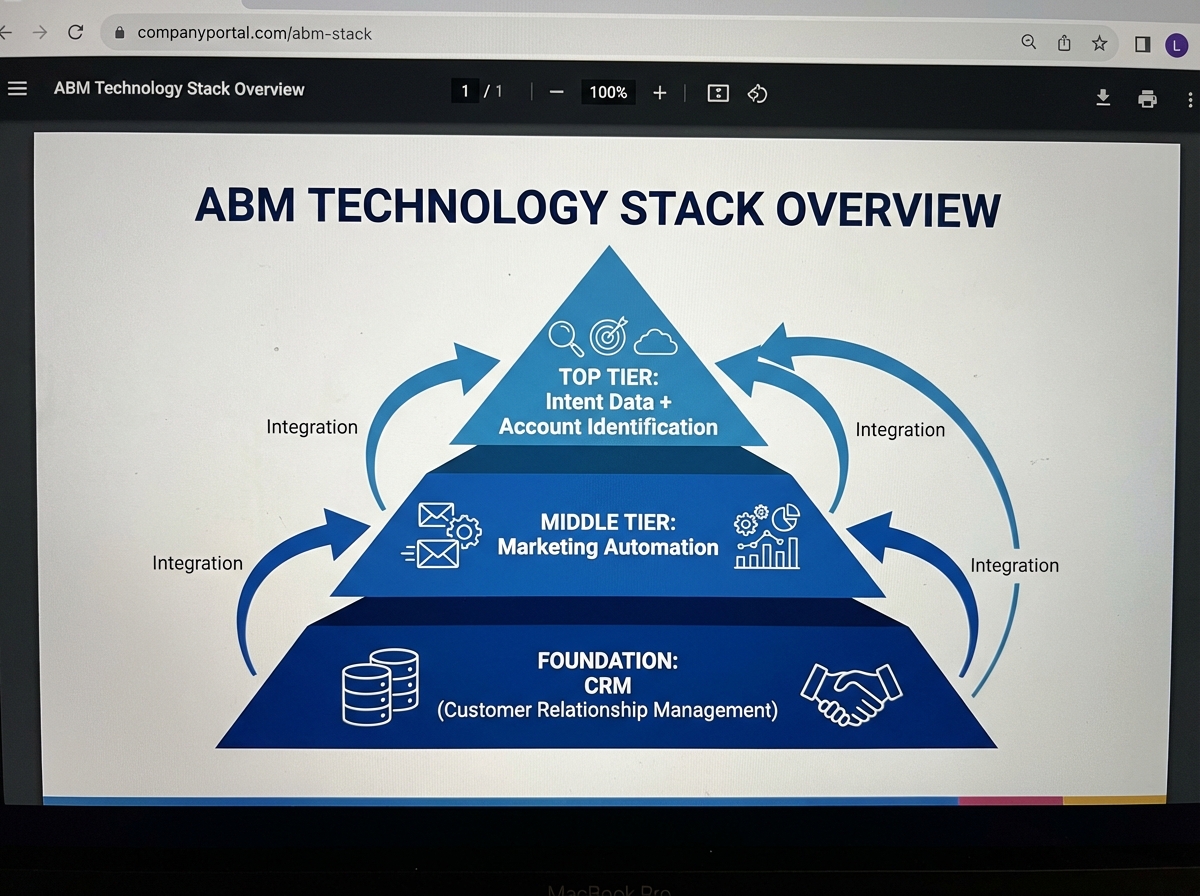
The honest technology stack for ABM has three tiers. The foundation is your CRM — this is where account records live, where activities get logged, and where account stage is tracked. Everything else plugs into this. The second tier is marketing automation, which handles sequencing, nurturing, and triggering campaigns based on account behavior. The third tier is ABM-specific tooling: intent data providers, account identification platforms, or dedicated ABM software like those that identify anonymous company-level web traffic or aggregate buyer intent signals from third-party sources.
You do not need tier three to start getting ABM results. Teams that nail the ICP, align sales and marketing, and run disciplined one-to-few programs with nothing more than a CRM and a solid email tool regularly outperform teams with six-figure tech stacks and poor fundamentals. The data and analytics layer matters most for optimization — tracking account engagement scores, measuring multi-touch influence across the buying committee, and proving ROI to leadership — but it only generates signal once campaigns are actually running.
What Good ABM Metrics Actually Tell You
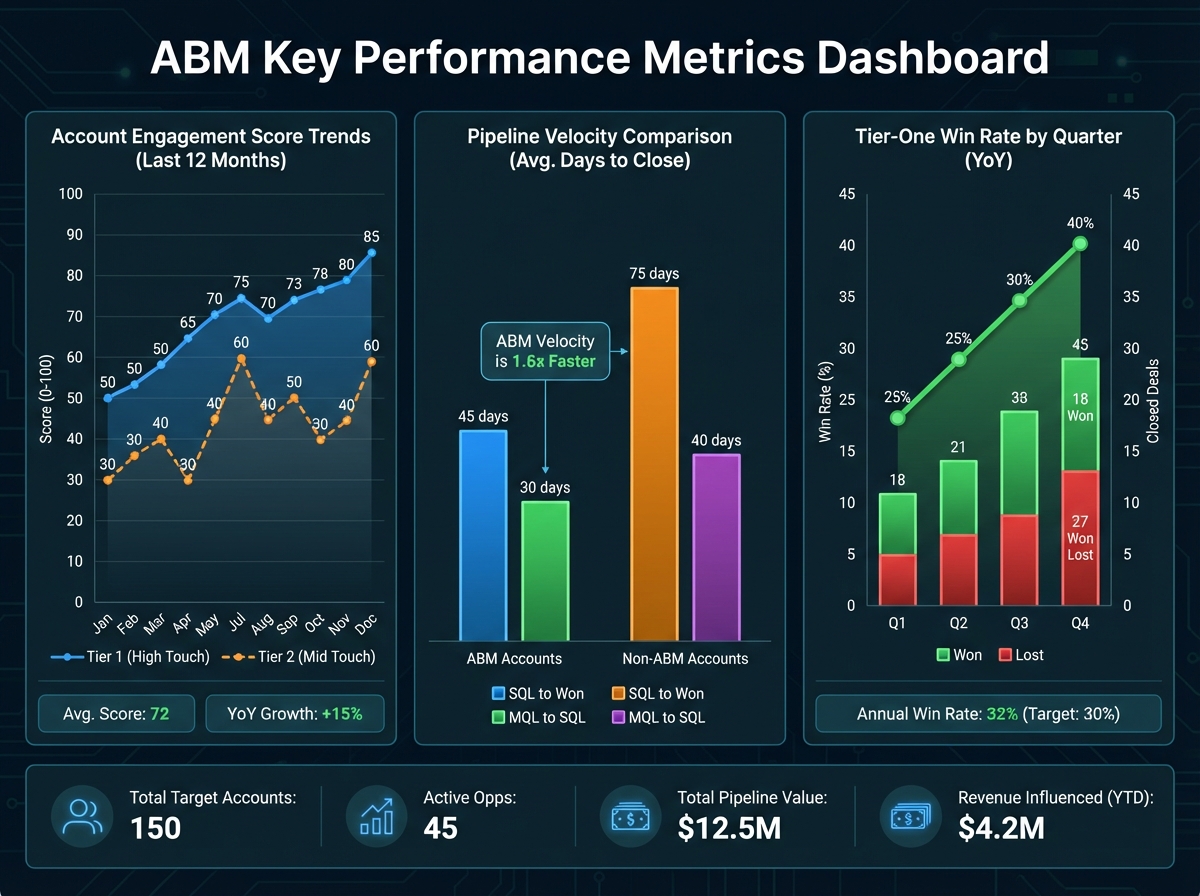
Pipeline attribution in ABM is where most reporting conversations go sideways. Leadership wants to know if ABM is working, and the temptation is to point at MQLs or leads generated. Those numbers don’t tell the right story. ABM metrics live at the account level, not the contact level.
The metrics that matter in a mature ABM program: account engagement score (are the right people at the right accounts consuming your content and responding to outreach?), account progression rate (are accounts moving through buying stages?), deal velocity for ABM accounts versus non-ABM accounts (are the accounts you’ve invested in closing faster?), and win rate within your ICP tier-one list. That last one is the clearest signal of whether the program is working — if your win rate on tier-one accounts isn’t improving quarter over quarter, something in the targeting or the execution is off.
ROI measurement in ABM requires patience. The programs that look weakest in the first 90 days often produce the highest-value deals at month eight. Building a business case for ABM requires tracking influence, not just attribution — which means being honest with leadership that some of the value of ABM doesn’t show up in a last-touch model. Getting ahead of that conversation, and agreeing on measurement methodology before campaigns launch, is one of the most underrated moves a B2B marketer can make.
When ABM Connects to Customer Success, the Math Changes
Most ABM programs are built to win new accounts. The ones that compound the fastest are the ones that connect ABM logic to the accounts you already have.
Customer success integration with ABM works because the same principles apply: you know exactly who the stakeholders are, you know their priorities, and you have a track record of what’s worked inside the account. The expansion playbook looks like ABM because it is ABM — just aimed at deepening a relationship rather than starting one. Identifying expansion signals (a new department spinning up, a new executive hire, a renewal coming up on a competing contract) and activating account-specific content and outreach at those moments is the same muscle as acquisition ABM, just pointed inward.
The teams that figure this out stop thinking about ABM as a campaign framework and start thinking about it as an account relationship operating system. That shift in framing is what separates teams running ABM programs from teams building durable revenue engines.
Looking back, the thing that took longest to internalize wasn’t any specific tactic — it was accepting that ABM is fundamentally a bet on depth over breadth. Every instinct from traditional demand gen pulls toward scale, volume, optimization. ABM pulls the other direction: fewer accounts, deeper investment, longer time horizons, and a willingness to say no to accounts that don’t fit even when the pipeline is thin.
Here’s what to do with that insight right now:
- Pull your last 20 closed-won deals and find the pattern. Industry, company size, tech stack, buying committee composition — the ICP is already hiding in your data, you just haven’t extracted it yet.
- Schedule a weekly 30-minute sales-marketing sync before you build a single campaign. Alignment without a recurring cadence is just a kickoff meeting with good intentions.
- Start your account list at 20–30 accounts, not 200. Depth of engagement on a small list beats shallow touches on a large one every time in account-based marketing.
- Map every content asset you own to a buying stage and an ICP segment. Before creating anything new, know what you have and where the gaps are.
- Agree on one shared metric for account progression before launch. If sales measures success by meetings booked and marketing measures it by content downloads, the program will fracture along that seam.
- Use intent data as a trigger, not a strategy. When a target account shows third-party intent signals for your category, that’s the moment to activate — not the moment to build a program from scratch.
- Document your first 90-day results at the account level, not the campaign level. Which specific accounts engaged, progressed, or went quiet — and why. That analysis is worth more than any dashboard.
- Connect your ABM motion to renewal and expansion from day one. The sooner customer success is in the room when ABM playbooks are built, the sooner the program pays for itself twice.
Leave a Reply