


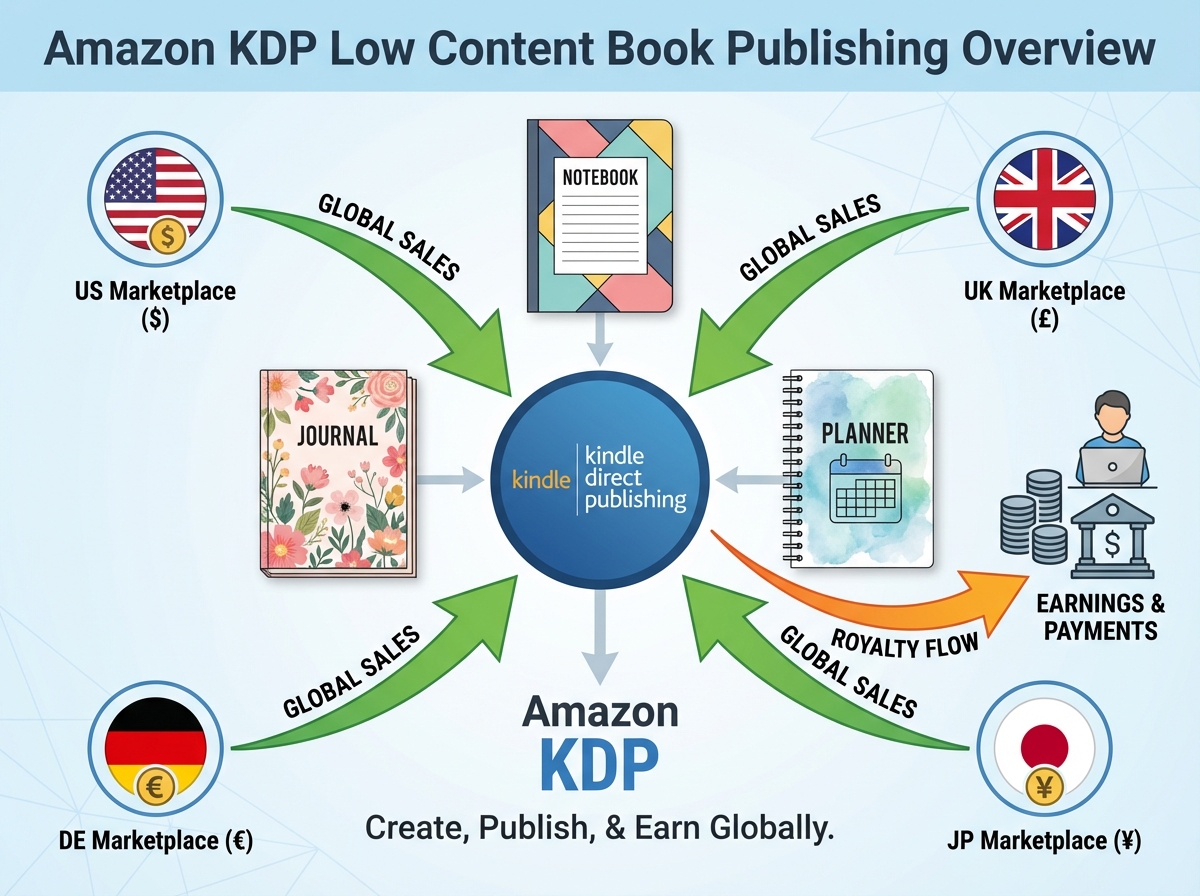
The first time I heard about Amazon KDP low content books, I assumed it was one of those side-hustle myths — the kind that sound plausible until you try them. Then I actually sat down, made an account, uploaded something, and watched a royalty notification land in my inbox three weeks later for a lined journal I’d built in an afternoon.
If you’re looking to learn Amazon KDP publishing, the honest answer is that the model is real, the barrier to entry is genuinely low, and the single thing that separates people who earn from it from people who don’t is understanding how niche research actually works before you ever open a design tool. The platform handles printing, shipping, customer service, and payments — your job is to create the right book for the right search.
- You can publish your first low content book on Amazon KDP at zero cost — no inventory, no upfront spend, no design experience required.
- The biggest bottleneck isn’t creation — it’s niche selection. Getting that right early is the difference between books that sell passively and books that collect dust.
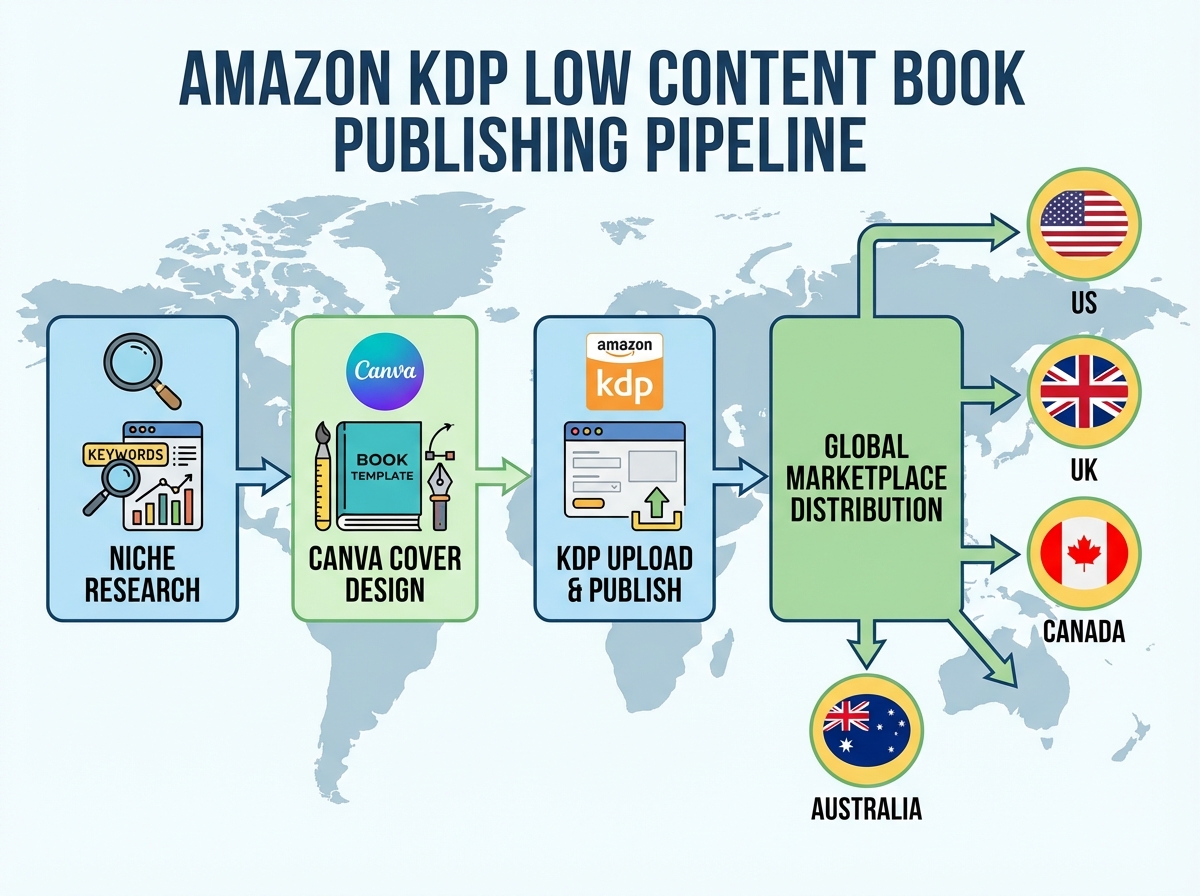
- Royalties are paid per sale across Amazon’s global marketplaces, including the US, UK, Canada, Australia, Germany, India, and Japan.
What Low and No Content Books Actually Are
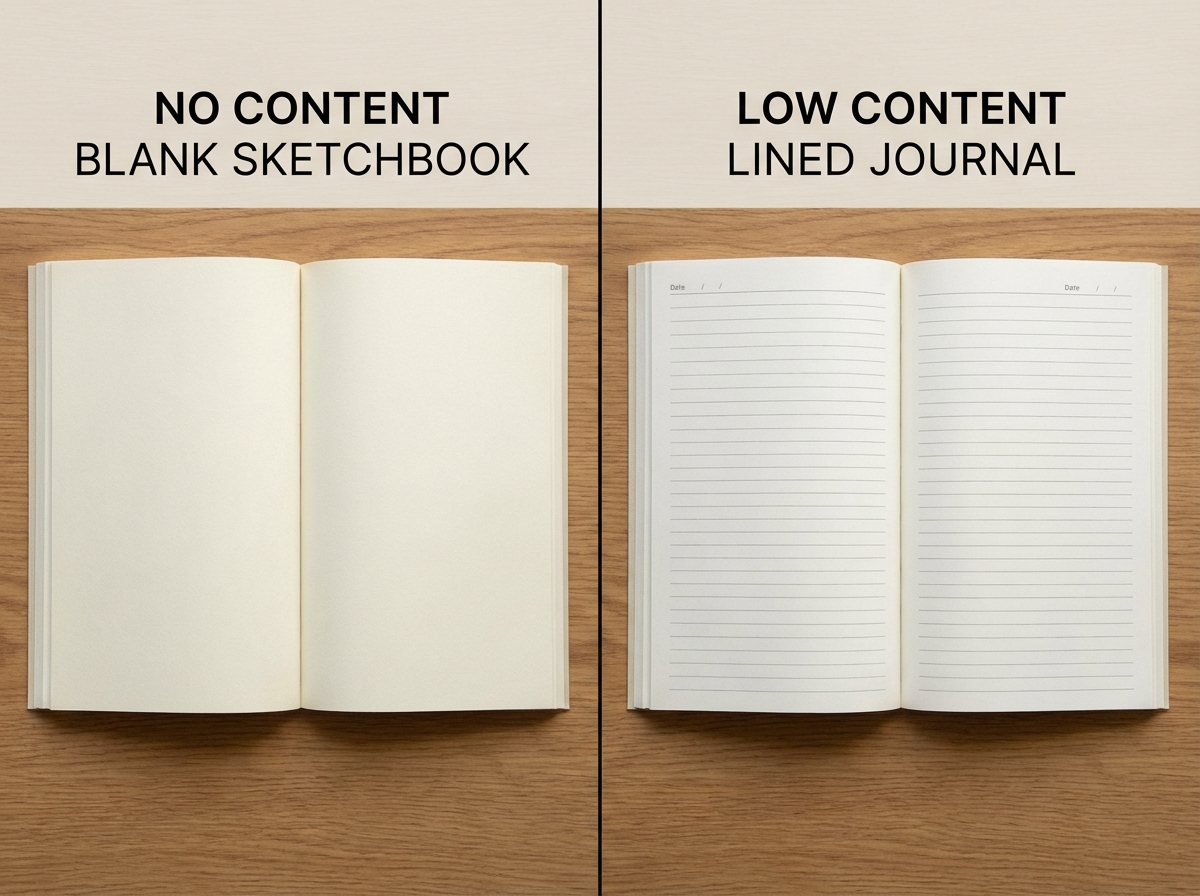
A low content book is any book where the interior is mostly structural rather than written — think lined journals, habit trackers, dot grid notebooks, composition books, drawing sketchbooks, and logbooks. A no content book takes that further: blank sketchbooks, plain-page drawing pads, and similar products where the buyer supplies all the actual content themselves.
The distinction matters when you’re starting out because the production path is different for each:
- No content books: Blank or near-blank interiors — fastest to produce, highest competition in generic form, easier to differentiate with a strong niche cover
- Low content books: Structured interiors (lined pages, date fields, prompt headers) — takes slightly more setup but adds perceived value
- Illustrated children’s books: Sit in a separate tier — more creative effort but also stronger differentiation in search
Keep this section under 150 words. Amazon KDP self-publishing treats all three categories the same way at the listing level — you upload a cover, upload an interior PDF, set a price, and the book goes live across marketplaces within 72 hours.
Three Things That Surprised Me Early On
- Amazon prints the book only after someone buys it — you never touch inventory.
- A journal in a micro-niche with 200 monthly searches can outperform a generic notebook with 20,000 searches.
- Your cover does more selling work than your title in the browse results.
How Long This Actually Takes
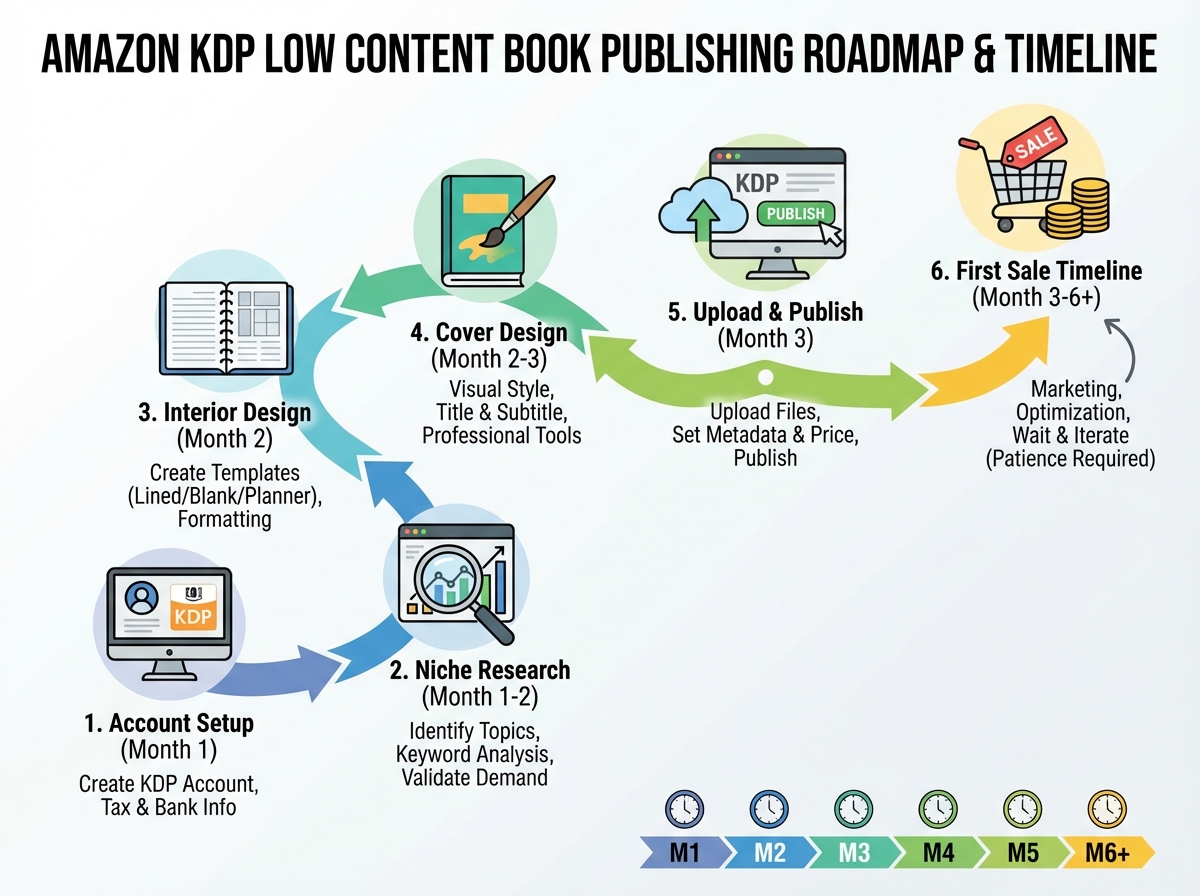
| Stage | What You’re Doing | Time |
|---|---|---|
| Account setup | KDP account, tax info, payment method | 1–2 hours |
| Niche research | Validating demand and competition | 3–6 hours |
| Interior creation | Building your PDF interior in Canva or a template tool | 1–3 hours |
| Cover design | Designing a print-ready cover to KDP specs | 2–4 hours |
| Listing and upload | Writing title, subtitle, keywords, description, pricing | 1–2 hours |
| First sale | Organic traction from search | 2–8 weeks |
| Total to first published book | 8–17 hours active work |
The order of these stages matters more than how fast you move through them — someone who rushes niche research and spends three hours on cover design is working backwards. If you take longer than this estimate, especially on niche research, that’s not a problem — that’s exactly where the work is.
The Part Nobody Warns You About: Niche Research
The biggest mistake people make when learning Amazon KDP is treating it like a design challenge. They spend days perfecting a cover for a gratitude journal in a category already flooded with 80,000 competing titles, then wonder why nothing sells. The product isn’t the problem. The niche is.
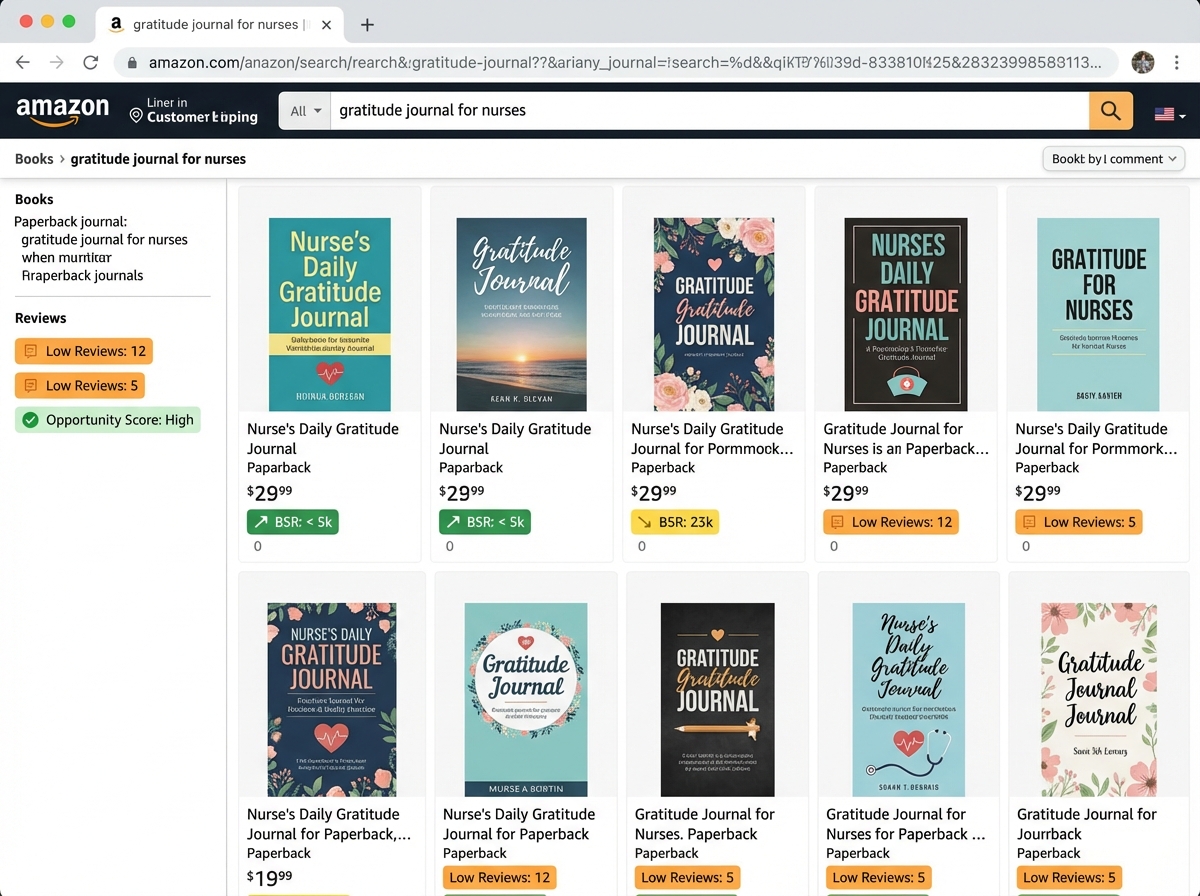
Niche research for KDP low content books comes down to one fundamental question: is there demand here, and is the competition thin enough that a new listing can actually show up? You can get a feel for this without any paid tools. Search your target keyword on Amazon’s book store. Look at the bestseller ranks of the top results — specifically, look for books in the top 100,000 BSR range in Books. That number tells you roughly how often they’re selling. Then count how many results come back for your search term. Under 1,000 results with several books showing strong BSR? That’s a signal worth chasing.
The specific realization that shifted everything for me was understanding that a niche isn’t just a topic — it’s a topic plus an audience identity. “Notebook” is not a niche. “Notebook for night shift nurses who track patient handoff notes” is closer to one. The more precisely your book’s cover and title speaks to a specific person’s identity or daily routine, the more that person feels like it was made for them — and the more likely they are to buy without needing to comparison-shop.
Metrics matter here too. BSR gives you demand signal. Review count on competing books tells you how established that competition is. A book with 3 reviews and a BSR of 50,000 means someone found a gap and it’s still open.
Setting Up Your KDP Account and Understanding the Listing Process
The account setup itself is the least dramatic part of this whole journey, but people still get stuck on it — usually on the tax information step. If you’re outside the United States, Amazon requires you to complete a W-8BEN form, which establishes your foreign status and affects your royalty withholding rate. It sounds intimidating and takes about fifteen minutes once you realize it’s just a form.
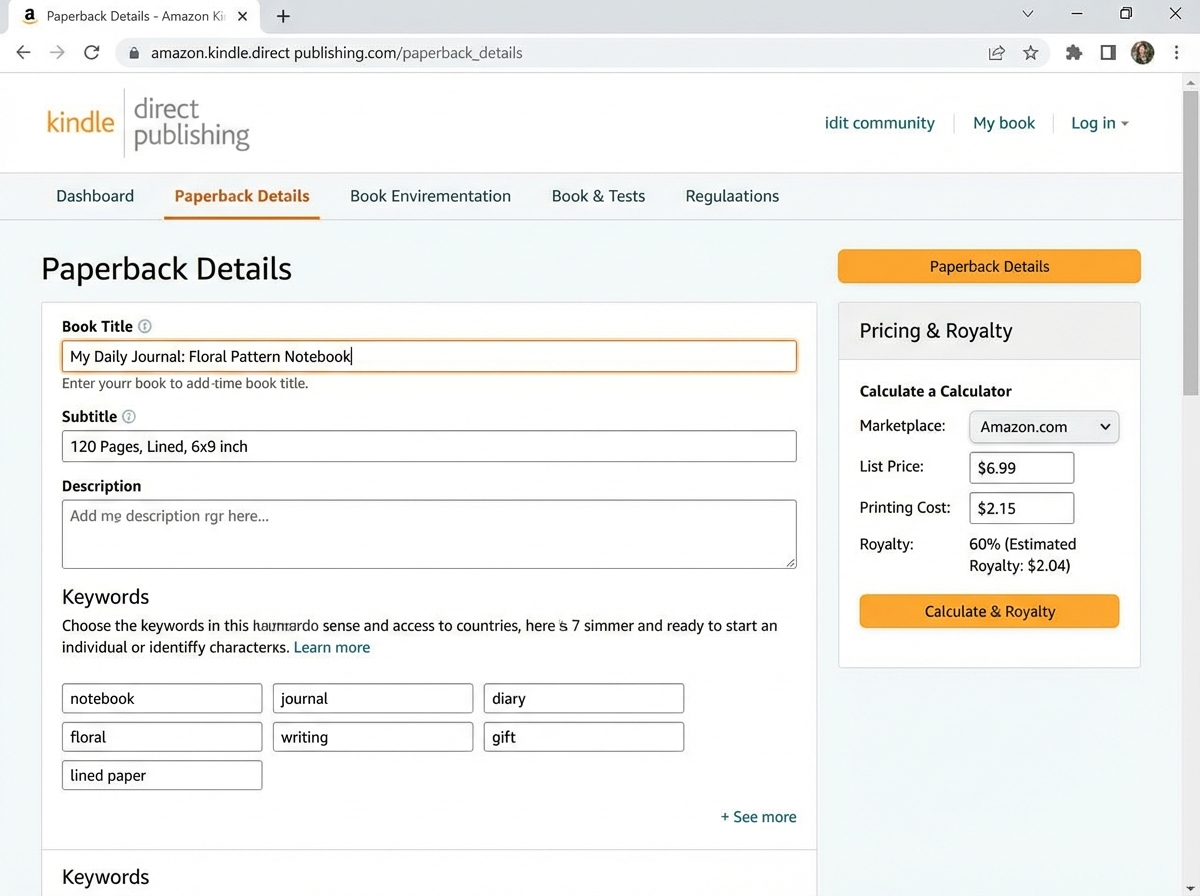
After that, the listing process follows a predictable structure: you enter your title, subtitle, author name, description, and seven keyword fields, then choose two categories. Those keyword fields are not afterthoughts — they determine which searches your book appears in. The seven fields aren’t for your seven most obvious keywords. They’re for long-tail phrases your ideal buyer is actually typing: things like “daily habit tracker for teachers” or “lined journal for teenage girls with prompts.” Generic single words get swallowed by established titles with hundreds of reviews.
Pricing is where new publishers tend to undercut themselves unnecessarily. The 60% royalty threshold for paperbacks means you keep 60% of the list price minus printing costs. A lined journal priced at $6.99 earns you almost nothing per sale after printing. Price it at $9.99 and the math changes significantly — and on Amazon, $9.99 doesn’t feel expensive for a physical book.
Creating Your Interior: Where People Over-Complicate Everything
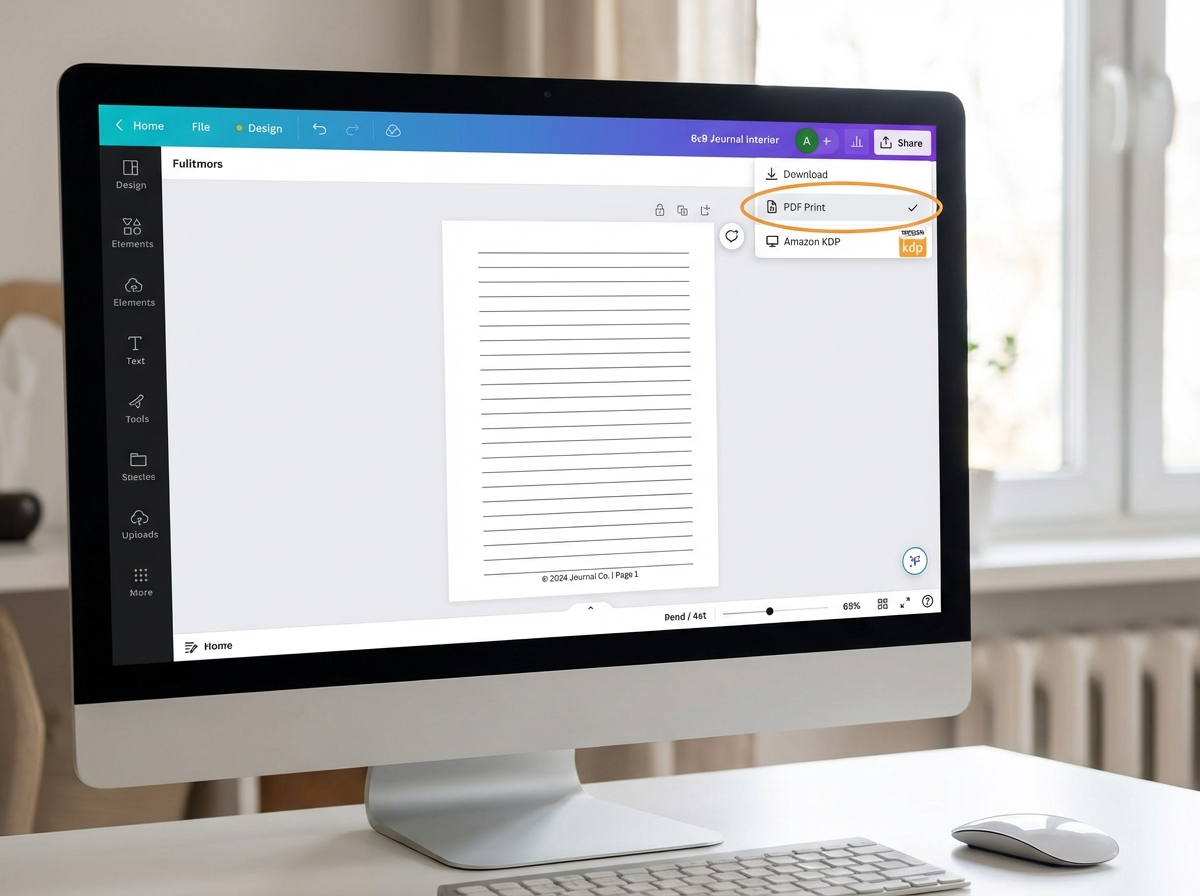
This is the stage where perfectionism kills momentum. The interior of a low content book does not need to be elaborate. A lined journal interior is 120 pages of lined pages with consistent margins. A habit tracker is a repeating table. A sketchbook is blank pages with a small footer. The buyer is purchasing the physical object and its niche identity — they’re not evaluating your InDesign skills.
Canva handles this for most book types. The KDP interior template dimensions are 6×9 inches for most standard notebooks, and you can build a 120-page interior in Canva by duplicating a single page design, then exporting as a PDF with bleed settings off. The whole thing, done properly, takes under two hours the first time and under forty minutes once you’ve done it once.
The one technical detail that catches people is bleed settings. Your cover needs bleed (0.125 inches on all sides). Your interior does not, unless you have full-page images that extend to the edges. Getting this wrong means your upload gets rejected and you have to resubmit — frustrating, but not catastrophic. KDP’s error messages on this are actually specific enough to tell you exactly what’s wrong.
Cover Design and the First Impression Problem
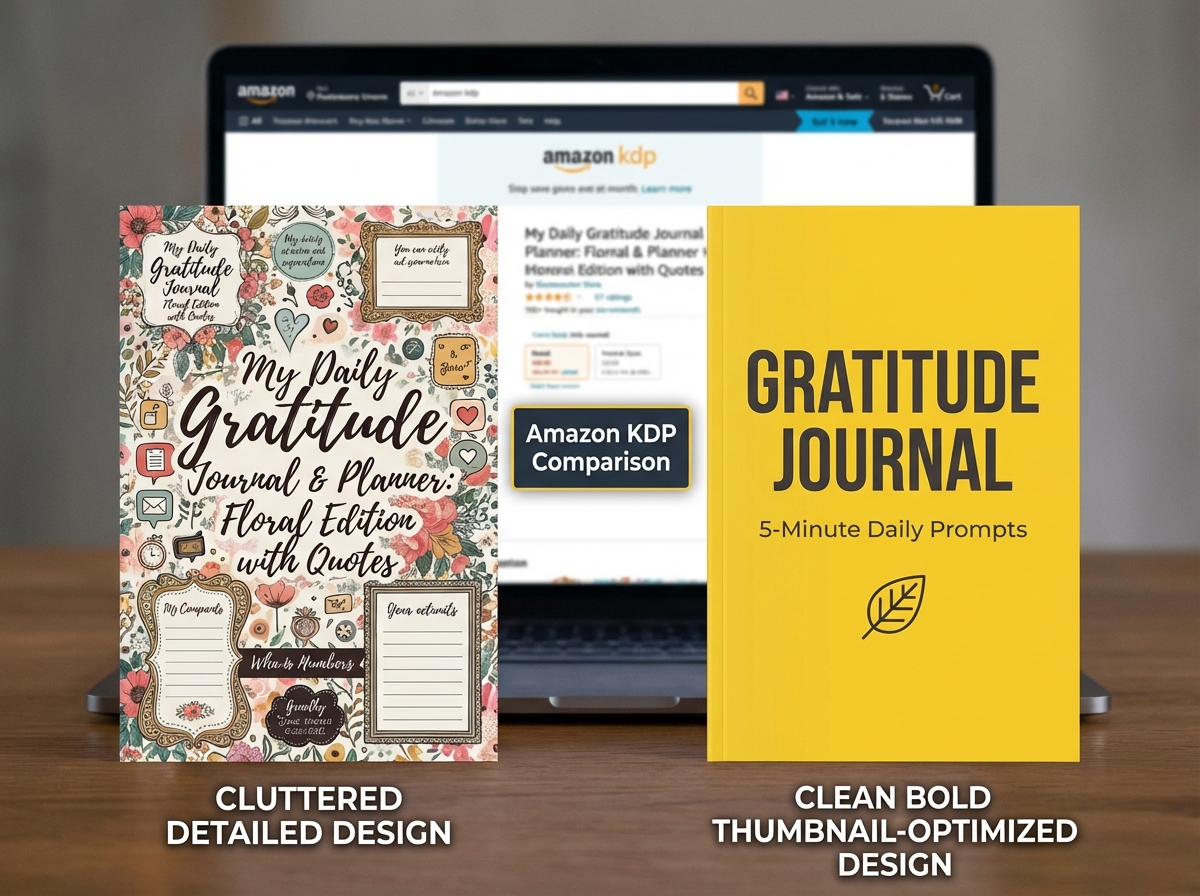
In the Amazon browse results, your cover is running against every other result in that search. The thumbnail is roughly the size of a postage stamp on a phone screen. This is the context your cover needs to work in — not on a 27-inch monitor at full resolution.
The most effective low content book covers for KDP self-publishing follow a consistent pattern: a bold, readable title in a large font, a simple but thematically relevant illustration or background, and a color palette that stands out against the surrounding results. That’s it. You’re not designing a coffee table book. You’re designing something that reads clearly at 80 pixels wide and communicates its niche identity in under two seconds.
The mistake here isn’t bad design skill — it’s designing for the wrong viewing context. I made this error on my first few books. I used detailed illustrations that looked beautiful at full size and became indistinguishable noise at thumbnail scale. The fix was simple: zoom out to 10% in Canva, look at the cover, and ask whether the title is still readable and whether the image still communicates something. If not, simplify.
For people building this as a self-publishing business from scratch, cover design is where outsourcing eventually makes sense — but in the beginning, the constraint of doing it yourself forces you to develop an eye for what actually works in the marketplace.
Scaling Beyond Your First Book
One book is a proof of concept. Ten books in a validated niche is a business. The difference between someone who earns $20 a month from KDP and someone who earns $2,000 is almost always volume combined with niche coherence — not a single viral book.
Scaling means building series. If your lined journal for night shift nurses sells, you create a companion pocket-size version, a weekly planner version, and a gratitude journal version — all targeting the same buyer identity, all cross-listed on the same author page. When someone finds one book and clicks your author name, they see a catalog that reinforces the niche. That’s not an accident of luck — it’s a deliberate architecture.
Amazon Advertising (AMS ads) becomes relevant once you have enough books to justify the learning curve. But starting ads before you’ve validated through organic sales is backwards — you’re spending money to test whether a niche works when you could test that for free first. Get your first two or three organic sales before you touch the ads dashboard.
The royalty structure across global Amazon KDP marketplaces also compounds this model. The same book you publish once becomes available in the US, UK, Canada, Australia, Germany, India, and Japan simultaneously. You don’t manage any of this — Amazon does. The royalty percentages differ slightly by marketplace and book type, but the distribution is automatic.
Looking Back at What Actually Mattered
If I could go back to when I first opened the KDP dashboard, I’d skip the three days I spent worrying about cover fonts and spend that time on niche research instead. The platform is straightforward. The process is learnable. The part that requires actual judgment — reading demand signals, identifying buyer identity, building a series around a validated topic — that’s where the real skill lives.
Here’s what to act on immediately:
- Validate before you create: Search your target keyword on Amazon Books, check the top 10 BSR numbers, and count total results. Only proceed if you see demand and thin competition.
- Use all seven keyword fields in your listing: Each field should be a distinct long-tail phrase your buyer would actually type — not single words, not your title repeated.
- Price above $9.99 for 60-page-plus books: The royalty math at $6.99 or below leaves almost nothing per sale once printing costs come out.
- Build your cover for thumbnail scale: Export at full size but evaluate it at 10% zoom — if the title isn’t readable, it’s not ready.
- Create your interior in one session: Perfectionism on the interior is wasted energy. A clean, consistent layout matters; a perfect layout doesn’t exist.
- Publish your first book before optimizing anything: You will learn more from one live listing — real impressions data, real click-through rate, real conversion — than from any amount of pre-launch research.
- Build a series in your first validated niche: Three books from the same author in the same niche create a catalog effect that a single title never can.
- Check your BSR weekly for the first 60 days: A BSR that moves tells you whether your keywords are finding buyers. A flat BSR tells you the listing needs work — usually the keywords, not the cover.
Leave a Reply