


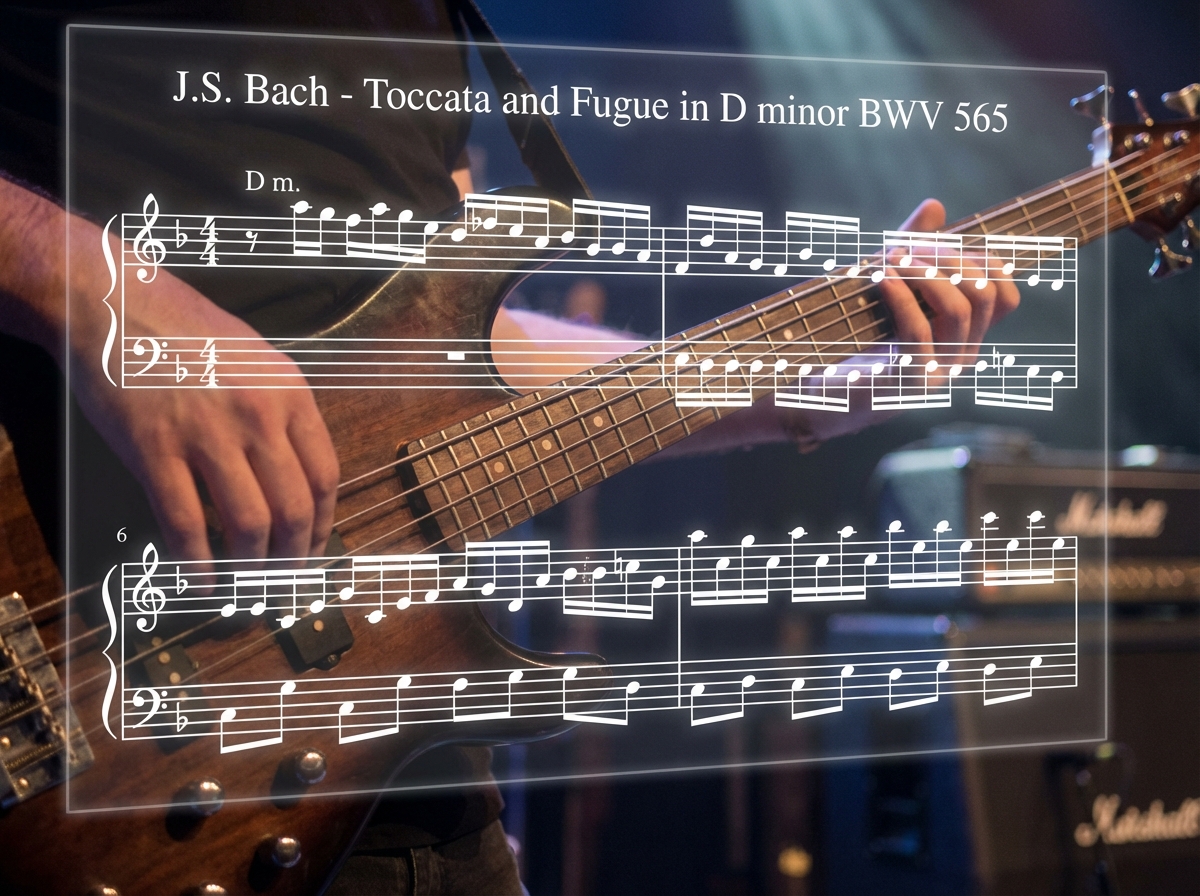
The first time I heard this piece played on an electric bass — not organ, not guitar, bass — something shifted. That low-end growl carrying one of the most recognizable melodies in Western music felt almost illegal. I needed to learn it.
If you’re looking to learn Bach’s Toccata and Fugue in D minor on bass guitar, the short answer is: it’s absolutely playable as a solo arrangement on electric bass, and it will teach you more about music theory, minor keys, and melodic-harmonic thinking than almost anything else you could pick up. The piece covers natural, harmonic, and melodic minor in a single performance — not as theory exercises, but as living, breathing music.
- This arrangement works best if you already play electric bass and can navigate the full neck — you don’t need to be advanced, but you do need basic fretboard fluency.
- The biggest gains come not just in technique but in understanding why Bach’s melody and harmony connect — knowledge that transfers to every style of bass playing.
- Expect to invest several weeks of focused practice across three distinct learning phases before you can perform the piece end-to-end.
What Toccata and Fugue in D Minor Actually Is
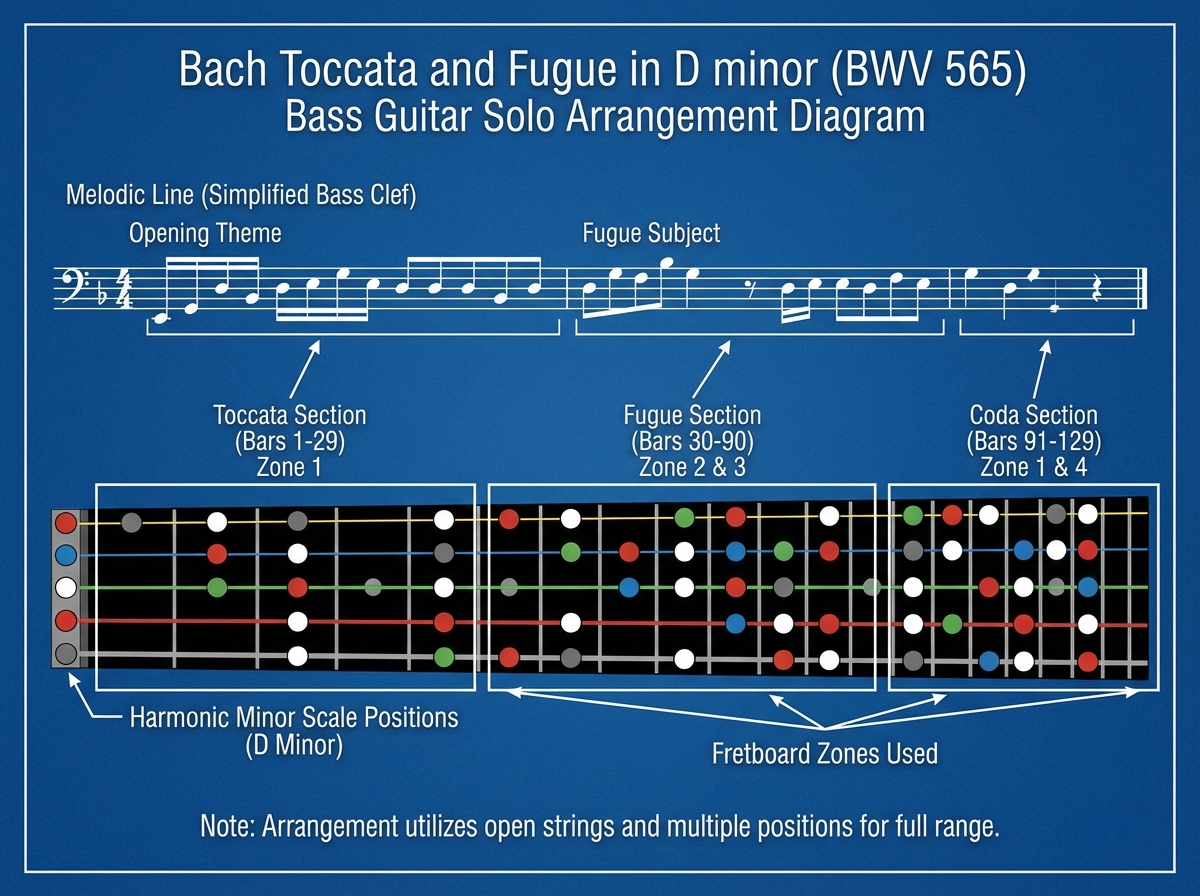
BWV 565 is a two-part keyboard work by Johann Sebastian Bach — a Toccata (a free-form, improvisatory opening) followed by a Fugue (a structured, voice-led development). Originally written for organ, its opening phrase is one of the most instantly recognized in all of classical music. The descending line that opens the Toccata is deceptively simple; the Fugue that follows is a masterclass in how a single short theme can be stretched, inverted, and restated across multiple voices.
On bass guitar, the solo arrangement collapses those multiple voices into a single instrument. That’s where it gets interesting — and hard.
| Element | In the Original | On Bass Guitar |
|---|---|---|
| Toccata opening | Single-voice flourish, doubled at octave | Single-string runs across the neck |
| Harmonic language | Diminished 7ths, D minor triads | Same chords, voiced across adjacent strings |
| Fugue voices | 3–4 independent lines | Implied through melodic phrasing and dynamics |
| Scale basis | Natural + harmonic minor | Same — played in position across neck |
Three Things That Will Surprise You Before You Start
- The opening four notes are easier than they look — it’s the resolution that trips everyone up.
- Harmonic minor is not just a theory concept here; you hear the raised 7th the moment you play it wrong.
- The Fugue is slower and more forgiving than the Toccata, not the other way around.
How Long This Actually Takes
| Stage | Content | Time |
|---|---|---|
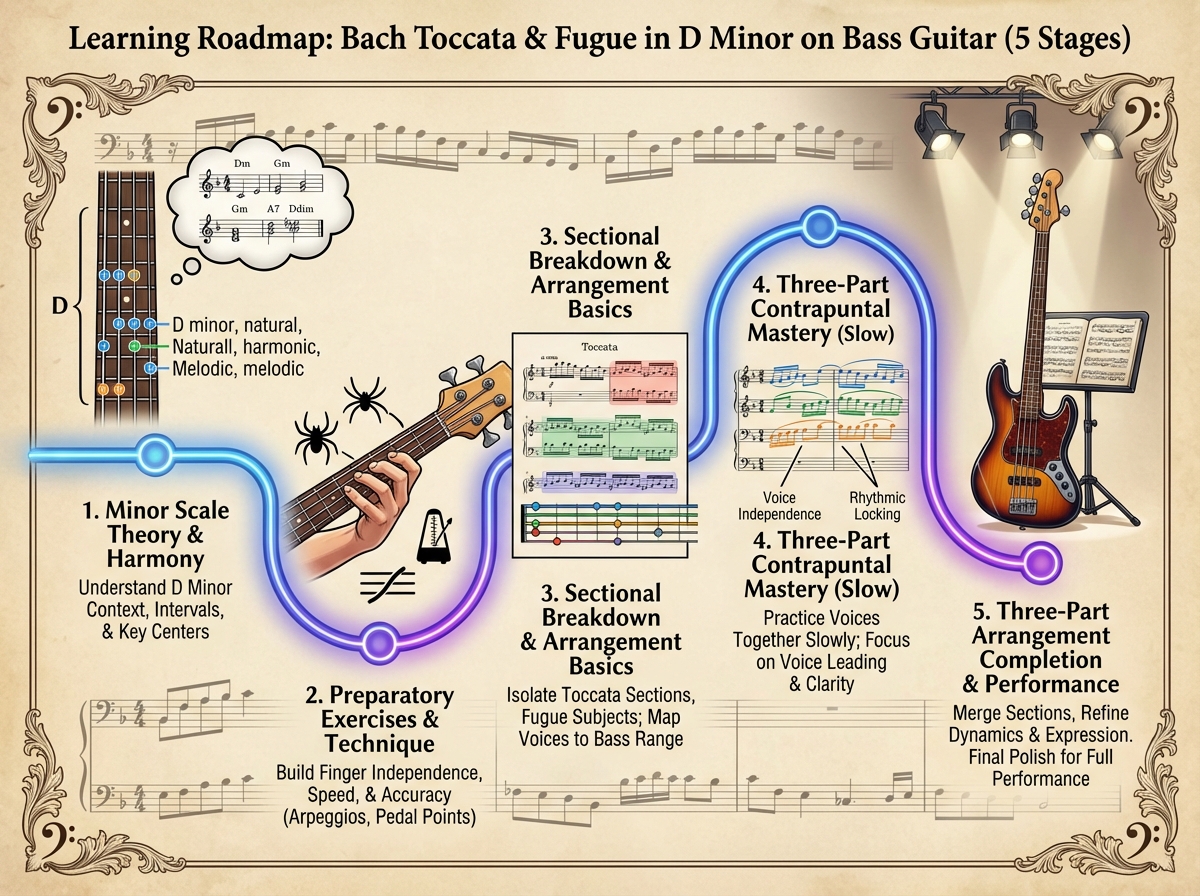
| Foundation | Minor scales (natural, harmonic, melodic) + harmonization basics | 1–2 weeks |
| Preparatory exercises | Technical drills, position shifting, right-hand articulation | 1–2 weeks |
| Part 1 — Toccata opening | First section of the arrangement with TAB | 2–3 weeks |
| Part 2 — Toccata continuation | Mid-section figurations and modulation to A minor | 2–3 weeks |
| Part 3 — Fugue | Theme statement, development, and full-piece run-through | 3–4 weeks |
| Total | Full BWV 565 arrangement performance-ready | 9–14 weeks |
The order matters more than the pace — skipping the minor scale harmonization section to jump straight to the fun part is exactly how you end up with hands that play the notes but ears that don’t understand the music. And if it takes you twenty weeks instead of fourteen, that’s not failure — that’s what learning a Bach arrangement on a non-keyboard instrument actually looks like.
Why the Minor Scales Section Feels Like a Detour (It Isn’t)
Every bassist I’ve talked to who tried to skip straight to the TAB hit a wall around measure 12 of the Toccata. Not a technical wall — a musical one. They could play the notes, but when they hit the passage where the harmony shifts and the raised 7th of harmonic minor suddenly appears, it felt random. Out of nowhere. Like a mistake.
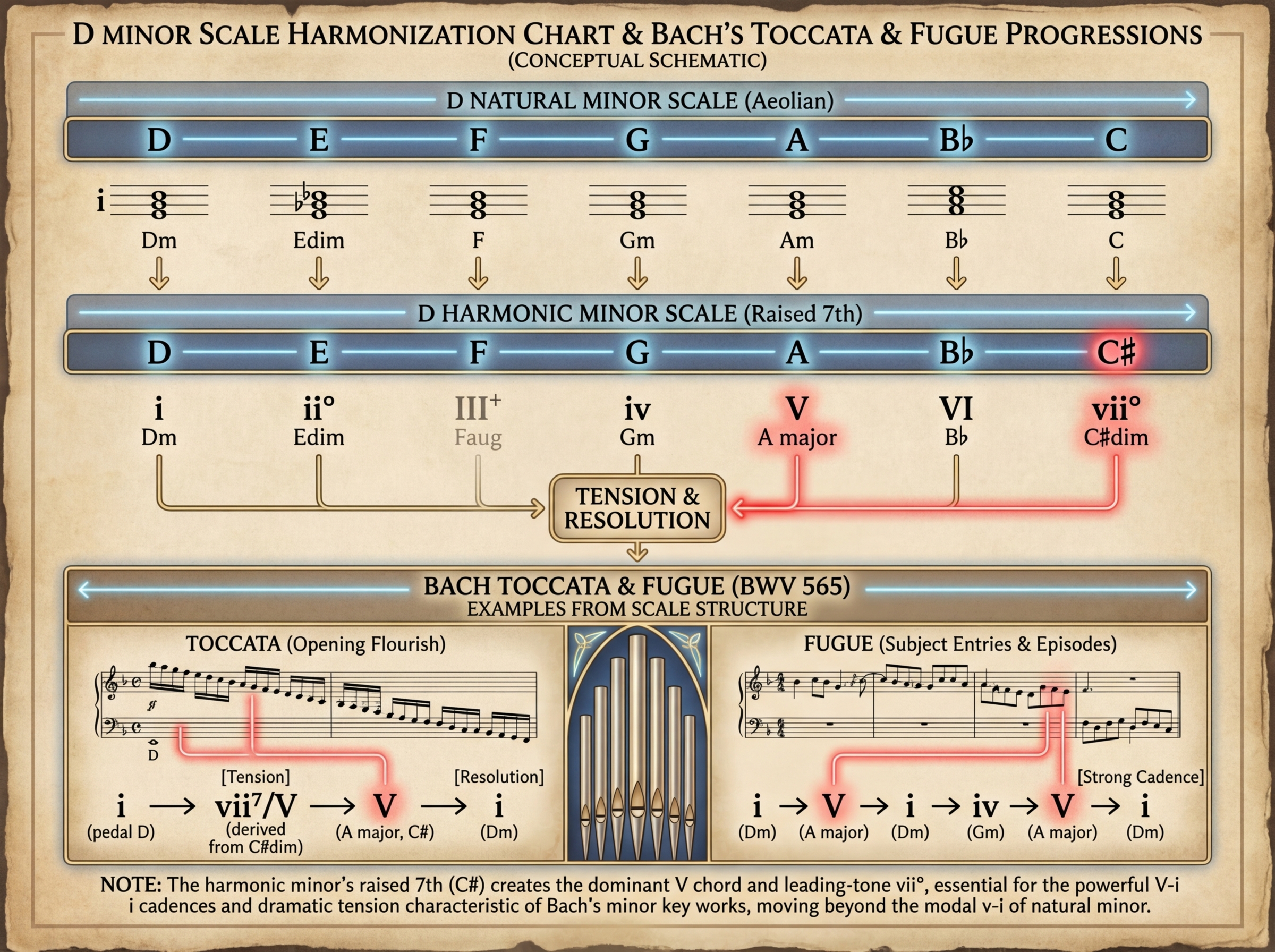
That moment — that confusion — is what the minor scale foundation is designed to prevent. When you’ve spent time learning natural, harmonic, and melodic minor not as abstract fingering patterns but as sounds with personalities, that raised 7th in the Toccata stops being a surprise. You hear it coming. You lean into it.
The harmonization work is even more revealing. When you go through the D minor scale and start building chords on each degree — seeing which chord is major, which is diminished, which minor — you start to hear Bach not as a composer writing difficult passages but as someone following the logic of the key with total inevitability. Nothing in BWV 565 is arbitrary. Once you understand the harmonic minor scale’s relationship to the dominant chord, the way the piece resolves starts feeling like gravity rather than notation.
This is the section that upgrades your ears, not just your hands. And upgraded ears make every other section faster to learn.
The Preparatory Exercises Reveal Every Weakness You Have
The biggest mistake people make when approaching a classical arrangement on bass guitar is treating it like a bass line. A bass line lives in a band — it’s supported by drums, guitar, keys. A solo arrangement of Bach lives alone. Every note is exposed. Every hesitation in your right hand reads as a rhythmic flaw. Every missed shift reads as a pitch flaw.
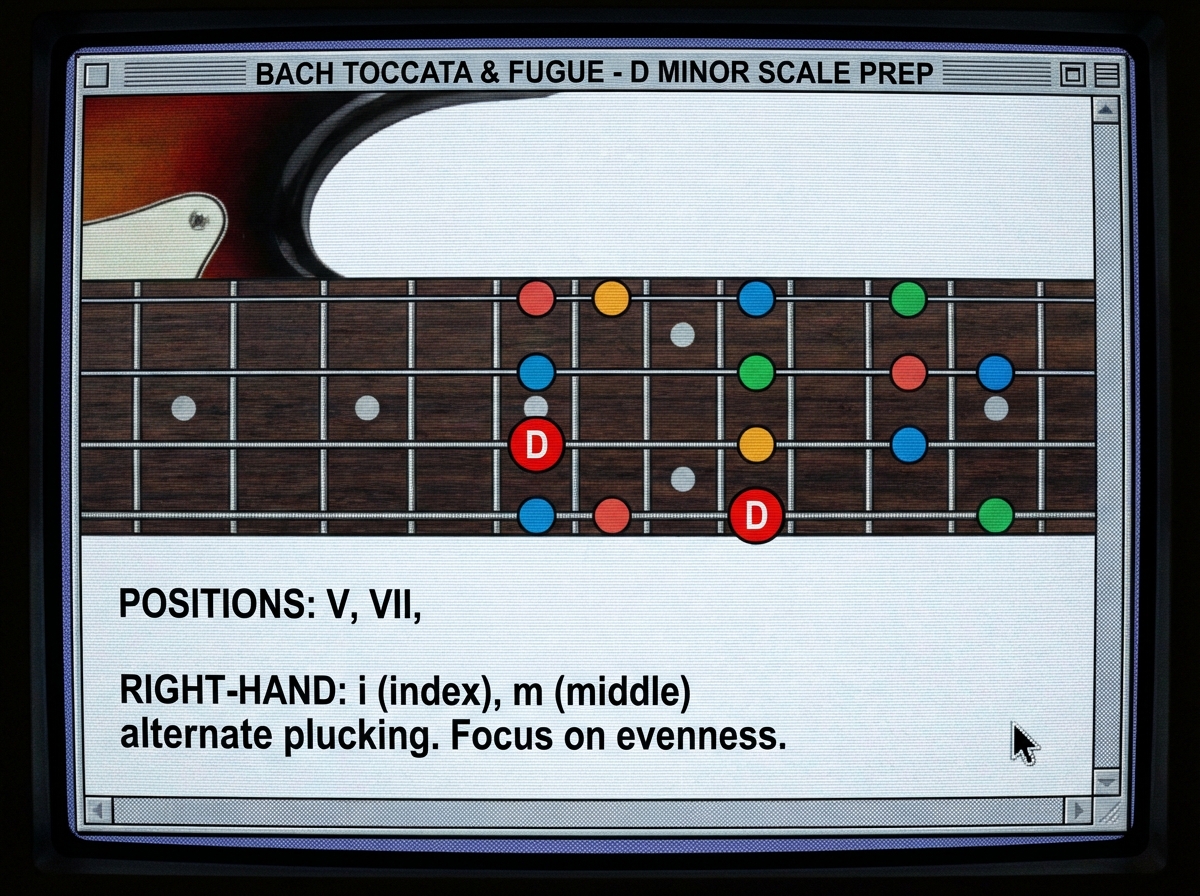
The preparatory exercises — the scales played in position, the chromatic work, the shifting drills — exist to give you the physical vocabulary the arrangement demands. What’s less obvious is that they also teach you phrasing. Classical music breathes in phrases, not riffs. A scale exercise played musically, with a slight crescendo on the way up and a controlled decay on the way back down, is teaching you how to shape the Toccata’s opening flourish before you even touch the actual piece.
The right-hand articulation work hits especially hard here. On bass, you have choices that an organist doesn’t — you can dig in with your fingertip for a bright, cutting tone, or roll slightly to the flesh for warmth. BWV 565 wants both. The Toccata opening calls for attack; the Fugue theme asks for roundness. Developing that range in a preparatory context means you’re not making those decisions mid-performance for the first time.
Learning the Toccata: Where the Arrangement Really Lives
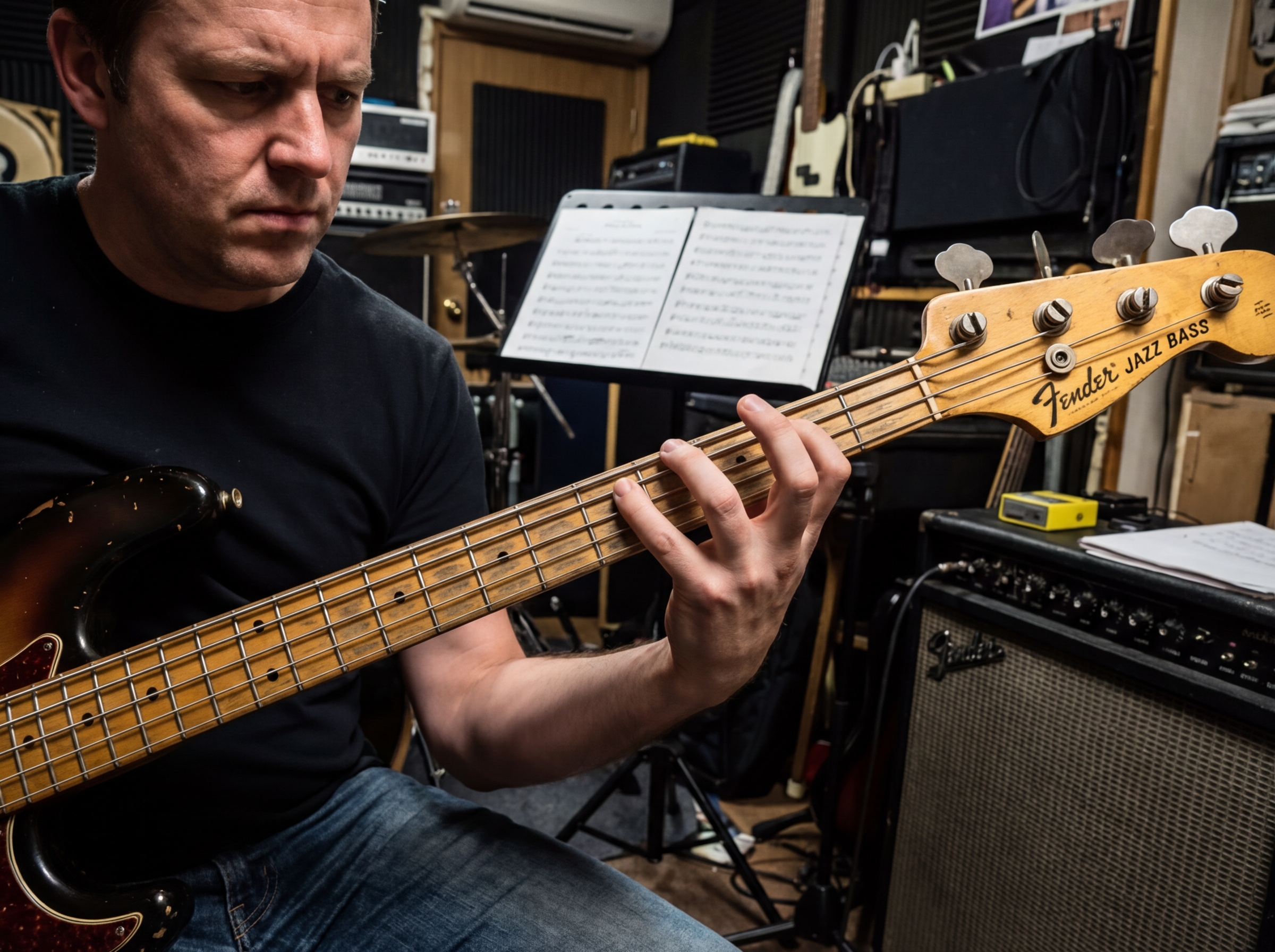
The Toccata opening — that iconic descending run — is split between what feels like multiple registers on the bass. On organ it cascades from treble to bass; on the electric bass, you’re tracking that same contour but across strings and positions rather than pitch ranges. The first time it sits under your fingers correctly, with the right fingering so that each note rings cleanly into the next, the piece stops feeling like a transcription and starts feeling like it was written for this instrument.
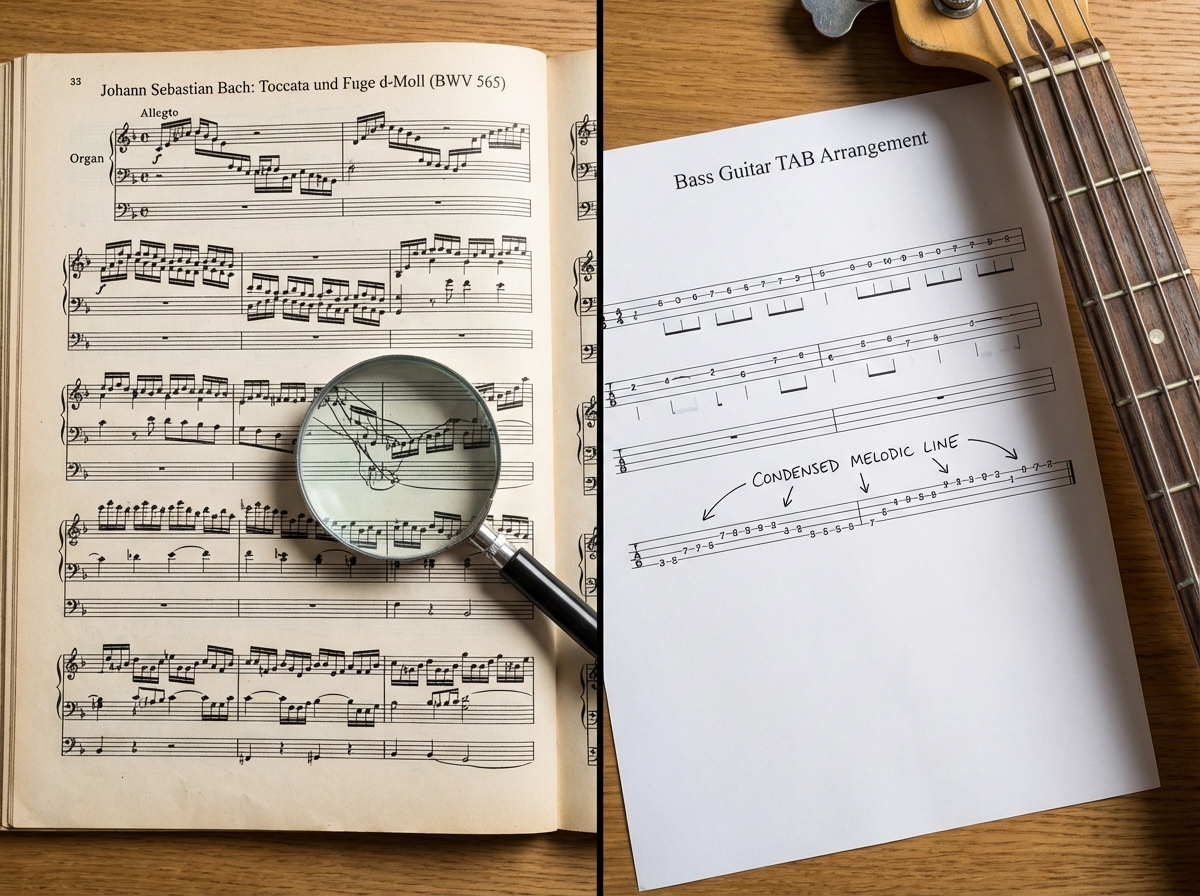
Part 1 of the arrangement covers the opening flourish and the first substantial section of the Toccata. The PDF with TAB and score is non-negotiable here — not because you can’t work out the notes by ear, but because the fingerings are the lesson. The choices made in how to execute a run — which string, which finger leads, where the position shift happens — are what separates a version that sounds labored from one that sounds inevitable.
Part 2 introduces the mid-section of the Toccata, where the harmony moves toward A minor before returning. This is the section with the passage doubled at the sixth — a technical challenge that, once solved, is also the most satisfying thing to play in the entire piece. The doubling creates a sudden thickness, an almost orchestral swell, that a single bass line doing a Bach arrangement has no business producing. When it lands, it’s genuinely surprising.
The Fugue Is Where Music Theory Becomes Audible
Most people are nervous about the Fugue. The word sounds academic, multi-layered, intimidating. And technically, yes — a fugue is a piece built on the imitation of a theme across multiple voices. On a single-line instrument like bass, you’re not playing three simultaneous voices. You’re implying them through phrasing, dynamics, and timing.
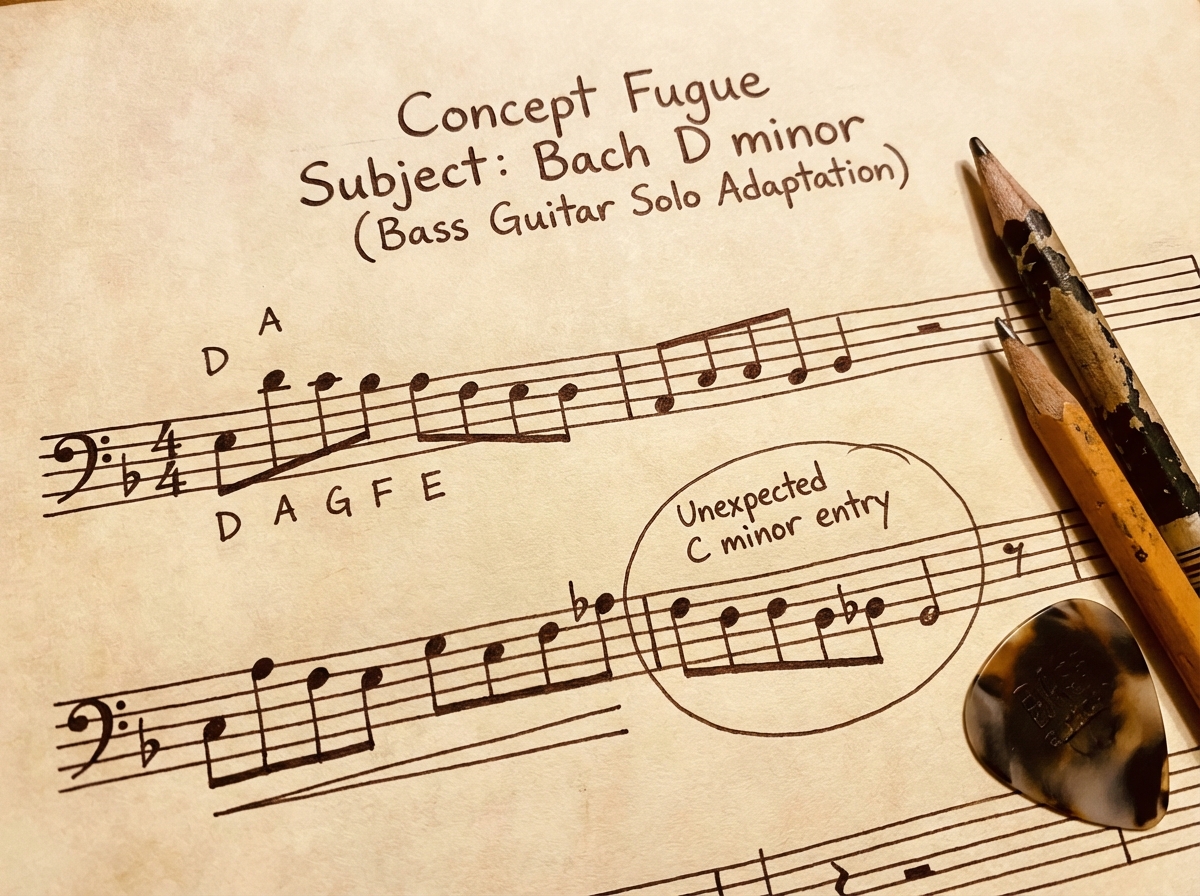
What actually happens when you learn to play the Fugue theme on electric bass is that you start hearing how melody and harmony are the same thing stated differently. The Fugue subject in D minor is just a few notes — but every time it reappears in the piece, the surrounding harmony recontextualizes it. When it enters unexpectedly in C minor (an unusual move even for Bach), it doesn’t feel wrong. It feels inevitable. Because by the time you’ve worked through the harmonization exercises and the Toccata, you understand the language well enough to hear where the grammar is being bent.
Part 3 of the arrangement carries through the Fugue development and brings the piece to its conclusion. The final section returns to the free Toccata style — a full-circle moment that, once you’ve learned the whole piece, carries genuine weight. You’ve earned that ending.
What Changes After You Can Play This
Learning Bach’s Toccata and Fugue in D minor on bass guitar changes the way you hear music. That’s not hyperbole. When you’ve spent weeks inside the harmonic logic of BWV 565 — understanding why the raised 7th creates tension, why the Fugue subject in the subdominant sounds unusual, why the chord inversions in the harmonization feel like voice leading rather than just chord changes — you start hearing those same patterns everywhere. In the bass line of a soul record. In the bridge of a pop song. In the chord substitution a jazz bassist throws in on a ii-V.
The electric bass solo arrangement of Bach Toccata and Fugue isn’t a party trick. It’s a functional upgrade to your musical intelligence. The theory you absorb learning this piece isn’t theory you studied — it’s theory you played.
Spend the first week only on scales, not the arrangement. Natural, harmonic, and melodic minor in D — play them slowly, listen to the difference between the versions, particularly where the 6th and 7th degrees change. Your ear needs this map before your hands need the TAB.
Practice the opening run in three-note fragments, not as a full sweep. The Toccata opening fails because people try to play the whole descending line before each fragment is secure. Lock in the first three notes, add the fourth, then the fifth. The full run assembles itself.
Use the TAB fingerings exactly as written before experimenting. The fingering choices in a well-arranged classical transcription encode years of thought about what is sustainable at tempo. Override them only after you can play the section cleanly.
Record yourself on the phone and listen back immediately. Your ear while playing filters out the flaw; the recording does not. You’ll hear hesitations in the Toccata phrasing and unevenness in the Fugue theme that are invisible while you’re playing.
Learn the harmonic minor scale harmonization before Part 2. The mid-section of the Toccata makes harmonic sense only if you understand why the chord built on the 5th degree of harmonic minor is major (not minor). Forty-five minutes on this saves hours of confusion later.
Practice the doubled-sixth passage slowly enough that each note is equally weighted. The tendency is to accent the upper note and blur the lower. The passage needs balance — both notes the same volume, the same length.
Map the Fugue subject by itself across the neck. Play the Fugue theme as an isolated phrase in three or four positions. Understanding how it sits in different parts of the neck prepares you for its multiple entries across the Fugue section.
Don’t perform it until the Fugue section is as comfortable as the Toccata. The instinct is to show people the dramatic opening. But the Fugue is where the musical understanding lives. If you’re shaky there, the full performance doesn’t land.
Leave a Reply