


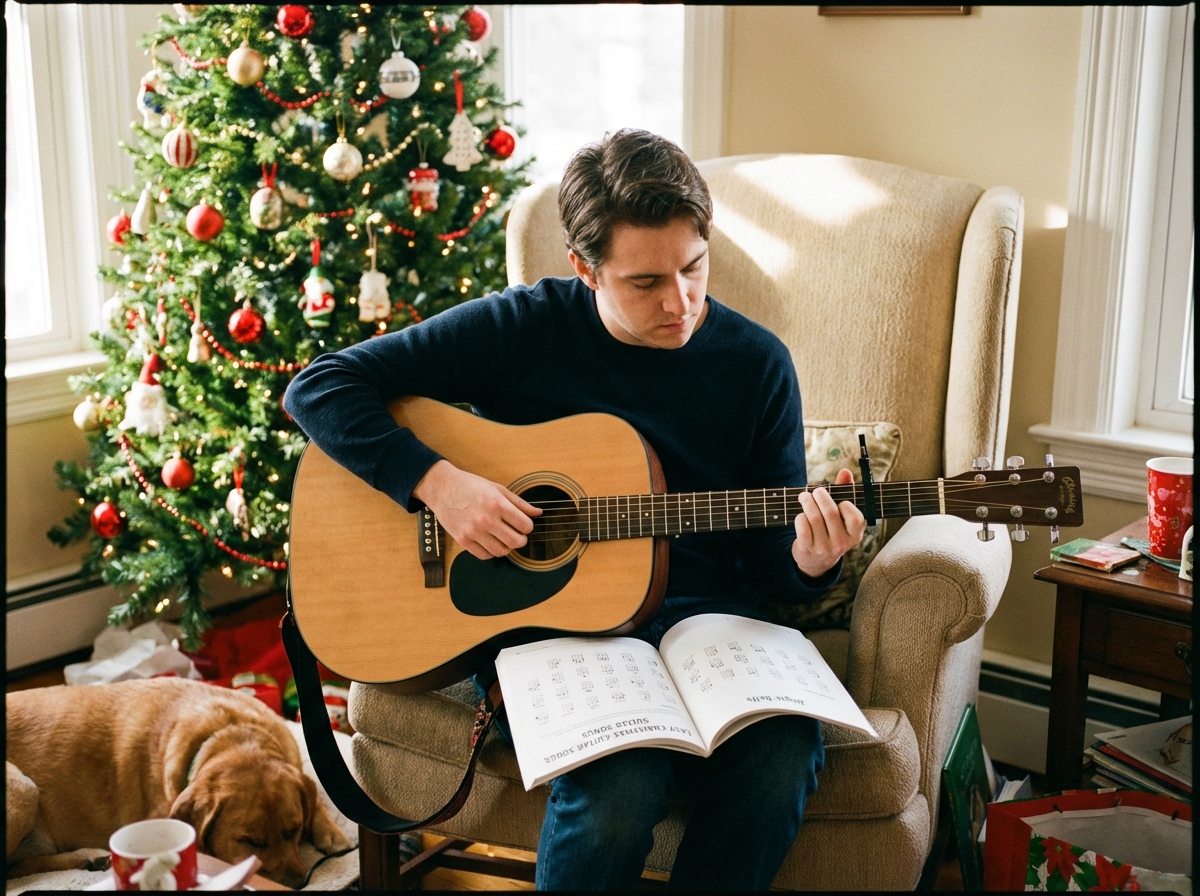
The guitar was sitting in the corner of the room, barely touched since the summer. Then December arrived, and suddenly every family gathering had someone pulling out an instrument and expecting you to join in.
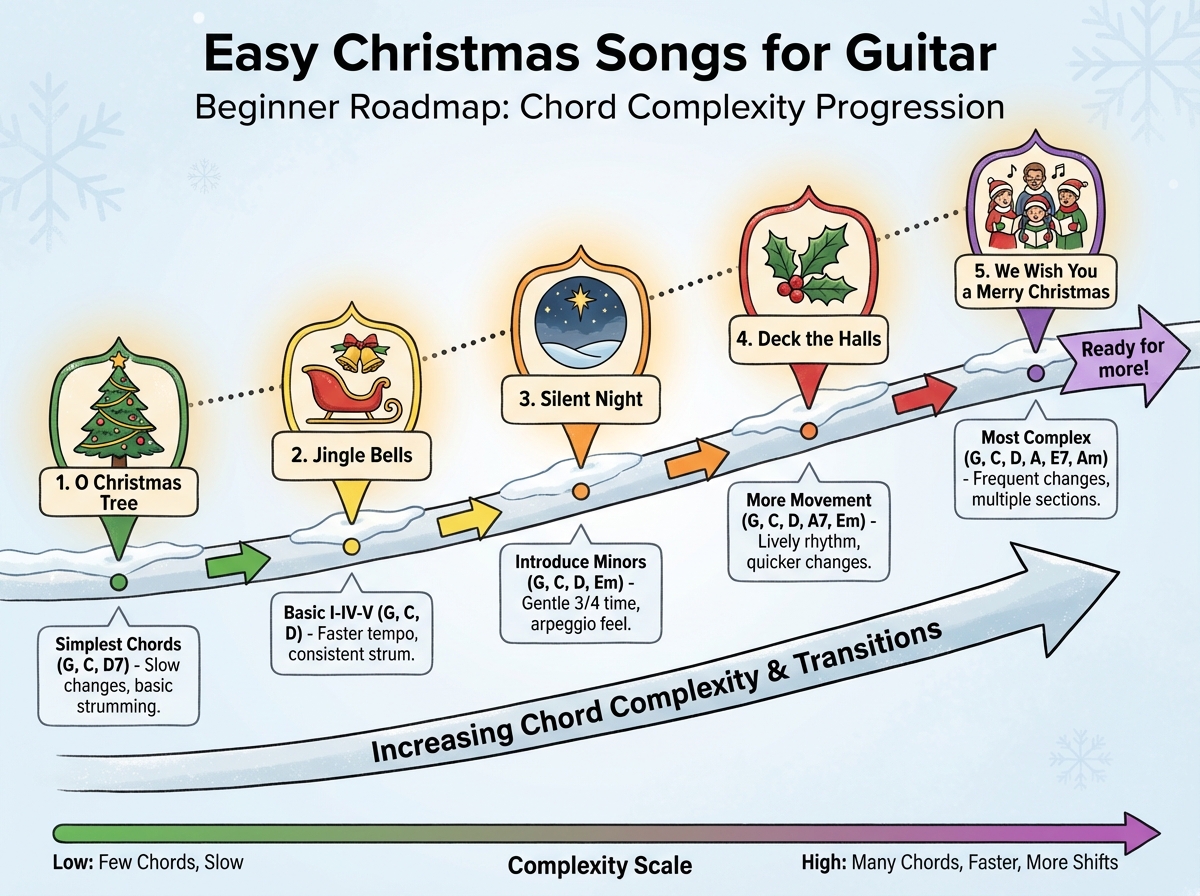
If you’re looking to learn easy Christmas songs for guitar, the honest truth is that five classics — O Christmas Tree, Jingle Bells, Silent Night, Deck the Halls, and We Wish You a Merry Christmas — can all be learned using open chords that an absolute beginner can form within a few days. The entire repertoire is built on a small, shared family of chord shapes, and the strumming patterns repeat across songs in ways that compound your progress rather than reset it each time.
- You don’t need any prior guitar experience — if you can form a basic open chord, you can play these songs before Christmas arrives
- The biggest obstacle isn’t finger strength or music theory — it’s not knowing which songs share chords, so you keep restarting from zero
- Playing along to a steady beat, even at slow tempo, is what separates someone who “knows” the song from someone who can actually perform it
What “Easy” Actually Means on Guitar
When people say a song is easy for guitar, they usually mean one of three things: it uses open chords (no barre chords), the chord changes are slow enough to prepare for, or the strumming pattern is simple enough to stay consistent under pressure. The best beginner Christmas songs for guitar hit all three conditions at once.
| Song | Time Signature | Core Chords | Chord Changes Per Bar |
|---|---|---|---|
| O Christmas Tree | 3/4 | G, D7, C | 1–2 |
| Jingle Bells | 4/4 | G, C, D7 | 1–2 |
| Silent Night | 3/4 | G, D7, Em, C | 1–2 |
| Deck the Halls | 4/4 | G, D7, C, Em | 1–2 |
| We Wish You a Merry Christmas | 3/4 | G, C, D7, Em, A7 | 1–2 |
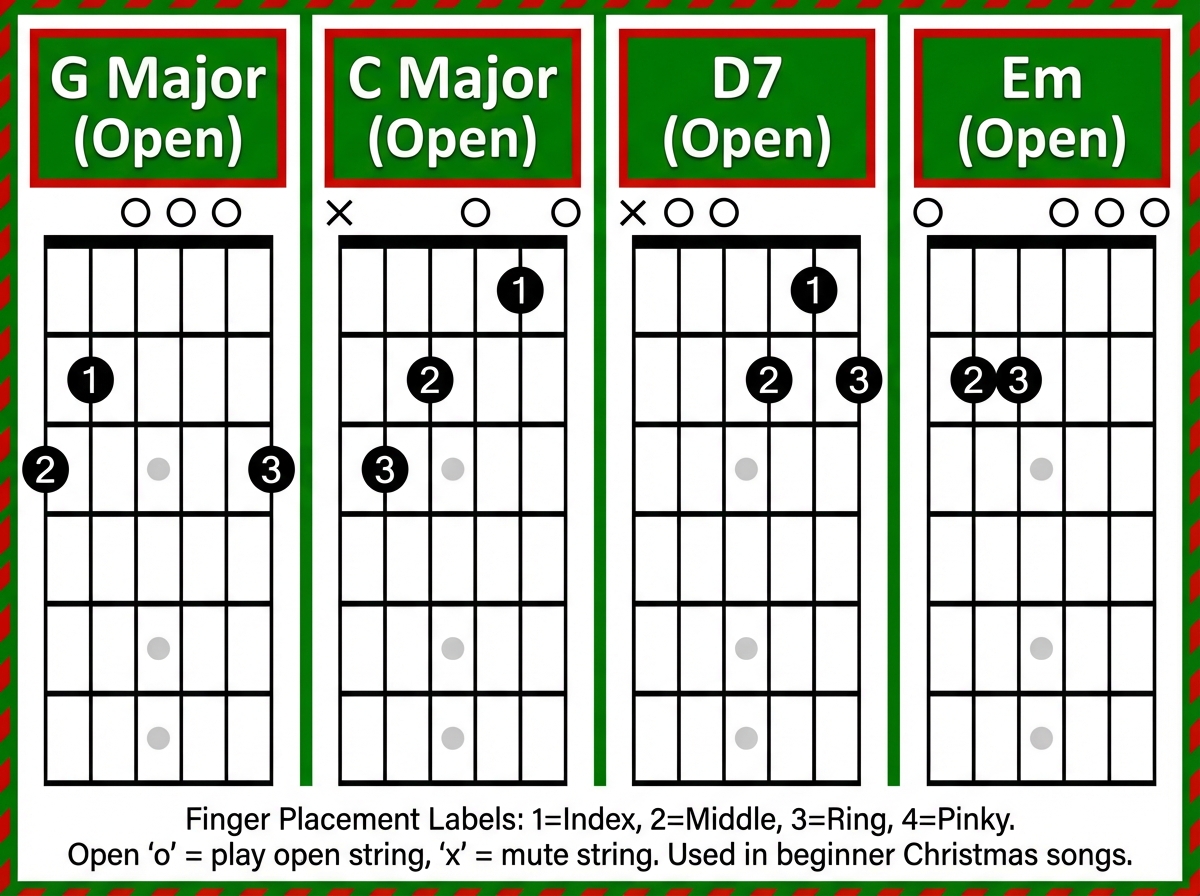
Notice something? These five songs share almost the same chord set. If you learn G, C, D7, and Em, you have the foundation for the entire Christmas playlist. That’s the insight most beginners miss when they search for individual song tutorials instead of treating the songs as a system.
The Biggest Mistake Beginners Make Right Away
Most people who try to learn easy Christmas songs for guitar start by learning the chord shapes in isolation — they can hold a G chord, hold a C chord, but the moment they try to switch between them mid-song, everything collapses. They stop strumming, stare at their fingers, find the next chord, start again. What they’re doing is practicing pausing, which means they get very good at stopping.
The fix is uncomfortable at first: keep the strumming hand moving even when the fretting hand hasn’t landed yet. Mute the strings if you need to. An muted beat inside the song is far less disruptive than a dead stop, and it trains the timing part of your brain to stay in charge instead of handing control over to the fingers. Once the strumming hand leads and the fretting hand follows, changes start to snap into place on their own.
The other mistake is treating every song as a separate project. Because Jingle Bells and O Christmas Tree share so much harmonic ground, learning one properly is essentially a head start on the other. When you see the songs as a family rather than five individual challenges, you stop feeling like you’re behind.
How the 3/4 Songs Caught Me Off Guard
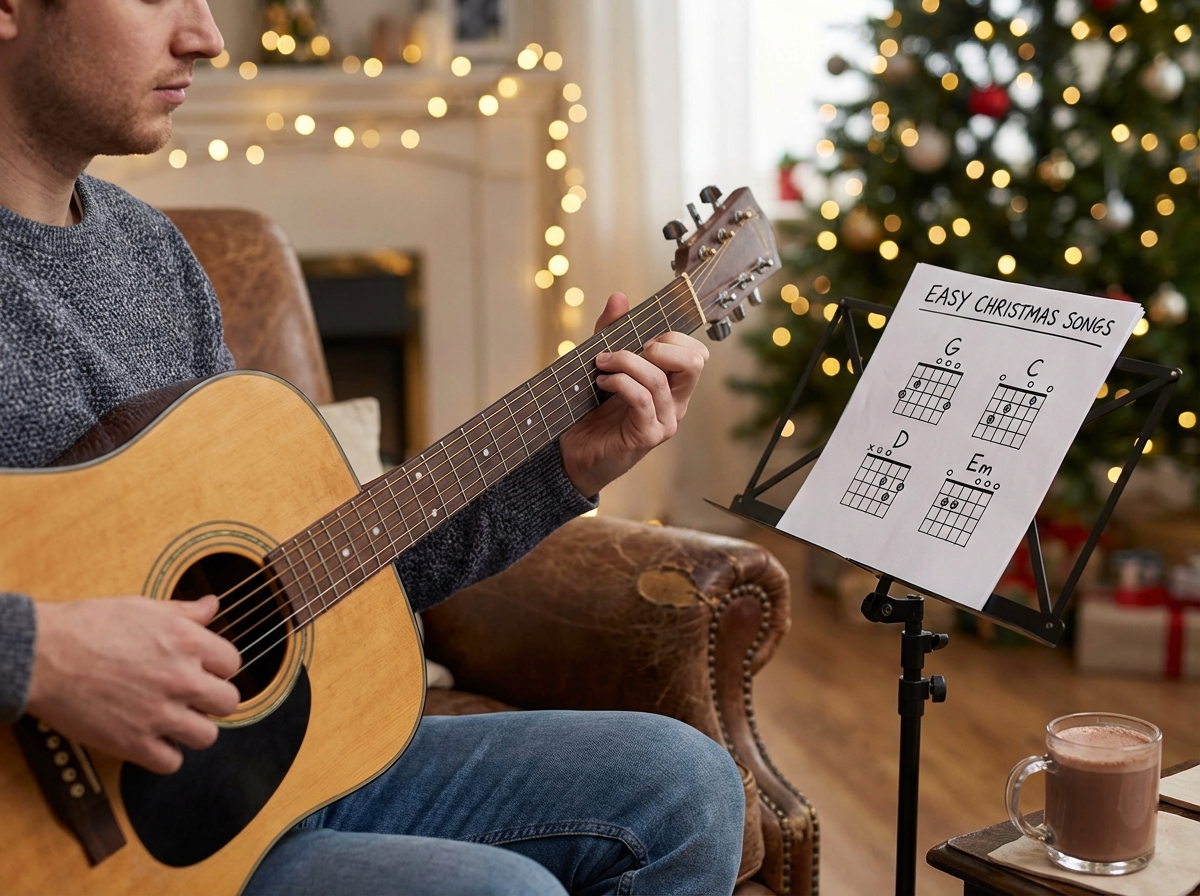
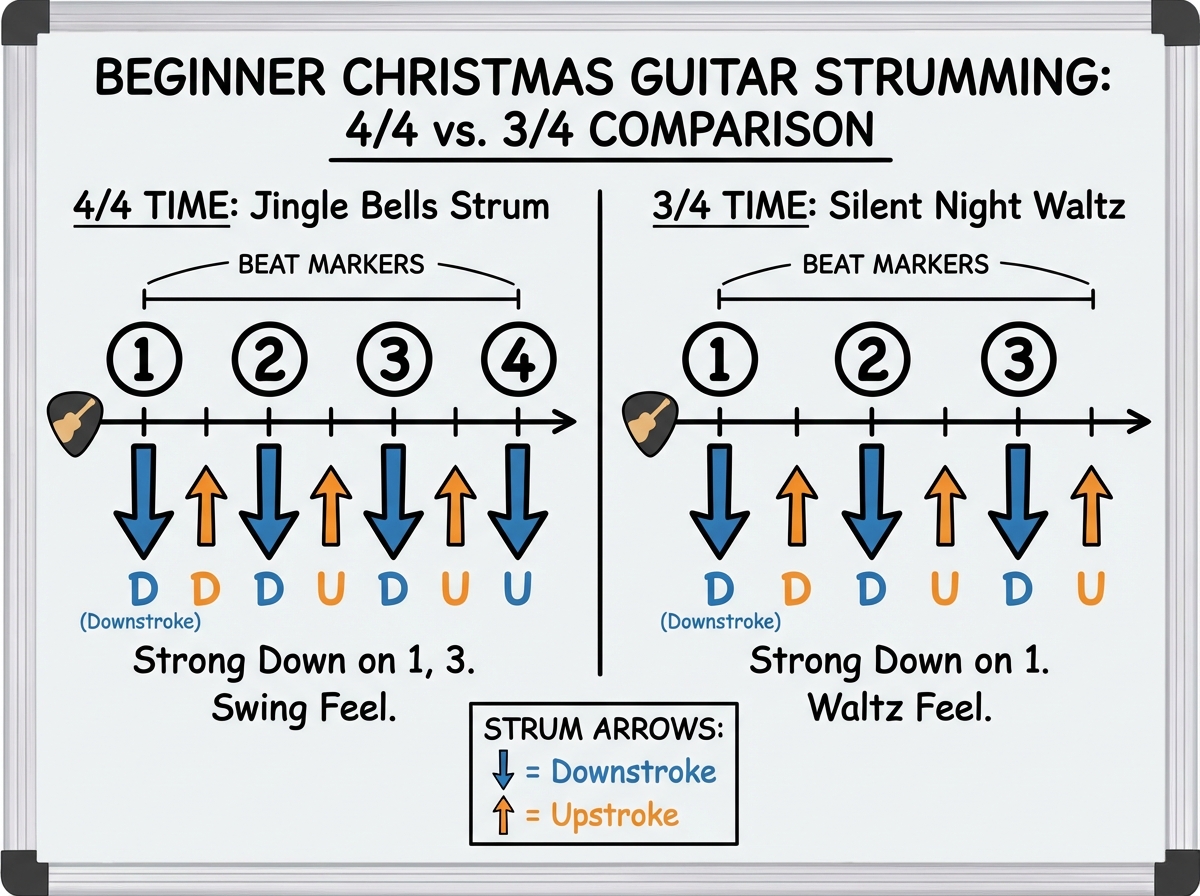
Jingle Bells sits in 4/4, which means four beats per bar, and most beginners have an intuitive feel for it from pop music. Then you try Silent Night or O Christmas Tree, and something feels off. You’re counting to four when the song is built around three, and the downstrum that felt natural a moment ago is now landing in the wrong place.
The switch to 3/4 — waltz time — is one of those moments where the music briefly stops making sense before it clicks. The strumming pattern changes to three beats per bar instead of four, usually played as down-down-up or simply down-down-down at the beginning. Once your body internalizes the “one-two-three, one-two-three” pulse, these songs start to feel like they’re breathing differently — more circular, less marching. That feeling is the 3/4 groove locking in.
Practice switching between a 4/4 song and a 3/4 song back to back. The contrast sharpens both. After a few sessions moving between Jingle Bells and Silent Night, you’ll stop counting altogether and start feeling which time signature you’re in.
What “Deck the Halls” Teaches You About Momentum
Deck the Halls moves faster than the other four songs in this collection, and that speed is actually a gift for beginners — it forces you to stop overthinking chord transitions. When the tempo is slow, like Silent Night, there’s enough silence between changes to spiral into self-correction. Deck the Halls doesn’t give you that luxury. You either move with it or fall behind.
The song also introduces a small chord you might not have built much muscle memory for yet: Em. It shows up in a sequence where the chord change needs to be decisive rather than precise. Here’s what I noticed after spending time with this song — the Em transition stopped being difficult once I committed to it fully rather than reaching for it tentatively. Half-hearted chord changes sound worse than fully committed imperfect ones.
Deck the Halls is also the song where strumming dynamics start to matter. The “fa la la” sections beg to be played with more energy, and playing with intentional variation in volume — even just hitting those bars a little harder — is the difference between playing a chord sequence and actually playing the song.
The Play-Along Session Changes Everything
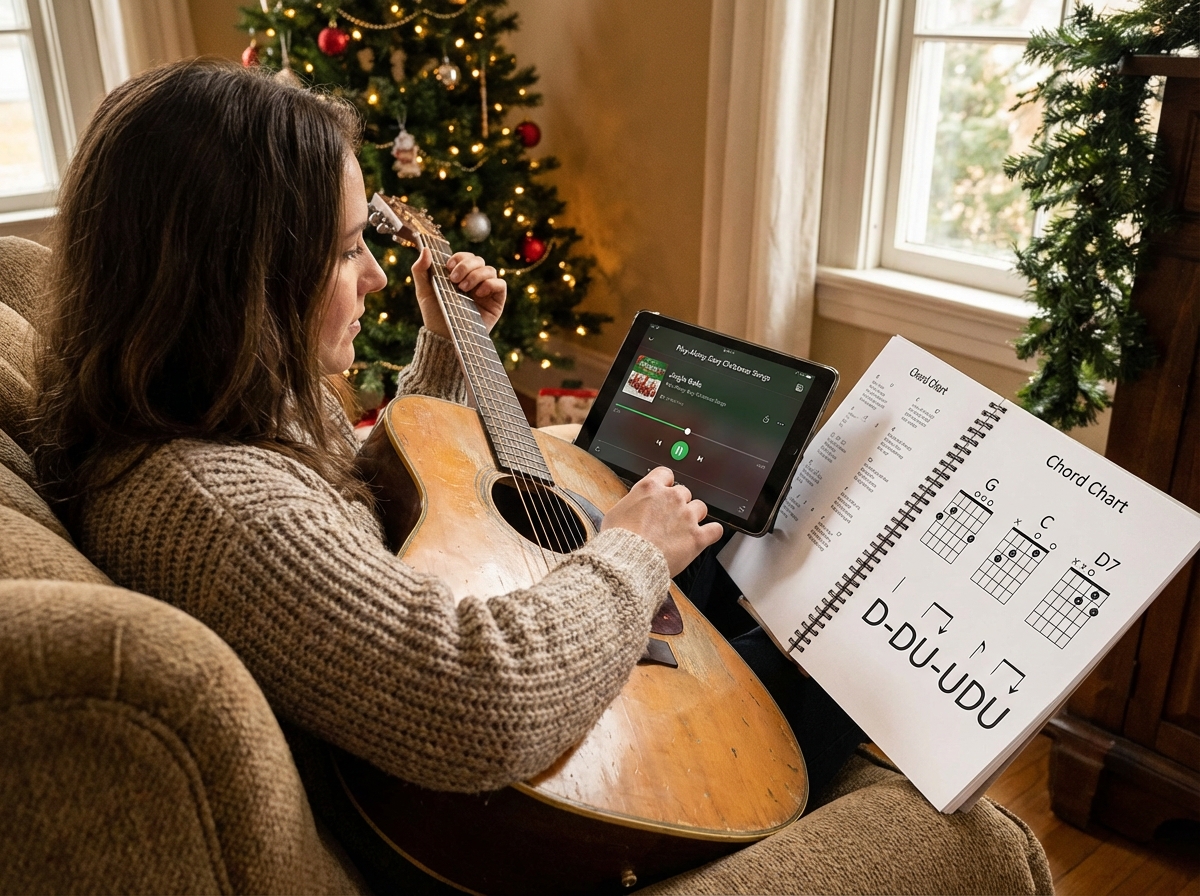
There’s a specific wall that every beginner hits when learning guitar from static chord diagrams: you can play the chords, you can do the strumming pattern slowly, but the moment you try to play the song as a song — with actual tempo, with the melody in your head, with other people around — everything tightens up and falls apart.
The solution is deceptively simple: play along to a steady pulse before you feel ready to. Set a metronome or back track at a comfortable speed — much slower than the original tempo — and play through the song continuously. Don’t stop when you miss a chord. Don’t restart from the beginning. Stay in the song and keep moving. The goal isn’t accuracy; it’s continuity.
This is what play-along practice does that solo practice cannot. It simulates the actual conditions of performing — there’s a beat, there’s forward motion, and stopping has a consequence. After a few of these sessions, the muscle memory starts to work during transitions instead of freezing. The chord changes become automatic because your brain has practiced them under time pressure, not just in a comfortable, stop-and-fix environment.
If you’re interested in how systematic music learning principles apply to other instruments, the same ideas about structured repetition and performance simulation show up in approaches like learning cajon through repetitive rhythmic foundations.
We Wish You a Merry Christmas and the A7 Surprise
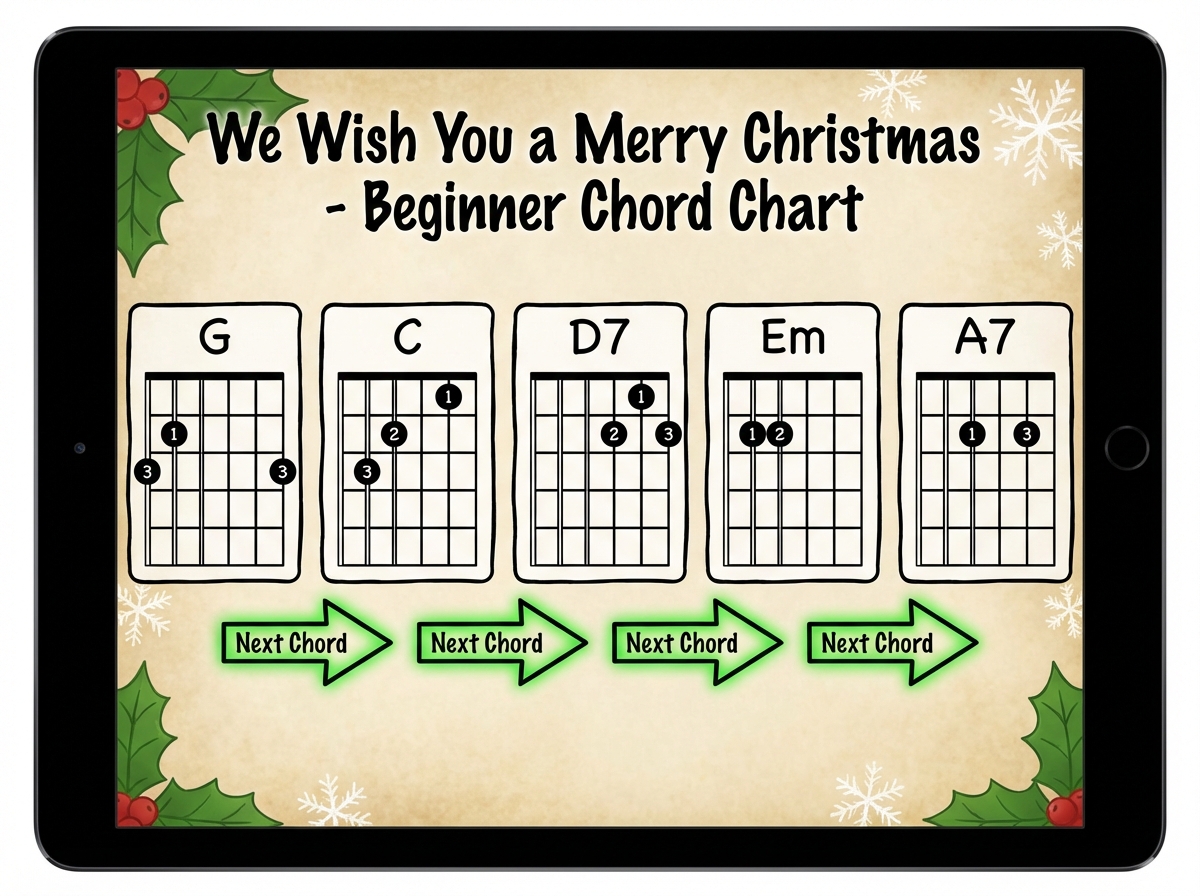
Of the five songs in this set, “We Wish You a Merry Christmas” is the one that quietly introduces the most chords — G, C, D7, Em, and A7. After spending time on songs that stay within three or four chords, this one feels slightly more demanding. The A7 chord appears and breaks the familiar pattern of the other songs.
A7 as an open chord is actually one of the more ergonomically friendly chords on the guitar — two fingers, comfortable spacing — but it feels foreign the first time simply because you haven’t seen it in this context before. The transition from Em to A7, which comes up in this song, is worth isolating and practicing as a two-chord loop for a few minutes before running the whole song. That short preparation makes the rest of the song feel manageable instead of shaky.
“We Wish You a Merry Christmas” also benefits enormously from playing it at a joyful tempo rather than a careful one. Slow it down to learn, but once you have the chords, the song needs energy to sound right. It’s the kind of carol that sounds worse at half speed, because the spirit of the song is built into its momentum.
How Long This Actually Takes
| Stage | Content | Time |
|---|---|---|
| Chord foundations | Learning G, C, D7, Em, A7 as individual shapes | 1–3 days |
| First song complete | O Christmas Tree with basic strumming | 2–4 days |
| Three songs running | Adding Jingle Bells and Silent Night | 5–10 days |
| Full set | All five songs playable with continuity | 2–4 weeks |
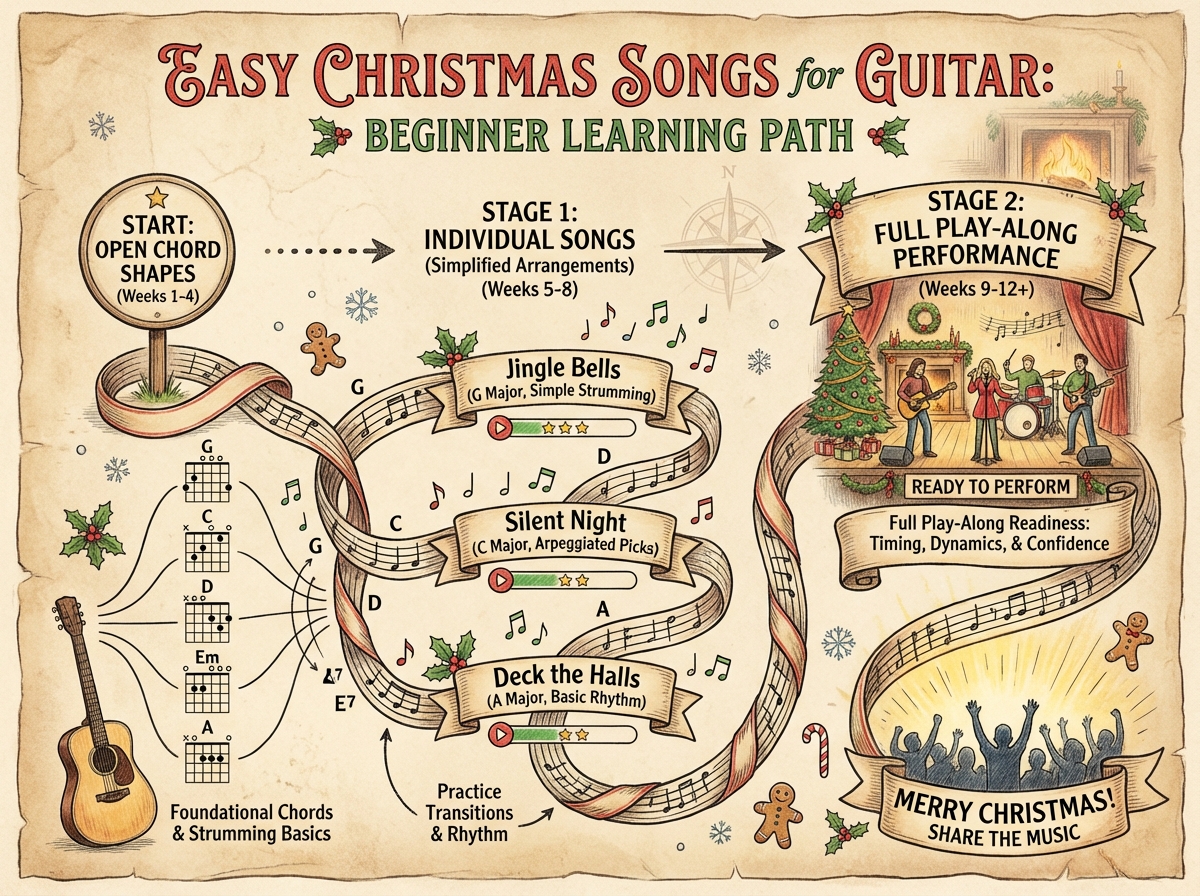
| Performance-ready | Smooth play-alongs at full tempo | 4–6 weeks total |
The order you practice these in matters more than how fast you move through them. Starting with the songs that share the most chords builds momentum; jumping between unrelated songs slows everything down. If you find yourself taking longer than these estimates, that’s normal — the plateau between “I can play the chords” and “I can play the song” is real, and it lifts when you stop practicing parts and start practicing performance.
The Extra Song That Proves You’ve Actually Learned Something
Once you’ve worked through the five core songs, there’s a natural moment of wanting to test whether you actually learned the skill or just memorized specific patterns. That’s where an additional song like “Up on the Housetop” becomes useful — it’s built on the same open chord vocabulary, but you haven’t drilled it specifically. If you can pick it up quickly based on what you already know, that’s evidence you internalized the system, not just the songs.
This is the difference between a beginner who knows five Christmas songs and a beginner who actually plays guitar. The first person can perform five things they’ve memorized. The second person can look at chord letters above a new song and figure it out. Getting to the second position is what everything in this set — the chord sharing, the play-alongs, the time signature switches — is quietly building toward.
The moment you see a new chord chart and think “I know most of these already” is when the guitar starts to feel like something you own rather than something you’re visiting.
What to Do Right Now
Tune your guitar before every single session. An out-of-tune guitar trains your ear to accept wrong pitch as normal, and that association is harder to undo than most beginners realize.
Learn G, C, and D7 before you touch a song. These three chords cover the majority of all five songs — build them first and the songs will feel like applying something you know, not learning something new.
Practice chord transitions in pairs, not full songs. Pick the two hardest adjacent chords in a song (G → D7 is common), loop them for two minutes, and then move to the next problem pair. Isolated transition drilling fixes issues that full-song practice just cycles over repeatedly.
Set your metronome to 60% of song speed when running a full play-through. Slow tempo locks in correct transitions before speed does, and it’s far more effective than playing fast and stopping to fix mistakes.
Keep the strumming hand moving even when a chord change isn’t ready. A muted beat maintains timing; a pause breaks it. This single habit accelerates progress more than almost anything else in the early weeks.
Spend at least one practice session per song doing nothing but the play-along. Not learning the chord shapes. Not fixing the strumming. Just running the song with a steady pulse from start to finish, staying in it no matter what. This is how your hands learn to perform rather than practice.
Work through the 3/4 songs and 4/4 songs in alternating sessions. The contrast between waltz time and standard time sharpens your internal rhythm in ways that playing one style only cannot achieve.
Learn “Up on the Housetop” without any preparation after completing the main five. Use it as a self-test. If you can figure out a new song using the same chords you already know, you’ve genuinely built something transferable — not just a holiday playlist.
Leave a Reply