


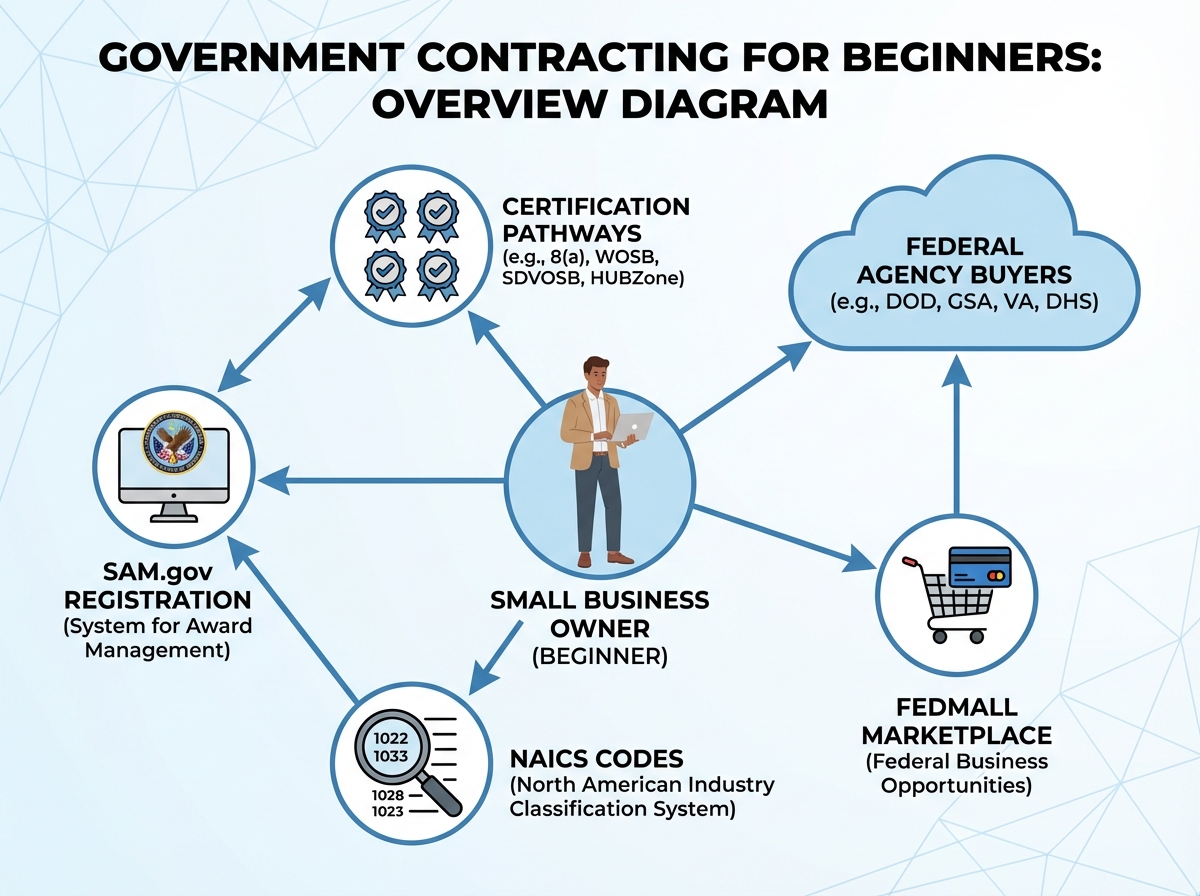
Nobody tells you upfront that the federal government is the single largest buyer of goods and services in the world — and that most of the businesses around you aren’t even trying to get a piece of it.
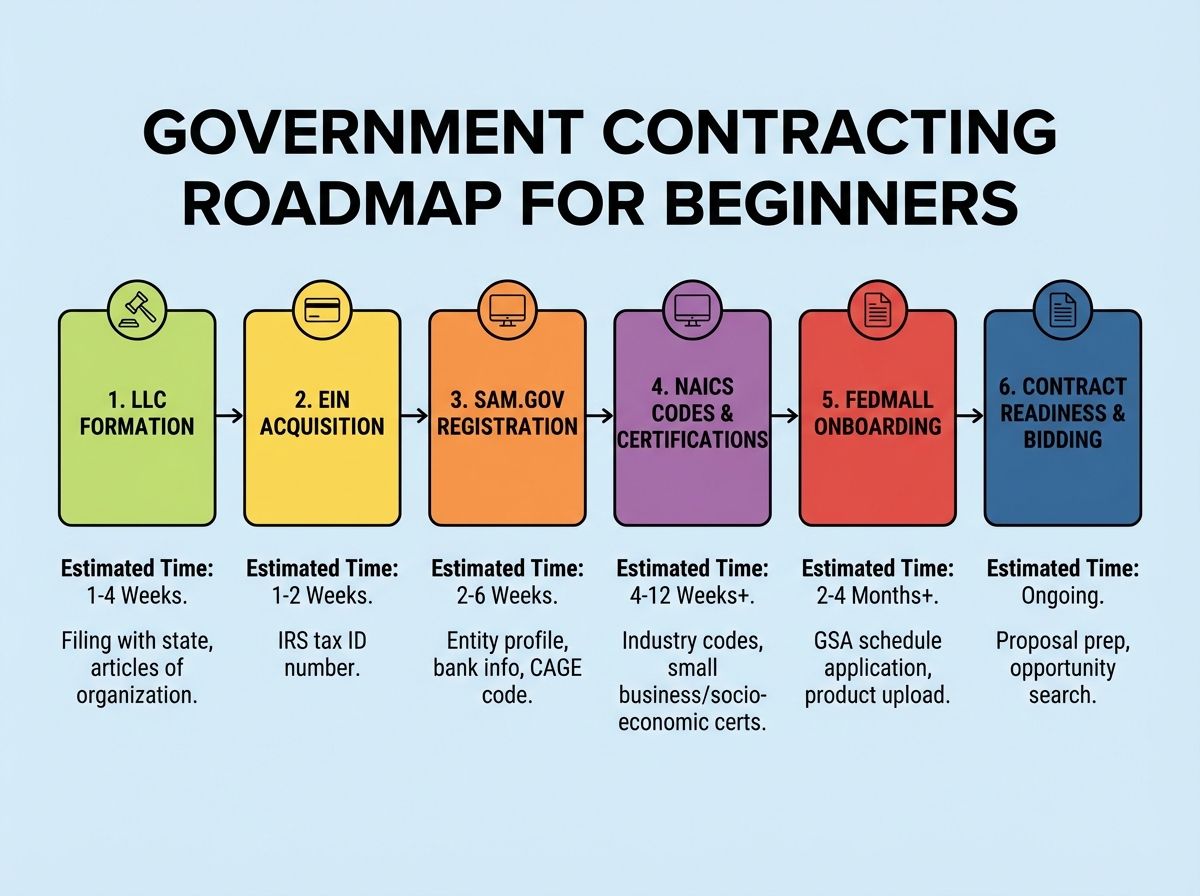
If you’re looking to learn government contracting, the honest answer is that it’s more accessible than it looks, but the paperwork maze stops most people before they ever submit a single bid. The process has a specific sequence — business formation, Tax ID, SAM registration, NAICS codes, certifications — and if you skip or misorder any step, you can’t get paid even if you win work. Once you understand the sequence, the entire system becomes navigable.
- Most beginners have the wrong starting assumption: they think you need industry connections or a physical office. You need neither.
- The registration stack (EIN → SAM → NAICS → FedMall) is the actual entry barrier — everything else is secondary.
- Dropshipping is a legal and practical fulfillment model for federal buyers, which means you can start without holding inventory.
What Government Contracting Actually Means for a Small Business
Government contracting is simply the act of selling products or services to a federal, state, or local agency under a formal agreement. For small businesses, the federal government sets aside a mandated portion of its annual spending — over $600 billion per year — specifically for small business vendors. You don’t need to be a defense contractor or a tech firm. Agencies buy office supplies, cleaning services, IT equipment, uniforms, food, and thousands of other everyday categories.
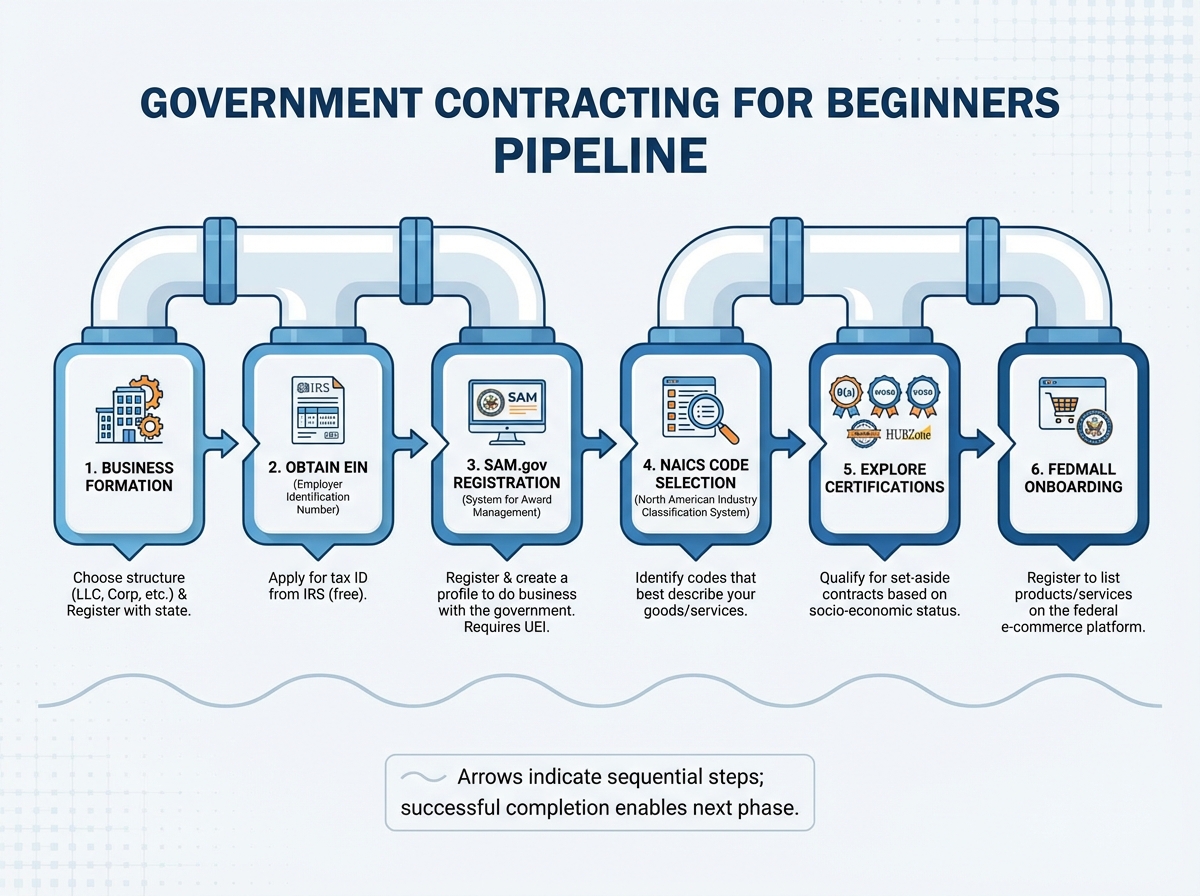
The confusion for most beginners is that “contracting” sounds like big RFPs and complex bids. In reality, many entry-level federal purchases happen through simplified acquisition channels like FedMall or micro-purchase thresholds, where the barrier is being registered and visible — not having the lowest price or the most impressive proposal.
| Channel | Best For | Typical Purchase Size |
|---|---|---|
| FedMall / DLA Marketplace | Product sellers, resellers, dropshippers | Under $10,000 (micro-purchase) |
| SAM.gov Opportunities | Service and product contracts | $10,000–$250,000+ |
| GSA Schedule | Established vendors with track record | $25,000+ |
| Set-Aside Contracts | 8(a), WOSB, SDVOSB certified businesses | Varies |
Three Things That Are True Before You Start
The federal government doesn’t care how long you’ve been in business. It cares whether you’re registered correctly.
Dropshipping is a fully legitimate fulfillment strategy in federal procurement. You don’t need a warehouse. You don’t need to hold inventory. What you need is a registered entity, the right codes, and a supplier who can ship on your behalf to a government address.
Over 98% of U.S. businesses have never attempted to sell to the federal government. That number isn’t a discouragement — it’s the whole point. The competition pool is dramatically thinner than any private-sector market you’re already competing in.
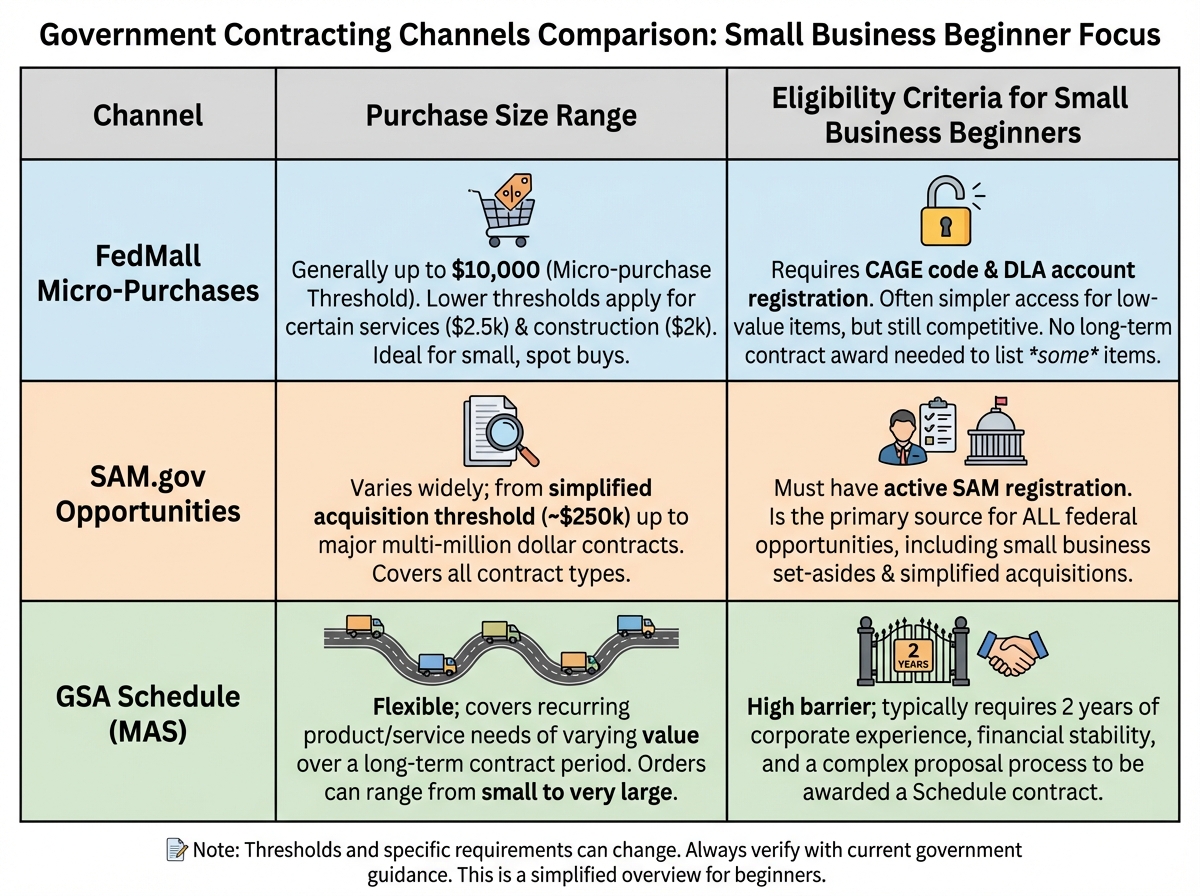
How Long Getting Set Up Actually Takes
| Stage | What You’re Doing | Estimated Time |
|---|---|---|
| Business Formation | Register LLC or sole proprietorship with your state | 1–5 days |
| Tax ID (EIN) | Apply via IRS.gov — instant or up to 2 weeks by mail | Same day (online) |
| Reseller’s Permit | State-level permit for resale without paying sales tax | 1–10 days |
| UEI / SAM Registration | Register your entity on SAM.gov — processing time varies | 7–14 business days |
| NAICS Code Selection | Research and assign your industry codes inside SAM | 1–2 hours |
| Certifications | Apply for small business set-asides (WOSB, 8(a), etc.) | Weeks to months |
| FedMall Onboarding | Apply as a supplier through the DLA portal | 1–3 weeks |
| Total to First Opportunity | 4–8 weeks |
The order matters far more than the speed — rushing SAM registration with incorrect data is harder to undo than taking an extra week to get it right. And if your SAM registration takes longer than the estimate, that’s normal; the system processes thousands of new entities and sometimes flags applications for manual review.
Setting Up Your Business Entity the Right Way
The biggest mistake people make when starting government contracting is trying to register on SAM.gov before they have a clean, legitimate business structure in place. It seems backwards — why does a website care about your LLC paperwork? But SAM.gov verifies your Taxpayer Identification Number (TIN) against IRS records, and if those records don’t match what you entered, your registration gets rejected or delayed for weeks.
You need a formal business entity — typically an LLC or corporation — with a name that matches exactly across your state registration, your EIN application, and your SAM profile. One misplaced comma or abbreviation can trigger a mismatch. The government isn’t being difficult; it’s just that every field in SAM maps to a legal record somewhere else in a federal or state database.
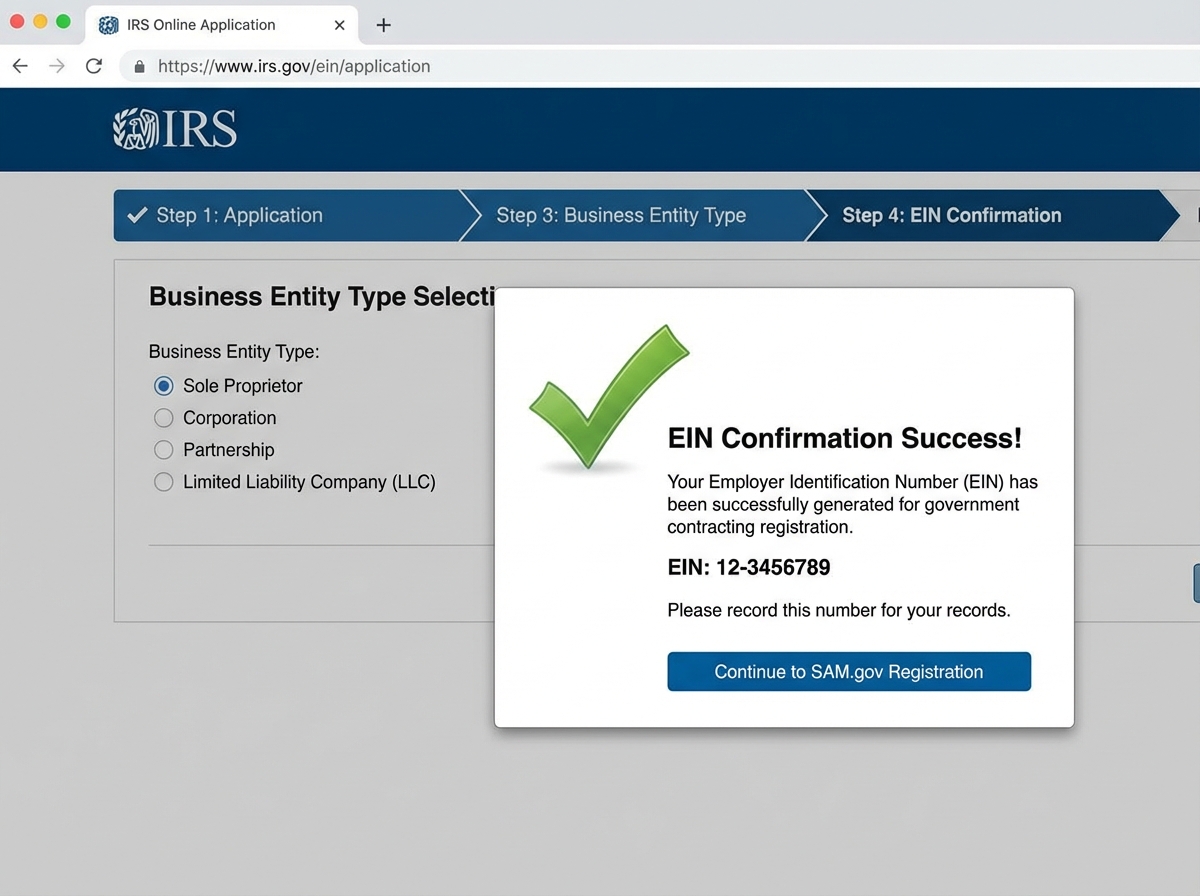
Once your entity is clean, your EIN from the IRS is your identity in the federal system. Get it before you do anything else. It’s free, and the online application through IRS.gov takes about ten minutes. The EIN is what flows into every registration that follows — SAM, FedMall, payment systems, all of it.
Navigating SAM.gov and NAICS Codes Without Getting Stuck
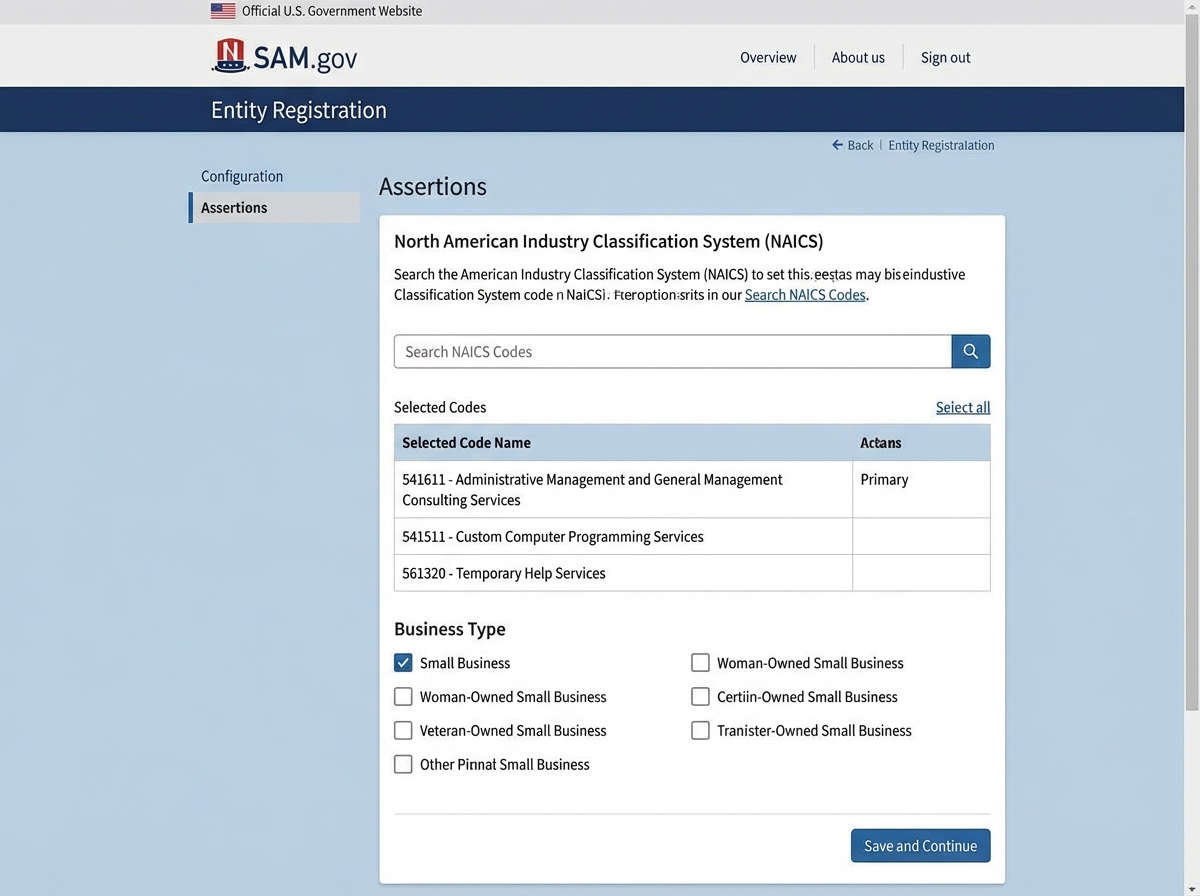
SAM.gov — the System for Award Management — is the central hub for all federal vendor registrations. It replaced the old DUNS number system; since 2022, your identifier is a Unique Entity ID (UEI) assigned directly by SAM. Registration is free. Any third-party service charging you to register is unnecessary.
The part that slows beginners down isn’t creating the account — it’s the NAICS codes. NAICS (North American Industry Classification System) codes tell the government what your business sells. You can list multiple codes, and you should. The right codes determine which contract opportunities show up in your searches, which set-aside categories you qualify for, and whether your business is classified as “small” for a given contract (because size standards are NAICS-specific).
Spend real time here. Look at the products or services you intend to sell, look up their NAICS codes using the SBA’s size standards tool, and check what other vendors in those categories have listed. Your codes are the algorithmic layer between you and every relevant federal opportunity — getting them wrong means you’ll be invisible to buyers who are actively searching for what you offer.
What the Reseller’s Permit Actually Does for You
A reseller’s permit — also called a resale certificate — is a state-issued document that allows you to purchase goods for resale without paying sales tax at the point of purchase. In the context of government contracting, this matters the moment you’re dropshipping or reselling products to federal buyers.
Without it, you’re paying sales tax on your cost of goods and then selling to a government buyer who is tax-exempt anyway. That margin loss compounds fast. The permit protects your pricing competitiveness and keeps your books clean, because you’ll need to document that the items you’re reselling were not taxed twice when you’re eventually audited or reviewed during contract performance.
The application is a state-level process — every state has its own form and timeline, but most are straightforward. Get this in place before you start listing products on FedMall or quoting on any opportunity.
How Dropshipping Works Inside Federal Procurement
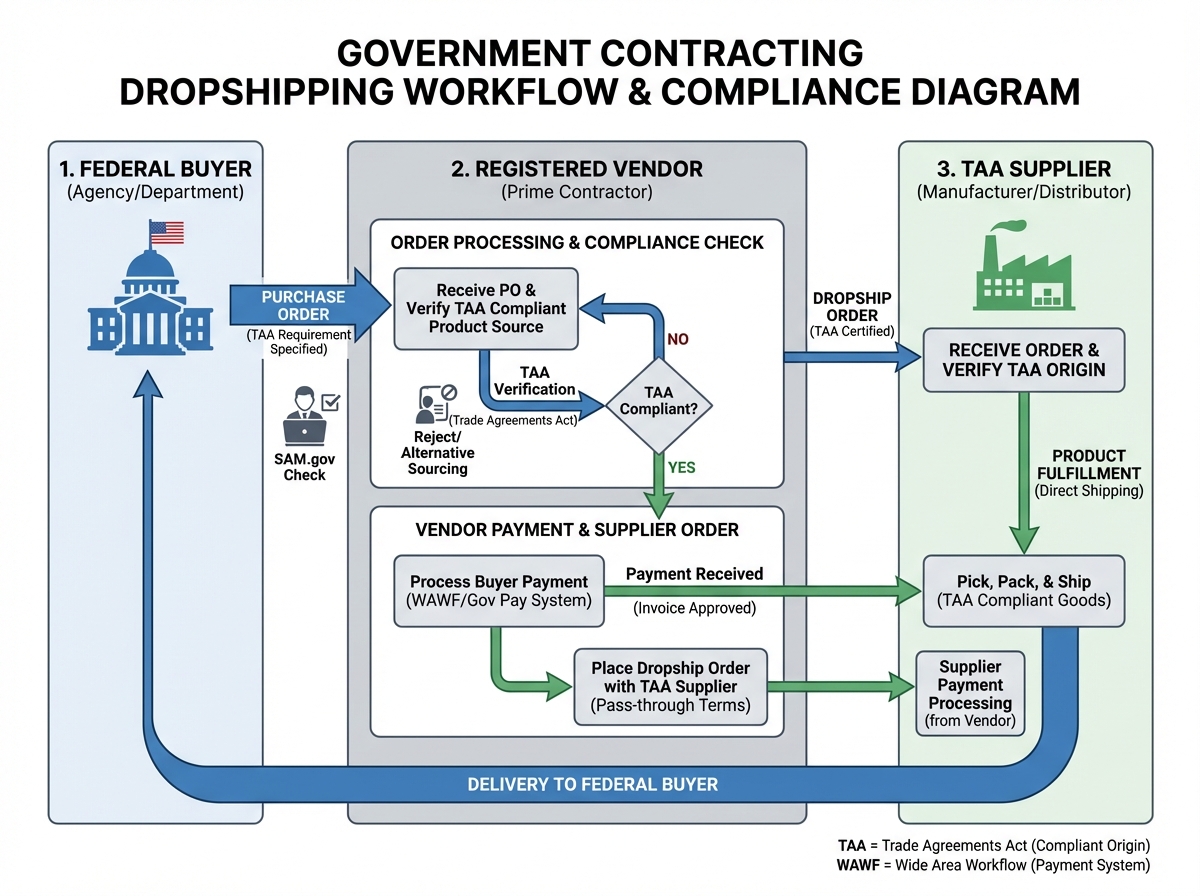
Dropshipping in government contracting works the same way it does in e-commerce: a buyer places an order, you pass it to your supplier, and the supplier ships directly to the buyer. What changes is the compliance layer.
Federal buyers need to know they’re dealing with a registered, accountable vendor — you. The product needs to meet any applicable federal standards (TAA compliance for manufactured goods is one common requirement). Delivery windows need to be reliable because federal purchasers operate under budget cycles and reporting obligations. And your invoicing needs to go through the government’s payment systems, not a PayPal link.
The practical upside of dropshipping in this context is that it gives you a low-overhead entry point. You’re not managing a warehouse; you’re managing vendor relationships and compliance. That’s a legitimate, scalable business model — and it’s how a significant number of small government vendors operate, especially in the early stages when cash flow is tight.
Certifications That Open Locked Doors
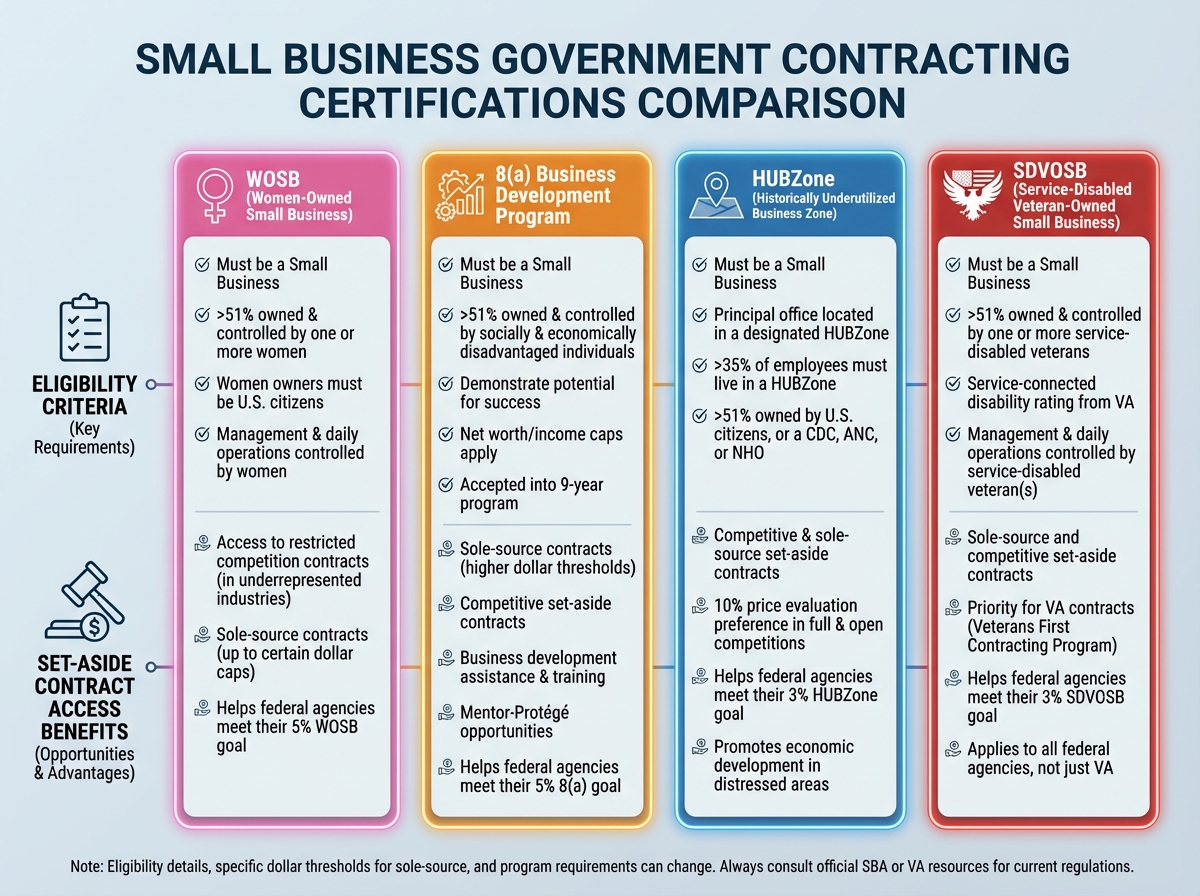
The federal government maintains specific set-aside programs that reserve certain contract opportunities exclusively for businesses that qualify. These certifications are optional to start — you can pursue unrestricted contracts without any of them — but they dramatically improve your odds once you’re in the system.
The most commonly pursued by beginners: the Women-Owned Small Business (WOSB) designation, the 8(a) Business Development Program for socially and economically disadvantaged business owners, the HUBZone certification for businesses in historically underutilized areas, and the Service-Disabled Veteran-Owned Small Business (SDVOSB) status. Each comes with its own eligibility criteria and application process through the SBA.
Security clearance is a separate track entirely, required for specific defense or intelligence agency work. For most beginners selling commercial products, clearance isn’t relevant for years — if ever. Don’t let the word “clearance” make the whole system feel inaccessible. Start with the civilian agency market, build a track record, and pursue clearance-related work when it makes sense for your direction.
FedMall: The Easiest Entry Point Nobody Talks About
FedMall is run by the Defense Logistics Agency and functions as an e-commerce platform for government buyers. It offers over 63 million items and is accessible to military services, federal agencies, and state and local governments. For a new government vendor, it is the most direct path from “registered” to “first sale.”
Becoming a FedMall supplier involves a separate onboarding process from SAM, but your SAM registration is a prerequisite. Once approved, you can list your products in the FedMall marketplace and government buyers with purchasing authority can order from you directly — often under the micro-purchase threshold of $10,000, which means no formal solicitation, no competition, no proposal writing. A buyer sees your product, buys it, and you fulfill it.
This is where the dropshipping model plugs in cleanly. Your FedMall listings represent products your suppliers carry. When a buyer orders, you process it with your supplier and they ship to the government delivery address. Your margin lives in the spread between your supplier’s price and your listed price — and your job is to keep that spread healthy while staying competitive enough to get repeat orders.
Getting Paid: How Federal Payment Actually Works
The government pays. That’s the joke and the relief — federal buyers don’t ghost invoices or delay payments indefinitely the way private clients sometimes do. Federal agencies are legally required to pay within 30 days under the Prompt Payment Act, and many pay faster.
Payment flows through systems like IPP (Invoice Processing Platform) or Wide Area WorkFlow (WAWF) for defense contracts. You submit your invoice electronically through the designated system for that agency, and payment hits your registered bank account. Your banking information lives in your SAM profile — another reason why keeping that profile current and accurate is non-negotiable.
The most common payment problem for new vendors isn’t late payment — it’s invoice rejection due to missing contract line item numbers, wrong period of performance dates, or mismatched vendor information. Learn the invoice format your first buyer uses before you submit. A rejected invoice resets the payment clock.
What You Can Do Right Now
Looking back at this whole process, the thing that’s genuinely true is that the hardest part is deciding to start. The paperwork is tedious, not complicated. The registrations are free. The market is enormous and actively looking for small vendors.
Here’s what to do with that:
- Register your business entity before touching SAM.gov. Your LLC or sole proprietorship needs to be clean, consistent, and match your IRS records exactly — a name mismatch will kill your registration before it starts.
- Apply for your EIN on IRS.gov in a single sitting. The online application is immediate, free, and the number you receive is your identity across every federal registration that follows.
- Get your Reseller’s Permit from your state before sourcing any products. Paying sales tax on goods you’re reselling to a tax-exempt government buyer compresses your margins unnecessarily from day one.
- Spend at least two hours on NAICS code research before submitting your SAM registration. Your codes determine your visibility to buyers — wrong codes means invisible in the opportunities feed.
- Do not pay anyone to register you on SAM.gov. It is free, and third-party registration services add no value to a process you can complete yourself in under two hours.
- Explore FedMall as your first sales channel before pursuing formal contracts. Micro-purchase transactions require no proposal writing, no competition, and process quickly — your first government sale can happen within weeks of completing registration.
- Set up your banking information in SAM accurately the first time. Payment for every contract you ever win will route to that account; errors cause payment delays that have nothing to do with your performance.
- Track your SAM registration expiration date and renew annually. SAM registrations expire every 12 months, and an expired registration means you cannot receive federal payments — even on existing contracts.
Leave a Reply