


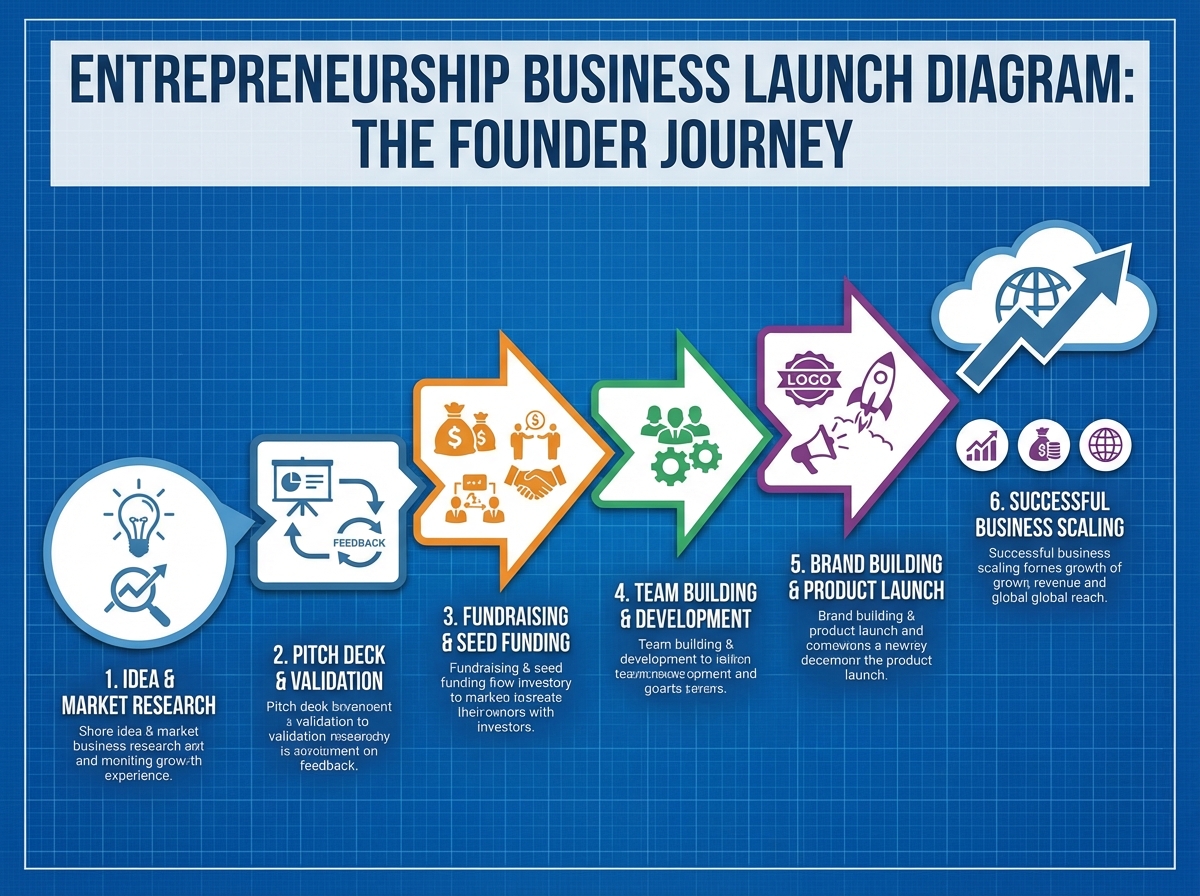
Most people who want to start a business don’t fail because they had a bad idea. They fail because no one ever told them what the first year actually feels like — the silence after you launch, the pitch that goes nowhere, the team member who quits two months in.
If you’re looking to learn entrepreneurship from the ground up, the honest answer is that it’s less about inspiration and more about sequencing. Understanding what to do first — and why the order matters — is the difference between a business that gains traction and one that burns cash while you figure things out.
- Most first-time founders skip market research and go straight to building — this almost always leads to a product nobody asked for
- A pitch deck isn’t just for investors; it forces you to stress-test your own assumptions before anyone else does
- The businesses that scale aren’t the ones with the best ideas — they’re the ones that built repeatable systems early
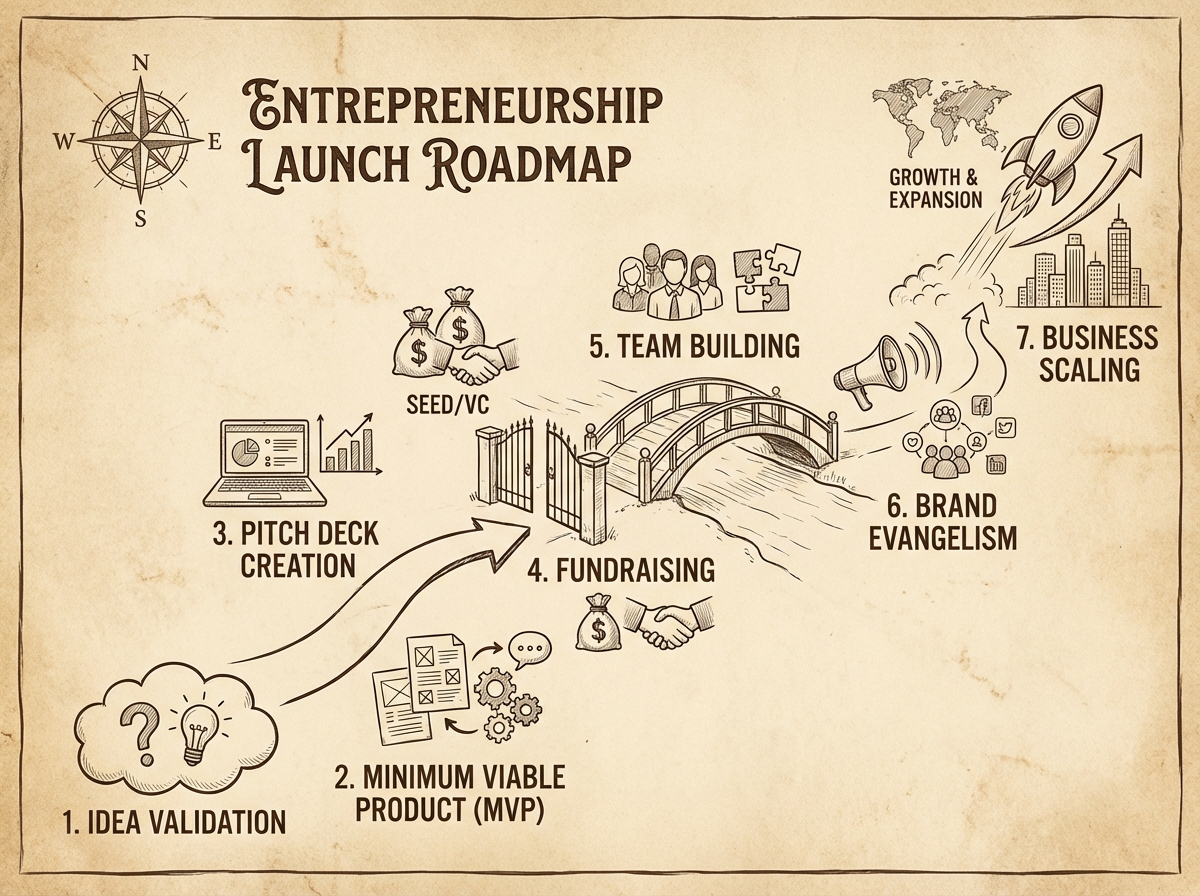
What Entrepreneurship Actually Means for a First-Time Founder
Entrepreneurship gets defined in a lot of unhelpful ways. It’s not about disruption for its own sake. It’s not about being a visionary. At its core, it’s about spotting a problem that enough people have, and building something that solves it in a way that can sustain itself financially.
For someone starting out — whether you’re an MBA student, a small business owner, or someone leaving a job to go solo — the practical definition matters more than the inspirational one. You’re not building a movement on day one. You’re building a hypothesis and testing it with the least amount of money and time possible.
The natural endowment principle is a useful lens here: every founder brings something to the table that others don’t — domain knowledge, a network, a lived experience with the problem. Identifying that edge early keeps you from trying to compete on terrain where you have no advantage.
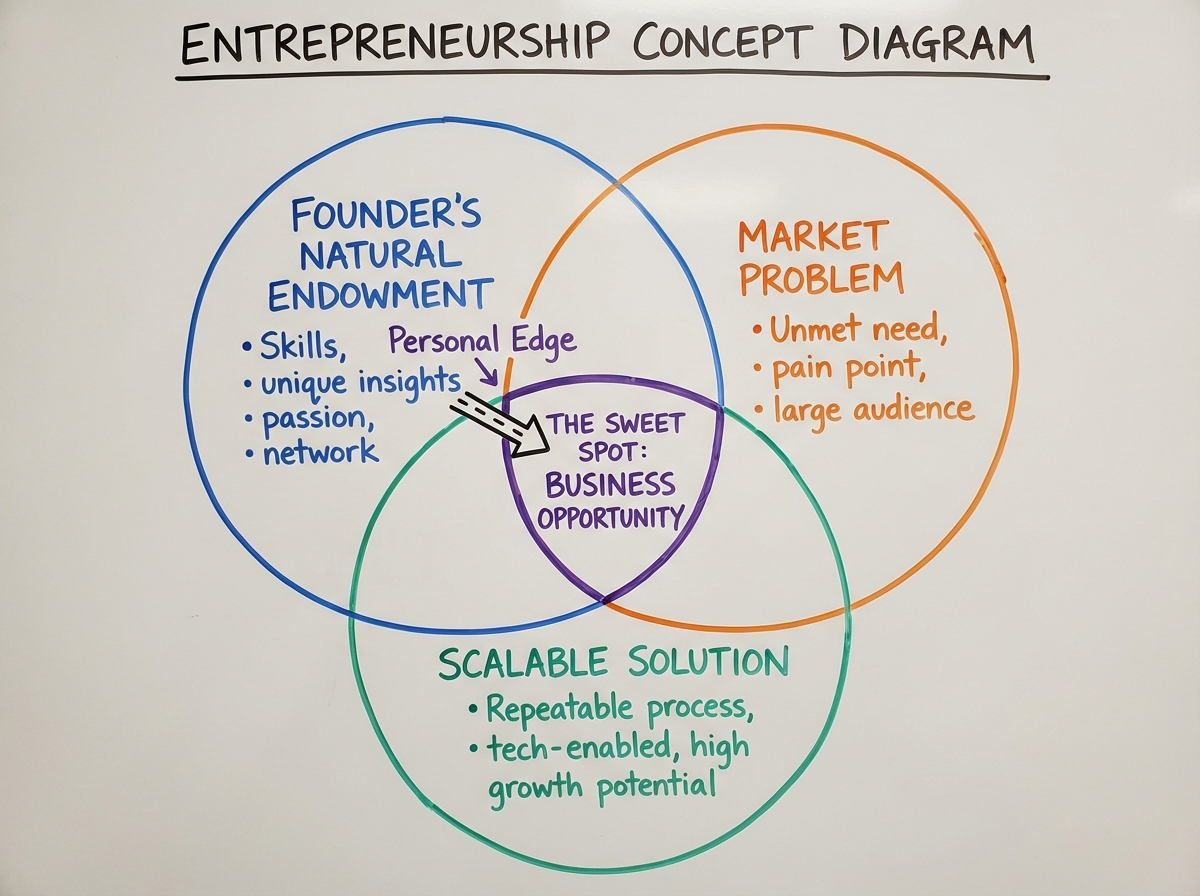
What entrepreneurship means vs. what people think it means:
| Common Misconception | What It Actually Looks Like |
|---|---|
| You need a breakthrough idea | You need a solvable problem with a defined customer |
| Funding comes first | Validation comes first — funding follows traction |
| A great product sells itself | Distribution is a strategy, not an afterthought |
| You hire fast to move fast | You hire slow and fire fast |
Three things that are true about starting a business that most articles won’t say directly:
- Your first business model will be wrong — plan to revise it within 90 days
- Speed without direction destroys more startups than lack of funding
- The founder who learns to sell outlasts the one who only knows how to build
The Part Nobody Talks About: Choosing What to Build
The Amazon story is instructive not because Jeff Bezos was a genius, but because he made a specific, constrained decision: books first, everything else later. He didn’t try to build the everything store on day one. He picked a category where the unit economics worked, proved the model, and expanded from there.
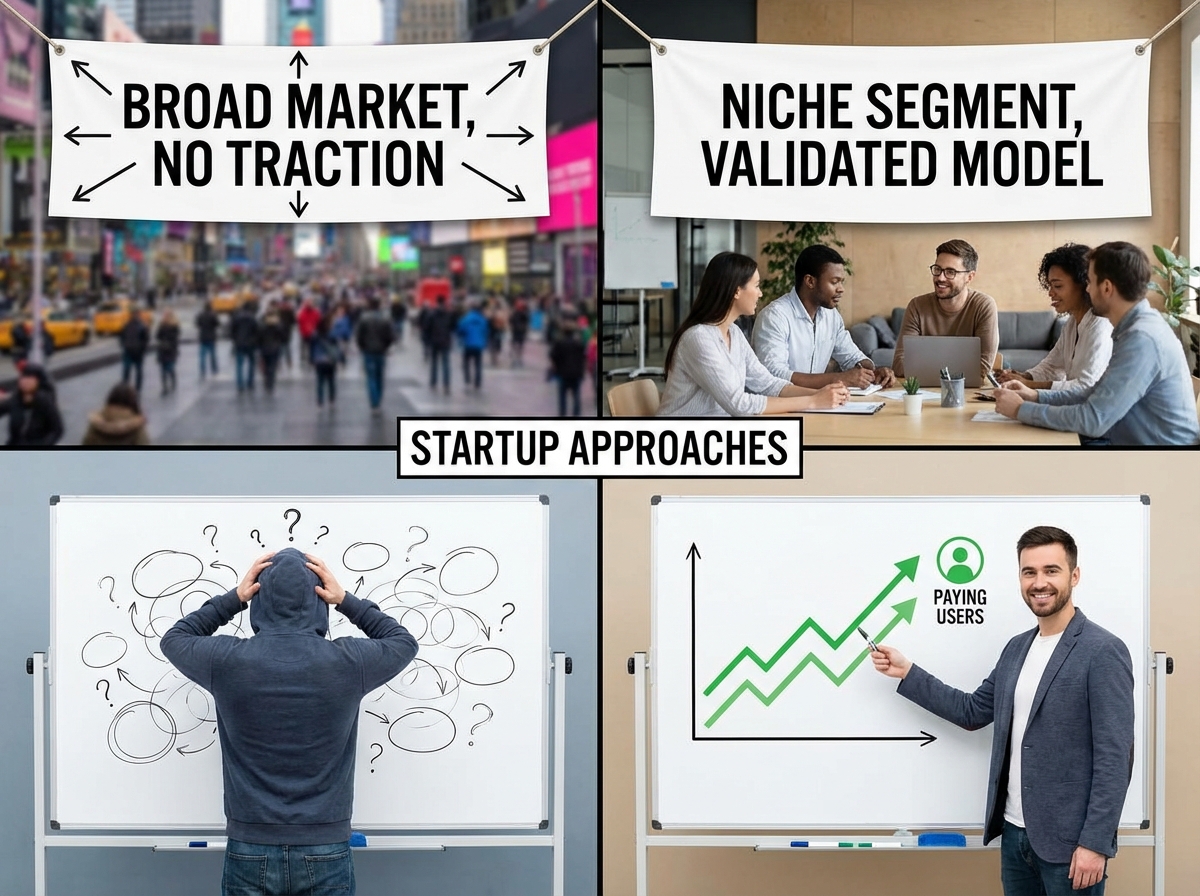
Most first-time founders do the opposite. They build something ambitious and undefined, aimed at everyone, solving a vague problem. Then they spend months trying to find their customer instead of building for one they already understand.
The question to answer before you write a single line of a business plan: Who has this problem so badly that they would pay for a half-finished solution? If you can name three real people and call them, you’re ready to start. If your answer is “millennials” or “small businesses in general,” you’re not ready yet.
Once you’ve defined that person, the launch process gets simpler. You need a minimum viable version of your solution, a way to take payment, and a way to reach the person you just described. That’s it. Everything else — the branding, the website, the office — comes after you’ve confirmed someone will actually hand you money.
Why Your Pitch Deck Is a Thinking Tool, Not Just a Sales Document
The biggest mistake people make when learning to pitch is treating the pitch deck as something you build for investors. You build it for yourself first. The act of forcing your idea into ten slides — problem, solution, market size, business model, traction, team — reveals every hole in your thinking before an investor has the chance to find it for you.
Airbnb’s original pitch deck is famous because it was simple and brutally clear. They didn’t oversell the vision. They showed the problem (expensive hotels, empty rooms), the solution (rent a room), and early evidence that people were willing to do both. What made it work wasn’t design — it was the absence of vagueness.
Dropbox didn’t even have a fully built product when they pitched. They made a three-minute demo video. The insight there is important: investors aren’t funding your product, they’re funding the evidence that the problem is real and that people want the solution. Traction — even tiny traction — beats polish every time.
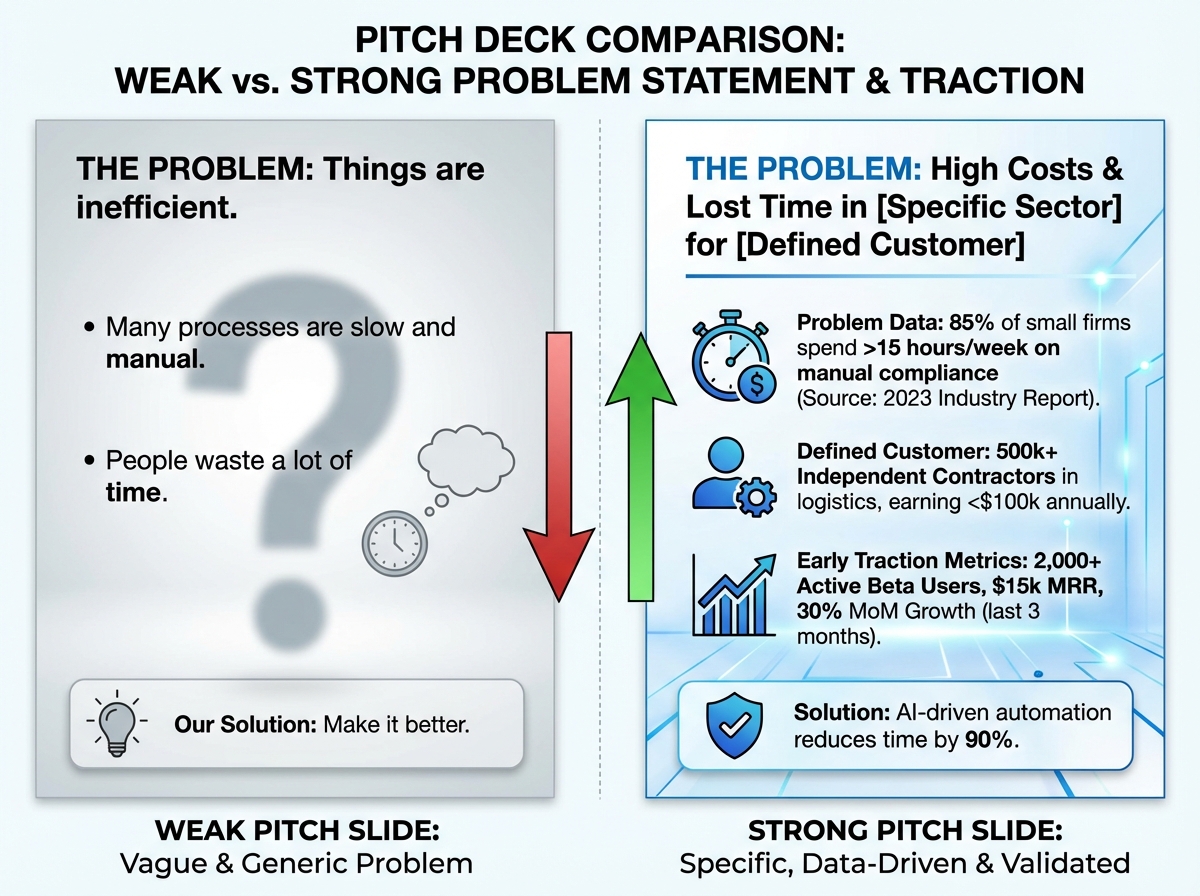
When you’re preparing your own pitch, the section that most founders underwrite is traction. It feels uncomfortable to show small numbers. But a founder who says “we have 200 users who found us with zero marketing spend” is more fundable than one who says “our TAM is $50 billion.” Show what’s already moving, even if it’s moving slowly.
Securing Funding Without Losing Control of Your Business
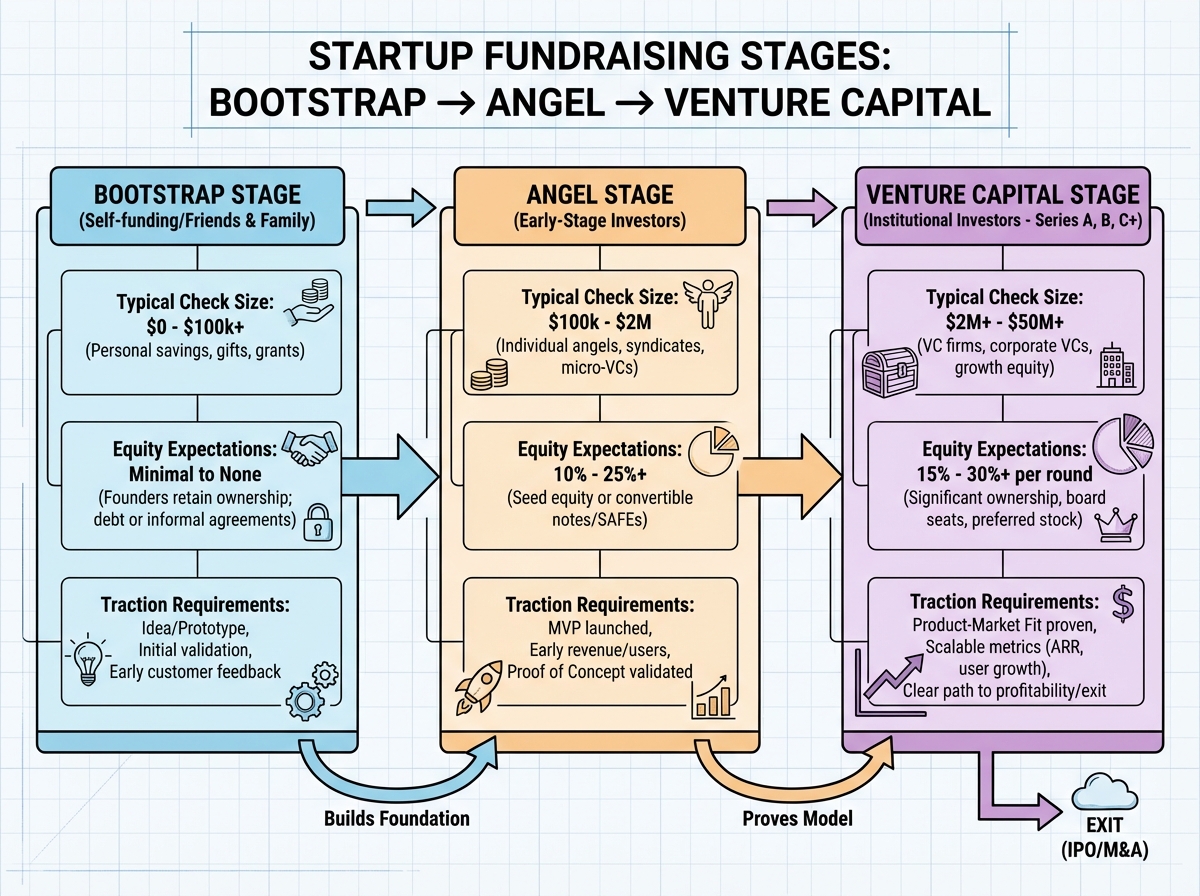
Fundraising has a sequence that most people learn backwards. They approach venture capital first because it’s the most visible form of funding, then they’re confused when VCs aren’t interested in a pre-revenue idea. The actual sequence — for most businesses — runs bootstrapping → friends and family → angel investors → VC → growth equity.
Each stage has its own logic. Bootstrapping forces discipline and keeps you focused on revenue from day one. Angel investors are useful when you have early validation but need capital to accelerate. VCs invest in businesses with high growth potential and a clear path to a large exit — they’re not the right fit for every business model.
What secures funding at any level is the same thing: a crisp explanation of the problem, a defensible reason why your solution will win, and evidence that real humans want it. The pitch deck you built in the last stage is your fundraising document. The thing that gets you meetings is your network — which is why building relationships before you need capital is one of the highest-leverage things an early-stage founder can do.
Building a Team That Doesn’t Fall Apart in Year One
Hiring feels exciting. It’s the moment the business feels real — you’re not just a solo operator anymore, you’re building something with people. The problem is that most early hiring decisions are made emotionally: someone is enthusiastic, they seem smart, you like them. None of those things alone predict whether they’ll still be effective six months in when the work gets unglamorous.
The Ray Kroc model is worth studying here. McDonald’s didn’t scale because of the food. It scaled because Kroc built systems that didn’t depend on any individual person being exceptional. Every role was defined, every process was documented, every new hire could be trained to the same standard. That’s the mindset shift that matters: you’re not hiring talent, you’re building a machine that talent can operate.
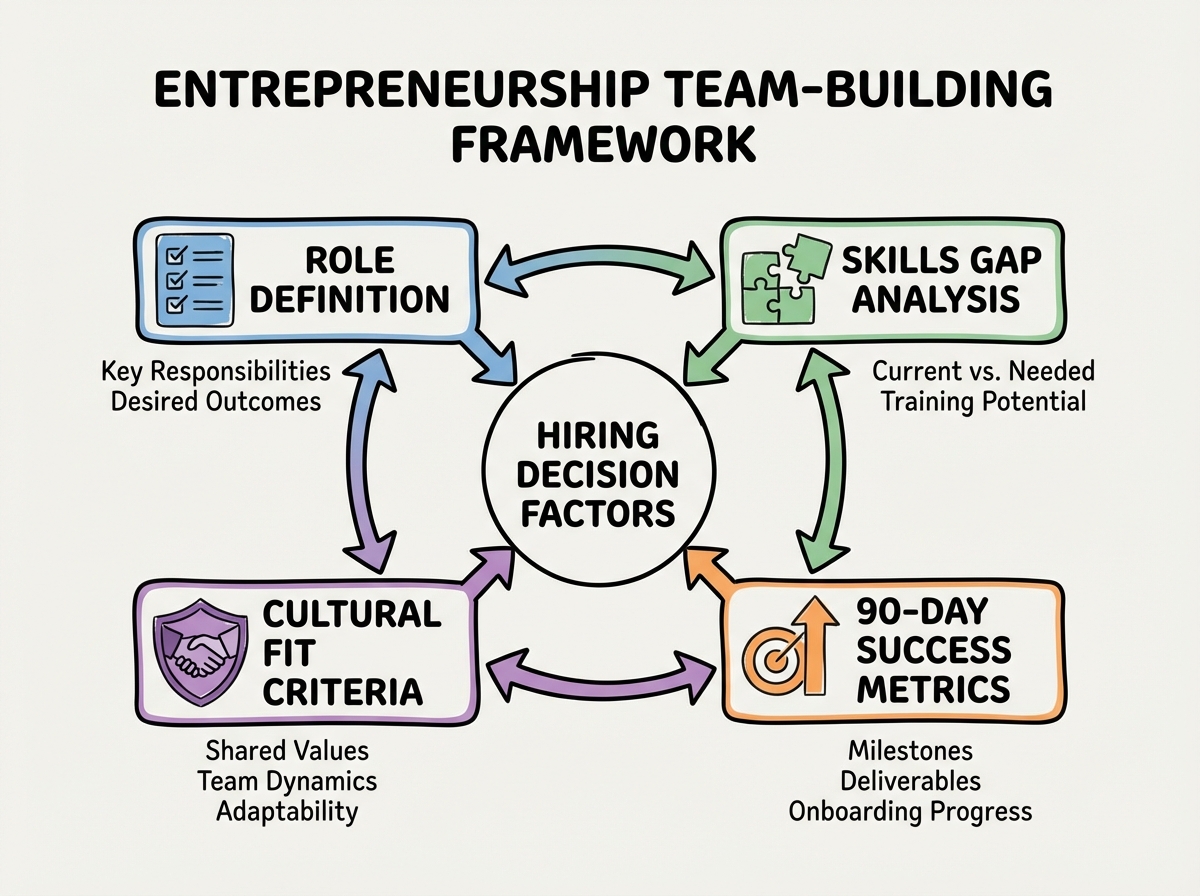
For early hires specifically: hire for the problem you have right now, not the company you imagine having in two years. The first hire should do something you genuinely cannot do — not a replica of your own strengths. And before you hire anyone, write down what success looks like for that role in ninety days. If you can’t define that, you’re not ready to hire.
How Social Media Actually Drives Early Growth (And Where Founders Waste Their Time)
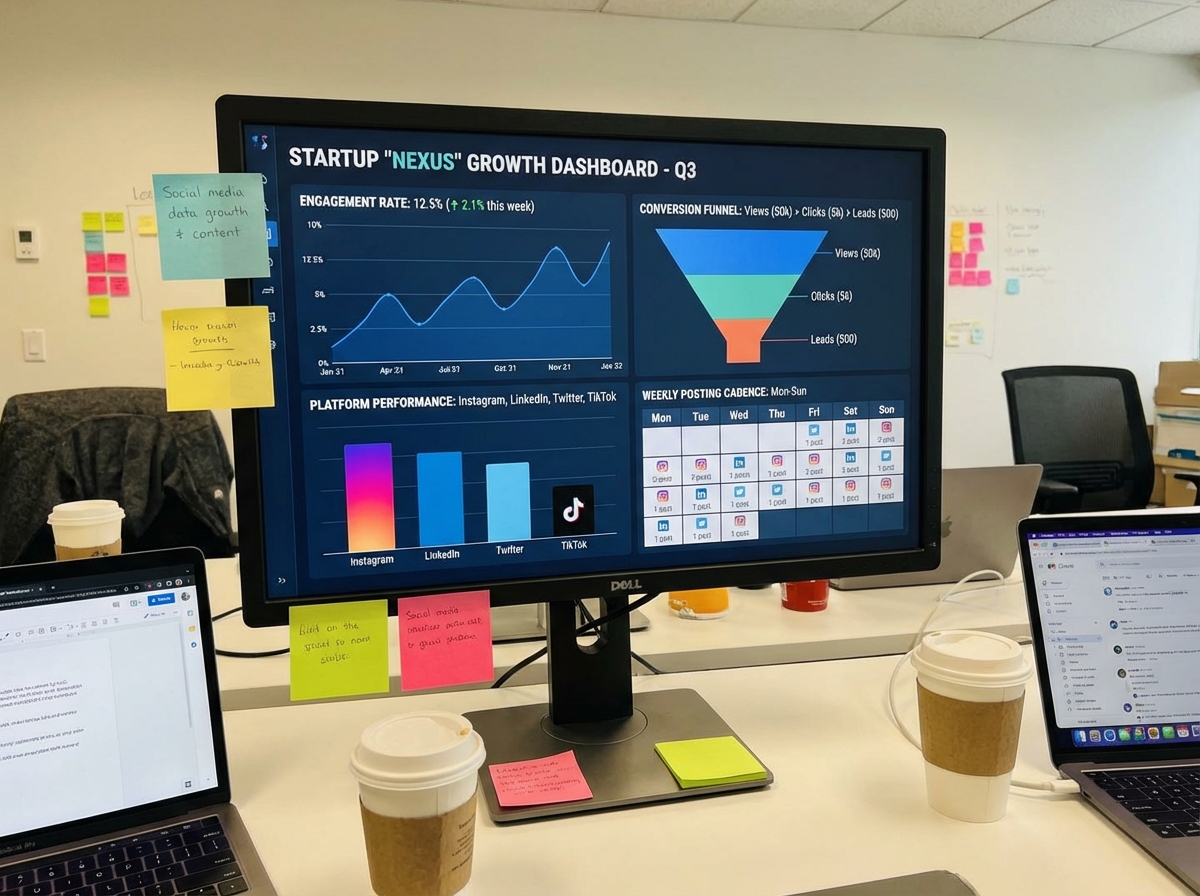
Every founder knows they need social media. Most of them use it wrong — posting intermittently, measuring follower counts instead of conversions, and treating every platform the same way.
The coffee maker example cuts through the noise: if you’re selling a physical product, social media works when it shows the product solving a real problem in a real moment. Not a polished product shot. Not an inspirational quote with your logo. A video of someone using it and having their life made slightly easier. Gymshark built a brand worth hundreds of millions not by advertising, but by seeding products with fitness influencers who already had trust with the exact audience Gymshark wanted to reach.
The principle is the same whether you’re selling a product or a service: find where your specific customer already spends time, and show up there with content that demonstrates you understand their problem better than they do. Analytics tell you what’s working — check them weekly, not daily, or you’ll optimize for noise instead of signal. Harnessing social media for growth means treating it as a feedback loop, not a broadcast channel.
What Brand Evangelism Looks Like Before You’re Apple
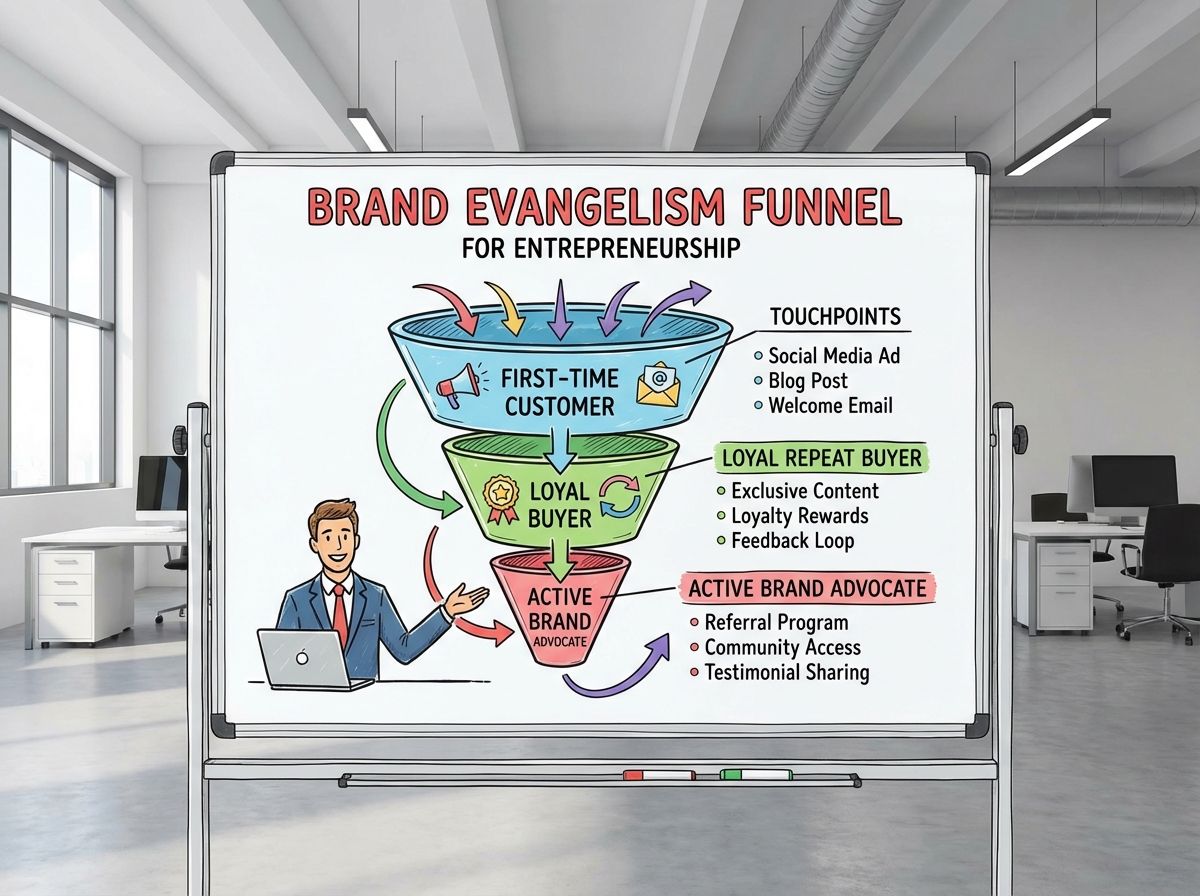
Apple is the most cited example of brand evangelism, and also the least useful one for a founder who just launched six months ago. The lesson people take from Apple — create passionate advocates — is correct. The mechanism they try to copy — premium design, keynote events, a cult of personality — is wrong for an early-stage business.
Brand evangelism at the beginning looks like this: you make someone’s life noticeably better, you follow up personally to ask how it’s going, and you make it easy for them to tell someone else. That’s it. The KFC and McDonald’s case studies are instructive precisely because neither brand started with a cult following — they started with a consistent product that people could rely on and recommend without risk of embarrassment.
The moment things click with brand building is when you stop thinking about reach and start thinking about depth. Ten customers who talk about you unprompted are worth more than a thousand followers who passively scroll past your posts. Evangelizing your brand early means investing disproportionately in the experience of your first hundred customers — because they become the foundation every subsequent customer is built on.
Scaling Without Breaking What Already Works
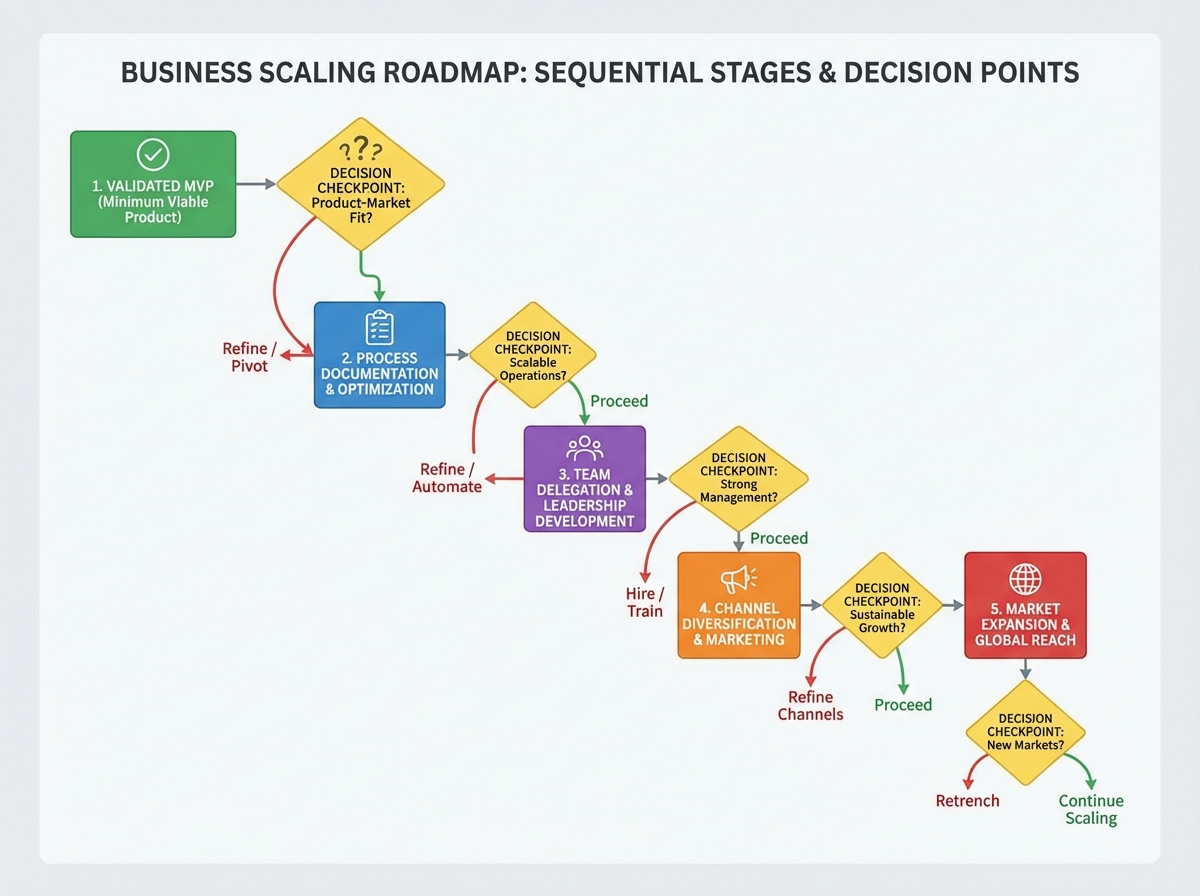
Scaling is where most businesses that survive their first year fall apart in their second. The instinct is to do more of everything — more marketing, more hiring, more products, more markets. The problem is that scaling a broken process just creates more expensive broken processes.
The businesses that scale successfully identify the one or two things that are working and build systems around those before adding anything new. If your customer acquisition through word-of-mouth is working, document why it works before you add paid advertising. If your sales process converts at a reliable rate, write it down and train someone else to do it before you add a new product line.
Future trends in entrepreneurship — AI-driven operations, platform businesses, remote-first teams — all create new surface area for growth. But the fundamentals don’t change. The entrepreneurs who navigate those trends well are the ones who already have strong unit economics, clear positioning, and a team that can execute without the founder in every room. Scaling your business successfully means building something that gets stronger when you’re not there, not something that stalls every time you step back.
What I’d Do Differently If I Were Starting Today
Looking back at the whole arc — from the first idea to the first hire to the first moment the business runs without you holding it together by hand — the things that mattered most were rarely the things that felt most urgent at the time.
The pitch deck mattered more than the product at first. The first ten customers mattered more than any marketing campaign. Hiring slowly mattered more than moving fast. And the moments of real clarity rarely came from planning — they came from doing something uncomfortable, watching it fail in a specific way, and understanding exactly why.
Here’s what’s actually worth doing when you’re starting:
- Write your pitch deck before you build anything. If you can’t explain the problem, solution, and business model in ten slides, the product won’t save you — you’ll just have a more expensive version of the same confusion.
- Talk to ten potential customers before writing a single line of a business plan. Ask them what they currently do to solve the problem, not whether they’d use your solution — what people say they’d do and what they actually do are completely different things.
- Define one acquisition channel and make it work before adding a second. Most failed startups spread across five channels simultaneously and master none of them.
- Set a 90-day success metric for every hire before you make the offer. If you can’t articulate what good looks like in three months, you’re not ready to hire for that role.
- Audit your social media content monthly against actual conversions, not engagement. Likes don’t pay rent — cut what doesn’t convert and double down on what does, even if it feels less exciting.
- Document your best-performing process every time it works twice in a row. This is what makes scaling possible — not talent, not funding, but repeatable systems that outlast any individual person.
- Spend at least one hour a week with a customer who recently churned or didn’t buy. The people who said no will tell you more about your business than the ones who said yes.
- Give your first hundred customers something that doesn’t scale — a personal call, a handwritten note, a custom solution. The word-of-mouth those customers generate is worth more than any paid campaign you could run at that stage.
Leave a Reply