



The morning routine you dread starts the same way every time. You walk past your child’s room, catch the smell before you even open the door, and watch your kid’s face fall before you say a single word. That look — that mix of shame and resignation — is the part no parenting book prepares you for.
If you’re looking to learn how to stop bedwetting in children, the honest answer is that there’s no single fix, but there is a clear path. Nocturnal enuresis — the clinical term for bedwetting past the age of five — is far more common than most parents realize, and it responds well to approaches that work directly with the subconscious mind rather than willpower alone. Hypnosis, combined with deliberate changes in how you communicate with your child about the issue, has helped many families move from wet nights to dry ones without shame, punishment, or endless alarm-clock disruptions.
- Bedwetting past age 5 is a subconscious issue — conscious effort and motivation alone rarely solve it
- How a parent talks about wet nights matters as much as any physical intervention
- Children who feel empowered, not ashamed, tend to achieve dry nights faster and more permanently
What Nocturnal Enuresis Actually Is — and Isn’t
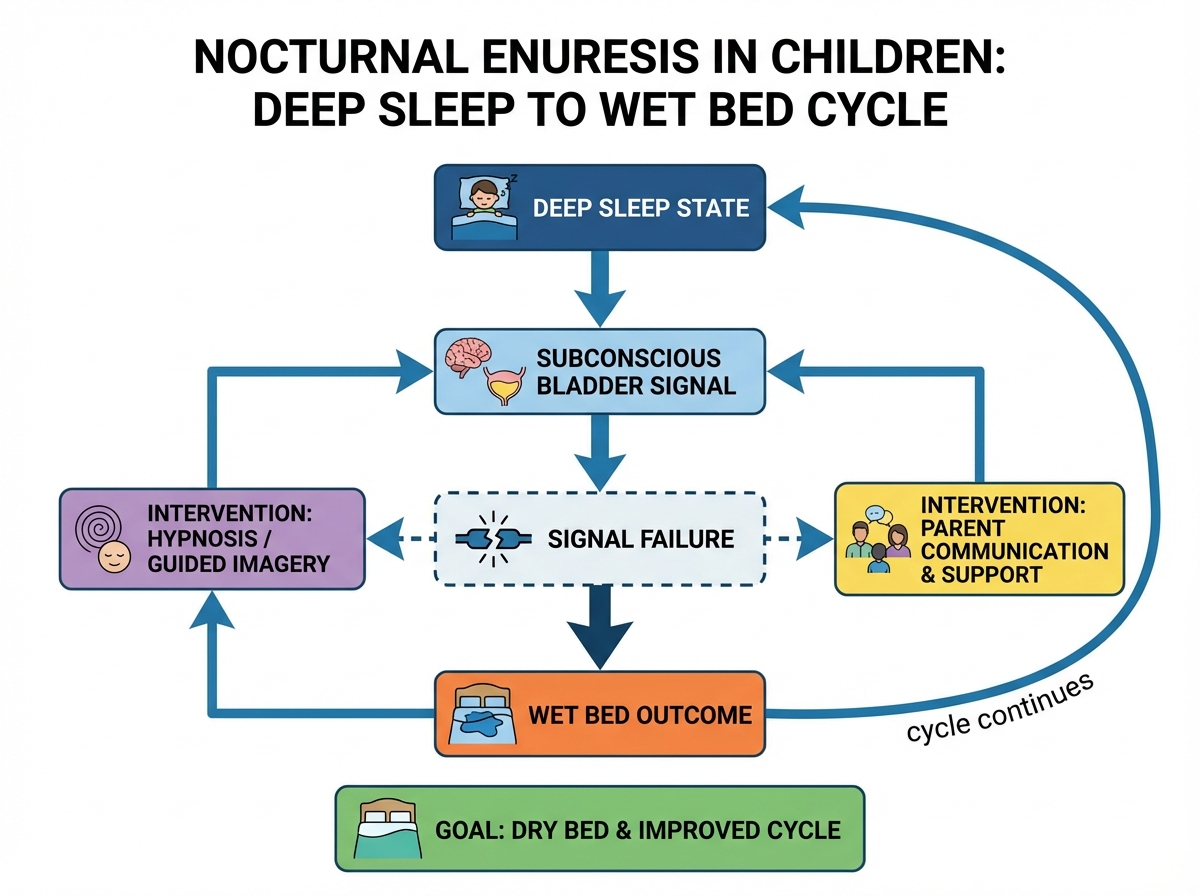
Most parents assume bedwetting is laziness, deep sleep, or a small bladder. The reality is more specific: the subconscious mind, which remains active during sleep while the conscious mind switches off, hasn’t yet learned to respond to the bladder’s signals with enough urgency to wake the child. It isn’t a character flaw. It isn’t defiance. And critically, it isn’t something a child can simply decide to stop doing.
Nocturnal enuresis breaks down into two types:
| Type | Description | Common Age Range |
|---|---|---|
| Primary enuresis | Child has never achieved consistent dry nights | Ages 5–10 |
| Secondary enuresis | Child was dry for 6+ months, then regressed | Any age, often tied to stress |
Understanding which type you’re dealing with changes everything — including how you talk to your child about it.

Three Things That Surprised Me About Childhood Bedwetting
- Shame makes bedwetting last longer — the stress response actively disrupts sleep architecture
- Telling a child to “try harder” is physiologically meaningless while they’re unconscious
- The words you use about wet nights are still playing in your child’s head when they fall asleep
How Long Does It Take to Stop Bedwetting?
| Stage | Focus | Typical Timeframe |
|---|---|---|
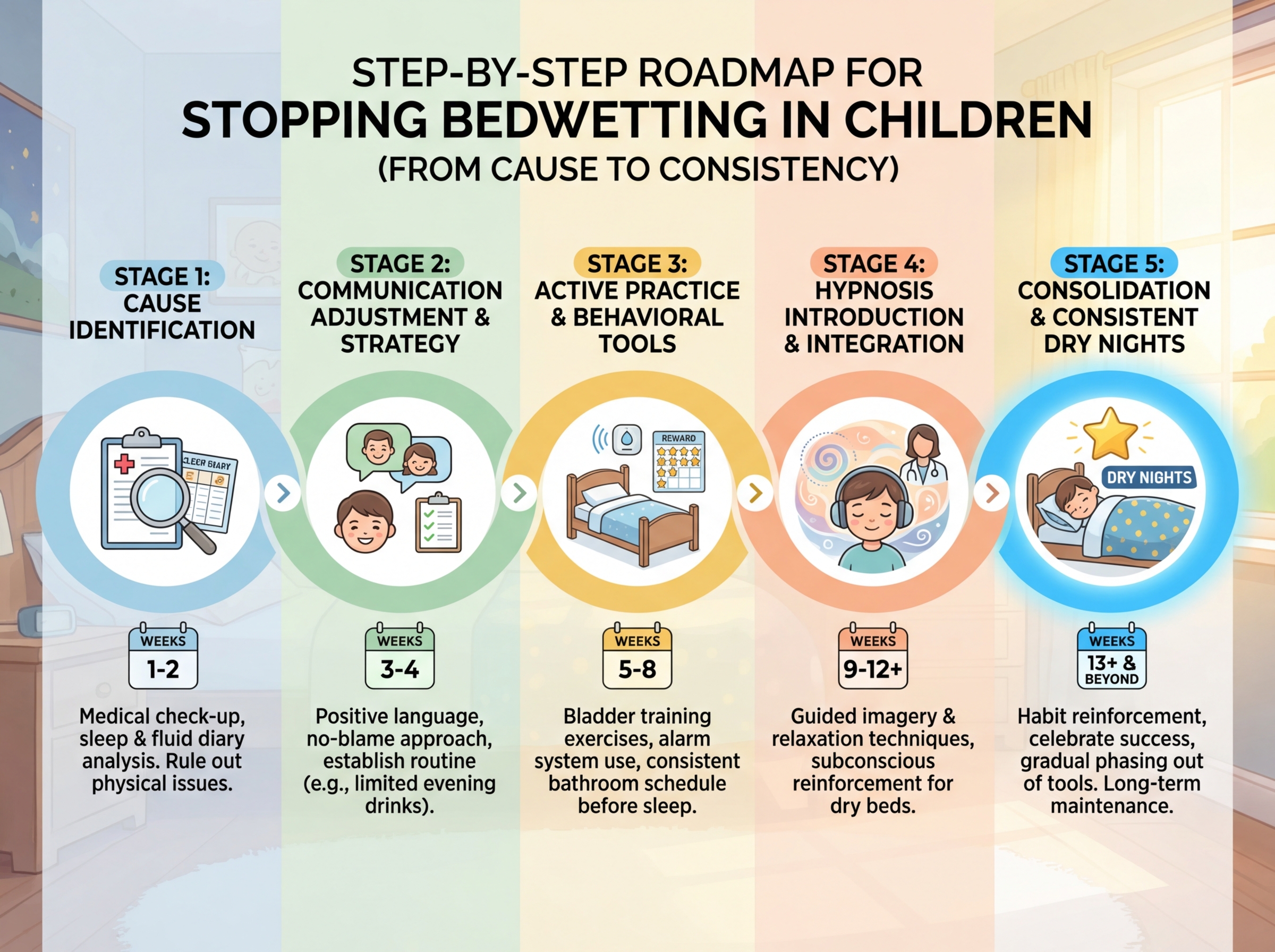
| Understanding the cause | Learning what’s driving the bedwetting | Days 1–3 |
| Adjusting communication | Changing how you talk to and around your child | Week 1 |
| Starting hypnosis recordings | Introducing nightly listening sessions at bedtime | Week 1–2 |
| First dry nights | Intermittent dry nights begin appearing | Weeks 2–4 |
| Consistent dry nights | Reliable pattern of staying dry | Weeks 4–12 |
| Total estimated journey | From first step to lasting change | 4–12 weeks |
The order of these stages matters more than the speed — a child who feels safe and understood before the hypnosis recordings begin responds much faster than one who’s already been shamed into anxiety about the issue. If your timeline runs longer than twelve weeks, that’s normal; every child’s subconscious moves at its own pace.
Why Your Child Can’t Just ‘Try Harder’ at Night
This is the wall almost every parent hits first. You’ve had the conversation. Your child genuinely wants to stay dry. They’ve promised, they’ve set intentions, they’ve even set alarms. And then 2 a.m. happens anyway, and you’re both standing in a dim hallway changing sheets while your child cries from exhaustion and embarrassment.
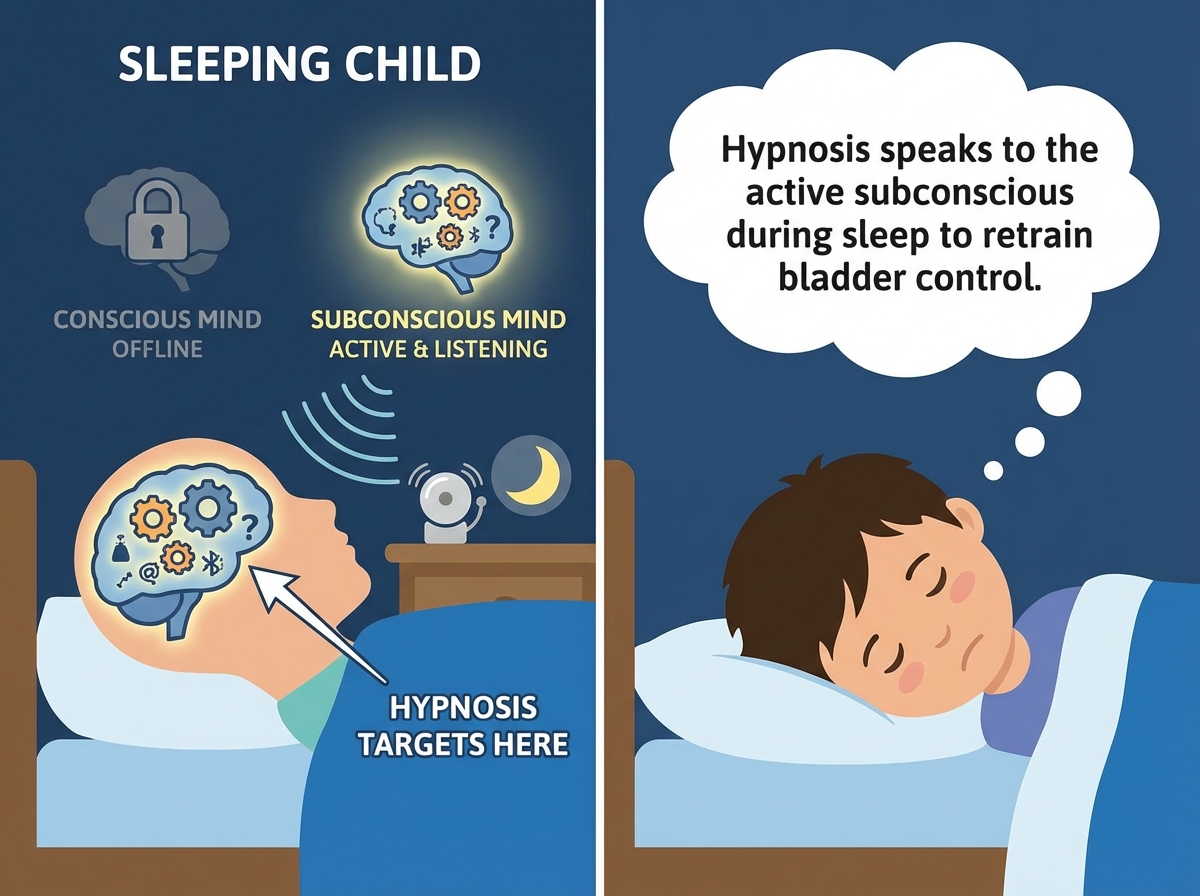
The biggest mistake parents make when trying to stop bedwetting is treating it as a motivation problem. It isn’t. When your child is asleep, the part of the brain that received all those conscious promises and goals is completely offline. The subconscious mind — the part running the show during sleep — never got the memo. It’s still operating on older, less mature programming that doesn’t yet route the bladder signal into a wake response.
This is why shame, reward charts, and stern conversations tend to produce anxiety rather than dry nights. They’re all communication directed at the conscious mind. And the conscious mind clocks out at bedtime.
What actually shifts things is reaching the subconscious directly — which is exactly what hypnosis does. It isn’t about putting your child in a trance or planting suggestions like a script. It’s about delivering calm, repeated, reassuring messages in the state when the subconscious is most receptive: the drowsy moments just before and during sleep onset.
The Conversation You’re Probably Handling Wrong
Before any recording, app, or alarm system, there’s a conversation that needs to happen — and most parents wing it in the worst possible way. They bring it up when they’re tired, when sheets are already being stripped, when their own frustration bleeds into their tone even if their words are kind.
How you broach the topic of bedwetting with your child sets the emotional frame for everything that follows. A child who absorbs the message that their body is broken, that this is shameful, or that they’re disappointing you will carry that frame into sleep. The subconscious is a sponge — it records emotional tone more reliably than words.
The better approach is to choose a neutral, calm moment — not post-wet-bed, not before school — and lead with curiosity rather than concern. Something like: “I’ve been thinking about how we can help your body learn something new at night.” That framing positions the body as a learner, not a failure. It positions you as an ally, not a disappointed authority figure.
Words spoken about your child when they’re present but not directly addressed — side comments to a partner, sighs in the laundry room — land just as hard as direct conversation. Children are excellent at absorbing emotional subtext, and that subtext follows them to bed.

Protecting the Bed Without Sending the Wrong Message
There’s a version of preparing for wet nights that quietly communicates: “We don’t expect this to change.” Thick mattress protectors pulled out with a resigned sigh, spare pajamas in a stack on the nightstand like wet nights are simply scheduled events — these small signals tell a child’s subconscious that wet nights are the expected reality.
The practical setup matters, but how you set it up matters more. A waterproof mattress cover is sensible and necessary. The difference is whether you frame it as a permanent infrastructure or a temporary bridge while their body learns. One sentence — “This is just here while we’re working on it” — is enough to shift the implicit message.
Some parents double-layer the bed: waterproof cover, fitted sheet, another waterproof cover, another fitted sheet. Middle-of-the-night changes take thirty seconds instead of ten minutes. That kind of practical preparation reduces your stress, which reduces how much tension your child absorbs from you at bedtime. The goal is protecting the bed without making the child feel like the problem.
Picking the Right Hypnosis Recording and Using It Correctly
Not every recording works for every child — age makes a significant difference in how the subconscious processes language, story, and suggestion. A recording written for a five-year-old uses imagery and pacing that a twelve-year-old will immediately dismiss as babyish, and that dismissal creates resistance rather than receptivity.
For children between five and ten, the approach typically uses more storytelling, character identification, and sensory detail. For older children and pre-teens, the language shifts toward ownership, inner strength framing, and body-awareness cues. Picking the right recording isn’t about matching a label to an age — it’s about knowing whether your child would find the language credible and engaging or patronizing.
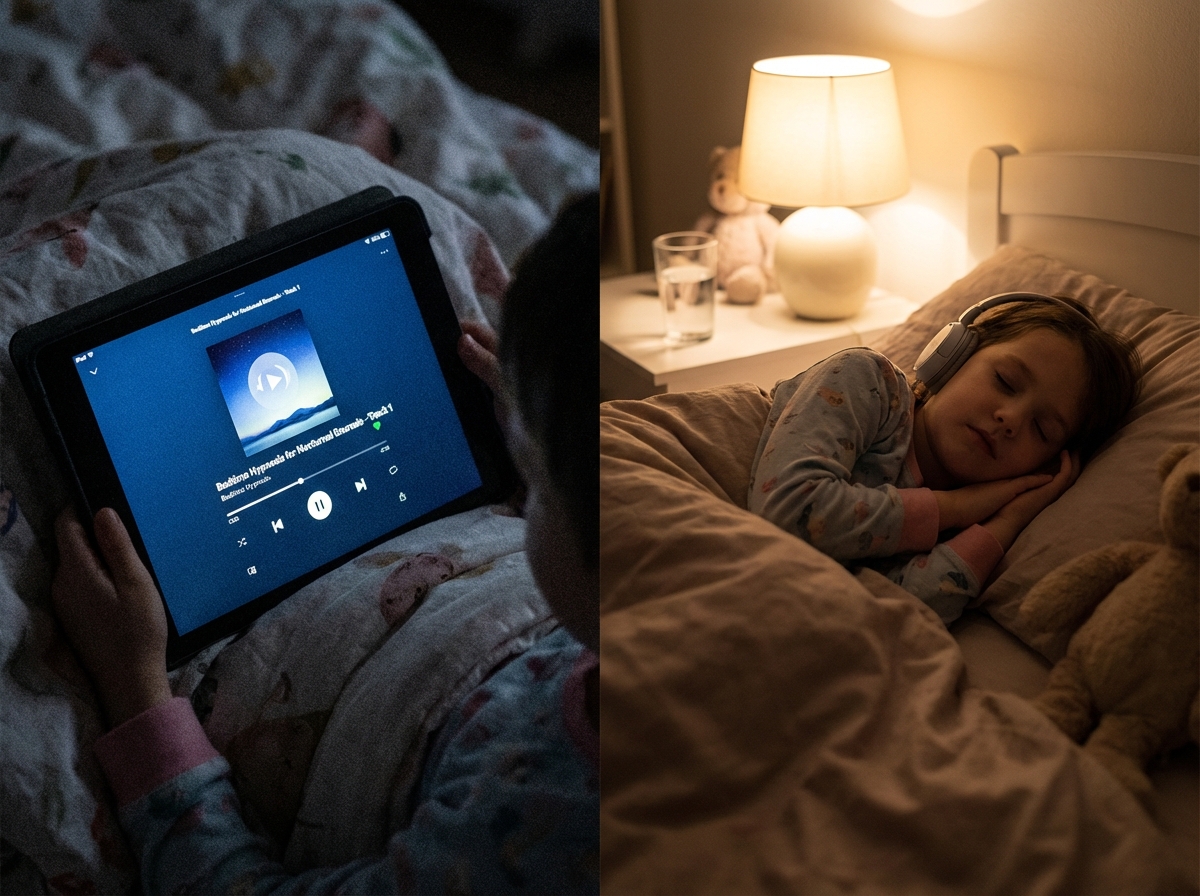
The recording works best when it becomes a genuine part of the bedtime routine — not an intervention that signals “we have a problem to fix tonight,” but something as unremarkable as brushing teeth. Consistency matters more than any single night’s result. The subconscious builds new patterns through repetition, not through a single peak experience.
When Dry Nights Start Appearing — and What to Do Next
The first dry morning is disproportionately important. Not because it proves anything medically, but because of what your child reads in your reaction. Overcelebrating creates pressure — now there’s something to lose, and the subconscious can tighten around that. Under-reacting misses a window to reinforce the signal that the body is already learning.
A calm, warm acknowledgment lands better than a parade. “Your body did something really good last night” is more durable than balloons and a big breakfast. You’re talking to the subconscious as much as the child — and the subconscious responds to quiet conviction, not performance.
When wet nights return after a dry stretch — and they often do — how you handle that moment is the real test. A neutral, matter-of-fact response (“That’s okay, it’s still learning”) maintains the frame that progress is real and the setback is temporary. Visible disappointment, even briefly, can undo two weeks of subconscious work. The goal is to make dry nights feel like the new normal rather than a fragile achievement.

What Changes After Consistent Dry Nights
Once the pattern stabilizes — once wet nights become the exception rather than the rule — something shifts in how a child carries themselves. It’s not dramatic. It doesn’t announce itself. But it shows up in small things: less hesitation about sleepovers, less anxiety at bedtime, a kind of quiet ease that wasn’t there before.
The self-esteem piece is real and it compounds. A child who’s been wetting the bed for years has often built a private story about themselves — something like “my body doesn’t work right” or “I’m behind other kids.” Dry nights don’t just fix the laundry problem. They begin to dismantle that story, one morning at a time.
Keeping the recording in the bedtime routine even after dry nights have stabilized is worth doing for a few extra weeks. The subconscious consolidates patterns through continued reinforcement, not just initial exposure. Pulling it too early is like stopping a medication because you feel better — the job might not be fully finished.
Looking back at this whole arc — the stripped beds, the careful conversations, the recordings playing softly at bedtime — what stands out isn’t any single technique. It’s that every part of it was pointing in the same direction: toward the subconscious, not around it.
Start with the conversation, not the solution. Before introducing any tool or recording, sit with your child in a calm moment and frame this as their body learning something new — not a problem to be fixed.
Choose the age-matched recording deliberately. A recording that feels credible to your child creates receptivity; one that feels babyish or clinical creates resistance before the first session is over.
Make it part of the routine, not an intervention. The recording should be as unremarkable as a bedtime story — something that happens every night, not something that signals tonight is different.
Watch your emotional tone around wet nights. Your audible sighs, your body language at 3 a.m., the way you talk to your partner while stripping sheets — all of it reaches your child’s subconscious. Neutrality is a skill worth practicing.
Acknowledge the first dry morning quietly and warmly. Skip the performance. A calm, genuine “your body did something great” reinforces the pattern without creating pressure to repeat it.
Treat setbacks as data, not failure. A wet night after a dry streak means the pattern is still consolidating, not collapsing. Your reaction to setbacks is one of the most powerful inputs in the whole process.
Keep the recording going after success. Two to four additional weeks of nightly listening after consistent dry nights helps the subconscious fully consolidate the new default rather than reverting under stress.
Protect the bed practically, frame it temporarily. Use a waterproof cover without making it feel like permanent infrastructure. “This is here while we work on it” is a sentence worth saying out loud.
Leave a Reply