


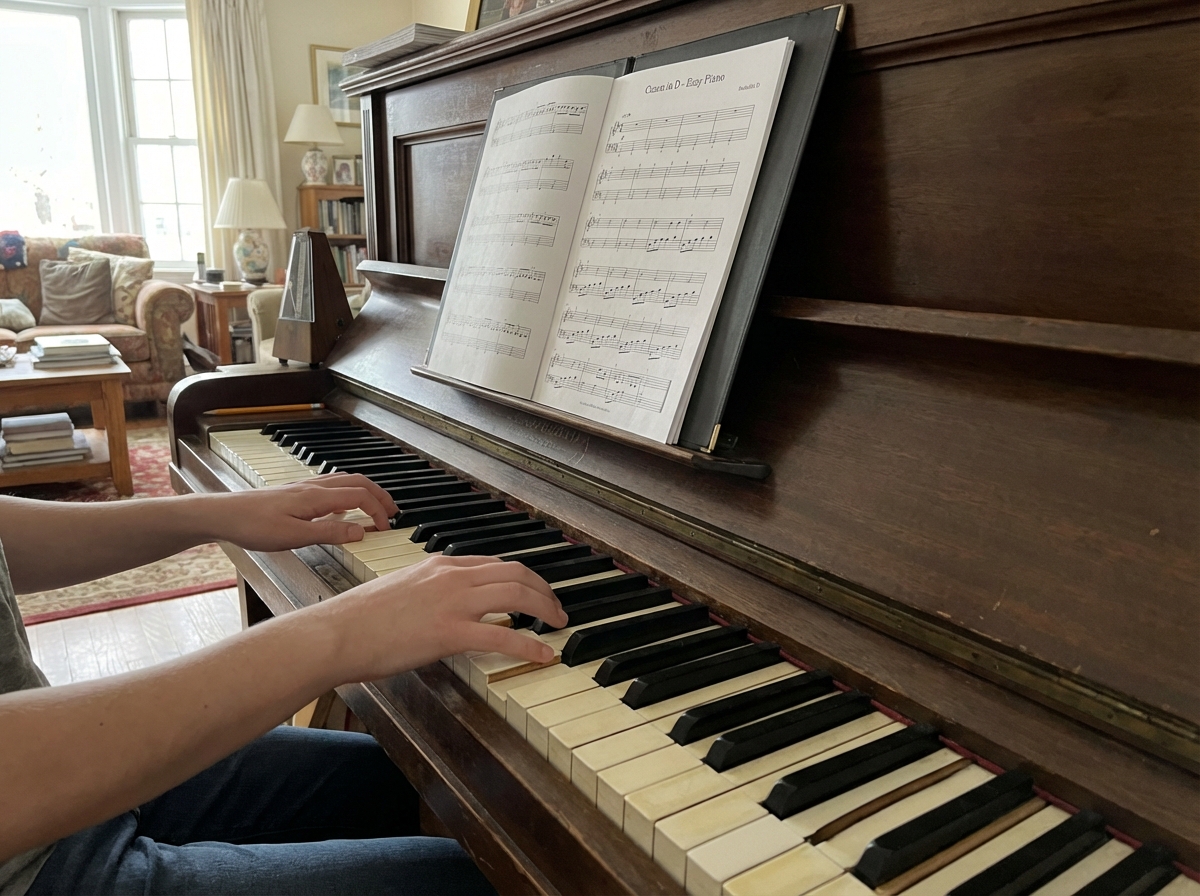
The first time I sat down and tried to play Canon in D, I had no idea where to put my hands. I had a keyboard, a printed score I’d found online, and absolutely no roadmap for how to turn those dots on the page into that sound I’d heard at every wedding I’d ever attended.
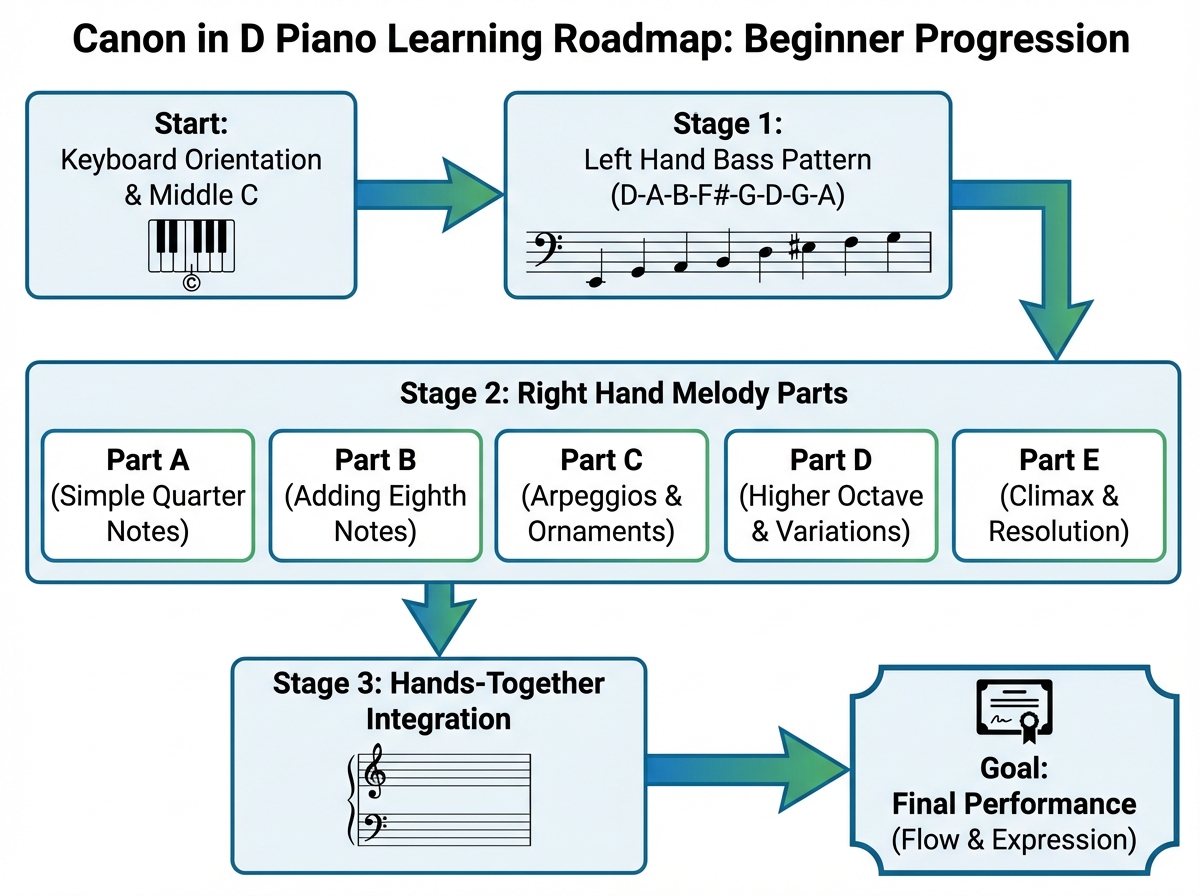
If you’re looking to learn Canon in D on piano as a beginner, the good news is that this piece is genuinely achievable — even with zero prior music experience. The structure is repetitive by design, which means once you lock in the left-hand pattern and understand how the right-hand melody builds across five sections, the whole piece starts to feel connected rather than overwhelming. You don’t need to read music fluently or have years of theory behind you. You need patience with the early stages and a willingness to go slower than feels comfortable.
- This piece works for absolute beginners because the left hand repeats the same 8-note bass pattern throughout the entire song — master that first and everything else builds on top of it.
- The right hand melody is split into distinct sections (Parts A through E) that increase in complexity gradually — rushing ahead before one part feels solid is the most common reason people get stuck.
- Most people can play a recognizable version of Canon in D within 4 to 8 weeks of consistent daily practice, even starting from scratch.
What “Canon in D” Actually Means for Piano Beginners
Canon in D is a baroque composition originally written by Johann Pachelbel for three violins and a basso continuo. For piano, the piece is typically arranged so the left hand carries the repeating bass line — the “ground bass” that gives the canon its foundation — while the right hand plays the evolving melodic voices on top. The “in D” simply means the piece is written in the key of D major.
| Term | What It Means for You |
|---|---|
| Key of D major | Two sharps (F# and C#) — you’ll learn these as you go |
| Time signature (4/4) | Four beats per measure — a steady, walkable pulse |
| Fingering numbers | 1 = thumb, 5 = pinky — guides which finger hits which note |
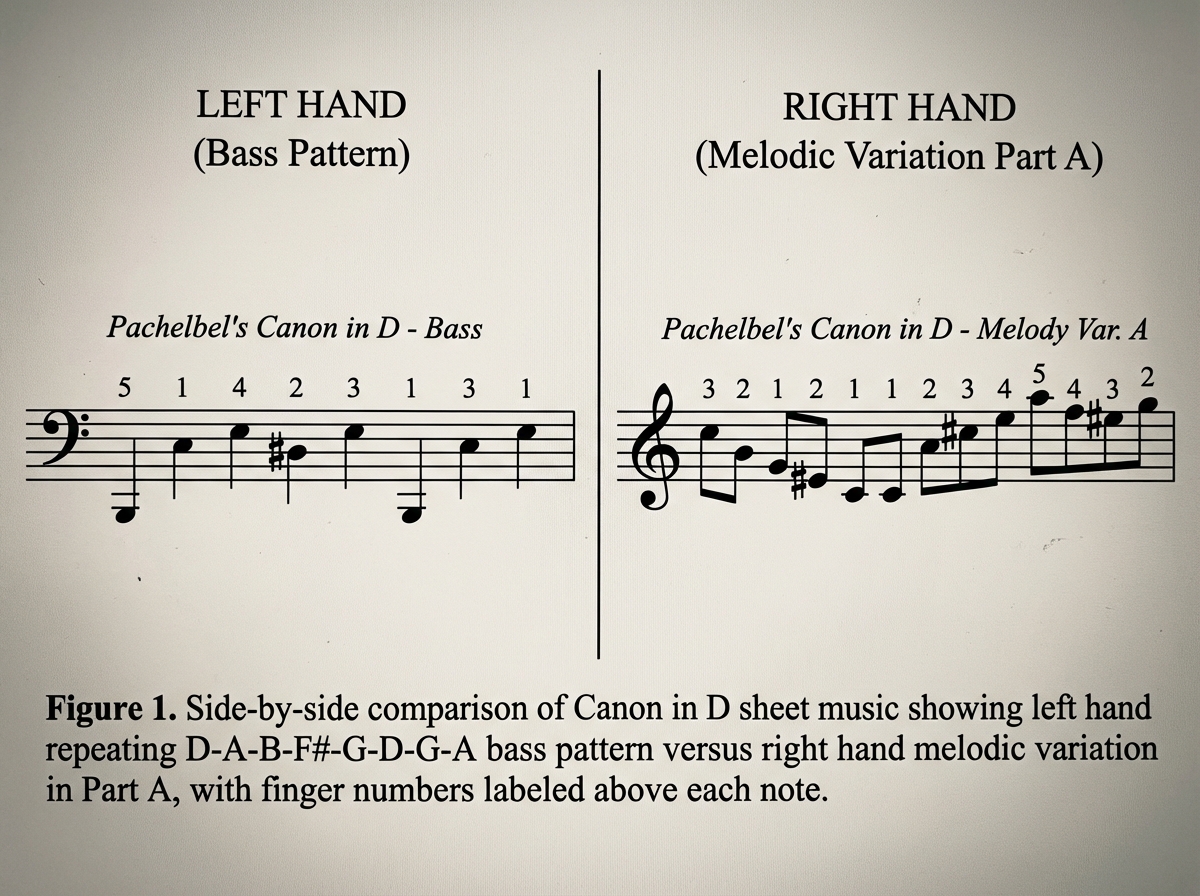
| Left-hand bass pattern | D–A–B–F#–G–D–G–A repeated throughout the whole piece |
You don’t need to memorize all of this before you start. These concepts reveal themselves naturally as you work through the piece section by section.
Three Things That Surprised Me About This Piece
- The left hand never changes — the entire piece runs on the same 8-note loop.
- Curved fingers aren’t a style preference; flat fingers physically block you from playing the transitions cleanly.
- Part D is where most beginners spend 70% of their total practice time — and that’s completely normal.
How Long Does It Actually Take to Learn Canon in D on Piano?
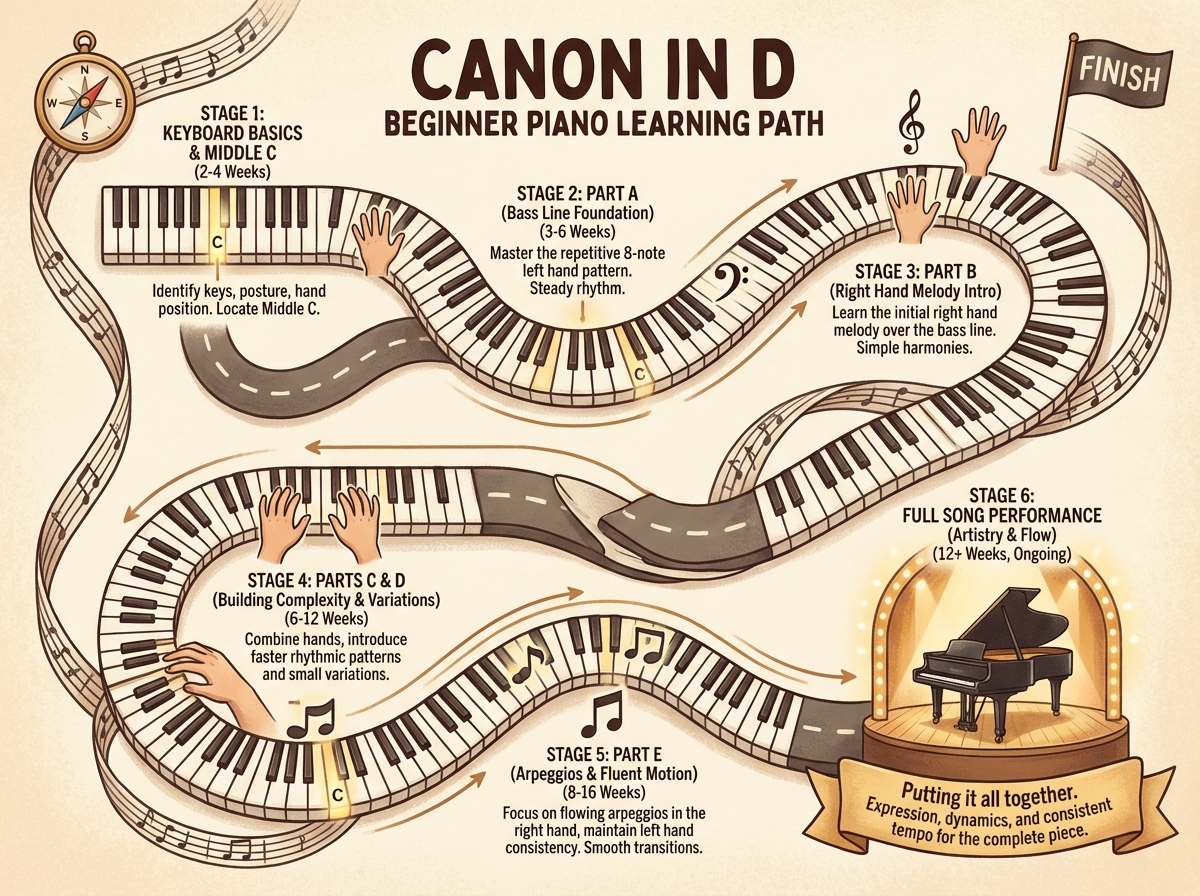
| Stage | What You’re Working On | Estimated Time |
|---|---|---|
| Piano basics | Keyboard layout, Middle C, hand position, finger curves | 1–3 days |
| Left-hand bass pattern | Memorizing and playing D–A–B–F#–G–D–G–A smoothly | 3–5 days |
| Part A (right hand + both hands) | First melodic phrase, hands separately then together | 3–5 days |
| Parts B and C (right hand + both hands) | Building melodic variations, coordinating both hands | 5–7 days |
| Part D (the hard section) | Eight sub-sections of increasing rhythmic complexity | 2–3 weeks |
| Part E + full run-through | Final phrase, then playing the entire piece start to finish | 3–5 days |
| Total | Full beginner playthrough of Canon in D | 4–8 weeks |
The order you learn things in matters far more than how fast you move through them. If the left hand isn’t automatic before you add the right hand, the whole coordination problem doubles.
If you’re moving slower than this table suggests, you’re not doing it wrong — you’re doing it honestly, which is the only way the piece actually sticks.
Getting Your Hands on the Keyboard Before You Touch the Melody
The single biggest mistake beginners make when learning Canon in D is jumping straight into the right-hand melody before their left hand knows what it’s doing. I did exactly this. The melody sounded familiar and exciting, so I chased it — and within a week I was tangled up trying to coordinate two hands where one didn’t know its job yet.
Before any melody, there’s orientation. Finding Middle C is not a throwaway exercise — it’s the anchor point that makes every other note locatable without looking down. Once you know where Middle C is, the two sharps in D major (F# and C#) stop being abstract and become just two specific keys you’ll always know by feel.
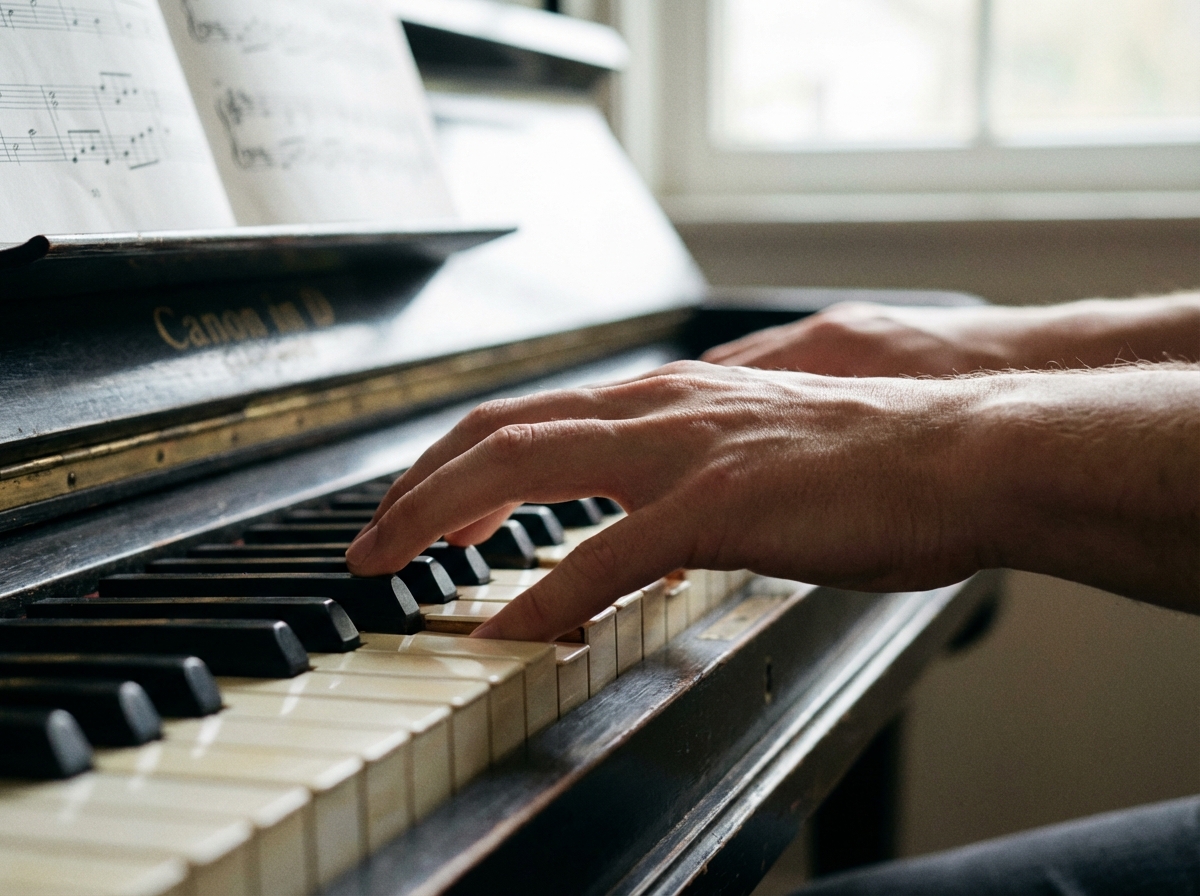
Hand position is the other thing that feels like a preliminary detail but isn’t. Curved fingers — where your knuckles are raised and your fingertips touch the keys rather than the flat pads of your fingers — let you move laterally across the keyboard without your hand collapsing. On a piece like Canon in D, where the right hand frequently shifts position between sections, curved fingers are what make those shifts silent and clean rather than clunky and hesitant.
The Left Hand Is the Whole Foundation
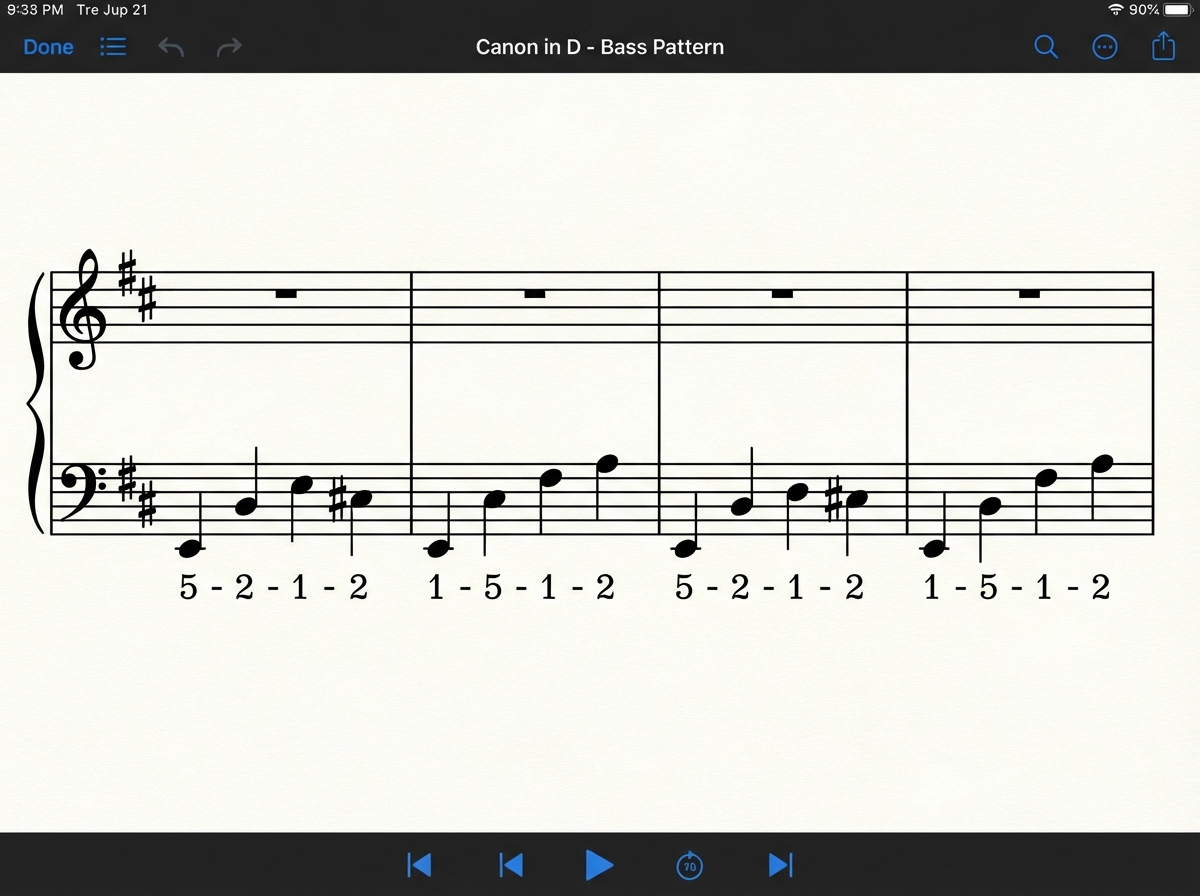
The left hand in Canon in D plays eight notes in a loop: D, A, B, F#, G, D, G, A. That’s it. That pattern repeats for the entire piece without variation. When I first saw that, I thought it would be easy. It’s not — not at first, anyway.
The challenge isn’t the pattern itself. The challenge is making it disappear. When you’re a beginner, your left hand demands your full attention. Your eyes drift down to watch it. Your counting gets interrupted. And the moment you try to layer the right hand on top, your left hand forgets what it was doing. The goal for the left hand isn’t to play it correctly once — it’s to play it so many times in isolation that it becomes background noise, something your hand does while your brain focuses elsewhere.
A useful test: can you play the left-hand pattern while carrying on a conversation? If not, it’s not ready for the right hand yet. Practice it while watching TV, while listening to the full piece, while counting out loud. The point is repetition until the physical movement is divorced from conscious attention.
Once that pattern is truly automatic, something remarkable happens — you stop feeling like you’re managing two separate problems and start feeling like you’re playing one piece.
How the Right Hand Builds — and Where It Gets Hard
The right hand in a beginner arrangement of Canon in D is divided into distinct sections — call them Parts A through E — where each part introduces a new melodic idea that sits on top of the same left-hand loop. Parts A, B, and C are where you find your footing. The notes move mostly by step, the rhythm is steady, and the fingering patterns repeat in predictable ways.
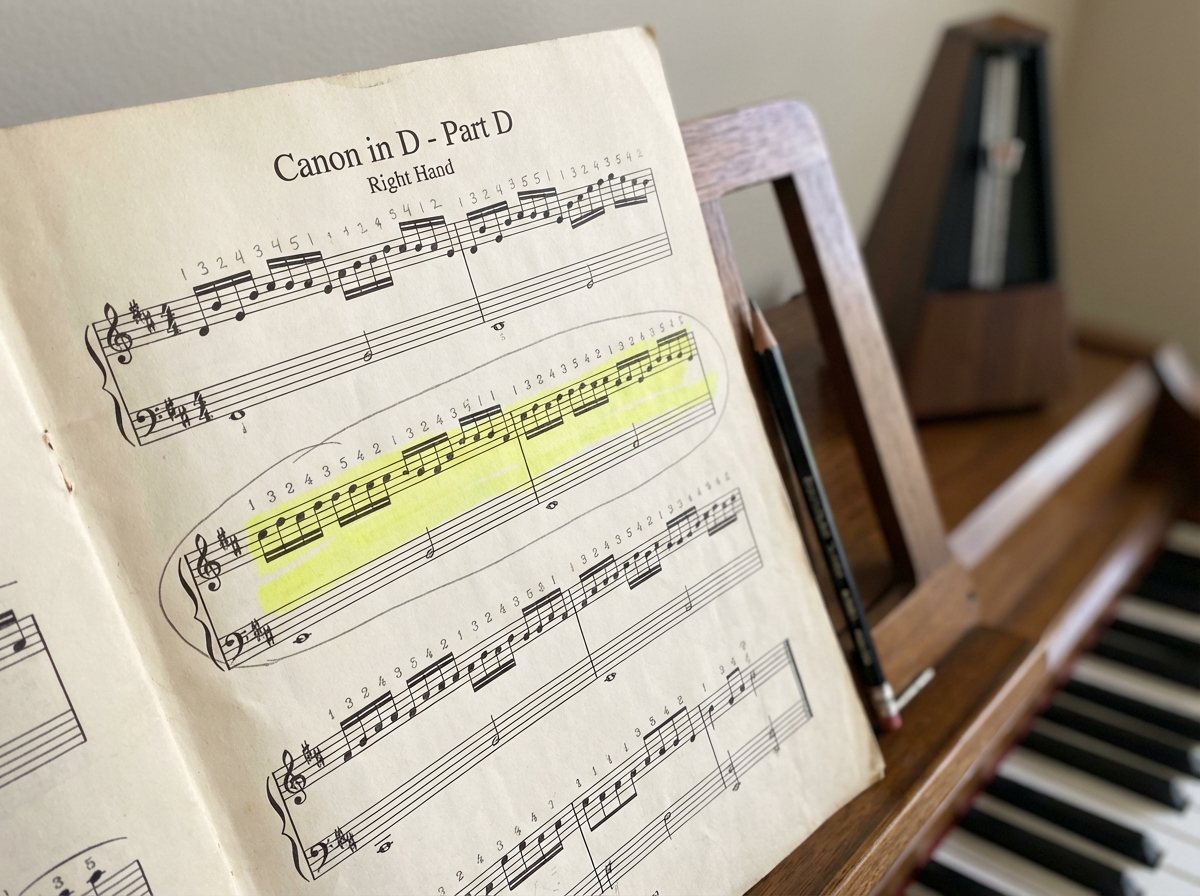
Part D is different. This is where the arrangement opens up rhythmically, introducing faster note groupings, wider interval jumps, and variations that don’t just build on each other but each demand their own muscle memory. There are eight sub-sections within Part D alone — and if you try to learn them as one block, you’ll overwhelm yourself and nothing will stick. The divide-and-conquer approach that works for the whole piece applies here too, but at a smaller scale: learn Part D1 until it’s clean, then add D2, then put D1 and D2 together, then move to D3.
The moment things clicked for me in Part D was when I stopped thinking about it as “the hard part” and started treating each sub-section as its own small piece. The frustration dissolved once I stopped measuring progress against the finished song and started measuring it against where I was yesterday.
Putting Both Hands Together — The Real Test
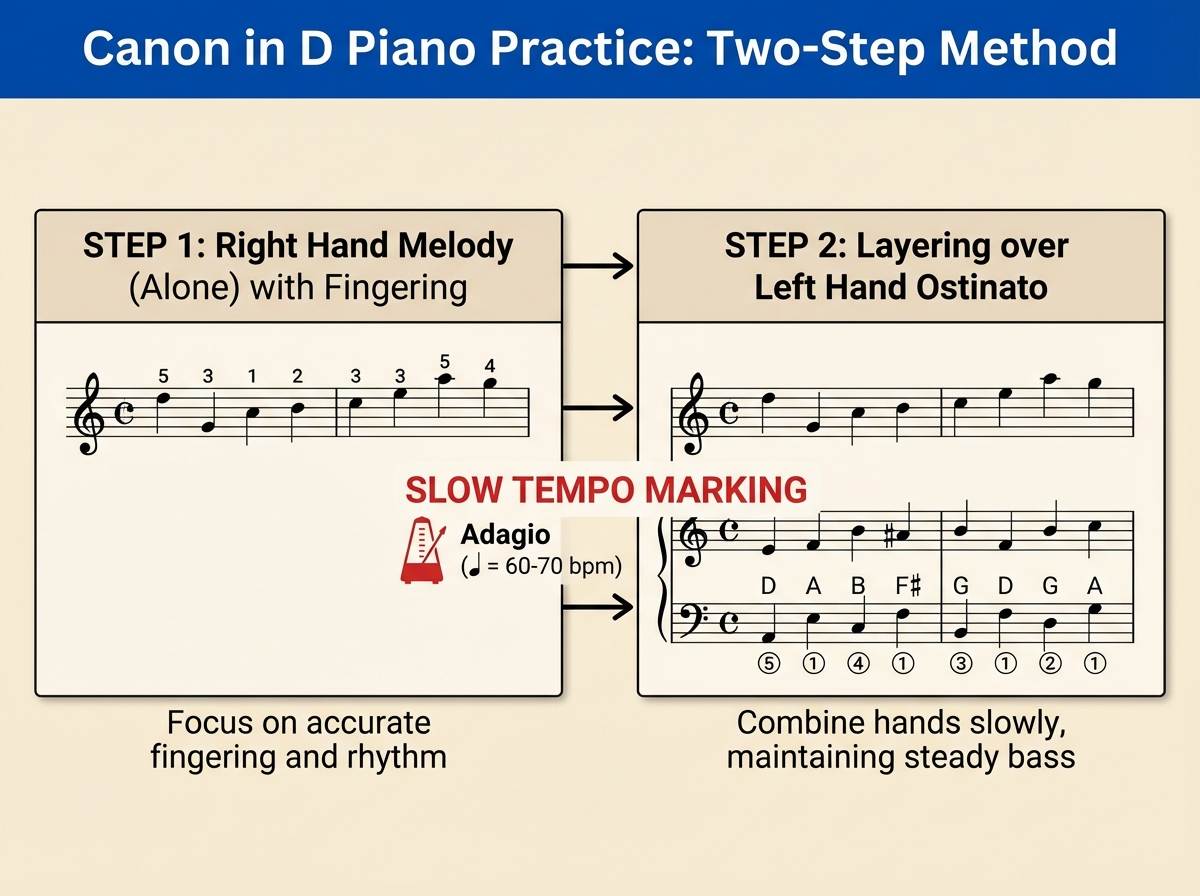
Every section of Canon in D follows the same structure: learn the right hand alone, then put it together with the left. This sounds obvious until you’re actually doing it and your brain completely short-circuits trying to process two independent lines simultaneously.
The key is tempo. The tempo you use when both hands are together should feel almost embarrassingly slow — slower than what you think is necessary. If you can play both hands together cleanly at half speed, you’re building the neural pathway that will eventually run at full tempo. If you rush to full speed before the coordination is there, you’re just rehearsing mistakes.
There’s a specific moment in the hands-together practice where things suddenly align. It usually happens somewhere in the middle of a repetition when you realize you’re not thinking about the left hand anymore — it’s just happening — and all your attention is on the right-hand melody. That’s the breakthrough. Once you feel that once, you know exactly what you’re chasing in every other section.
Playing Canon in D All the Way Through
The first time you play the whole piece from start to finish — even slowly, even imperfectly — it sounds like Canon in D. That’s not a small thing. The harmonic progression is so iconic that even a beginner-tempo run-through carries the emotional weight of the piece. The patience you put into each part separately suddenly pays off as a complete musical experience.
At this stage, the work shifts from learning to smoothing. Transitions between parts — the moments where the right-hand melody changes but the left-hand pattern keeps rolling — are where rough edges tend to hide. Slowing down just those transition bars and running them in isolation, then rejoining them to the surrounding sections, is usually enough to make the full piece feel cohesive.
Something also changes in how you hear the piece once you can play it. You stop experiencing Canon in D as background music and start hearing the architecture of it — the way each right-hand variation relates to the one before it, the way the bass line creates a kind of gravity that holds everything else in orbit around it. Playing it teaches you things about it that just listening never could.
What to Do Right Now
Start with the left hand, and don’t move on until it’s automatic. The entire piece depends on this foundation — rushing past it is why most beginners stall in the middle sections.
Practice the left-hand bass pattern D–A–B–F#–G–D–G–A with your eyes closed. If you have to look at your hand to find the notes, it’s not ready to support a right-hand melody yet.
Learn each part of the right hand in strict isolation before attempting hands together. Your brain needs to store each hand’s movements separately before it can coordinate them simultaneously.
When you combine hands, drop your tempo to 50–60% of what feels comfortable. Slow, clean repetitions build the coordination that fast, sloppy ones undo.
Treat Part D as eight separate pieces, not one. Work through each sub-section (D1 through D8) sequentially, adding the next only once the previous one is clean.
Curve your fingers from session one. Flat-fingered habits are extremely hard to undo once set, and they will physically limit your ability to play the faster right-hand passages in Part D.
Record yourself playing. What sounds right under your fingers often sounds different when played back. Recordings reveal timing and coordination issues that are invisible in the moment.
Use the score as a navigation tool, not a crutch. Once you know a section well enough to play it without looking at the page, close it. Memorized sections feel different — and better — than sight-read ones.
Leave a Reply