


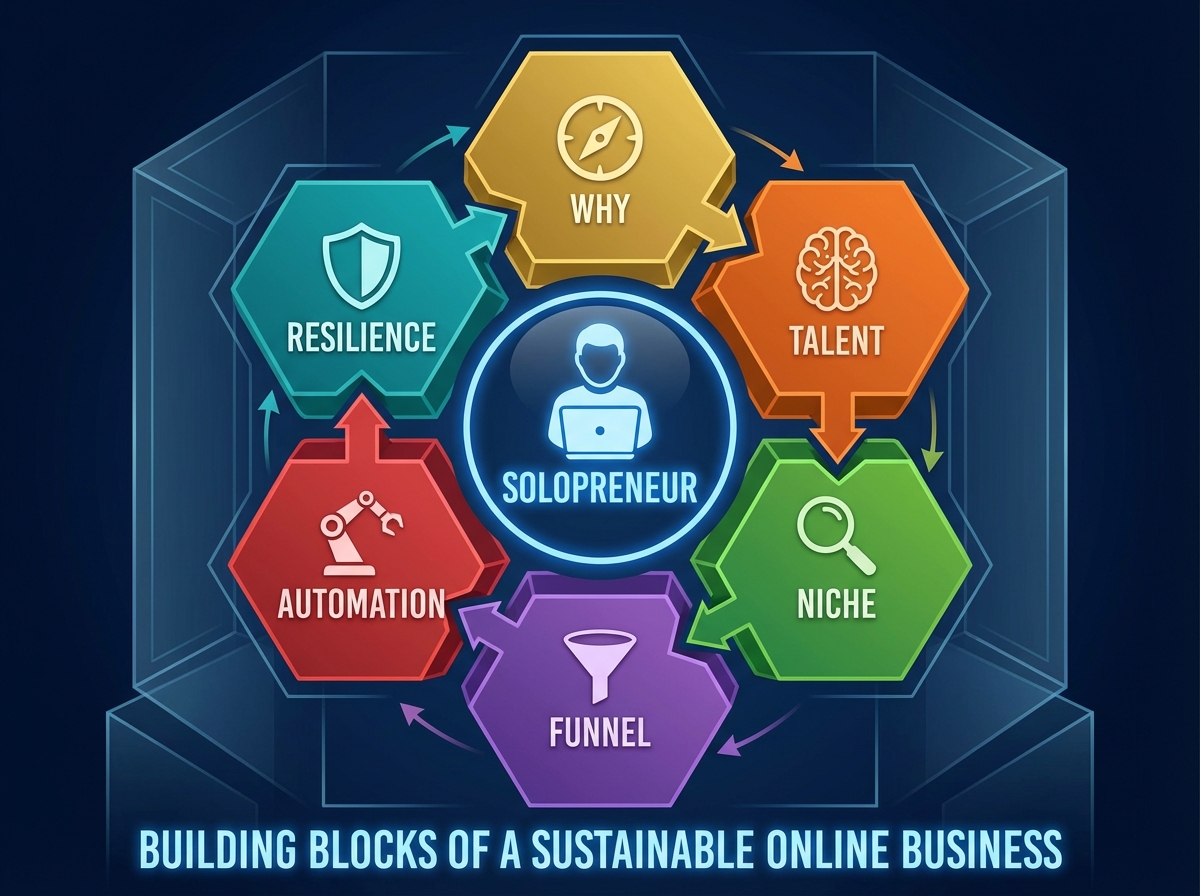
The first time you decide to start an online business, nobody warns you that most of the work happens before you ever touch a product, a website, or a marketing platform. You spend weeks building something that feels solid — until it isn’t.
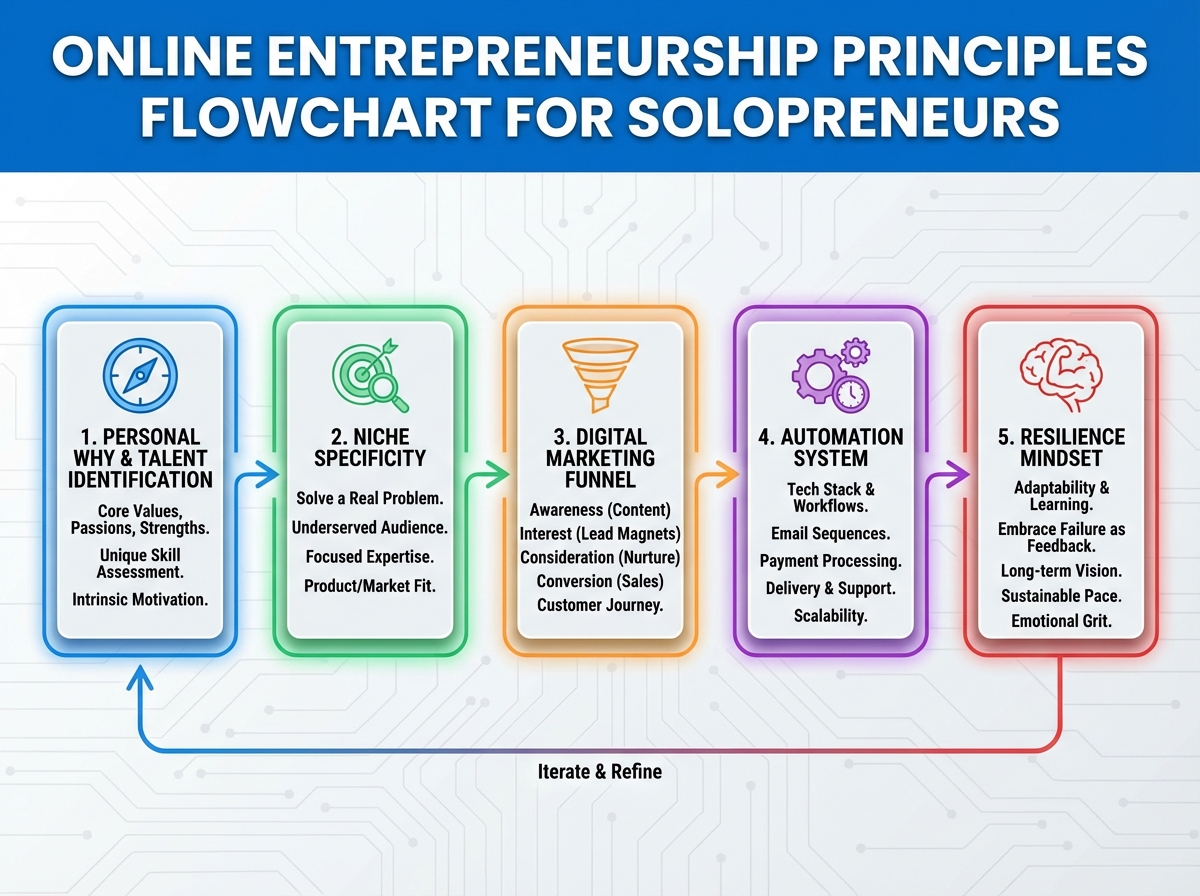
If you’re looking to learn online entrepreneurship, the fastest path isn’t finding the right niche or the right tool. It’s understanding the governing principles that make every business decision either coherent or chaotic. Online entrepreneurship has a logic to it, and once you see it, you can’t unsee it. The principles below aren’t frameworks borrowed from corporate strategy — they’re the actual fault lines where solopreneurs either break through or burn out.
- Most online businesses fail not from lack of effort but from building on the wrong foundation — wrong niche, wrong motivation, wrong audience clarity.
- A solopreneur who understands their own strengths and encodes them into their offer has a structural advantage no competitor can replicate.
- Automating and systematizing early isn’t laziness — it’s what separates someone with a business from someone with an expensive hobby.
What “Online Entrepreneurship” Actually Means for Someone Starting Solo
Online entrepreneurship isn’t just selling something on the internet. It’s the deliberate construction of a system — built around your skills and your market — that generates value without requiring your constant physical presence. For a solopreneur specifically, this means you’re simultaneously the strategist, the creator, the marketer, and the operator. That’s both the opportunity and the trap.
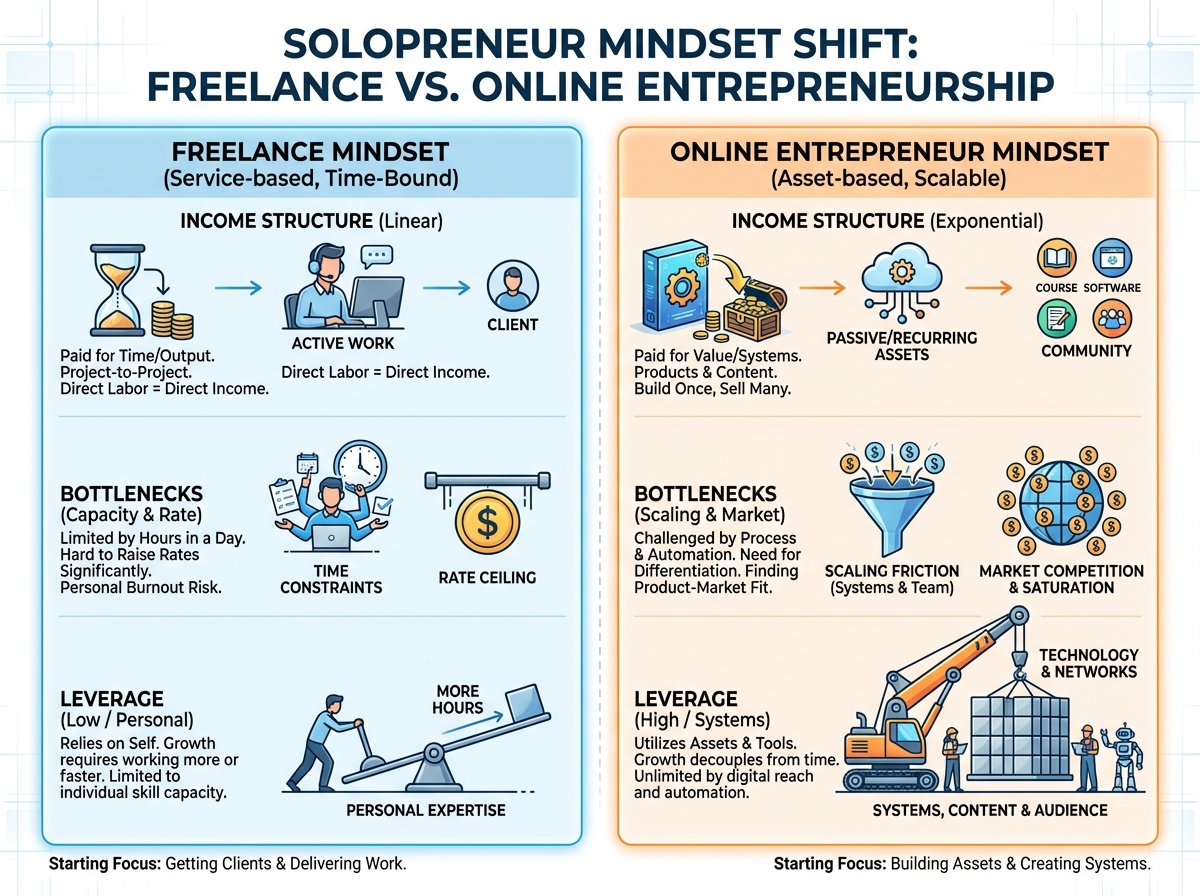
The distinction that matters most early on is between a freelance mindset and a business-building mindset. A freelancer trades time for money. An online entrepreneur builds a mechanism. The principles that govern whether you cross that line successfully have almost nothing to do with which platform you use.
| Dimension | Freelance Mindset | Business-Building Mindset |
|---|---|---|
| Income source | One client at a time | Systems and recurring value |
| Bottleneck | Your available hours | Your offer and funnel clarity |
| Failure mode | No clients | Wrong foundation from day one |
| Leverage | Skills | Automation + audience + positioning |
The three things this actually requires:
- A reason that outlasts motivation (your Why)
- A position in the market that’s specific enough to be found
- A delivery system that works when you’re not watching it
Starting With Why — and Why Most People Get This Wrong
The biggest mistake most people make when starting an online business is treating “why” as a motivational warm-up exercise. They write something vague about freedom or income and move straight to tactics. Six months later, the business is technically running but they’ve stopped showing up for it.
Your Why isn’t a tagline. It’s a stress test. When the first month brings zero sales, when a client disappears, when a competitor launches the same offer with more polish — your Why is what determines whether you pivot intelligently or quit. The solopreneurs who last are the ones whose reason to build is woven into who they already are, not pinned to an outcome they haven’t achieved yet.
The practical question isn’t “why do you want to run a business?” It’s closer to: what would you keep doing even if no one paid you for the first three months? The answer to that question points directly at both your staying power and your competitive edge. A business built on genuine internal motivation has a texture that audiences feel — it shows up in the writing, the product quality, the willingness to go deep on a topic.
This is the part that feels soft until you lose it. Then it feels like the only thing that mattered.
Talent and Specificity — The Two Laws That Work Together
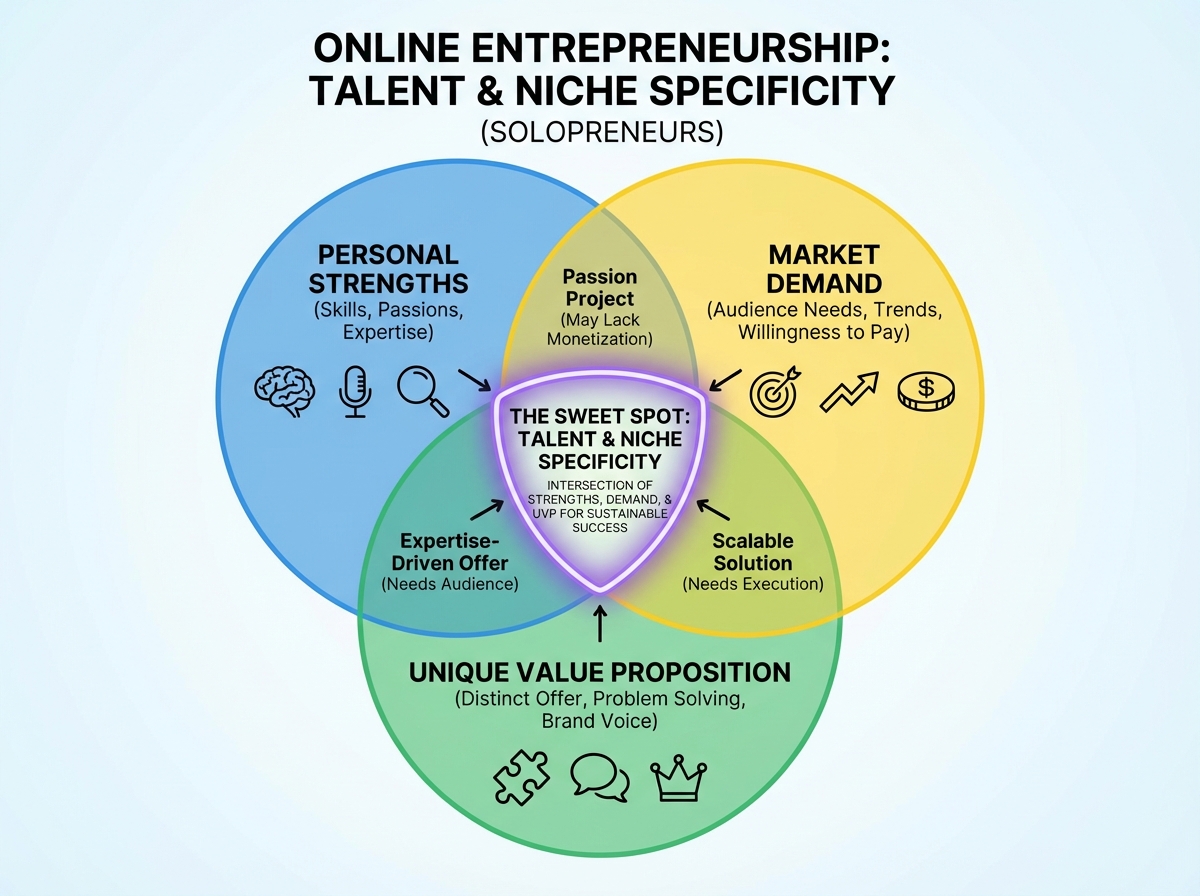
Most solopreneurs waste years chasing “profitable niches” while ignoring what they’re actually built for. The better path runs in the opposite direction: identify where your natural talent creates disproportionate output, then find the market where that talent solves a painful problem. That intersection is where you get an unfair advantage over competitors who are grinding at things they’re merely competent at.
Specificity is the mechanism that turns talent into authority. Broad positioning — “I help businesses with marketing” — makes you invisible. Specific positioning — “I help independent fitness coaches build automated email systems” — makes you the obvious choice for the right person. Counterintuitively, narrowing down expands your reach because you become easy to describe, easy to remember, and easy to refer. The internet rewards specificity in a way that physical markets never did.
The friction here is real. Going narrow feels like giving up. You look at a niche and think about all the people you’re not targeting. But the math works differently online: a small, highly specific audience that trusts you completely is worth more than a large, unfocused audience that vaguely knows you exist. The principle of specificity is what turns a content creator into a thought leader and a generic seller into a category of one.
What Profitability and Clarity Actually Look Like Before Launch
Here’s where solopreneurs almost universally get it wrong: they build first and validate later. They spend three months constructing an offer, then discover the market doesn’t want it at the price point that makes sense. The Law of Profitability isn’t about greed — it’s about sustainability. A business that can’t eventually run at a margin that compensates you properly isn’t a business. It’s a distraction with branding.
Clarity is the companion principle that makes profitability reachable. Clarity means knowing, without ambiguity, who your customer is, what specific problem you solve, how you deliver it, and what you charge. Most early solopreneurs have a blurry version of at least two of those four. They know the product but not the customer. They know the customer but not the transformation. That blur bleeds into every piece of marketing they produce — and audiences feel it.
The exercise that cuts through this fastest: write a one-sentence offer statement that a stranger could read and immediately know if it applies to them. Not a mission statement. Not a tagline. A functional sentence: “I help [specific person] achieve [specific result] through [specific mechanism].” If you can’t write it cleanly, you don’t have clarity yet. And without clarity, every marketing dollar you spend is aimed at a moving target.
For a deeper look at building a small business marketing system that actually converts, the same principle of clarity-first applies at every stage of customer acquisition.
The Freebie, the Funnel, and the Digital Marketing Strategy Underneath
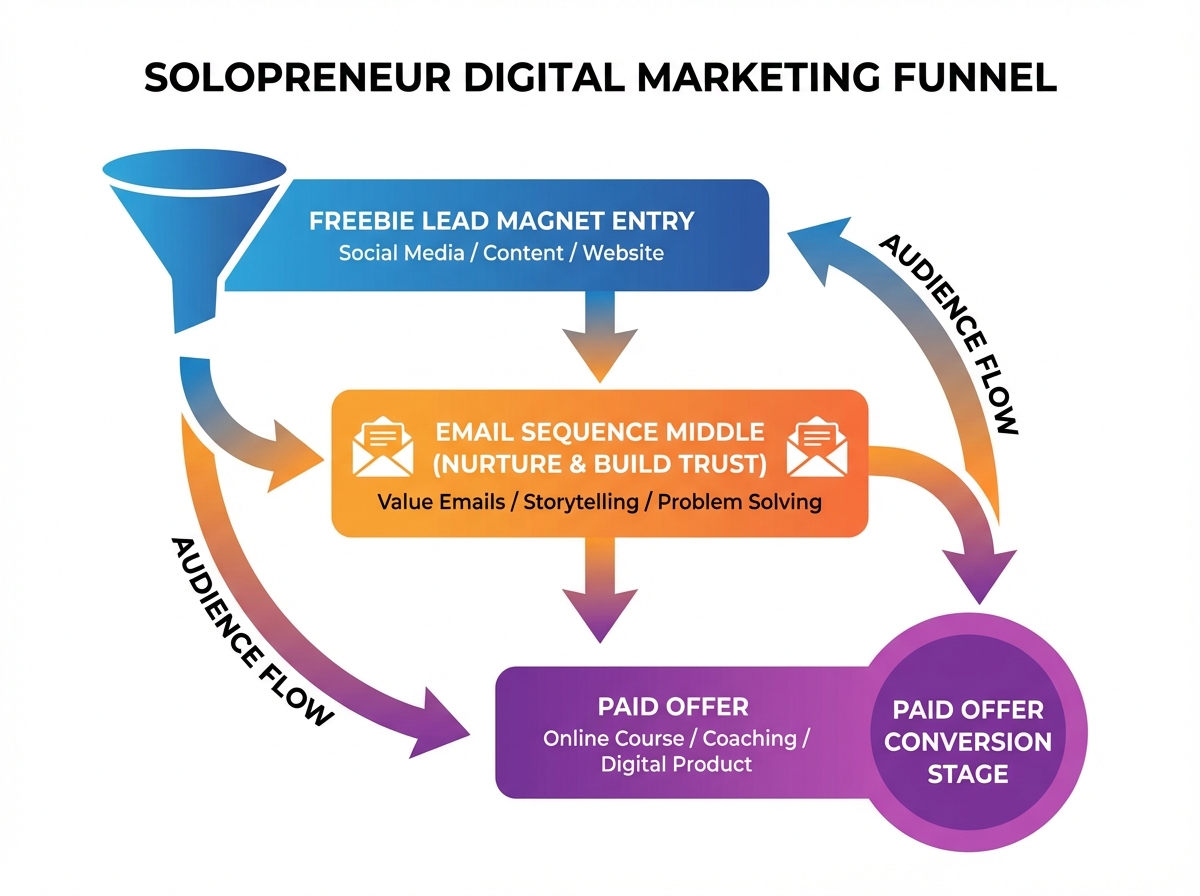
The freebie is almost always the most underestimated asset in a digital marketing strategy for online businesses. Most people create something free because they’ve read that they should — a PDF, a checklist, a mini-course — and then wonder why it produces no real audience. The problem is that a freebie built without intention is just clutter. A freebie built as the first genuine proof of your value is a trust-building machine.
What makes a freebie actually work is specificity and completeness. It shouldn’t hint at value — it should deliver a complete, usable result that makes the recipient think: “if the free thing is this good, the paid thing must be transformative.” That shift in perception is the entire mechanism behind a well-designed marketing funnel for solopreneurs. The freebie is not bait. It’s evidence.
The funnel itself is just the architecture of that trust journey — awareness, interest, decision, action. The mistake is treating each stage as a separate project. The funnel should feel to the customer like a continuous, natural escalation of value. You’re not pushing them through stages; you’re removing friction at each step so the decision to buy feels obvious. That’s what a well-built digital marketing strategy actually accomplishes: it makes saying yes easier than saying no.
Promotion, Automation, and Running an Online Business That Doesn’t Need You Awake
Promotion is where most solopreneurs get paralyzed by platform choice. Instagram vs. YouTube vs. LinkedIn vs. a newsletter — every option looks equally valid and equally demanding. The principle here is simpler than the noise around it: go where your specific customer already spends time, and go deep on one channel before spreading thin across many. Mediocre presence on five platforms produces less than dominant presence on one.
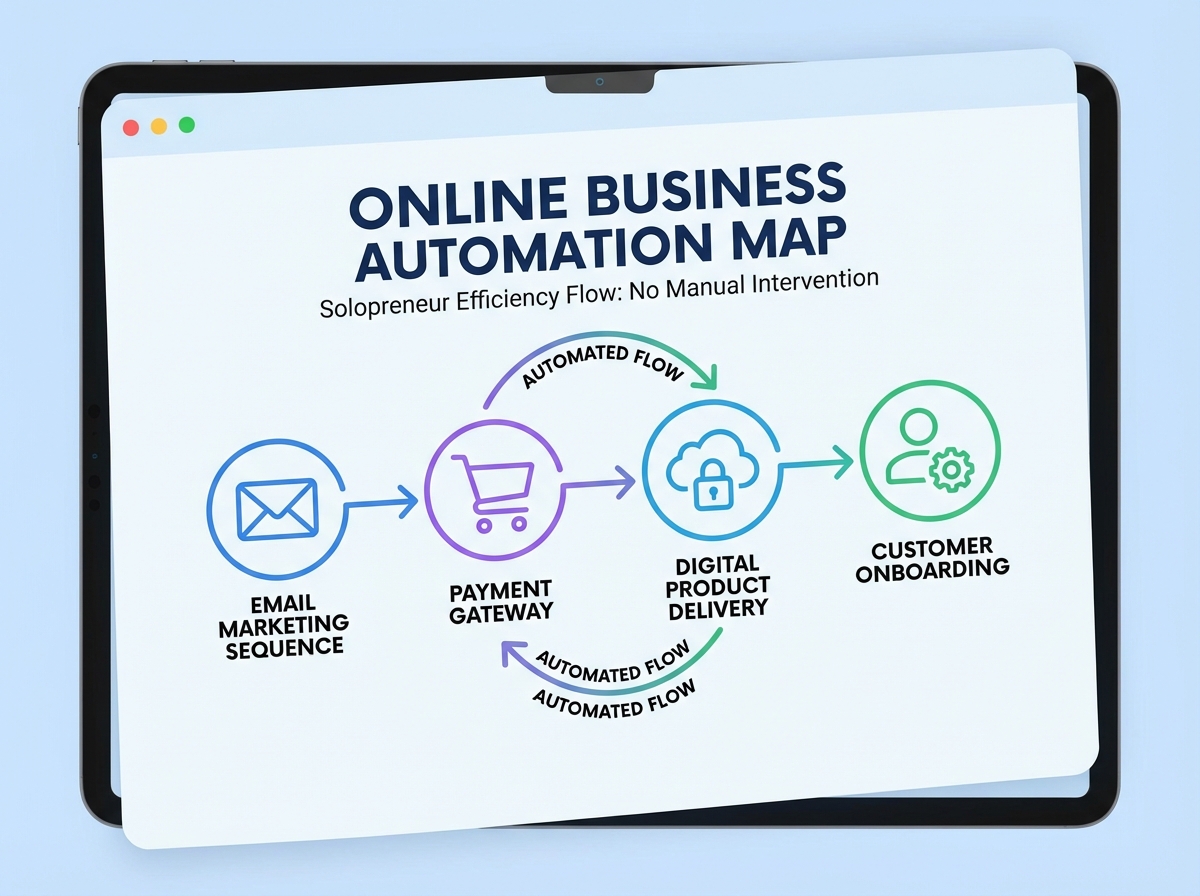
Automation is what separates an online business from a self-employment trap. The goal isn’t to remove humanity from your business — it’s to systematize the repeatable parts so your attention is reserved for the irreplaceable parts. Email sequences, payment processing, delivery, onboarding, FAQs — these can all run without you. When they do, you stop trading time for money and start building equity in a system.
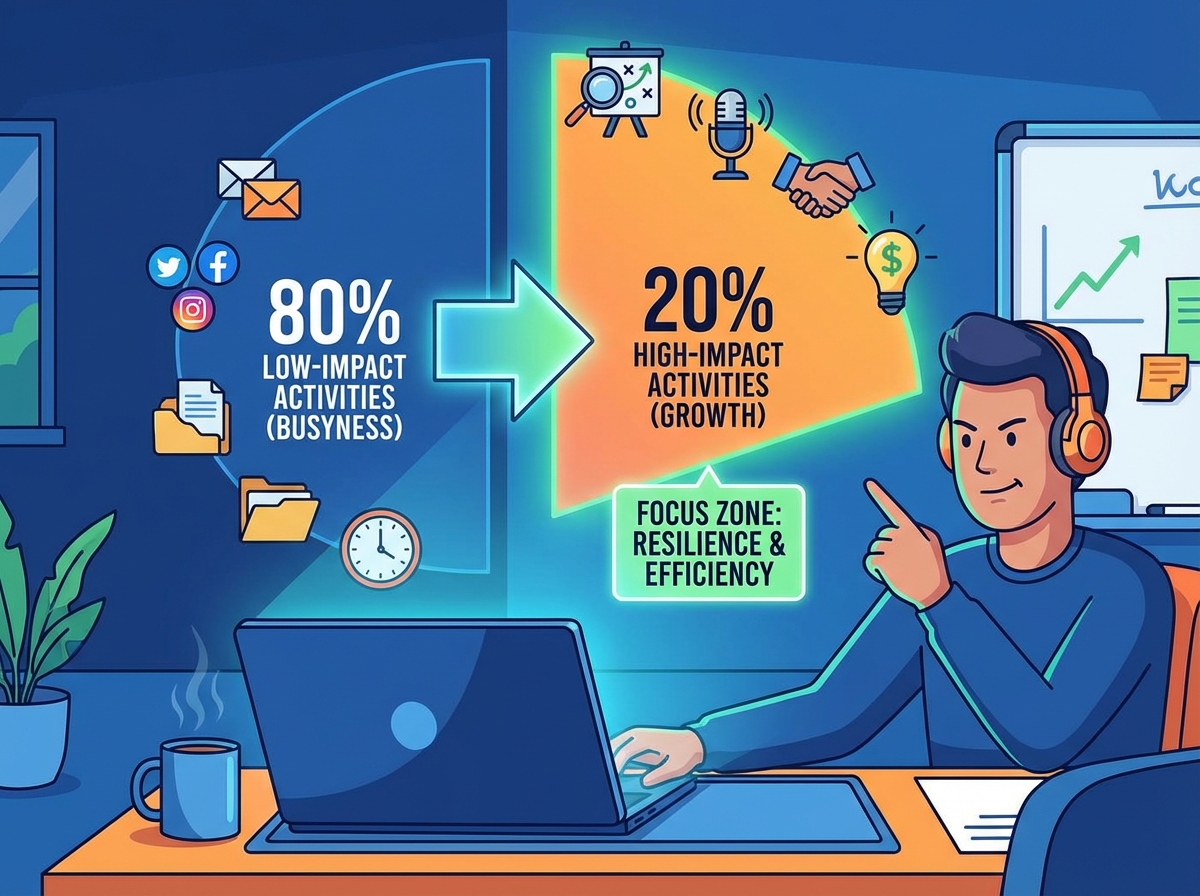
The combination of smart promotion and automation is what creates the scalability that makes online entrepreneurship worth the early grind. You build once, you refine based on real feedback, and then the system earns trust while you sleep. The Pareto Principle matters enormously here: 20% of your activities are producing 80% of your results. Finding those activities — and automating or delegating everything else — is the operational discipline that most solopreneurs take years to internalize.
If you’re building toward a structured selling system, learning how ClickFunnels dropshipping subscription funnels are constructed shows the automation architecture in action.
How Long It Actually Takes to Build a Working Online Business
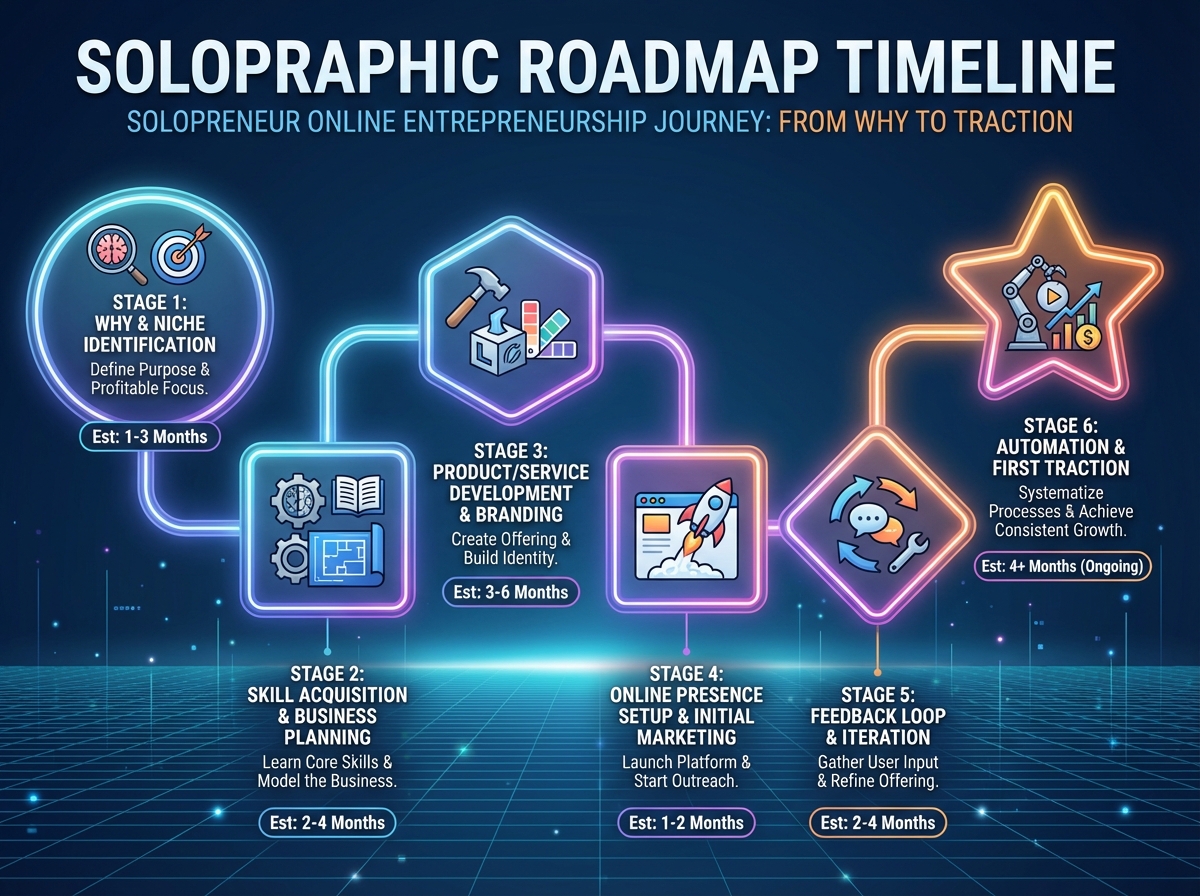
| Stage | What’s Happening | Realistic Time |
|---|---|---|
| Foundation | Why, talent, niche, offer clarity | 2–4 weeks |
| Offer creation | Product or service built and priced | 3–6 weeks |
| Funnel setup | Freebie, landing page, email sequence | 2–4 weeks |
| First audience | Consistent promotion on one channel | 4–8 weeks |
| First sales | Funnel tested, offer refined | 6–12 weeks |
| Automation layer | Repeatable delivery, systemized ops | Ongoing |
| Total to first real traction | 4–6 months minimum |
The order of those stages matters far more than the speed — skipping foundation to get to promotion early is the most common reason online businesses stall before they ever gain momentum. If you take longer than the estimate at any stage, that’s not failure. That’s the work of building something that will actually hold.
Excitement, Spontaneity, and Why Personality Is a Business Asset
The version of online entrepreneurship that fails most quietly is the one built entirely on strategy and devoid of personality. You can have a technically perfect funnel and a beautifully optimized marketing sequence and still produce content that nobody remembers. Excitement — the genuine kind, not the performed kind — is what makes an audience choose you over a competitor with better SEO.
Spontaneity is the underrated twin of consistency. Everyone tells solopreneurs to be consistent — and they’re right — but consistency without spontaneity produces a business that feels like a content schedule. The accounts and creators that build real loyalty do unexpected things: an unfiltered behind-the-scenes post, an opinion that contradicts the consensus, a product decision that prioritizes depth over reach. Those moves signal that there’s a real person inside the business, and real people are the only things audiences actually bond with.
Your individuality isn’t something you add to a business as decoration. It’s a structural advantage. In a saturated market where five people sell what you sell, the differentiator isn’t features — it’s the specific texture of how you think, communicate, and show up. The solopreneurs who scale are rarely the most polished. They’re the most distinctly themselves.
The Inner Game — Efficiency, Imitation, Resilience, and Intuition
Efficiency in an online business doesn’t mean doing more. It means doing the right 20% with full attention and aggressively cutting the rest. This is the Pareto Principle applied not just to revenue but to time, energy, and creative output. The solopreneurs who build the most sustainable businesses are often the ones who work fewer hours but with sharper prioritization.
Imitation gets a bad reputation, but learning from competitors is one of the highest-leverage activities available to someone just starting out. Not copying — observing. What are the top performers in your niche doing with their lead magnets? How are they structuring their offers? What content is performing? You don’t need to guess; the data is publicly visible. The principle of intelligent imitation says: shortcut your learning curve by standing on the shoulders of people who’ve already tested what works, then add your own layer on top.
Resilience is the principle that makes all the others sustainable. Online businesses go through dead periods — weeks where engagement drops, sales slow, and the whole project feels like a mistake. The entrepreneurs who outlast those periods aren’t the ones with the best strategy. They’re the ones who built their Why deep enough to keep showing up when the metrics don’t justify it. Intuition develops in that same space — the more time you spend inside your business, the more you develop pattern recognition that outpaces any checklist. You start to feel when an offer is wrong before the data confirms it.
For those also building toward a full online business launch from scratch, the inner-game principles of resilience and intuition apply just as directly to offline ventures.
Your Unique Value Proposition Is Not a Slogan — It’s a Decision Filter
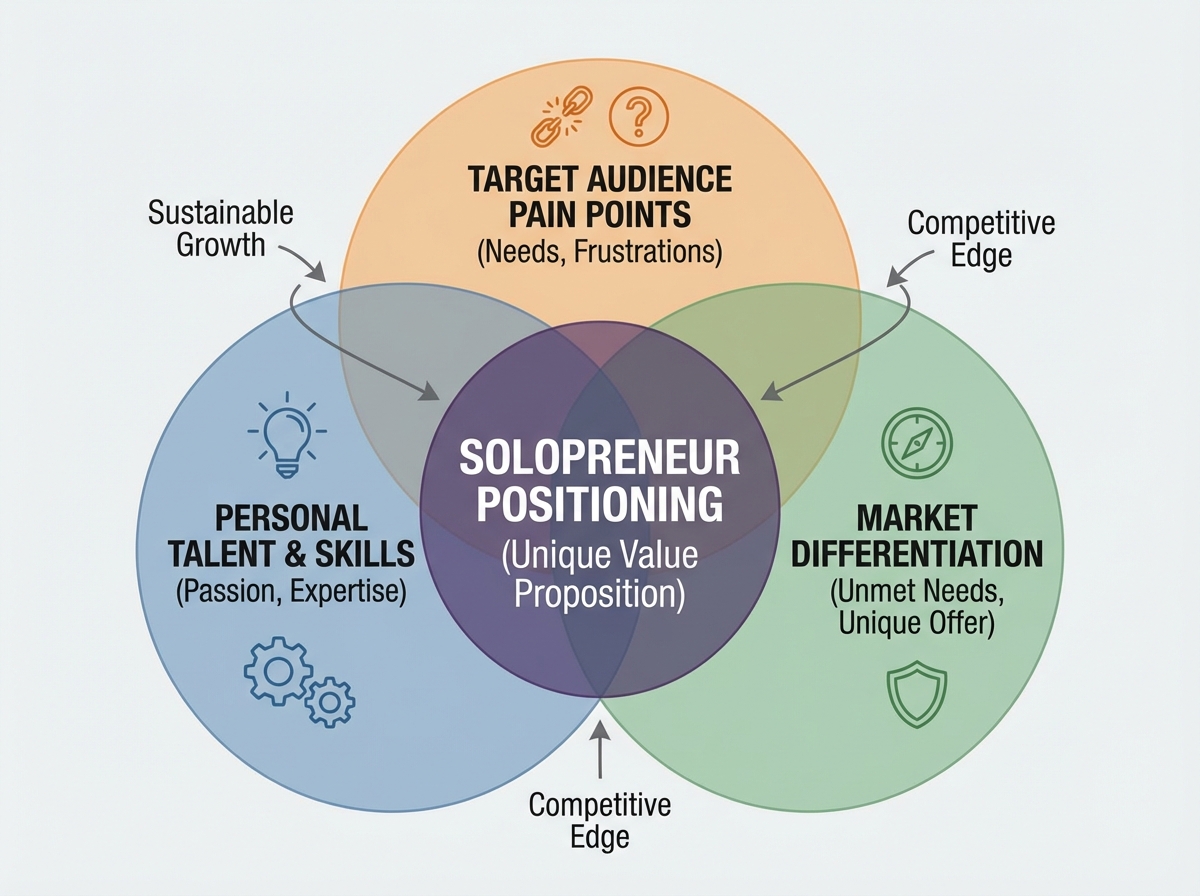
A unique value proposition (UVP) isn’t marketing copy. It’s the clearest possible articulation of why your specific customer should choose you over every other option available to them — including doing nothing. Most solopreneurs write a UVP for their homepage and then forget about it. The ones who build durable businesses use their UVP as a decision filter: does this product addition reinforce it? Does this partnership align with it? Does this content deepen it?
A strong UVP for an online business comes from the intersection of three things: what you do exceptionally well (talent), who experiences the most acute version of the problem you solve (specificity), and what transformation you deliver that alternatives don’t (differentiation). If any of those three is vague, the UVP will be vague — and a vague UVP produces a vague audience, which produces inconsistent sales.
The moment your UVP clicks into place, everything else in your online entrepreneurship journey becomes easier to prioritize. Promotion decisions become obvious because you know exactly who you’re talking to. Content decisions become easier because you know exactly what you stand for. The UVP is not the end of strategy — it’s the beginning of coherence.
What You Can Do Right Now
Looking back at the whole online entrepreneurship journey, the most expensive mistakes weren’t strategic — they were foundational. The people who get it right early are the ones who paused long enough to get the underpinning right before building on top of it. Here’s what that looks like in practice:
- Write your Why as a stress test, not a mission statement. Ask yourself: would I keep working on this if I made no money for six months? If the honest answer is no, dig deeper before building anything.
- Audit your natural talent before choosing your niche. List three things you do faster or better than most people you know, then find the market where that creates value. Build from strength, not from market research alone.
- Write your offer as a one-sentence test. Subject + specific problem + specific result + specific mechanism. If a stranger can’t immediately tell if it applies to them, it isn’t clear enough yet.
- Build your freebie as complete value, not a teaser. Design it to solve one specific problem fully — not to hint at the paid product. The quality of your free content is your most powerful sales mechanism.
- Choose one promotion channel and go deep for 90 days. Pick the platform where your target customer already spends the most time. Mediocre presence on five platforms is invisible. Dominant presence on one is a business.
- Map every repeatable task in your workflow and automate the first three. Email follow-up, delivery, and FAQ responses are the three most common time drains that can run on autopilot within a week.
- Study the top three competitors in your niche structurally, not emotionally. Analyze their funnels, their lead magnets, their pricing — not to copy but to identify the baseline your audience already expects, then exceed it.
- Revisit your UVP every 90 days. As your audience grows and your offer sharpens, your positioning should evolve. A UVP that was true at launch may be too broad — or too narrow — six months in.
Leave a Reply