


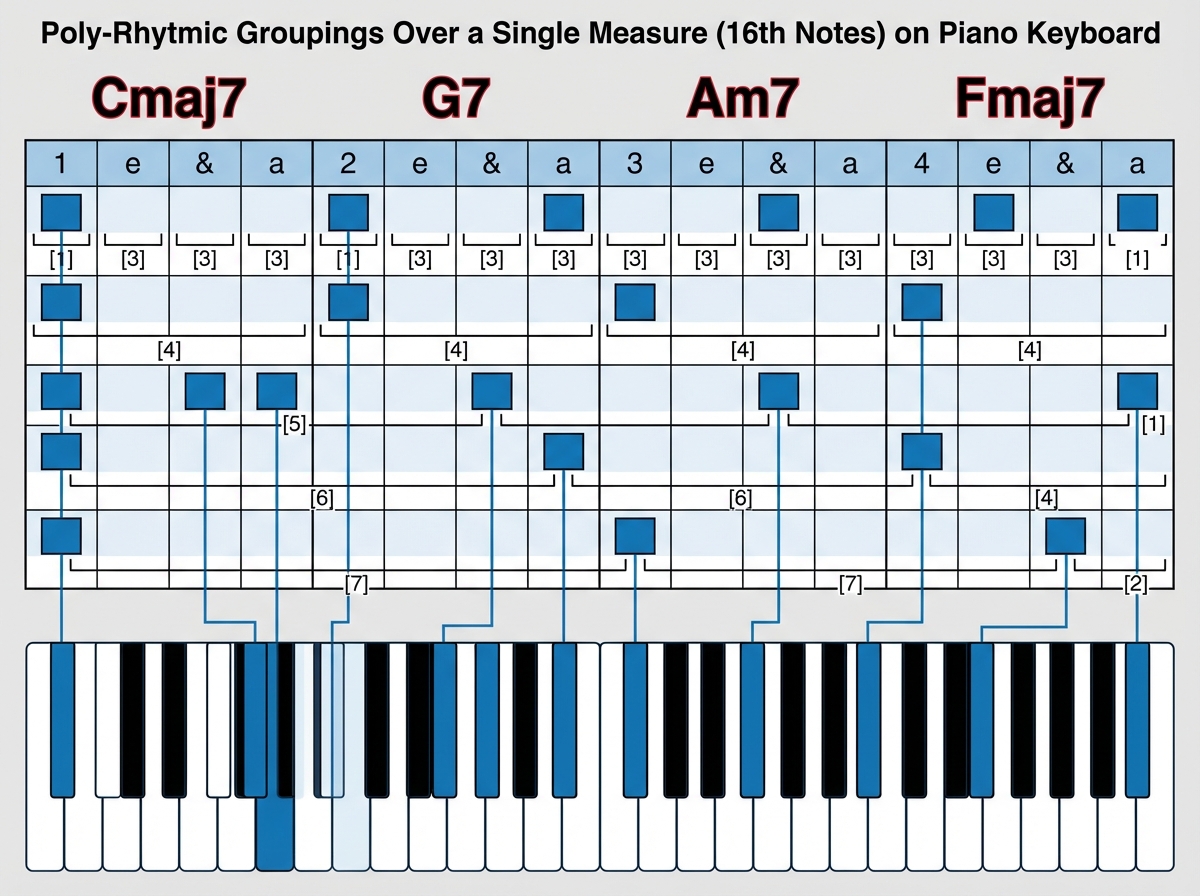
There’s a specific kind of frustration that hits when you can play all the chords but the music still sounds flat. You’re hitting the right notes, the harmony is there — but something’s missing. That something is rhythm, and for most piano players, it’s the last thing they think about and the first thing a listener hears.
If you’re looking to learn piano rhythm patterns, the real work isn’t memorizing notes — it’s training your hands and your ears to think in subdivisions. 16th note patterns are the engine behind almost every style that feels alive at the piano: gospel, R&B, pop, neo-soul, even film scoring. Once you understand how to move through a chord progression with a deliberate rhythmic shape, chords stop feeling static and start feeling like phrases.
- If you already know basic chords but your playing sounds like you’re just pressing buttons, rhythm patterns are the missing layer
- The jump from 3-note to 7-note patterns isn’t about adding more notes — it’s about learning to phrase across the beat differently
- Applying the same pattern across multiple chord progressions is how your hands internalize it so deeply that you stop thinking about it
What Piano Rhythm Patterns Actually Are
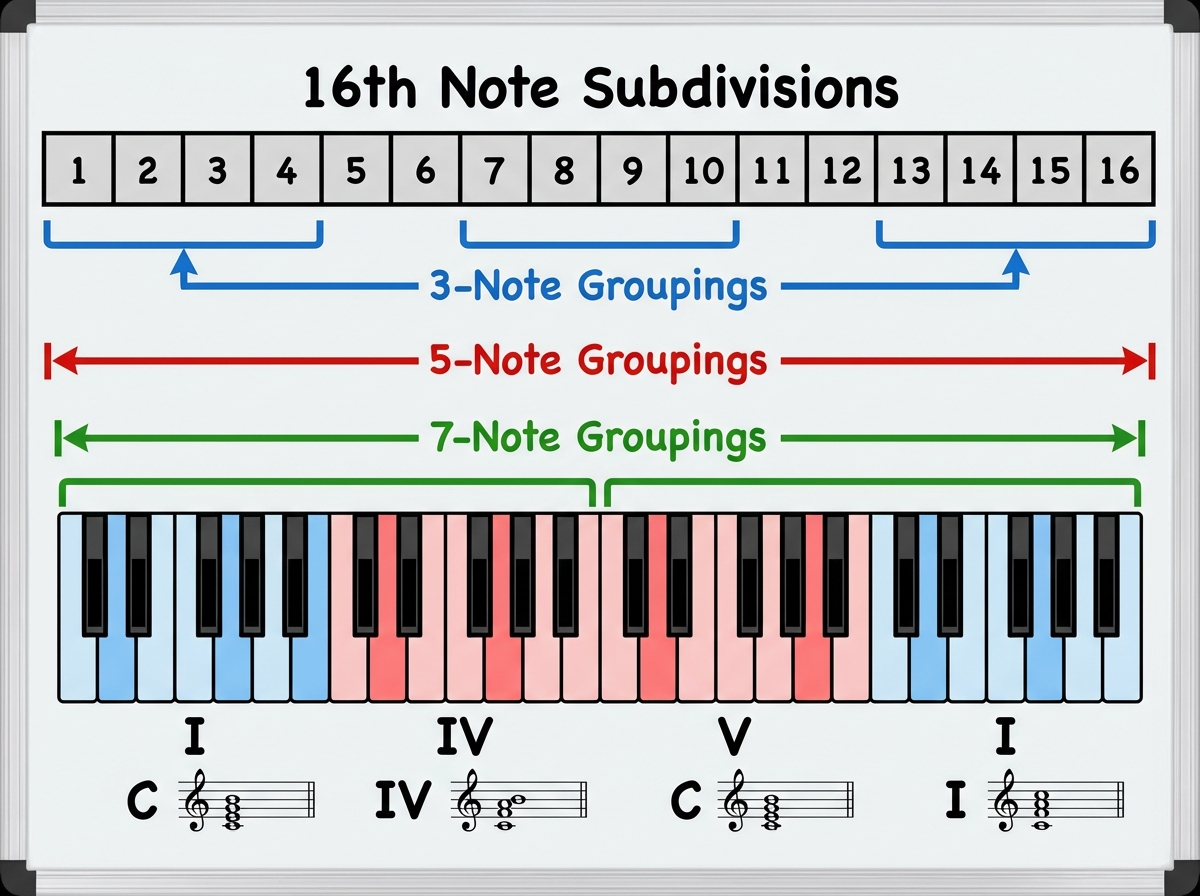
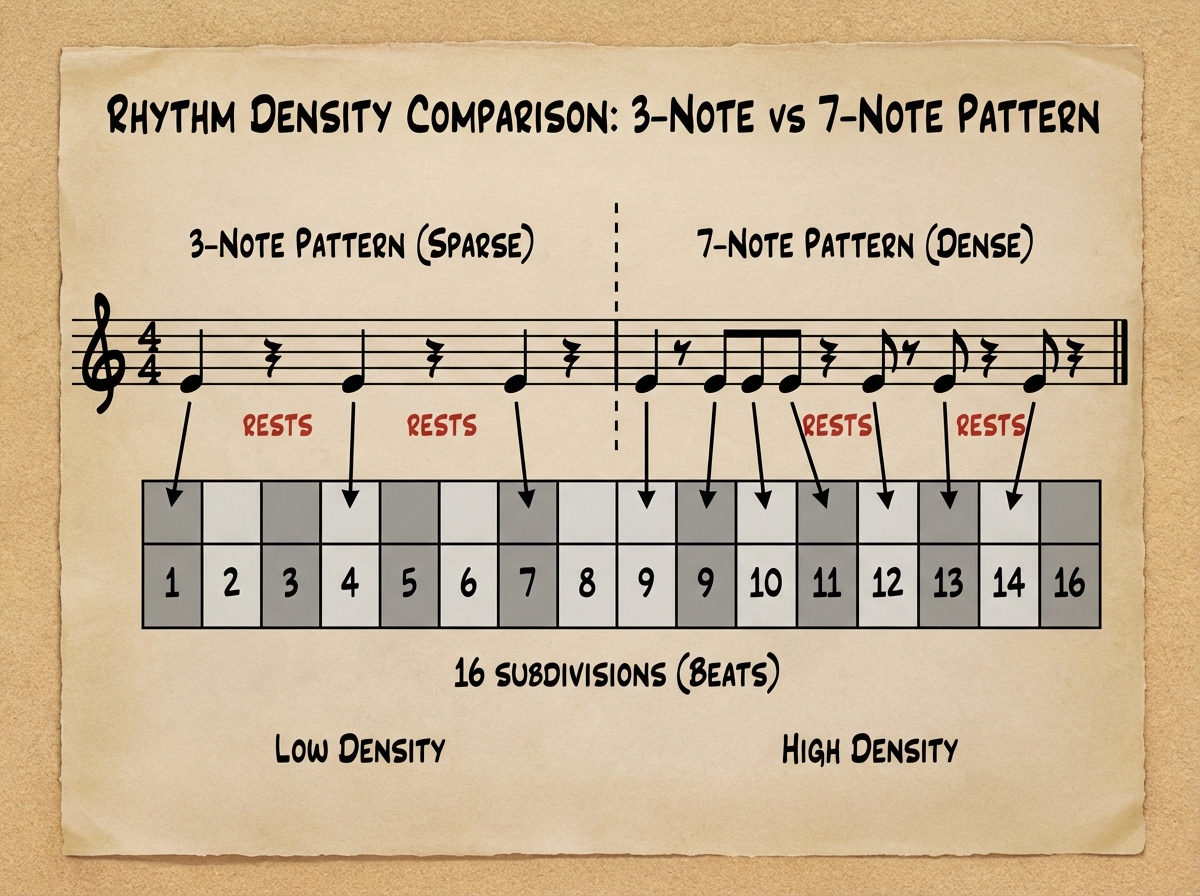
A rhythm pattern at the piano is a fixed sequence of notes within a measure that you repeat across chord changes. Unlike a melody, it isn’t trying to go somewhere — it’s creating forward motion inside the harmony. A 3-note 16th note pattern, for example, uses only three of the sixteen possible 16th note positions in a bar, creating a specific rhythmic texture that sounds sparse and clean. A 7-note pattern uses seven of those positions, creating something denser and more syncopated.
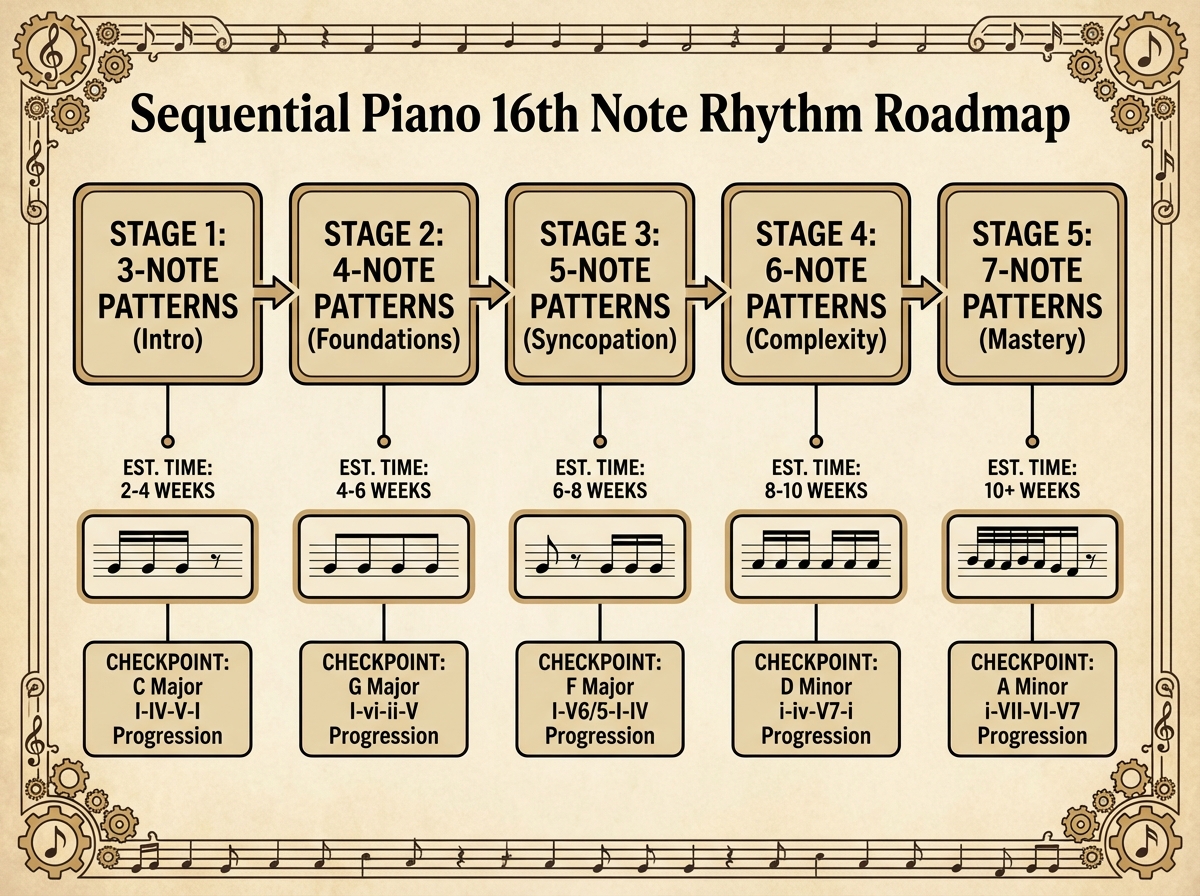
The five pattern types — 3, 4, 5, 6, and 7 notes — aren’t arbitrary. They map to a natural progression from simple to complex rhythmic feel. Beginners gravitate toward 4-note patterns because they sit symmetrically on the beat. More advanced players use 5, 6, and 7-note patterns because the asymmetry is what creates groove.
| Pattern | Note Count | Feel | Best For |
|---|---|---|---|
| 3-Note | 3 of 16 | Open, spacious | Slow ballads, ambient piano |
| 4-Note | 4 of 16 | Steady, even | Pop, beginner grooves |
| 5-Note | 5 of 16 | Slightly syncopated | R&B, light funk |
| 6-Note | 6 of 16 | Driving, full | Gospel, soul |
| 7-Note | 7 of 16 | Dense, complex | Neo-soul, jazz fusion |
Three Things That Surprised Me
- The pattern you choose matters less than how consistently you lock it to the beat
- Switching chord progressions while keeping the same rhythm pattern reveals harmony in a way theory books never do
- The 5-note pattern feels wrong the first twenty times — that’s how you know it’s working
How Long This Actually Takes to Build
| Stage | Content | Time |
|---|---|---|
| 3-Note patterns across 5 progressions | Establishing the feel, locking hands together | 3–5 days |
| 4-Note patterns across 5 progressions | Building steadiness, removing hesitation | 4–6 days |
| 5-Note patterns across 5 progressions | First real syncopation, the hardest wall | 1–2 weeks |
| 6-Note patterns across 5 progressions | Building density, groove starts emerging | 1 week |
| 7-Note patterns across 5 progressions | Full complexity, all 12 keys | 1–2 weeks |
| Total | 25 pattern-progression combinations | 5–7 weeks |
The order you move through these stages matters more than how fast you get through them — trying to skip to 7-note patterns before your 3-note feel is clean will cost you more time than you save. If you’re moving slower than this estimate, you’re probably just being thorough, which is exactly right.
Starting With Three Notes and Already Getting It Wrong
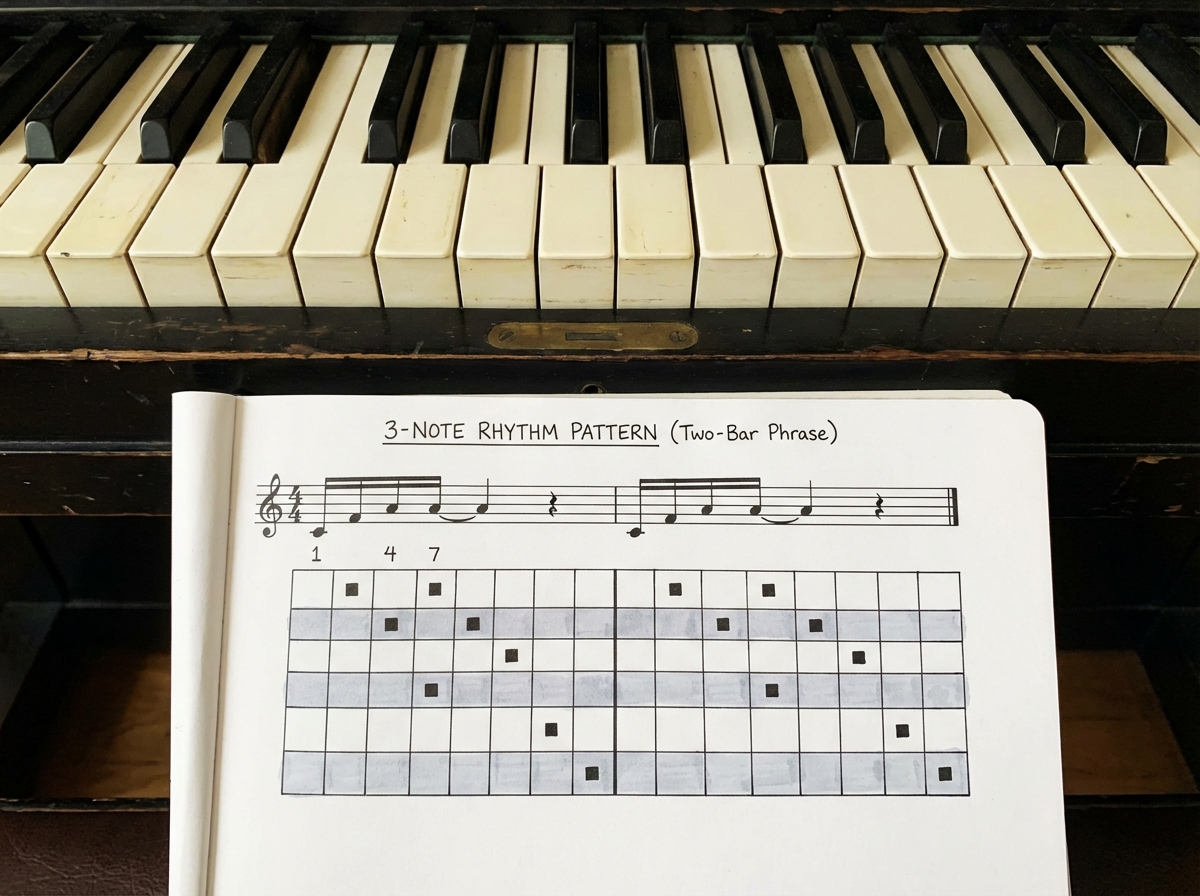
The 3-note pattern is where everyone underestimates what’s happening. It looks easy on paper — three notes, lots of space — so most people blow through it in a day, declare it done, and move on. That’s the mistake. The space in a 3-note pattern is not empty. It’s where the rhythm actually lives, because your brain and body have to hold the pulse internally while your hands stay quiet.
When I first played a 3-note pattern over a basic I-IV-V progression, I kept rushing the third note to “catch up” with the chord change. The pattern would stretch and compress depending on the harmony. That’s not groove — that’s just chasing chords with your hands. The fix was simple and brutal: slow the tempo down until the pattern felt almost boring, and count every single 16th note subdivision out loud, even the ones where nothing happened.
Once the 3-note pattern locked, something shifted. Silence in music stopped feeling like absence. It started feeling like intention. You can’t get that lesson from reading about rhythm — you have to sit inside a sparse pattern long enough for it to stop feeling sparse and start feeling purposeful.
The 4-Note Wall Is Actually a Door
Four-note 16th note patterns are where most intermediate piano players live permanently — and where they get stuck. Four notes divide evenly across a bar of four beats, which makes them feel natural and easy to memorize. The problem is that “natural and easy” also means you stop listening. The pattern runs on autopilot while your brain drifts to thinking about the next chord change.
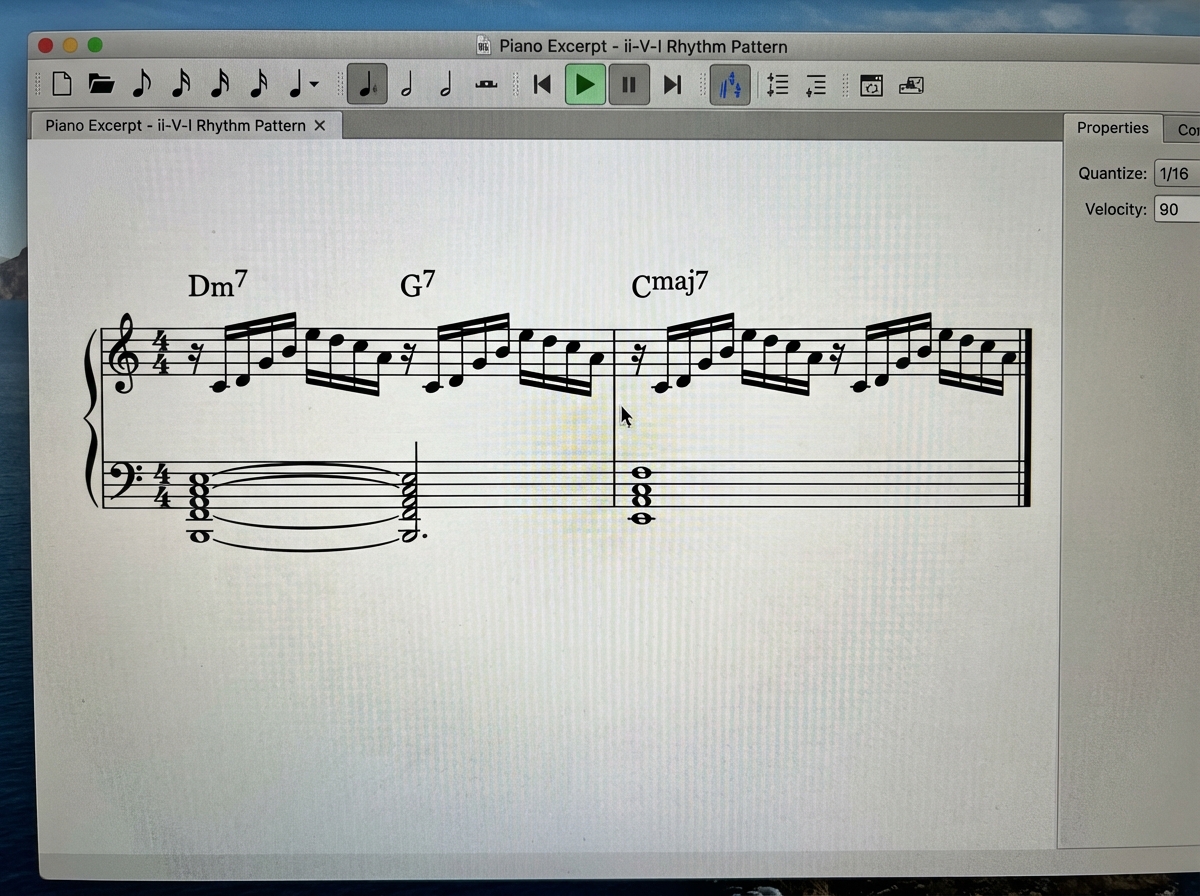
The real work with 4-note patterns isn’t playing them correctly — it’s playing them with weight. Some of those four notes should be louder than others. The rhythmic emphasis should shift depending on the chord progression underneath. A 4-note pattern over a minor ii-V-I should feel different from the same pattern over a major I-V-vi-IV, even though the notes are identical. That difference comes from dynamics, not fingering.
Playing the same pattern across all five chord progressions back to back is what forced me to actually hear it this way. The pattern is the same. The harmony changes. So what changes in how I play the pattern? That question kept me occupied for longer than I expected, and it’s the question that makes 4-note patterns interesting instead of just functional.
Where 16th Note Patterns Over Chord Progressions Start to Feel Like Music
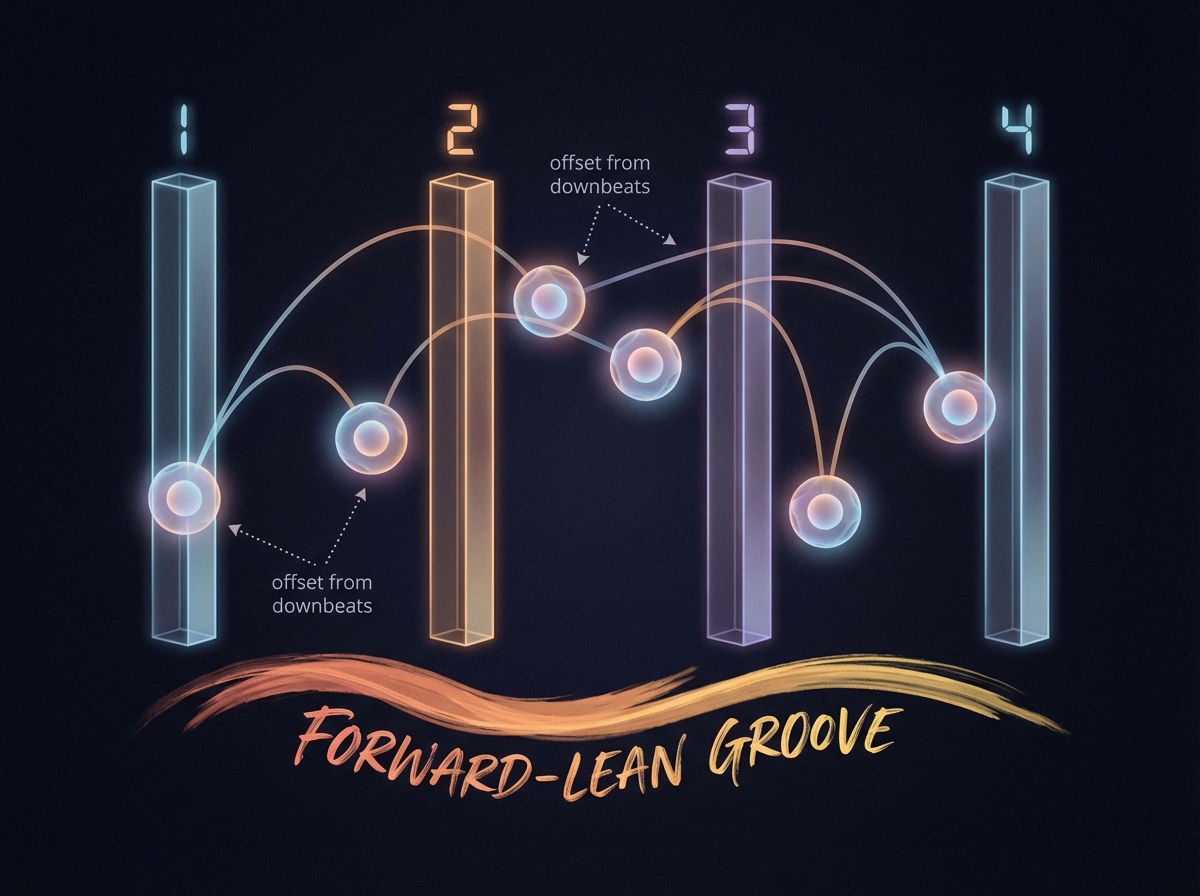
The 5-note pattern is where piano rhythm patterns stop feeling like exercises and start sounding like something you’d actually want to hear. Five notes across sixteen positions don’t sit symmetrically on the beat, which means the pattern has a natural lean — a subtle forward pull that four-note patterns never quite achieve. This is also where most people give up and go back to simpler patterns, because the 5-note feel is genuinely hard to internalize.
The biggest mistake I made here was treating the 5-note pattern like a melody — trying to remember which specific 16th positions had notes. That’s the wrong frame entirely. The right approach is to feel the pattern as a rhythmic shape, like a physical gesture, and repeat that gesture until it lives in your muscle memory rather than your conscious mind. The moment I stopped counting positions and started feeling the shape, the pattern locked in.
Applying the 5-note pattern across all five chord progressions is what makes the shape permanent. Each progression has a different harmonic rhythm — some change chords every bar, some every two bars — and the 5-note pattern responds differently to each one. By the fifth progression, you’re not learning a new pattern. You’re learning what the pattern actually is across different musical contexts. If you’re working on building a versatile rhythmic vocabulary, understanding swing trading strategy and market structure might sound unrelated — but the principle of reading context and adapting a fixed system to changing conditions is exactly the same mental model.
The 6 and 7-Note Patterns Are Where Everything Compounds
By the time you reach 6-note patterns, the game changes again. Six notes in sixteen positions means something is happening almost constantly — there’s very little silence left, and the texture becomes thick. The risk here is busyness: patterns that fill space without actually driving the groove forward. The discipline at this stage is asking whether each note is earning its place or just adding noise.
Seven-note patterns are the most demanding not because they’re complex to understand, but because maintaining them cleanly over chord changes that don’t align with the rhythmic pulse requires real independence between your rhythm sense and your harmonic awareness. Your hands have to know where the pattern is going while your ears track where the chords are going, and those two things don’t always land on the same beat.
Practicing 7-note patterns across five different progressions — including progressions that use non-diatonic chords or unexpected voice leading — is what separates players who know patterns from players who can actually use them. The pattern becomes a tool, not a trick. You can pull it out in any musical situation because you’ve already seen it work in situations that should have been harder than whatever you’re playing now.
Playing in All 12 Keys Is Not Optional
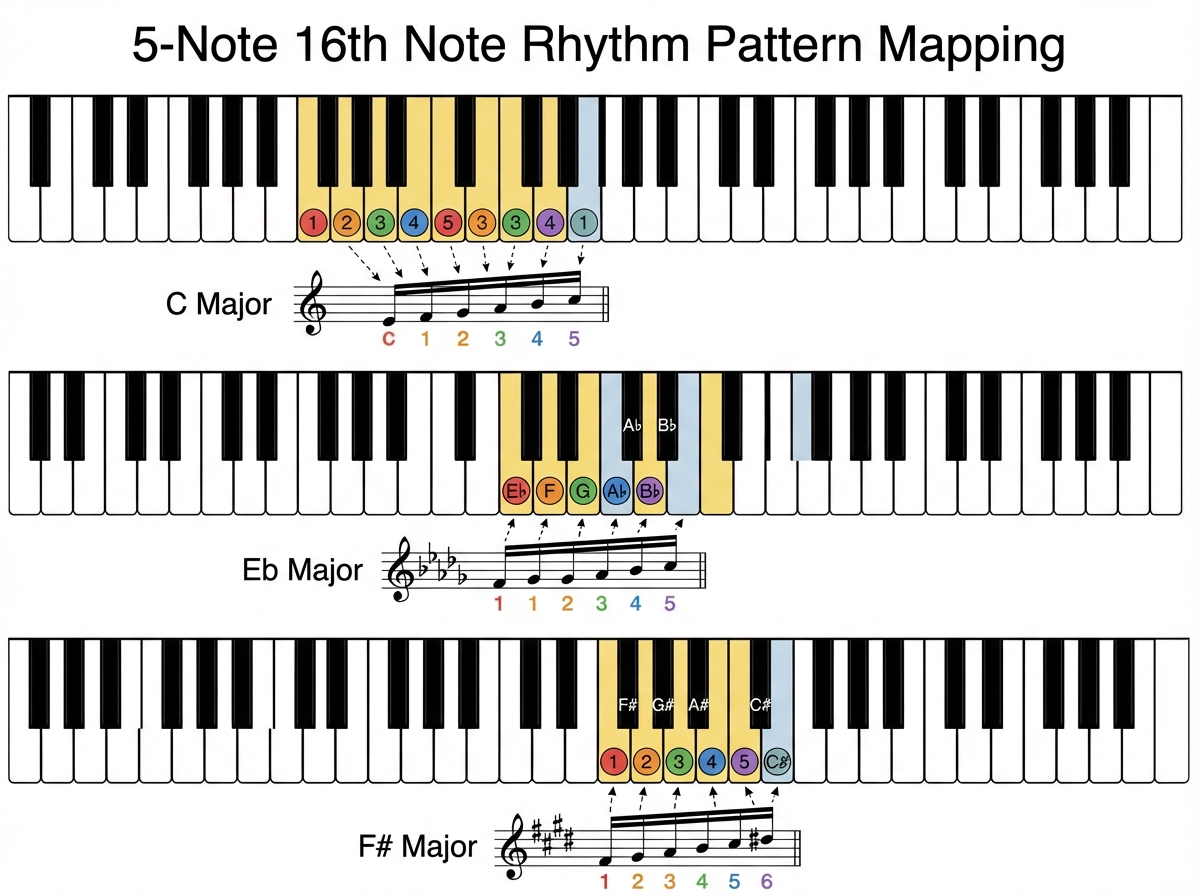
Sheet music in all 12 keys sounds like an academic exercise until you actually try it. Most piano players practice in C, then G, then maybe F, and their rhythm patterns are silently key-dependent without them realizing it. You can tell because the moment someone asks them to play in Eb or F#, the pattern falls apart — not because the notes are hard, but because the hands don’t know the shape in that key.
Working through each pattern in all 12 keys does something specific: it strips the pattern of its key identity and turns it into a pure rhythmic shape. Once your hands know the 5-note pattern in F# as well as they know it in C, the pattern is truly internalized. Until then, it’s just something you learned in one particular context.
This is also where practicing rhythm patterns becomes a genuine technique builder rather than just a rhythm exercise. Moving through different keys forces efficient fingering, clean transitions, and equal facility across the keyboard. The rhythmic workout and the technical workout happen simultaneously, which is why 300 exercises across all 12 keys isn’t overkill — it’s exactly the right amount of repetition done in the most useful way.
Why Most Piano Players Never Develop Real Rhythm
The single biggest mistake people make when learning piano rhythm patterns is treating rhythm as decoration — something you add after the notes are correct. You practice the chord progression until you can play it cleanly, then you try to “add some rhythm” on top of it. This always produces stiff, mechanical playing, because the rhythm was never part of the original intention.
Rhythm has to be the starting point, not the finishing touch. When you learn a chord progression through a rhythmic pattern from the very first time you play it, the two become inseparable in your muscle memory. The chord doesn’t exist in your hands without the rhythm — they’re the same movement. Players who learn this way sound like they’re playing music. Players who learned chords first and rhythm second always sound like they’re thinking in two separate tracks.
The way to fix this if you’ve already developed the habit is to start over with simple material. Take the most basic chord progression you know, strip it down to the simplest 3-note rhythm pattern, and relearn that progression from scratch with the rhythm locked in from bar one. It feels like going backward. It’s actually the fastest way forward.
What Looking Back Actually Reveals
After working through all five pattern types across all five chord progressions, what stands out isn’t any specific pattern or progression — it’s the framework itself. You stop hearing music as chords with rhythm added on top, and you start hearing it as rhythmic shapes moving through harmonic space. That shift changes how you listen, how you practice, and what you notice when something sounds good.
Here are the specific actions that make the biggest difference when working through piano rhythm patterns:
- Start every new pattern at 60% of your target tempo — rushing to full speed before the pattern is clean at slow tempo will bake in the sloppiness permanently
- Play the same pattern over all five chord progressions before moving to the next pattern — horizontal depth in one pattern beats shallow exposure to all five patterns
- Count every 16th note subdivision out loud when learning a new pattern — even the silent positions need to be accounted for in real time
- Record yourself every third session and listen back without playing along — you will hear things in the recording that are completely invisible to you while playing
- Practice transitions between chord changes as isolated two-bar phrases first — the moment the chord changes is where rhythm patterns almost always break down
- Work in at least three different keys per session, not just C — key variety is what turns a pattern you know into a pattern you own
- Use a metronome with a subdivision click, not just a beat click — hearing the 16th note grid while you play makes the pattern placement audible in a way that a beat click never does
- When a pattern starts to feel automatic, introduce it into a song you already know — transferring a pattern into a real musical context is the only true test of whether it’s actually internalized
Leave a Reply