


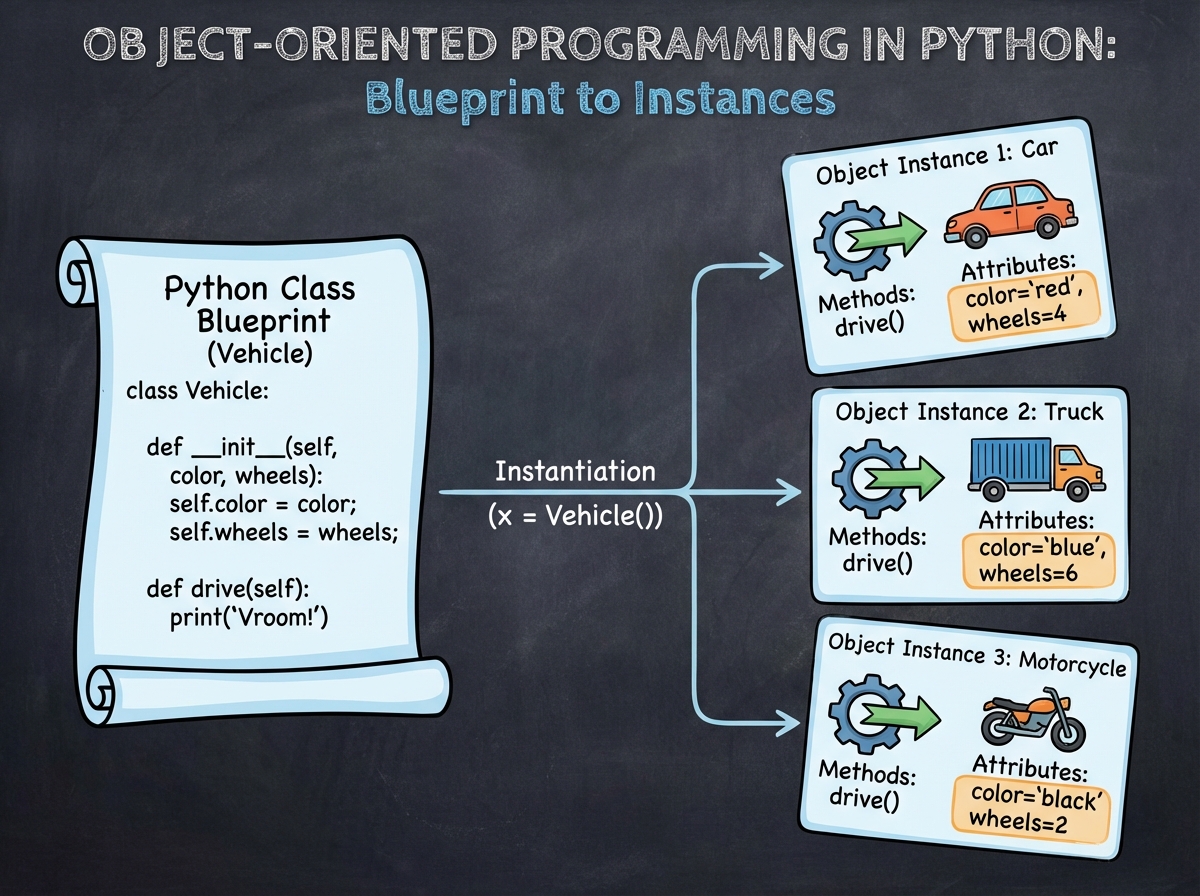
There’s a specific kind of frustration that hits when you’ve been writing Python for a few months and you start reading other people’s code. You see class, you see self, you see __init__, and suddenly everything that made sense — variables, loops, functions — stops making sense. You’re not a beginner anymore, but you’re not fluent either. That gap is exactly where most people get stuck with object-oriented programming in Python.
If you’re looking to learn Python OOP, the honest answer is that it’s not as abstract as it first appears — but the way most people approach it makes it feel that way. Object-oriented programming in Python is a way of organizing code around real-world entities: a BankAccount that knows its own balance, a Task that knows its own status, a User that manages its own files. Once you stop thinking in procedures and start thinking in objects, the syntax stops feeling foreign and starts feeling obvious. That shift is the whole game.
- If you already know Python basics (functions, loops, variables), you have everything you need to start — OOP builds directly on top of that foundation
- The concepts that seem most abstract at first (encapsulation, polymorphism) are actually the ones that solve the most concrete problems in real codebases
- Most people learn the syntax quickly but miss the why — and that’s what separates code that works from code that’s actually maintainable
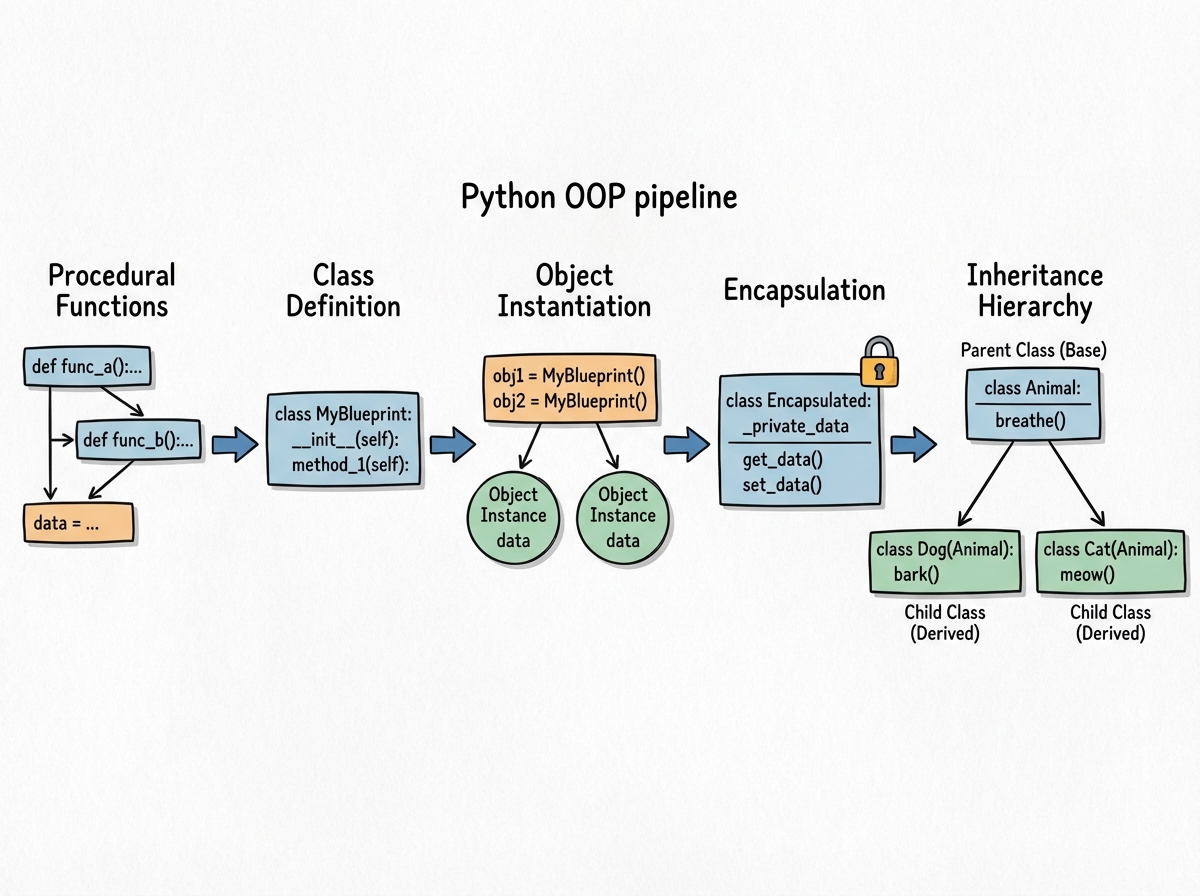
What Object-Oriented Programming in Python Actually Means
At its core, Python OOP is a programming paradigm where you model your code around objects — bundles of data and behavior that belong together. Instead of writing a function that takes a name and a balance as separate arguments, you write a BankAccount class that holds both and knows what to do with them.
Python supports OOP natively, which means the language itself is built around this model — even the built-in types like list, str, and dict are objects with methods. There’s no library to install, no framework to learn first.
| Approach | How it thinks | Where it breaks down |
|---|---|---|
| Procedural | Functions act on separate data | Data and logic drift apart as code grows |
| Object-Oriented | Objects hold data and behavior | Can feel over-engineered for tiny scripts |
For anything beyond a script — a project with multiple moving parts, a codebase with other developers, an interview where you’re expected to model a system — OOP is the approach that scales.
Three Things That Will Surprise You
selfis not special syntax — it’s just a variable name by convention, and understanding that changes everything- Inheritance doesn’t mean copying code; it means one class is a type of another class
- Encapsulation in Python is enforced by convention, not by the compiler — and that actually makes it more important, not less
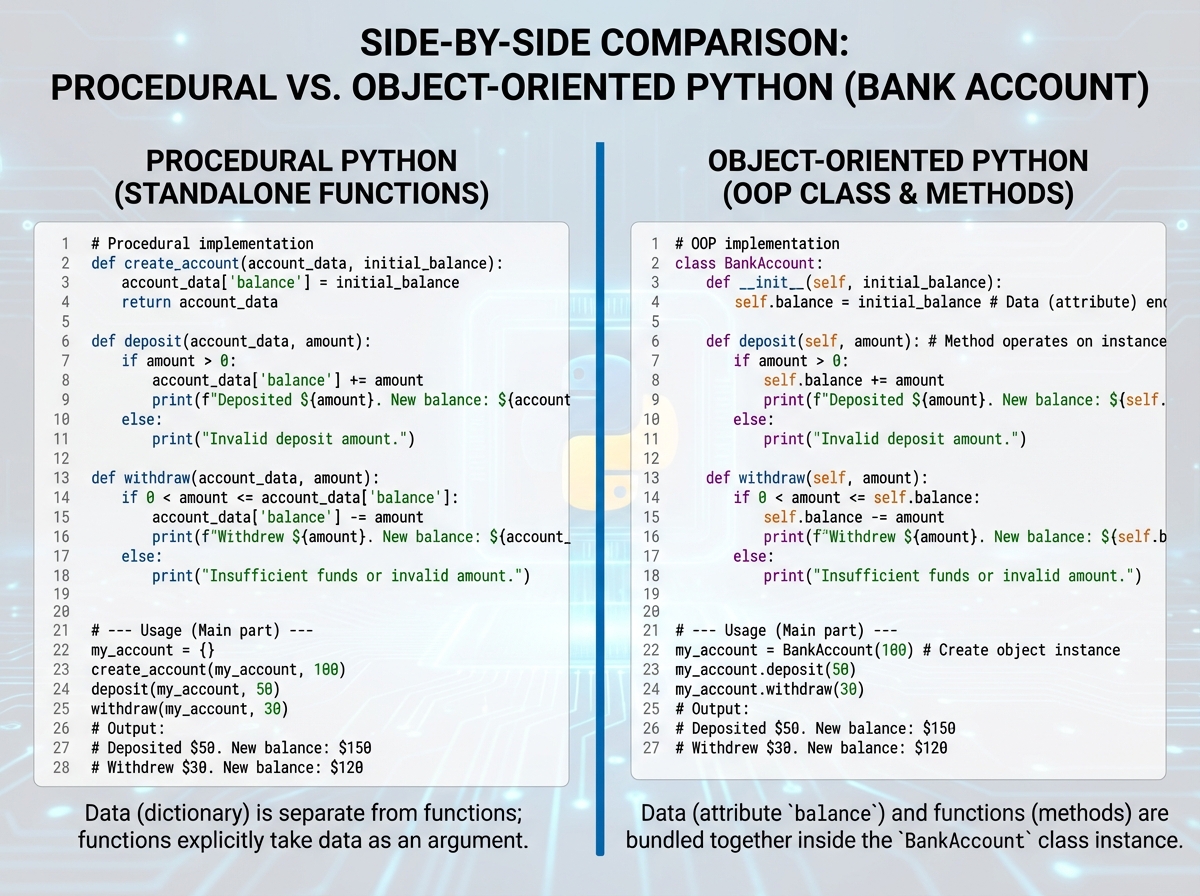
How Long It Actually Takes to Learn Python OOP
| Stage | What You’re Working Through | Estimated Time |
|---|---|---|
| OOP fundamentals | Procedural vs OOP thinking, what classes and objects actually are | 1–2 hours |
| Classes and constructors | Writing your first class, using __init__, adding methods |
2–3 hours |
| Attributes and methods | Instance vs class attributes, self, modifying state |
2–3 hours |
| Encapsulation | Public/protected/private attributes, getters, setters, property decorators | 2–3 hours |
| Inheritance and polymorphism | Hierarchies, method overriding, super() |
3–4 hours |
| Applied project | Building a real multi-class system from scratch | 3–5 hours |
| Total | From zero OOP to a working project | 13–20 hours |
The order in that table matters more than how fast you move through it — trying to understand inheritance before you’re comfortable with self and __init__ is one of the most common ways people end up confused and burned out. If you find yourself moving slower than the estimate, it almost always means you’re asking the right questions rather than skipping past them.
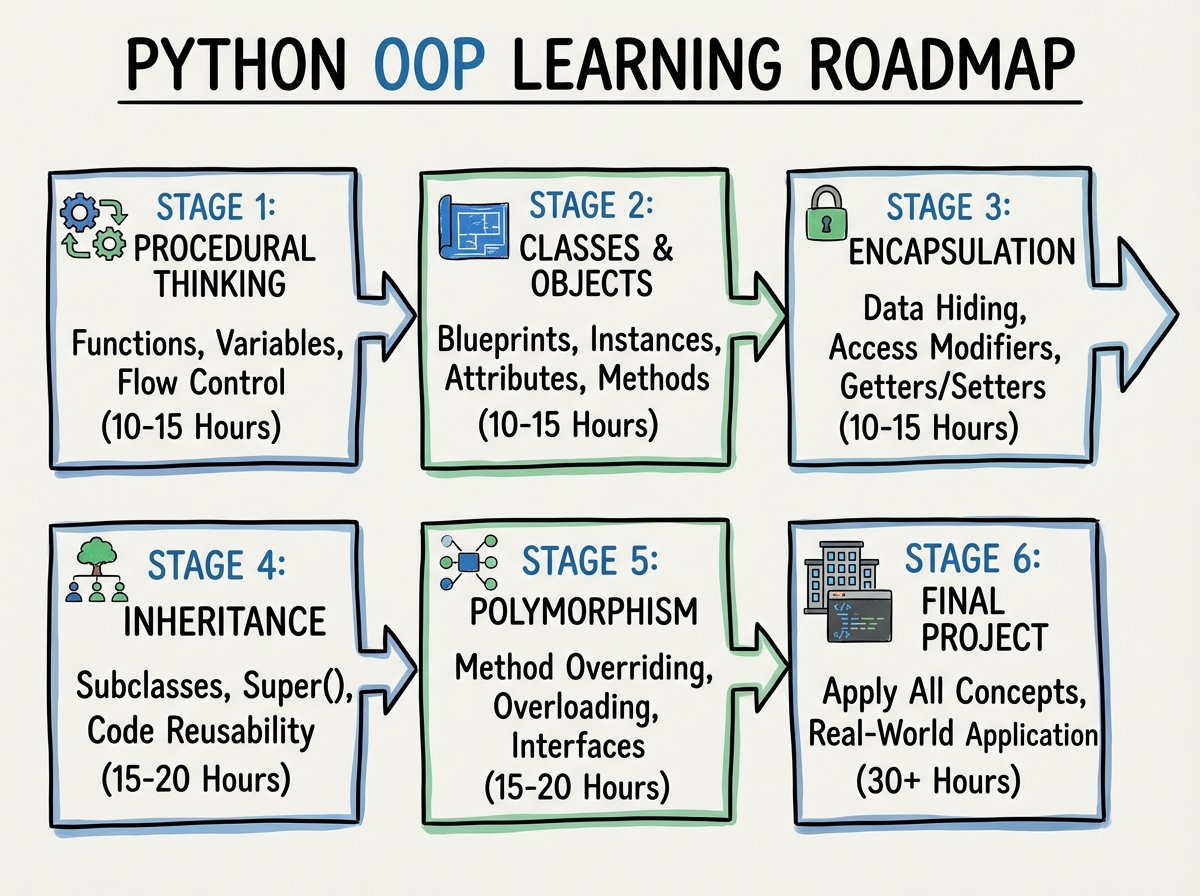
Why Procedural Thinking Keeps Tripping You Up
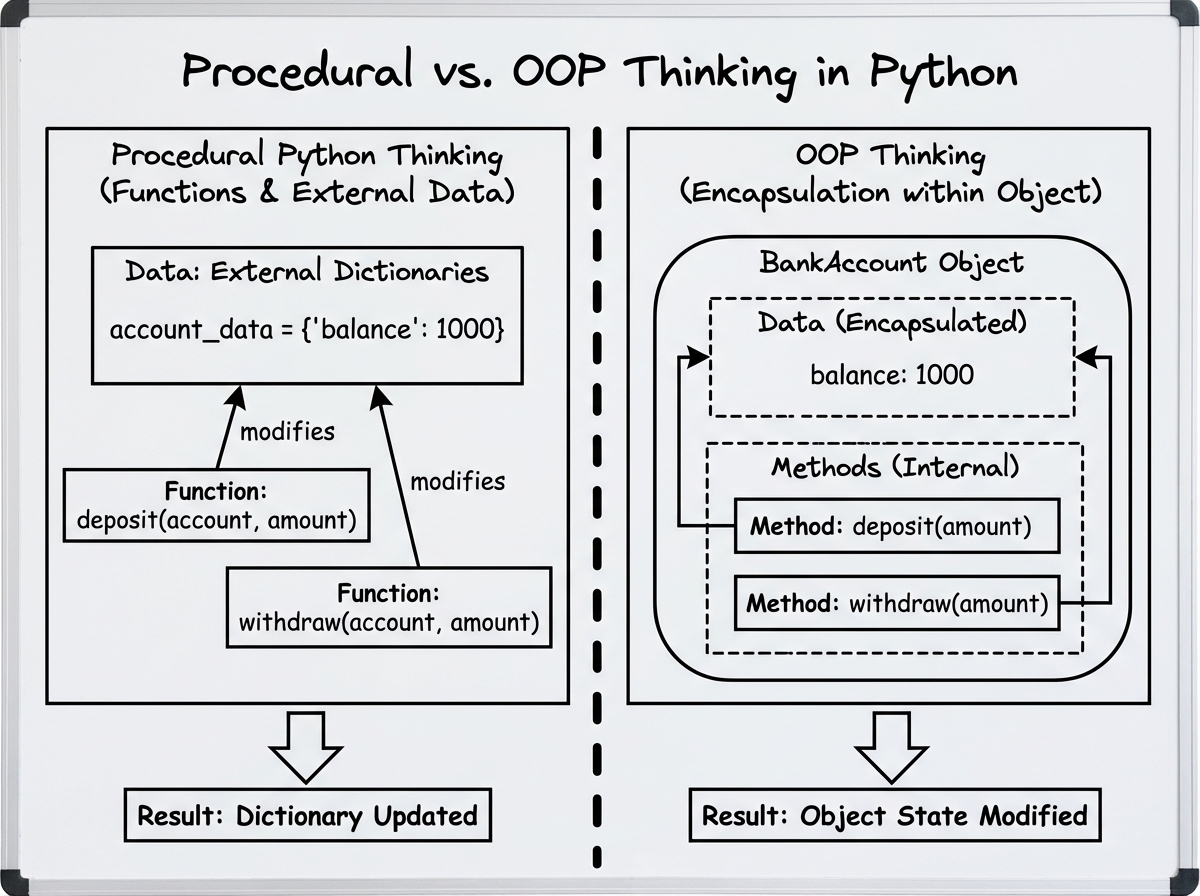
When you first sit down to write a class, your brain still wants to think procedurally. You want to write a function. You write def create_account(name, balance) and return a dictionary. It works. You move on. And then three weeks later that dictionary is being passed into twelve different functions across four files and nobody — including you — knows which function is allowed to change the balance.
That’s the moment procedural code breaks. It’s not that it’s wrong to start there — procedural thinking is a completely valid mental model and Python supports it well. The problem is that it doesn’t scale. When state and logic are separate, the relationship between them only exists in the programmer’s head. When you’re the only programmer and the project is small, that’s fine. When neither of those things is true, it becomes a liability.
The switch to OOP thinking isn’t about syntax. It’s about asking a different question. Instead of “what does this function need?” you ask “what does this thing know about itself, and what can it do?” A BankAccount knows its owner, its balance, and its transaction history. It can deposit, withdraw, and report. Everything it needs to do its job travels with it. That shift in thinking — from procedures that manipulate data to objects that are data — is the unlock.
The First Time You Write a Class, You’ll Do It Wrong
The biggest mistake people make when learning Python OOP is treating the class like a container for functions. They write a class, dump every method they can think of into it, and then wonder why the code is harder to read than before. The class doesn’t do anything wrong, but it doesn’t do anything right either — it’s just a namespace with extra steps.
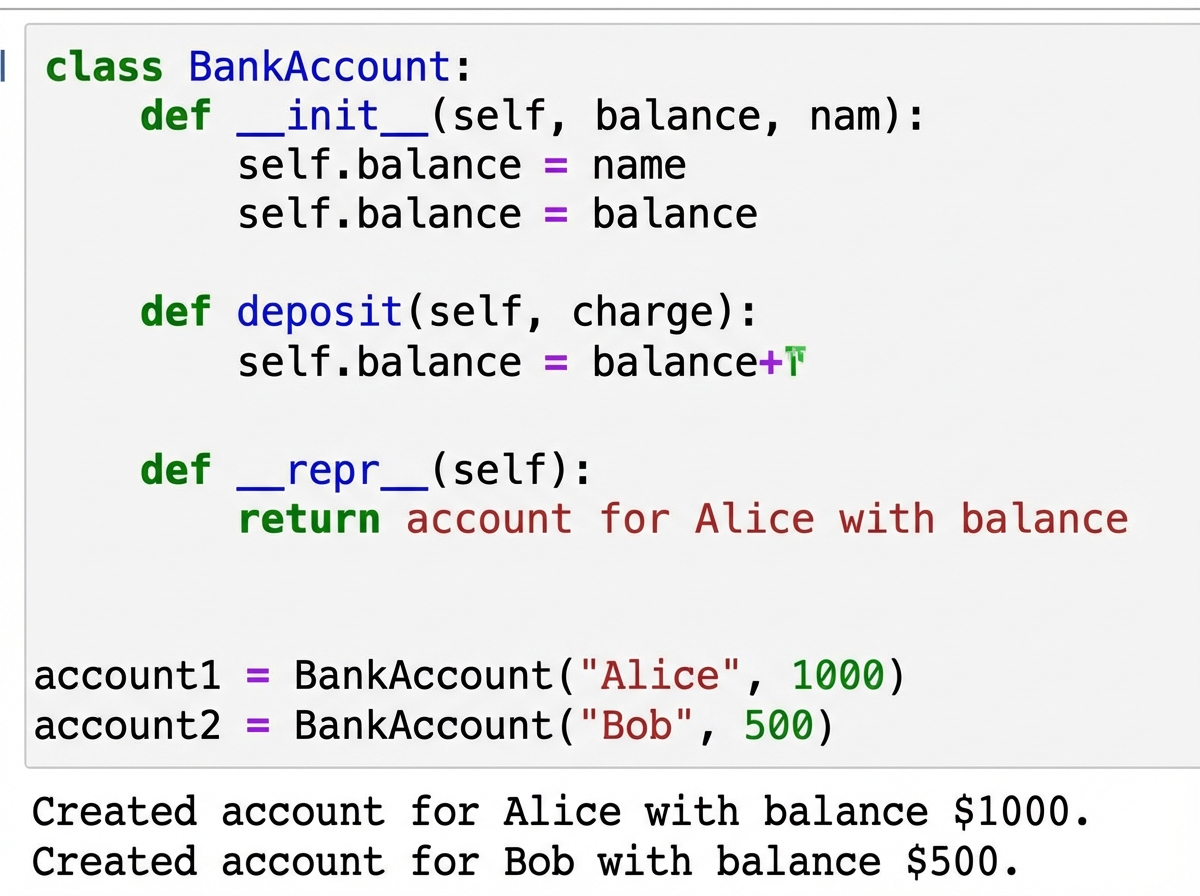
The __init__ method is where this usually goes sideways first. Most beginners either put too much in it (making it a function disguised as a constructor) or too little (setting almost no attributes, then patching them on later). What __init__ is actually for is setting the initial state of the object — the attributes that define what this object is when it’s first created. Everything the object needs to exist in a valid state should be set there. Everything it does belongs in methods.
Once you understand that, self stops being confusing. Every method in a class receives self as its first argument because methods need to know which object they’re operating on. If you have twenty BankAccount objects in memory, calling .deposit(100) on one of them needs to update that account’s balance, not someone else’s. self is how Python threads the right object through the right method every time. It’s not magic — it’s just a reference.
The moment things click is usually when you instantiate two objects from the same class and watch them hold separate state. You make account_a = BankAccount("Alice", 1000) and account_b = BankAccount("Bob", 500), and then you deposit into account_a and watch account_b‘s balance stay untouched. That’s the instant the abstraction becomes concrete.
Encapsulation Is Not About Security, It’s About Trust
When you first hear “encapsulation,” the word sounds like something from a computer science exam. The textbook definition — hiding internal data and exposing controlled access — is accurate but doesn’t explain why you’d bother. In a language like Python where nothing is truly private, it’s easy to dismiss it as optional.
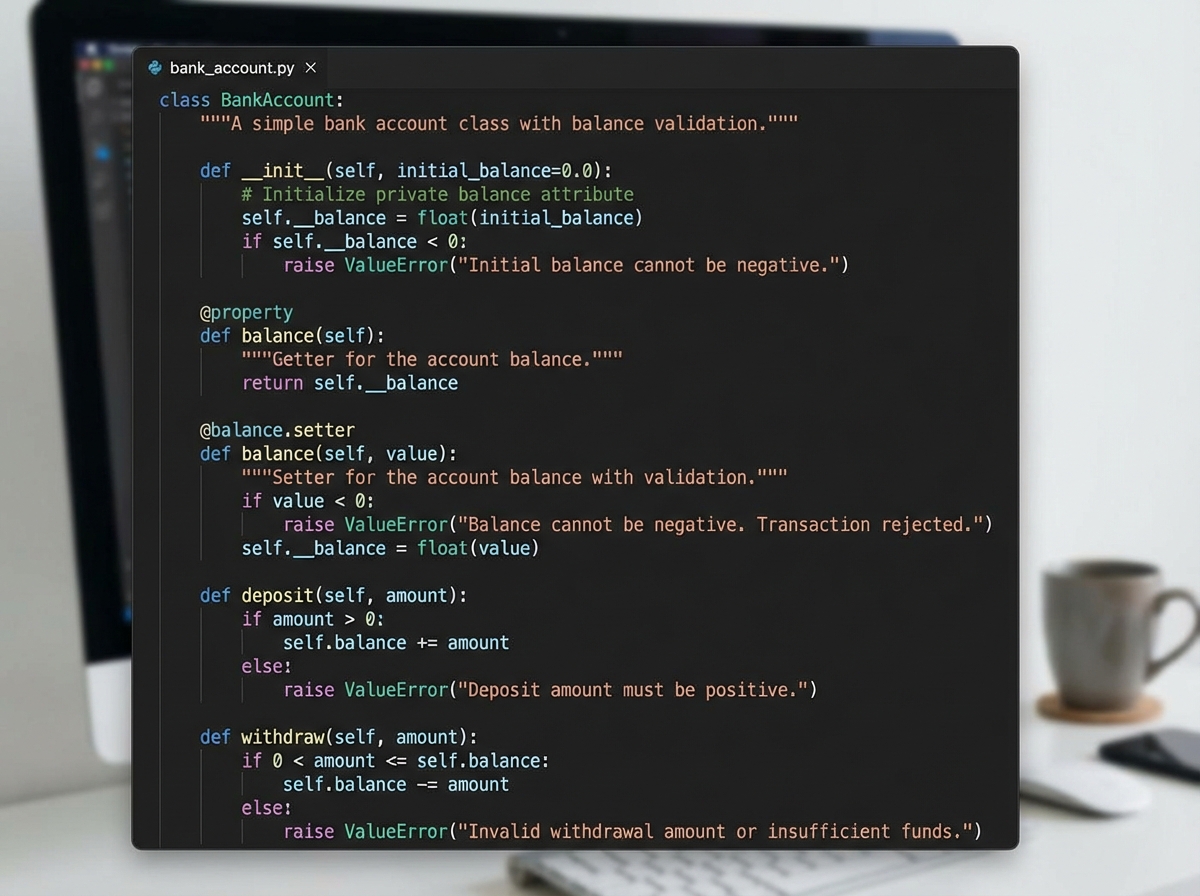
Here’s the frame that makes it make sense: encapsulation is about trust contracts. When you mark an attribute as private with a double underscore (__balance), you’re telling everyone who reads the code — including future you — that this value should only be modified through the methods the class explicitly provides. You’re not locking a door. You’re putting up a sign that says “don’t reach in here directly; use the interface.”
The getter and setter pattern feels verbose at first. Writing a get_balance() method when you could just do account.balance seems like extra typing for no reason. Then you have a bug where the balance goes negative because somewhere deep in the codebase someone assigned a raw value directly, bypassing the withdrawal logic entirely. Suddenly the getter doesn’t seem so verbose.
Property decorators in Python let you get the best of both worlds: the clean attribute-access syntax (account.balance) with the controlled access of a getter method running underneath. It’s the kind of feature that seems like syntactic sugar until you’re maintaining a class that dozens of other classes depend on, and then it starts to feel essential.
Where Inheritance Actually Pays Off
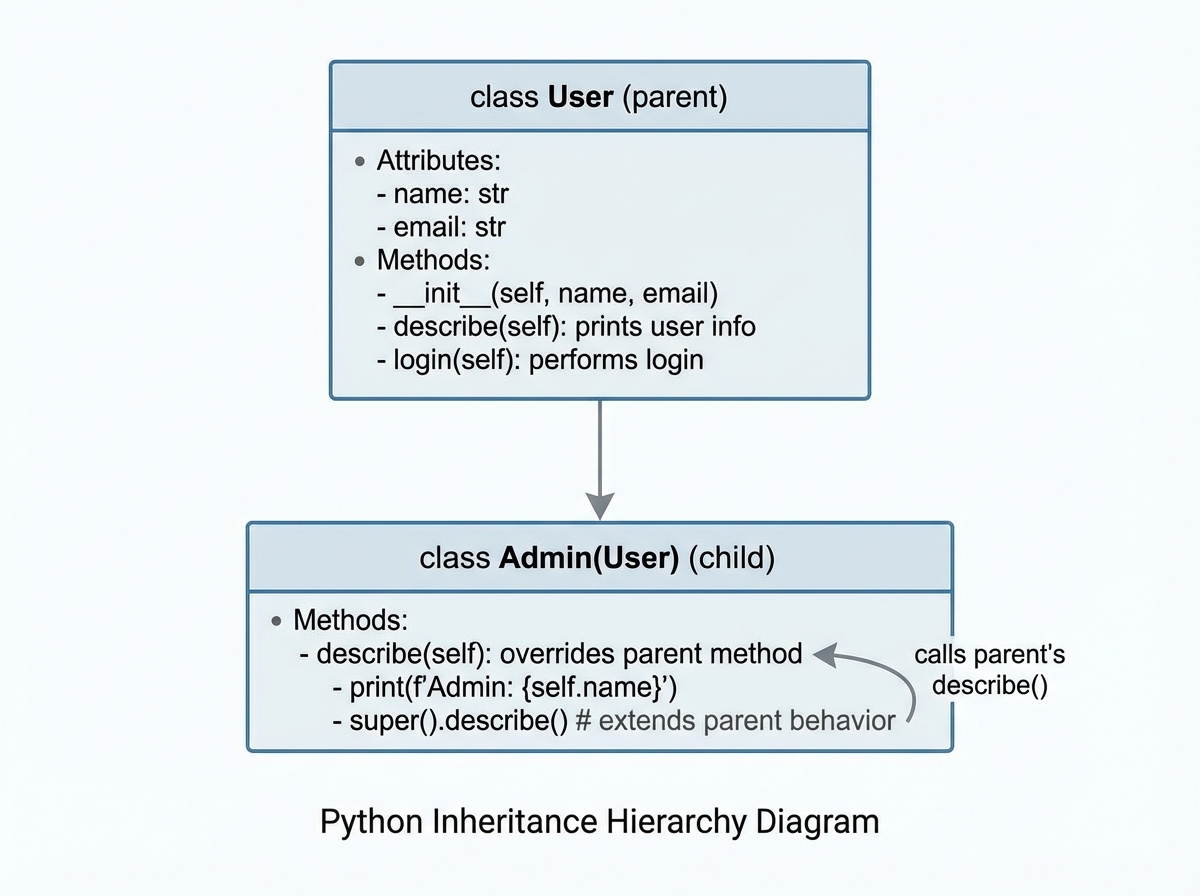
Inheritance is the concept that gets taught first and understood last. The classic example — Dog inherits from Animal — is so abstract it gives people the impression that inheritance is for modeling biology, not for writing software. The real-world case is more mundane and more useful: you have a User class, and then you realize some users are Admin users who can do everything a regular user can do, plus a few things only admins are allowed to do.
Without inheritance, you copy the User class, paste it into an Admin class, and modify it. Now you have two classes that share ninety percent of their logic, and every time you fix a bug in one, you have to remember to fix it in the other. Inheritance eliminates that. The Admin class inherits every attribute and method from User automatically, and you only write the parts that are different.
Method overriding is where inheritance gets expressive. You inherit a describe() method from the parent, and in the child class you override it with a version that includes the admin-specific information. The super() function lets you call the parent’s version of the method first and then extend it — so you’re not rewriting the base logic, just adding to it. That’s the pattern that makes large codebases maintainable: each class is responsible for its own additions, not for reproducing everything its ancestors already defined.
Polymorphism Is the Part Everyone Skips and Then Regrets
Polymorphism is usually the last concept introduced in any OOP curriculum, and it’s also the one that most beginners quietly decide to revisit later and then never do. It sounds academic. It has a Greek name. It requires you to already understand inheritance. So it gets skipped.
But polymorphism is why OOP actually scales. The idea is simple: different objects can respond to the same method call in different ways. If you have a list of tasks — some of them SimpleTask, some of them RecurringTask — and you call .display() on each one, every task shows itself correctly without the calling code needing to know what type of task it is. The calling code doesn’t check, doesn’t branch, doesn’t care. It just calls .display() and each object handles it.
Without polymorphism, you write if isinstance(task, RecurringTask): show_recurring() everywhere. Every time a new task type gets added, every if block in the codebase has to be updated. With polymorphism, you add a new class, define its .display() method, and the rest of the code just works. This is what people mean when they say OOP makes code easier to extend — it’s not a vague quality, it’s this specific mechanism.
Building Something Real Is When It All Connects
Reading about OOP and building with OOP are two completely different experiences. You can understand every concept in isolation and still freeze when you sit down to design a system from scratch. The question that trips most people up is the first one: “What should be a class?”
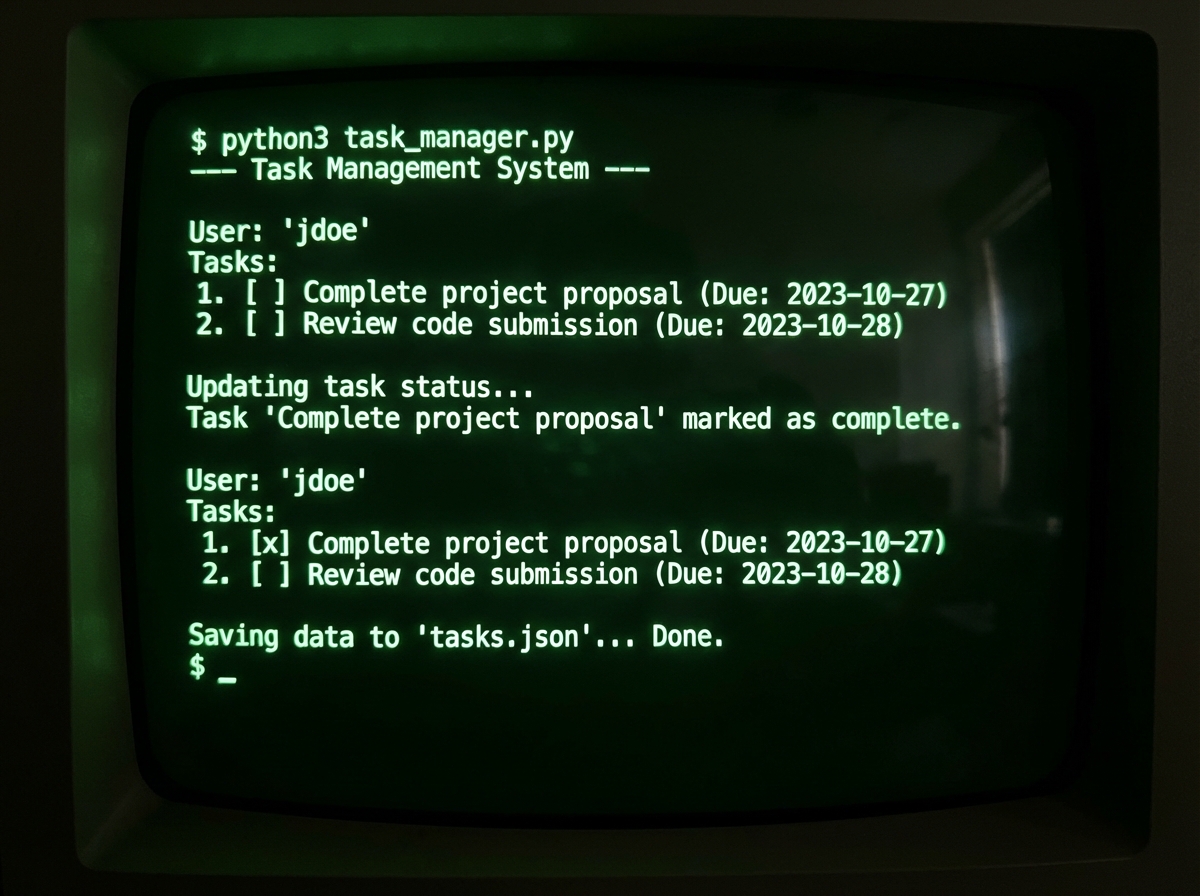
A task management system is a good forcing function because the answer is right on the surface. A Task class holds a title, a description, a status, a deadline — it knows how to display itself and how to update its own status. A User class knows its name and its list of tasks. A Manager class coordinates between them — loading and saving to files, routing commands to the right user. Each class has a clear identity and a clear responsibility.
Building it end-to-end — creating the class structure, writing the file handling, wiring the main method — is where all the abstract concepts prove their value simultaneously. You need encapsulation because the task list shouldn’t be modified directly from outside the User class. You need inheritance because Manager extends the capabilities of whatever simpler coordination class came before it. You need polymorphism because different task types display differently. None of these feel academic when a real bug is waiting at the other end.
When the program finally runs and you can create a user, add tasks, save them to a file, reload them, and mark them complete — that’s the moment the OOP mental model locks in permanently. It’s not the syntax that clicks. It’s the structure — that code organized this way is easier to read, easier to fix, and easier to extend than anything you wrote before.
Looking back, the concepts themselves were never the hard part. The hard part was unlearning the procedural instinct — the reflex to reach for a function when an object was what the situation actually needed. Once that shift happens, the rest follows naturally.
Here’s what will actually accelerate your progress with Python OOP:
- Write a class for something you already use in your code — take an existing script and identify one chunk of related data and logic that could become a class; the exercise is more valuable than any synthetic example
- Name your attributes before you name your methods — deciding what an object is before deciding what it does prevents the most common design mistakes
- Purposely break encapsulation once, then fix it — directly modify a private attribute, watch how hard it becomes to track down the resulting bug, then add a proper setter; the lesson sticks better than reading about it
- Build one inheritance hierarchy with at least three levels — grandparent, parent, child — and override a method at each level so you feel exactly what
super()is resolving - Write the same small project twice — once procedurally, once with OOP — and compare how each version handles a new requirement being added halfway through
- Read the source code of a Python built-in — look at how
listordictis structured; seeing OOP applied to the tools you use every day reframes how native the paradigm actually is - Implement your own property decorator from scratch — before using
@property, write a getter and setter manually so the decorator doesn’t feel like magic - Build a mini project with at least three interacting classes — the complexity of managing relationships between objects is where OOP proves itself, and you can’t feel that with a single isolated class
Leave a Reply