


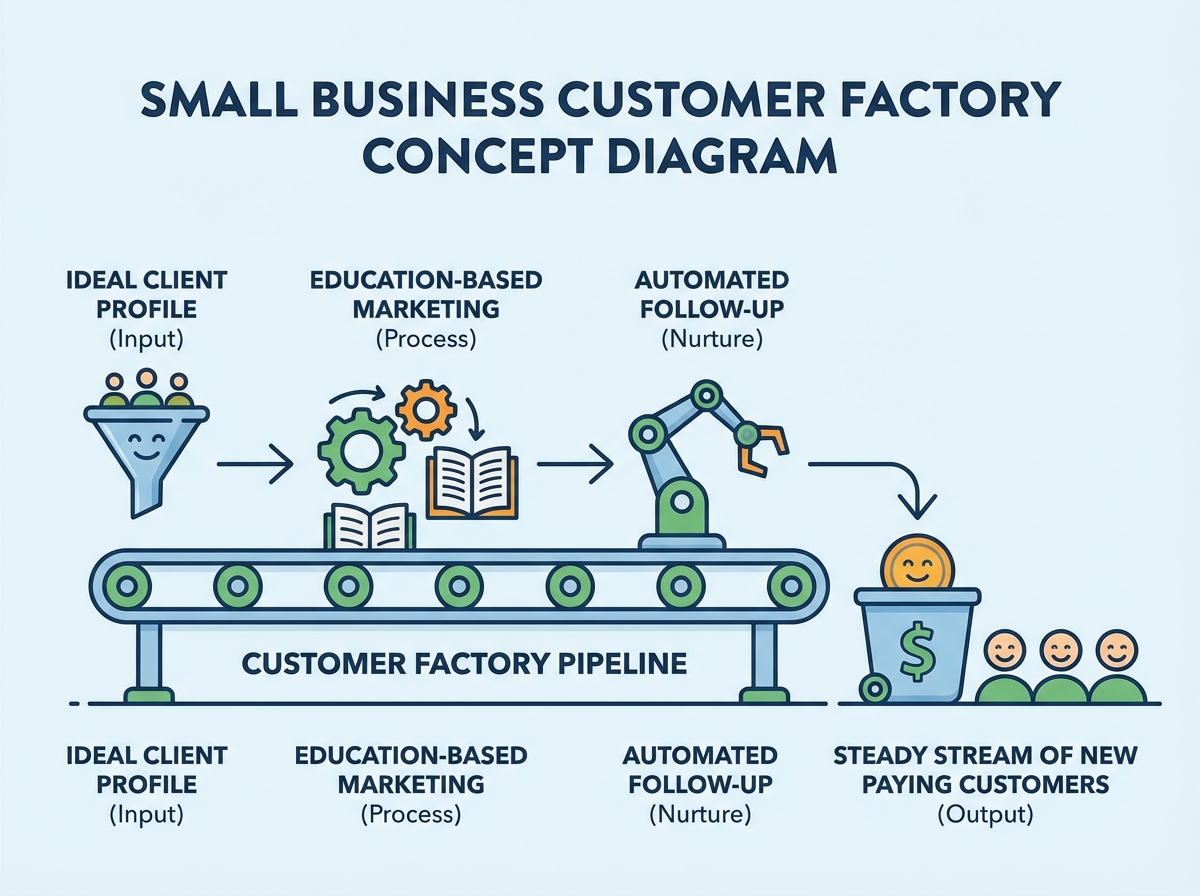
Most small business owners don’t have a sales problem. They have a system problem.
You put up a website, posted on social media, maybe ran a few ads — and nothing stuck. Not because you picked the wrong channels. Because there was no actual machine underneath any of it.
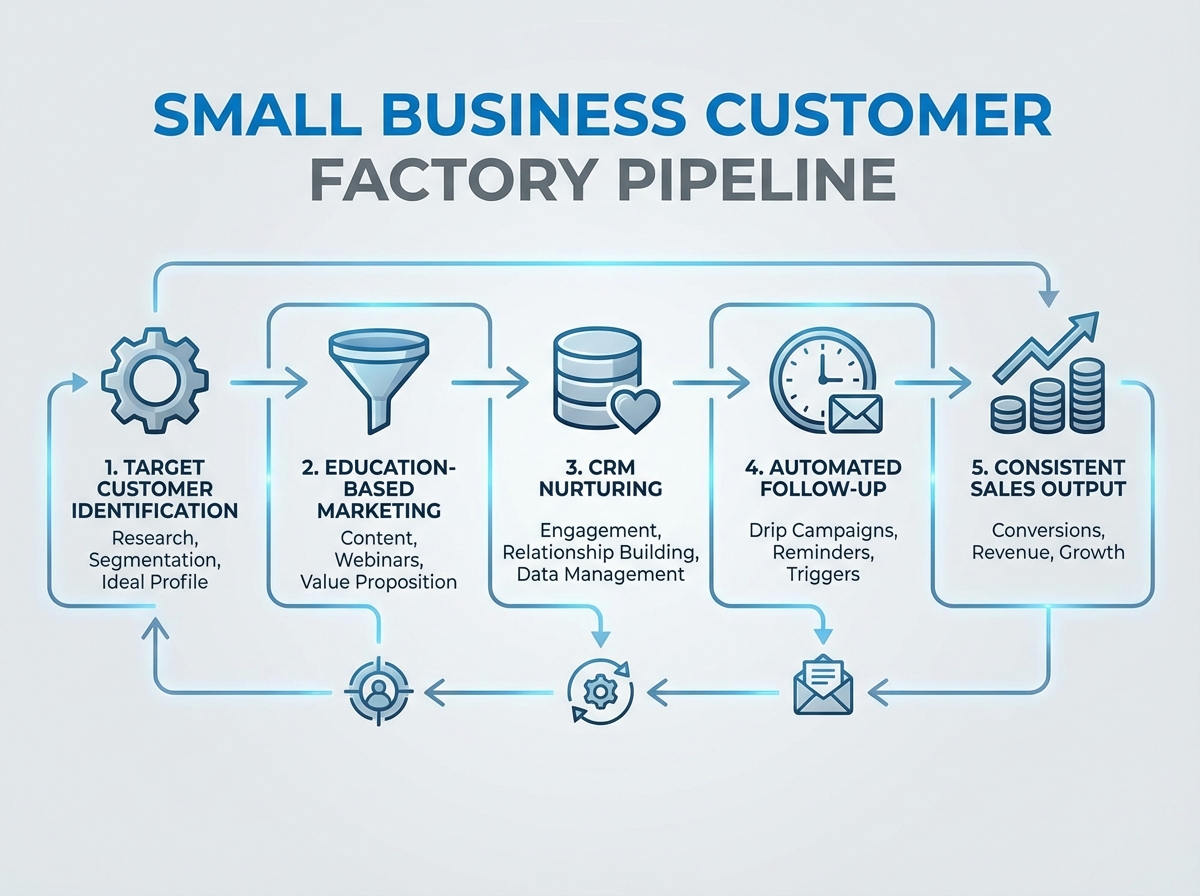
If you’re looking to learn small business marketing that actually produces consistent customers, the answer isn’t a new tactic — it’s building what most people skip entirely: a repeatable process with the right mindset, the right target, and tools that run without you babysitting them. That’s what a customer factory is. It’s not a funnel. It’s not a campaign. It’s a structured assembly line that takes a stranger and moves them, step by step, toward becoming a paying client — and then keeps doing it.
- A customer factory only works when you’ve clearly defined who it’s built for — skip this and every downstream step breaks
- Education-based marketing outperforms hard selling for small businesses because it removes the fear of being “salesy”
- The whole system fails without consistent follow-up; automation isn’t optional, it’s the engine
What “Small Business Marketing” Actually Means
Most people use the word marketing to mean advertising. Run an ad, get customers. That’s not marketing — that’s one tool inside a much larger process. Small business marketing is the entire sequence: finding the right person, earning their attention, building enough trust that they choose you, and then keeping them long enough to matter.
There are three things working underneath every successful small business marketing system:
- Target clarity — a precise picture of who you’re actually trying to reach
- A process — a defined path that moves someone from stranger to client
- Tools — software and systems that keep the process running with consistency
| What People Think Marketing Is | What It Actually Is |
|---|---|
| Running ads | Defining and reaching the right customer |
| Having a website | Building a system that converts visitors |
| Posting on social media | Creating touchpoints in a longer nurture sequence |
| A one-time campaign | An ongoing, measurable assembly line |
If you’re a business owner who feels like marketing is a black art — something that works for other people but not for you — it’s almost always because you’re treating one piece of the system as if it were the whole thing.
Why Your Marketing Isn’t Working (And It’s Not What You Think)
The first hard realization is this: most small business marketing fails not because of bad execution, but because of a broken process underneath. You can write a perfect email and send it to the wrong person. You can have a beautiful website that nobody trusts. You can run ads that get clicks from people who were never going to buy.
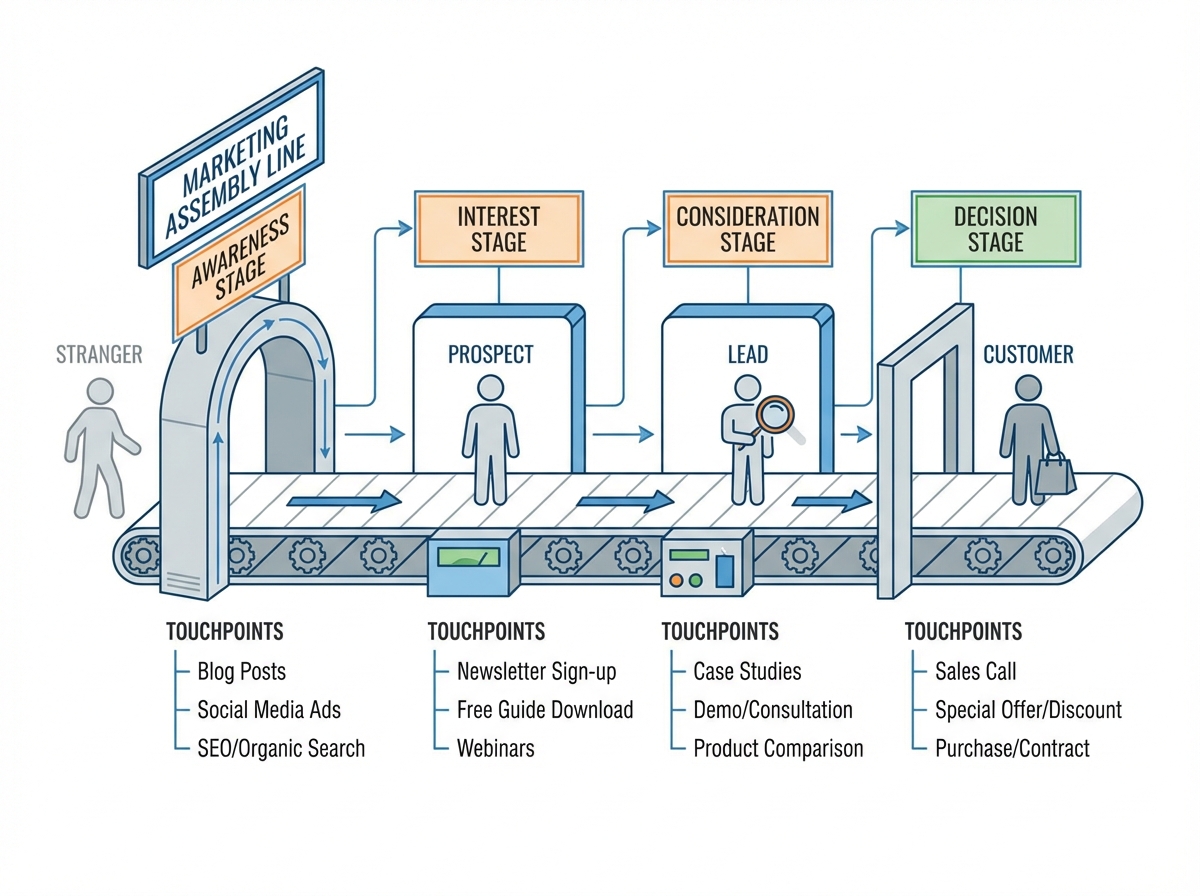
There’s a concept worth naming here: the Marketing Assembly Line. Think of it like a factory floor. Every station has a job. The raw material — a stranger who might need what you offer — enters at one end. They move through stages: awareness, interest, consideration, decision. At each stage, something specific has to happen or the whole line stops. Most small businesses are running with two or three stations missing entirely, and then wondering why nothing comes out the other end.
The other thing that breaks early is mindset. There’s a version of marketing that feels manipulative — high-pressure, pushy, designed to trap people. That feeling is real, and it makes most business owners hesitant to market at all. But the version that actually works for small businesses looks nothing like that. It looks more like a doctor-patient relationship: you understand the problem better than the person experiencing it, and you guide them toward the right solution. That’s not salesy. That’s useful.
The Biggest Mistake: Skipping Target Marketing
The single biggest mistake people make when building a customer acquisition system is refusing to narrow their target. “We help everyone” sounds inclusive. In practice, it means your message lands for nobody.
Target marketing gets resistance because it feels like you’re leaving money on the table. If you specialize in serving one type of client, aren’t you cutting off everyone else? The opposite is true. When your message speaks precisely to a specific person’s specific problem, it creates an immediate feeling of recognition — this is for me — that generic messaging can never produce.
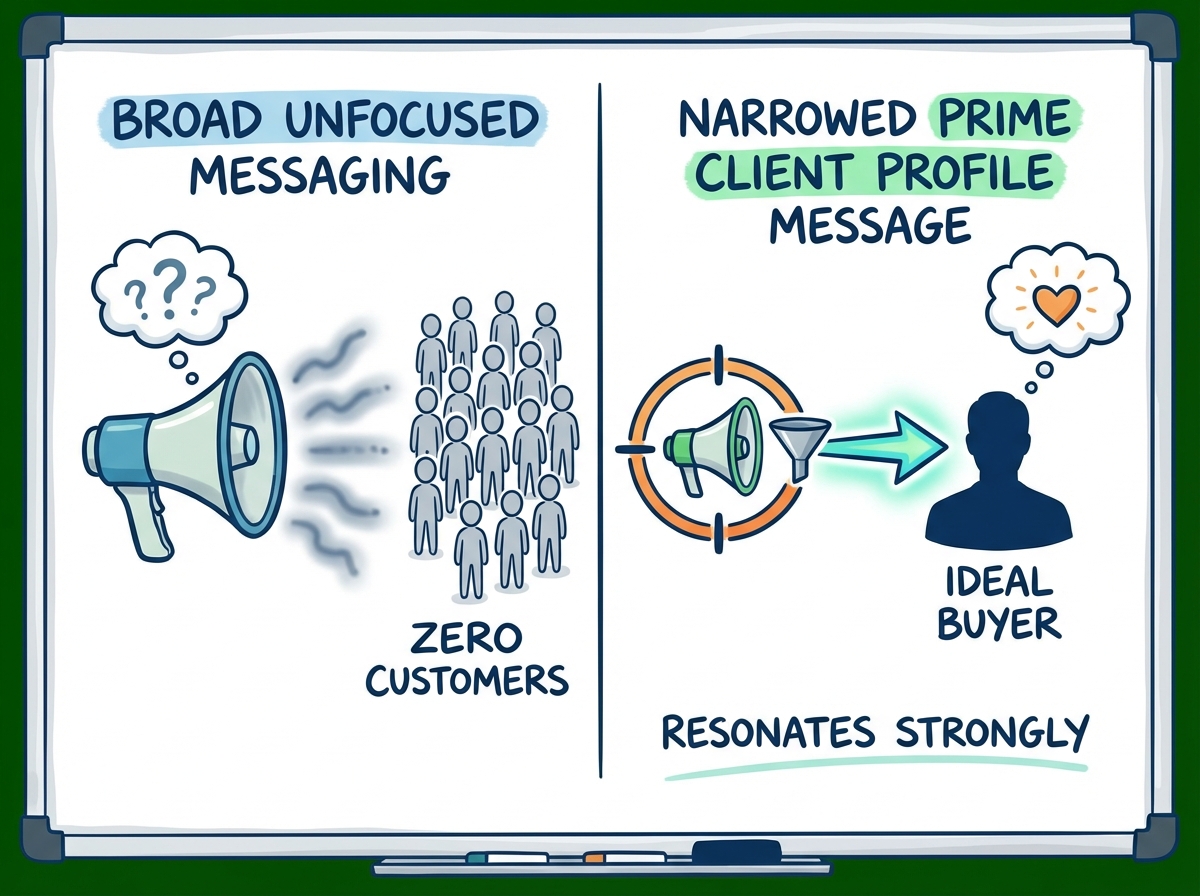
Building what’s sometimes called a Prime Client Profile means going beyond demographics. It means understanding the psychological state of the person you’re trying to reach. What are they frustrated about? What have they already tried? What words do they use to describe the problem they want solved? When you can write copy that sounds like you’re reading their mind, you’ve done target marketing correctly. The LinkedIn social selling and job search principle applies here too — your profile and positioning only work when they’re written for a specific audience, not everyone.
The elevator speech exercise forces this clarity in a way that nothing else does. If you can’t explain what you do, for whom, and why it matters in under 30 seconds — in plain language, with no jargon — then your marketing will always feel scattered. The elevator speech isn’t a party trick. It’s a diagnostic. If it’s vague, your whole system is vague.
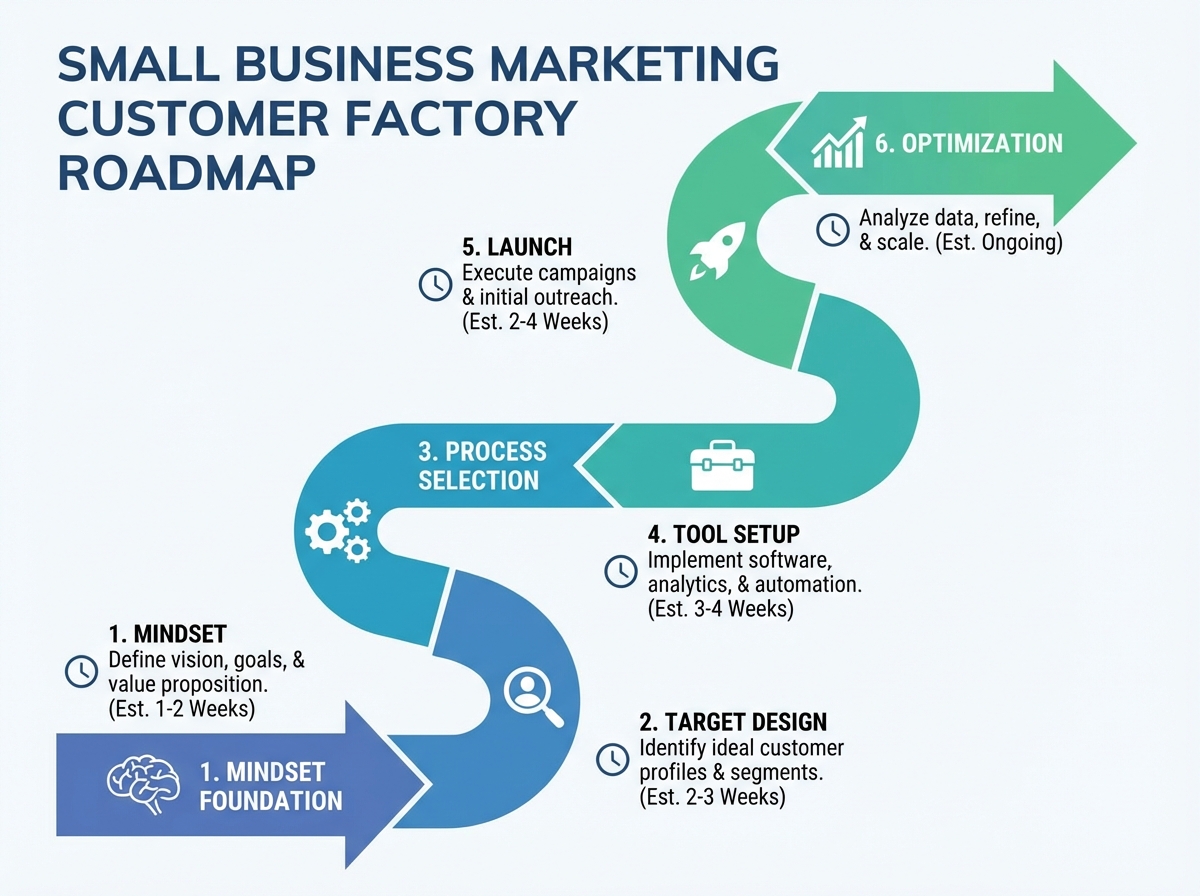
How Long Does It Take to Build a Working Customer Factory?
| Stage | What You’re Building | Estimated Time |
|---|---|---|
| Mindset and foundation | Understanding the customer life cycle, fixing your marketing lens | 1–2 weeks |
| Target customer design | Prime client profile, elevator speech, identity clarity | 1–2 weeks |
| Process selection | Choosing and mapping your education-based marketing path | 1–2 weeks |
| Tool setup | CRM, email automation, database building | 2–3 weeks |
| Launch and first cycle | Running your first real sequence, tracking results | 4–6 weeks |
| Testing and optimization | Tweaking based on real data, tightening the system | Ongoing |
| Total to first working system | 10–16 weeks |
The order matters more than the speed — rushing to tools before you’ve locked in your target customer is the most common reason systems get built and then abandoned. And if you’re moving slower than this estimate, you’re probably not behind — you’re probably being more thorough than average, which almost always produces better results downstream.
Education-Based Marketing: Why It Works When Everything Else Doesn’t
Once you have a clear target, the question becomes: how do you actually reach them without feeling like you’re hawking something? Education-based marketing is the answer that most small business owners never find on their own.
The idea is simple: instead of leading with what you sell, you lead with what the prospect needs to know. You teach them something genuinely useful — something that helps them understand their problem better and positions your solution as the natural next step. It’s not a trick. It’s not bait-and-switch. It’s a fundamentally different way of showing up in someone’s awareness.
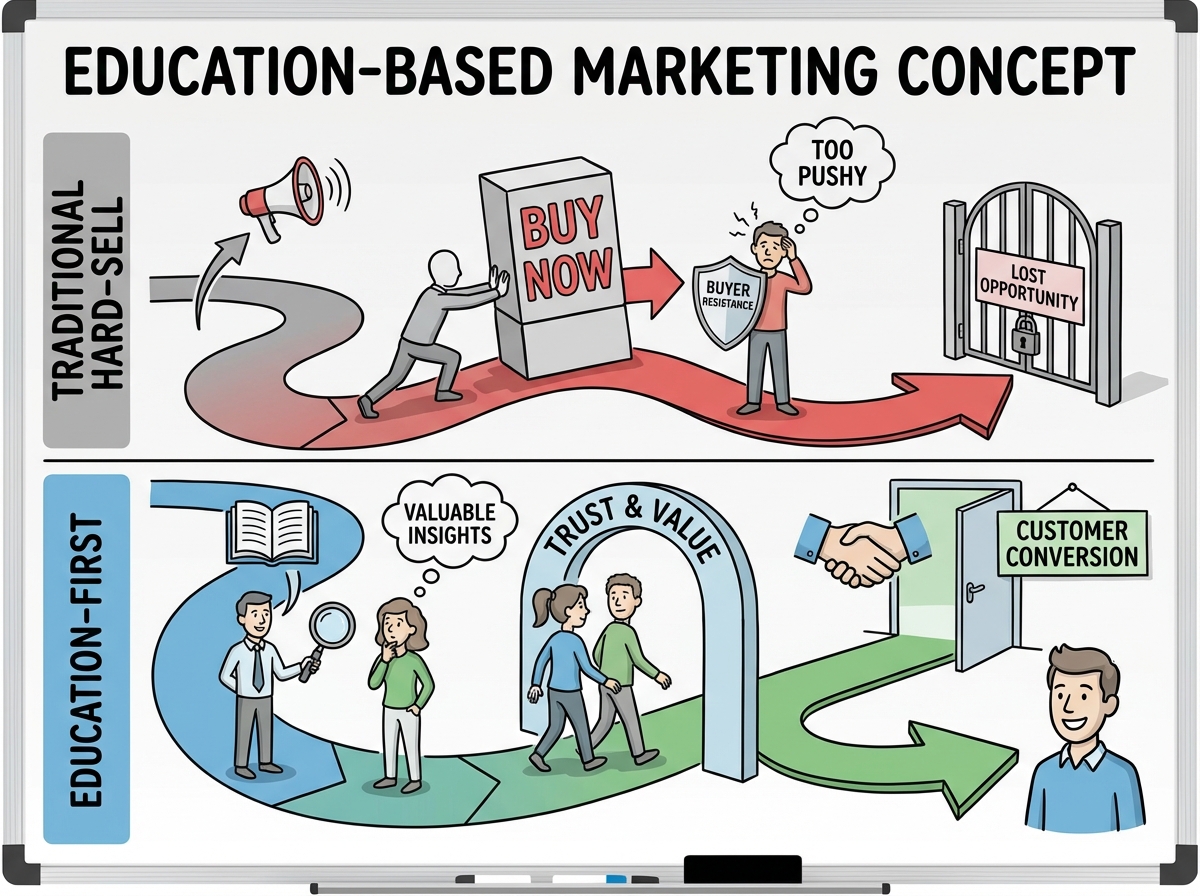
The real-world version of this might be a short email series that explains the three biggest mistakes people make when choosing a service like yours. Or a simple PDF that walks someone through a decision framework. Or a webinar that genuinely answers the questions your prospects are already Googling. The content teaches. The trust builds. The sale becomes a natural conclusion rather than a forced moment.
What makes this especially powerful for small business owners who fear being salesy: when you’re educating, you never feel like you’re selling. You’re just helping. And the people who are right for your business self-select forward, while the people who aren’t quietly opt out. That’s the system doing its job.
The Tools That Hold the System Together
Here’s where a lot of business owners stall out: they understand the strategy but never implement it because “setting up the tools” feels like a technical project that requires a different kind of brain.
It doesn’t. The tool stack for a working customer factory is actually small. You need a CRM — something that stores your contacts and tracks where each person is in your process. You need an email platform that lets you set up automated sequences. And you need a database to build your initial list from. That’s the core of it. Everything else is optional until the basics are running.
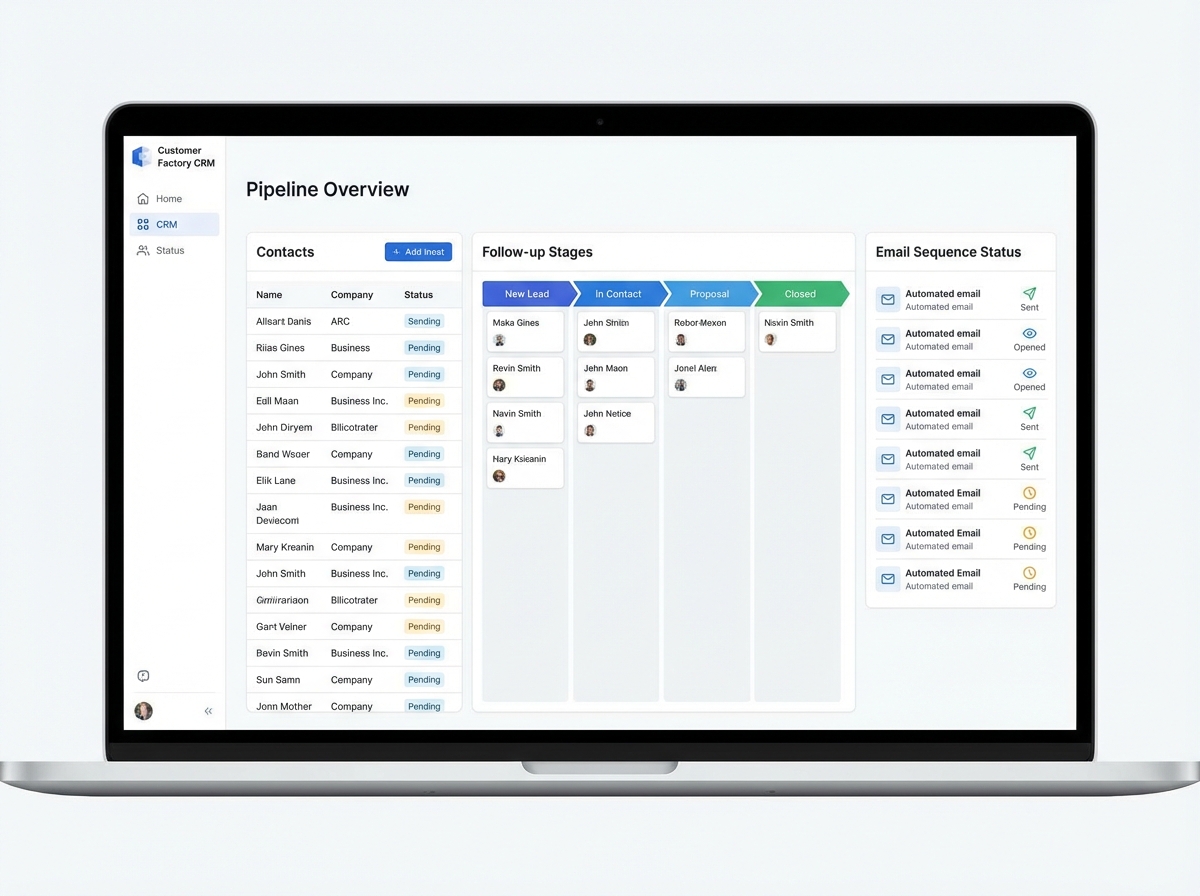
The automation piece is what most people skip — and it’s the difference between a system that runs and a system that dies the moment you get busy. Touch marketing, the practice of staying in consistent contact with prospects over time, only works if it’s automated. You will not manually follow up with 200 prospects every two weeks. Nobody does. But a sequence of pre-written emails set up once will do it forever.
The $20 marketing mindset is worth internalizing here: you don’t need a massive budget to make this work. You need consistency, specificity, and a system that doesn’t require you to reinvent the wheel every month. Start small, track what happens, and adjust. The testing-tweaking-tracking cycle is what turns a rough first version into something that reliably produces customers.
What Running Your Customer Factory Actually Looks Like
Most people expect some dramatic moment when the system “turns on.” That’s not how it works. What actually happens is quieter: you start seeing patterns. This type of prospect responds to this type of message. These emails get opened; those ones don’t. People who came in through this channel close faster than people from that channel.
Commitment is the unsexy variable that nobody talks about. You can have a beautifully designed system and still get zero results if you run it for three weeks and quit. The customer life cycle has natural timing — from first contact to first purchase, depending on your industry, might be 30 days or 6 months. If your follow-up sequence is shorter than your typical sales cycle, the machine will always run dry right before it would have produced results.
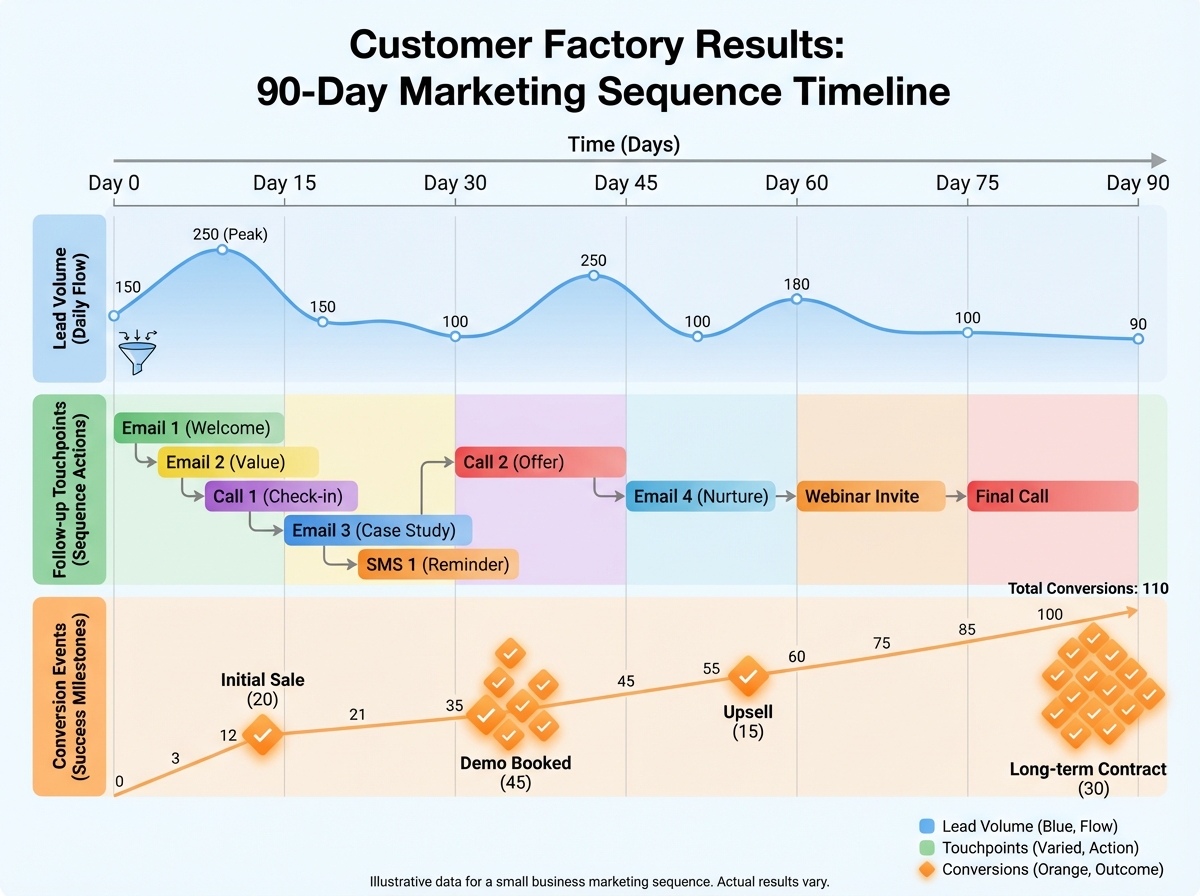
Tracking matters because it shows you which station on the assembly line is broken. If people are opening emails but not clicking, your content isn’t earning the next step. If they click but don’t schedule a call, your landing page isn’t converting. Every metric points at a specific place in the sequence — and fixing that one place often doubles the output of the whole system. That’s the leverage that makes a well-built customer factory worth building in the first place.
For business owners also exploring how to launch a business from scratch, the customer factory framework fits naturally into the early infrastructure decisions — it’s not something you bolt on after launch, it’s something you design before your first customer even knows you exist.
What Happens When the System Actually Works
The thing nobody tells you is that a working customer factory changes how you feel about your business. You stop dreading the question “where’s the next client coming from?” because you can see the pipeline. You know how many people are in each stage. You know roughly what’s coming out the other end.
That shift — from reactive scrambling to a system you can look at and understand — is worth more than any single tactic. It’s the difference between a business that runs you and a business you actually run.
Here’s what to apply immediately:
- Write your Prime Client Profile before you touch any tools — describe your ideal client in psychological terms, not just demographics; this single document will improve every piece of marketing you ever produce
- Rewrite your elevator speech until a 12-year-old understands it — if you need jargon to explain what you do, you don’t understand your own value proposition yet
- Map your current marketing process on paper — draw every step from first contact to closed sale and find the stations that are missing or broken
- Choose education-based content for your first marketing sequence — pick the three biggest mistakes your prospects make and write one email about each
- Set up a CRM before you generate a single lead — trying to retrofit contact management after you have leads is how people fall through the cracks
- Build your first automated email sequence to run for at least 90 days — match the sequence length to your actual sales cycle, not to what feels comfortable
- Track open rates, click rates, and conversion rates separately — each metric diagnoses a different part of the system; looking at them together hides which station is actually broken
- Run one budget-conscious test campaign with a defined end date — the $20 marketing mindset means you’re testing assumptions, not making commitments; keep the first run small enough that a bad result teaches you something instead of hurting you
Leave a Reply