



You’ve uploaded a video. Maybe five. Maybe twenty. You followed every checklist you found online — good lighting, a clear call to action, a thumbnail that didn’t look terrible. And then… almost nothing. A handful of views, zero leads, and the quiet dread of realizing you might have been doing this completely wrong.
If you’re looking to learn video storyselling for your business, the short answer is this: the videos that actually convert aren’t the ones with the best production quality — they’re the ones built around a real story with a real emotional arc. Video marketing without story is just broadcasting. Story is what makes someone stop scrolling, watch to the end, and then actually reach out.
- Most business videos fail not because of bad cameras or weak editing, but because they pitch instead of tell a story.
- The businesses winning with video aren’t the ones posting most often — they’re the ones whose stories get shared by people who aren’t even customers yet.
- You don’t need a studio. You need a structure — specifically, a narrative arc that moves a viewer from problem to solution in under three minutes.
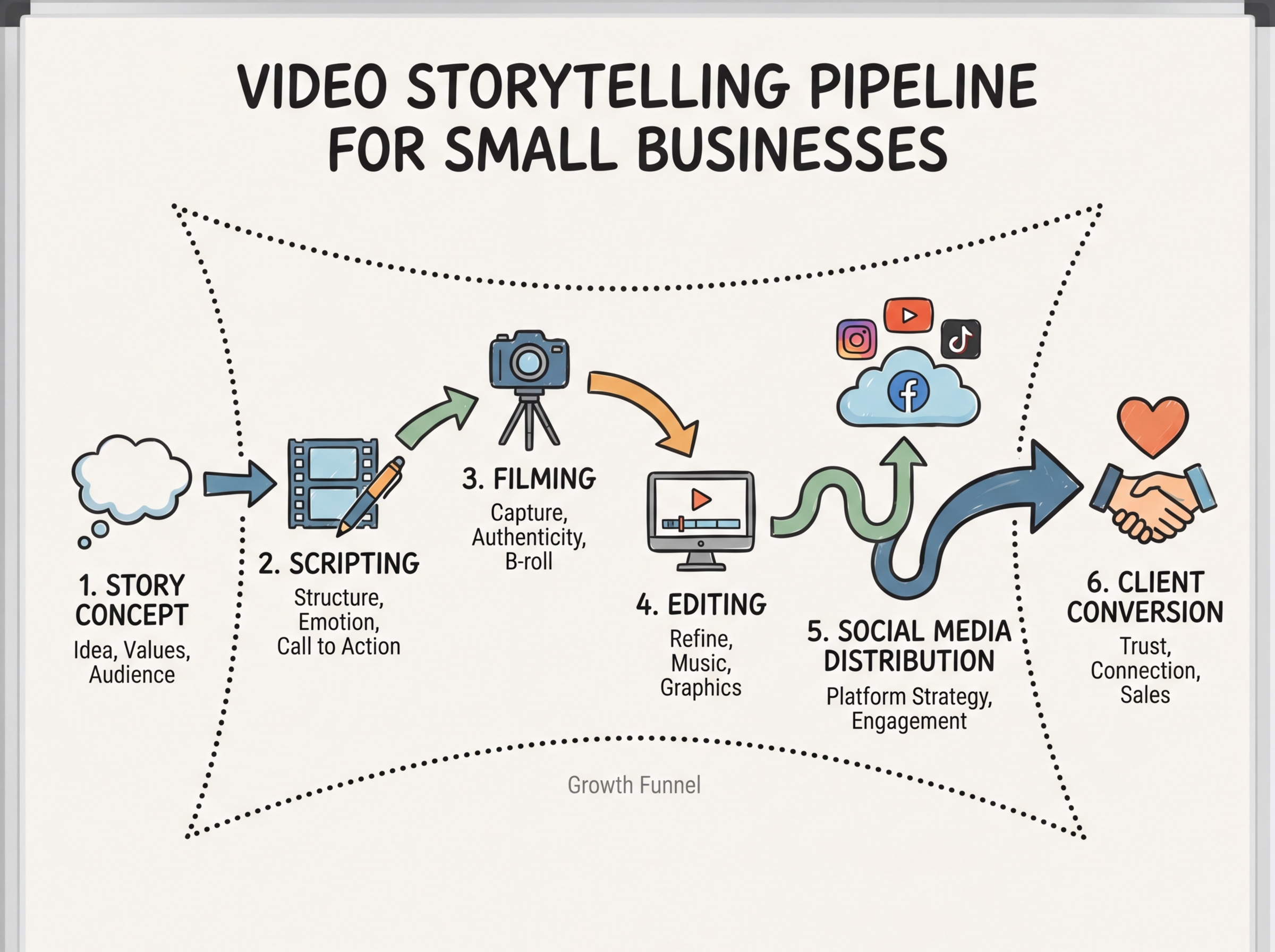
What Video Storyselling Actually Means for a Small Business Owner
The phrase gets used loosely, so let’s be precise — especially if you’re an entrepreneur who’s been told to “just make more content” without anyone explaining what content is supposed to do.
Video storyselling is the practice of structuring a short marketing video around a narrative arc — a protagonist (your viewer), a problem they recognize, a turning point, and a resolution that positions your product or service as the mechanism of change. It’s not a testimonial. It’s not a demo. It’s not a talking-head explainer. It’s closer to a three-minute short film that happens to end with a call to action.
| Format | What It Does | Story Present? |
|---|---|---|
| Product demo video | Shows features | Rarely |
| Testimonial video | Builds trust | Sometimes |
| Branded story video | Creates emotional connection | Always |
| Video storyselling | Converts viewers into clients | Always, by design |
Sharp Insights
- Viewers share stories, not services — nobody reposts a feature list.
- Your call to action lands harder when it’s the natural end of an arc, not an interruption.
- The “sell yourself, not what you do” rule separates forgettable videos from ones that build real authority.
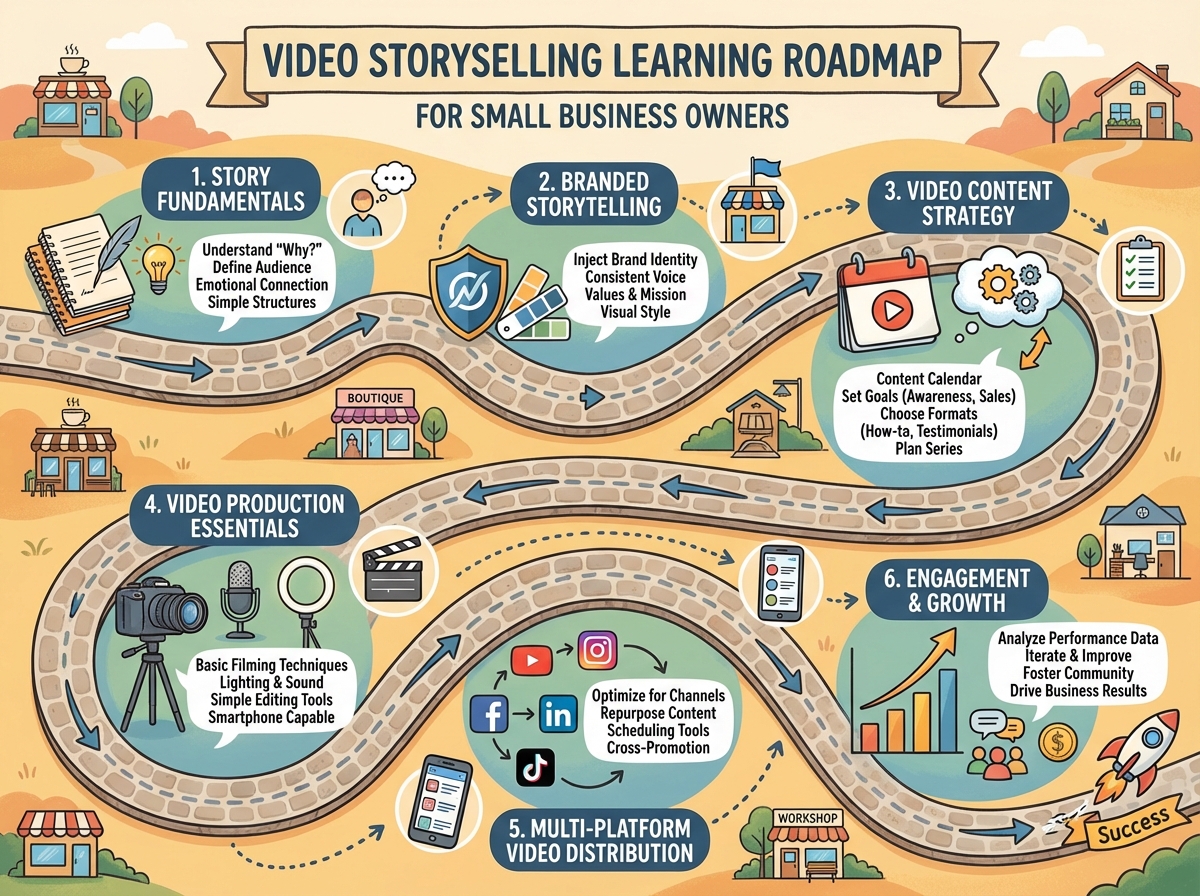
How Long Does It Actually Take to Get Good at This
| Stage | Content | Time |
|---|---|---|
| Foundation | Understanding story beats, identifying your audience, setting business goals for video | Week 1–2 |
| First production | Scripting, filming, and publishing your first story video | Week 2–3 |
| Iteration | Refining based on feedback, avoiding common pitfalls, sharpening your call to action | Week 3–5 |
| Show format | Building a repeatable weekly show format that your audience expects | Week 5–8 |
| Distribution mastery | Placing your videos across YouTube, Facebook, LinkedIn, and email for maximum reach | Week 8–10 |
| Advanced storytelling | Branded storytelling, ad stories, landing page video | Week 10–14 |
| Total | From first concept to confident, repeatable video content system | 10–14 weeks |
Order matters far more than speed here — trying to nail distribution before you’ve got a repeatable story format is one of the most common reasons people plateau. And if it takes you eighteen weeks instead of fourteen, that’s not a failure — most people who stick with this are still ahead of the entrepreneurs who never finished their second video.
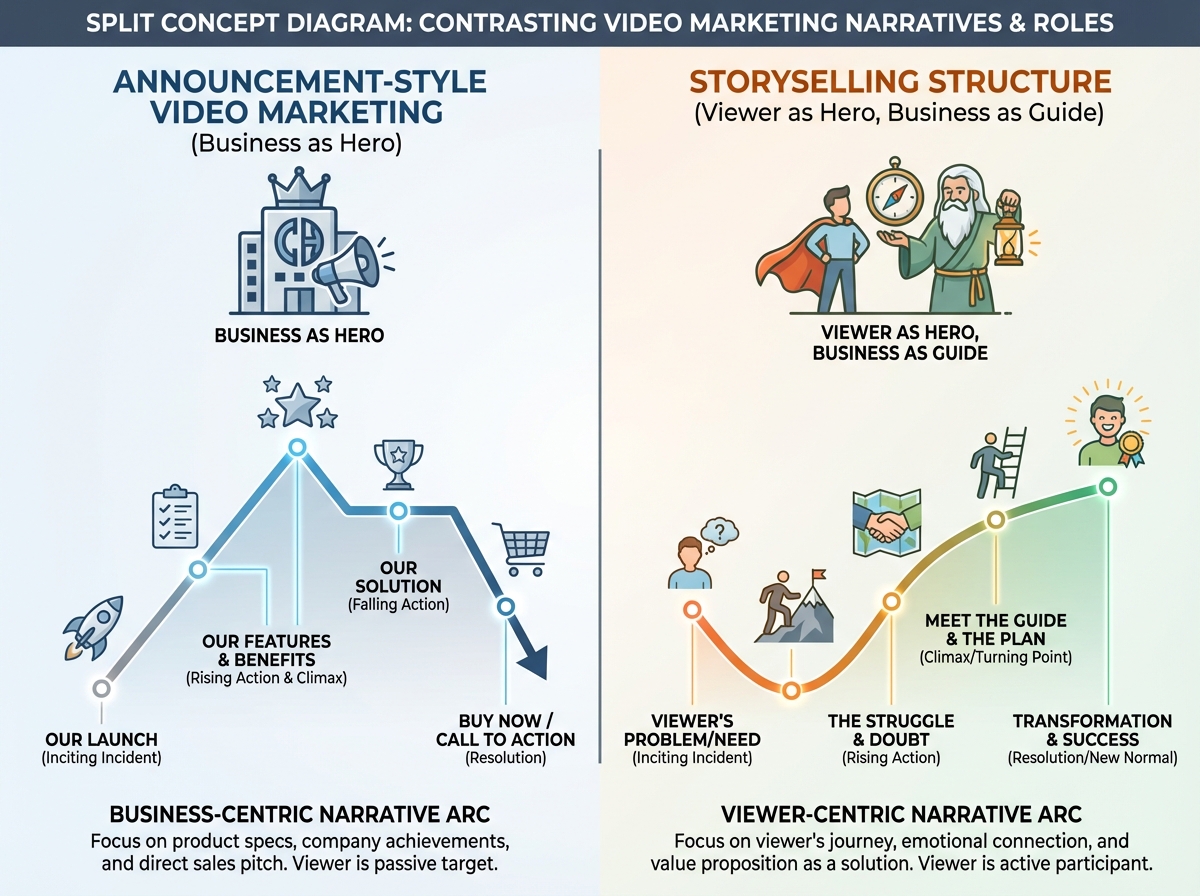
The Moment You Realize You’ve Been Making Announcements, Not Stories
The biggest mistake people make when learning video marketing is treating their business like the hero of the story. Every video starts with “We offer…” or “Our company specializes in…” and the viewer — who came to the video because they have a problem — immediately tunes out.
This is the wall almost every entrepreneur hits in the first week. You sit down to write a video script and what comes out reads like a brochure. You know your business deeply. You know why you’re different. But translating that into something a stranger would actually watch is a completely different skill, and nobody tells you that going in.
The shift happens when you flip the frame. Your viewer is Han Solo. You are Obi-Wan. Your job isn’t to be the hero — it’s to hand the hero a lightsaber and tell them the Death Star’s weak point. Once that lands, your scripts change completely. The opening line stops being about you. It starts being about the exact moment of frustration your viewer is living right now.
From that point on, every video you write starts by asking: what does my viewer feel before they find me? Not what do I offer — what do they feel? That question alone separates story from announcement.
Story Beats Are the Skeleton — Everything Else Is Flesh
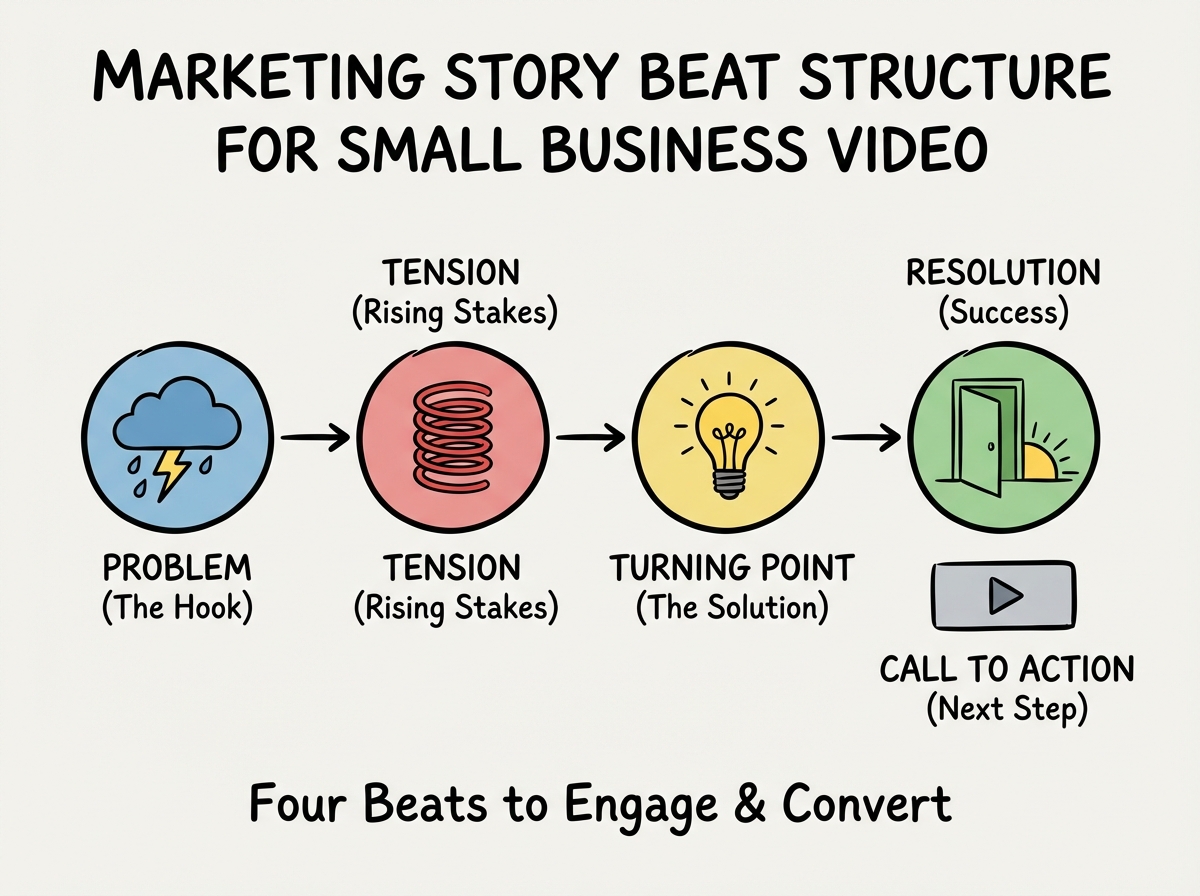
Once you’ve accepted that your viewer is the protagonist, the next question is structure. And this is where people overcomplicate things. You don’t need a fifteen-page screenwriting manual. You need four beats that fit in under three minutes.
The marketing story beat structure that actually works in short-form video goes like this: open on the problem (in vivid, specific terms the viewer recognizes), introduce tension (what’s at stake if it stays unsolved), offer a turning point (the thing they didn’t know before watching this), and close on the new world (what life looks like on the other side, with a clear next step). That’s it. Every branded story that’s ever gone viral — Dollar Shave Club, Dove Real Beauty, any Super Bowl ad you still remember — follows a version of this arc.
The practical work is making those beats specific to your audience. “Follow the money trail” isn’t a metaphor — it means identifying the exact emotional and financial stakes your viewer is navigating before they ever hit play. A small business owner selling bookkeeping services isn’t competing with other accountants in someone’s head. They’re competing with the anxiety of a founder who’s avoiding their own finances because they don’t understand them. That’s the real tension. That’s the opening beat.
When you nail that opening beat — when you name the feeling before you name the service — the watch time goes up before you’ve said a single word about your offer.
Filming Your First Story Without Spiraling Into Perfectionism
Here’s what actually happens the first time you try to film: you rewrite the script four times, rearrange your background twice, and then watch the footage back and hate your voice. This is not a technical problem. It’s a fear response dressed up as a production problem.
The fear of being on camera is real, and it doesn’t fully disappear — but it stops mattering once you’ve published three videos. The first one is the hardest because it carries every expectation you have of yourself. Treat it like a rough draft you’re publishing anyway, because that’s what it is. The goal of your first video is not to go viral. The goal is to establish that you can do this at all.
For the actual filming, a phone with decent lighting beats an expensive camera with bad light every time. Natural light from a window, a cheap clip-on microphone, and a clear background will get you 80% of the way there technically. The other 20% is showing up as yourself — direct, not polished; confident, not stiff. Viewers forgive imperfect production. They don’t forgive obvious discomfort with the camera.
Your call to action at the end matters more than any piece of gear. Decide what you want the viewer to do before you film — subscribe, book a call, visit a page — and build backward from that moment. A video without a clear call to action is a performance. A video with one is a conversion tool.
Why Most People Quit Before the Show Format Clicks
Posting one video and waiting for results is the trap. The algorithm doesn’t reward singles — it rewards series. A show format changes everything because it transforms you from a content creator into a destination. Your audience knows what to expect, when to expect it, and what kind of person watches this show. That last part is the real leverage: when your viewer knows who else watches, they know whether this is for them.
Building a show format means making three decisions once so you don’t remake them every week. Format (interview, solo story, behind-the-scenes), length (consistent within a range), and cadence (weekly is the baseline). Once those are locked, what used to take a full day of creative energy takes a couple of hours — because the scaffolding is already up.
The transition from “making videos” to “running a show” is also the point where your audience starts doing the distribution work for you. When someone shares your video, they’re not sharing a piece of content — they’re vouching for you. That only happens when the video feels like it belongs to a series worth following, not a one-off attempt at going viral.

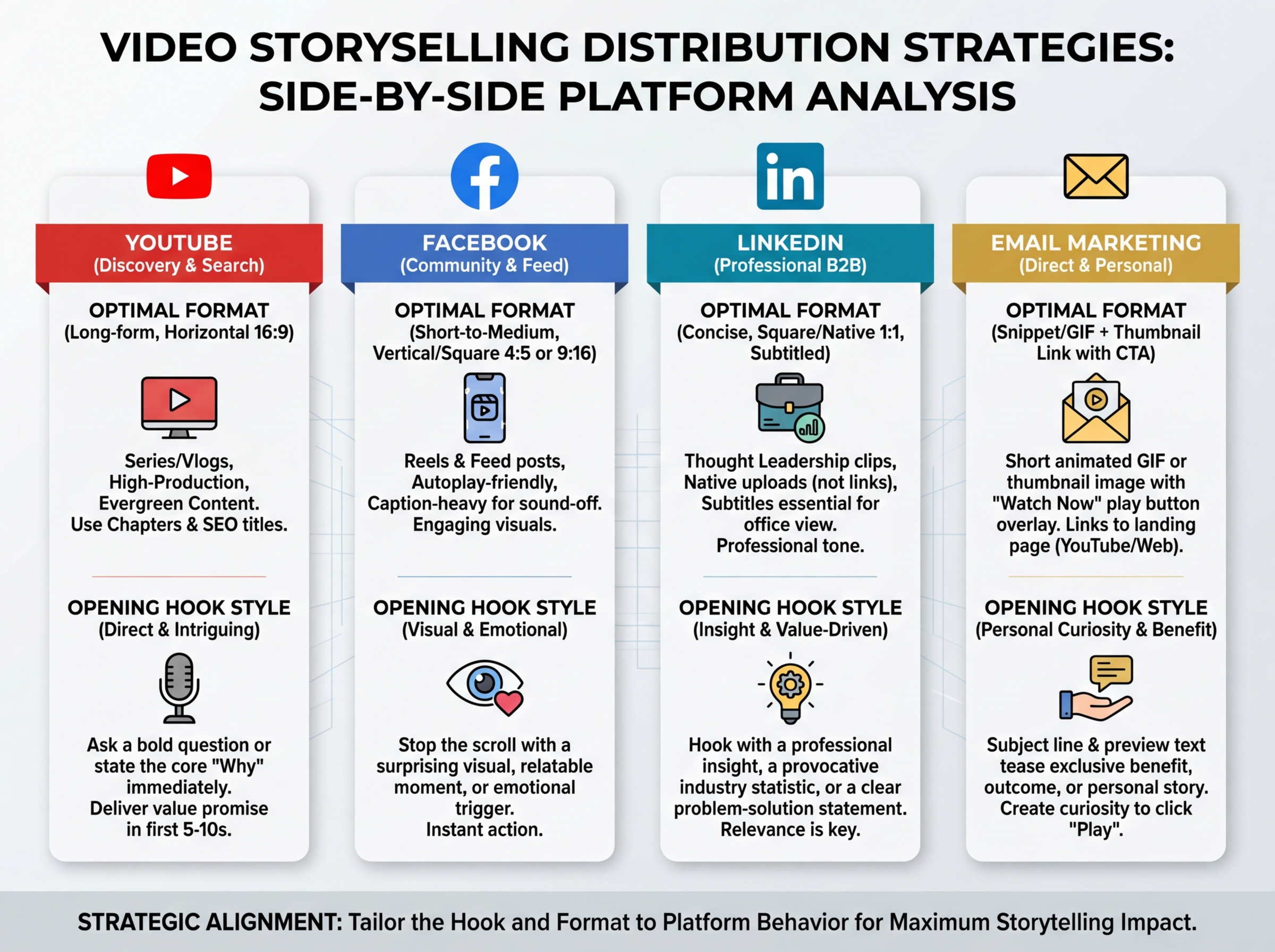
Distributing Your Video Stories So the Right People Actually See Them
Uploading to YouTube and hoping is a distribution strategy in the same way buying a lottery ticket is a retirement plan. Every platform has its own native behavior, and video that performs on one doesn’t automatically translate to another without adjustment.
YouTube rewards search intent — people go there to find answers. Your titles and descriptions need to match what someone would actually type when they have the problem your video solves. Facebook and Instagram reward emotional interruption — the first three seconds either stop the scroll or don’t, and because most video is watched on silent, your opening visual has to carry the weight your voice usually carries. LinkedIn rewards professional credibility stories — the most shared content there is someone being honest about a failure or a pivot, not a polished brand video.
Email is the distribution channel most people forget, which makes it the highest-signal one left. Embedding a video thumbnail in an email to your existing list — even a list of two hundred people — generates more qualified views than most social posts, because those people already opted in. They want to hear from you. Sending them a video is easier than sending them a newsletter, and it lands with more warmth.
Branded Storytelling Is a Different Discipline Entirely
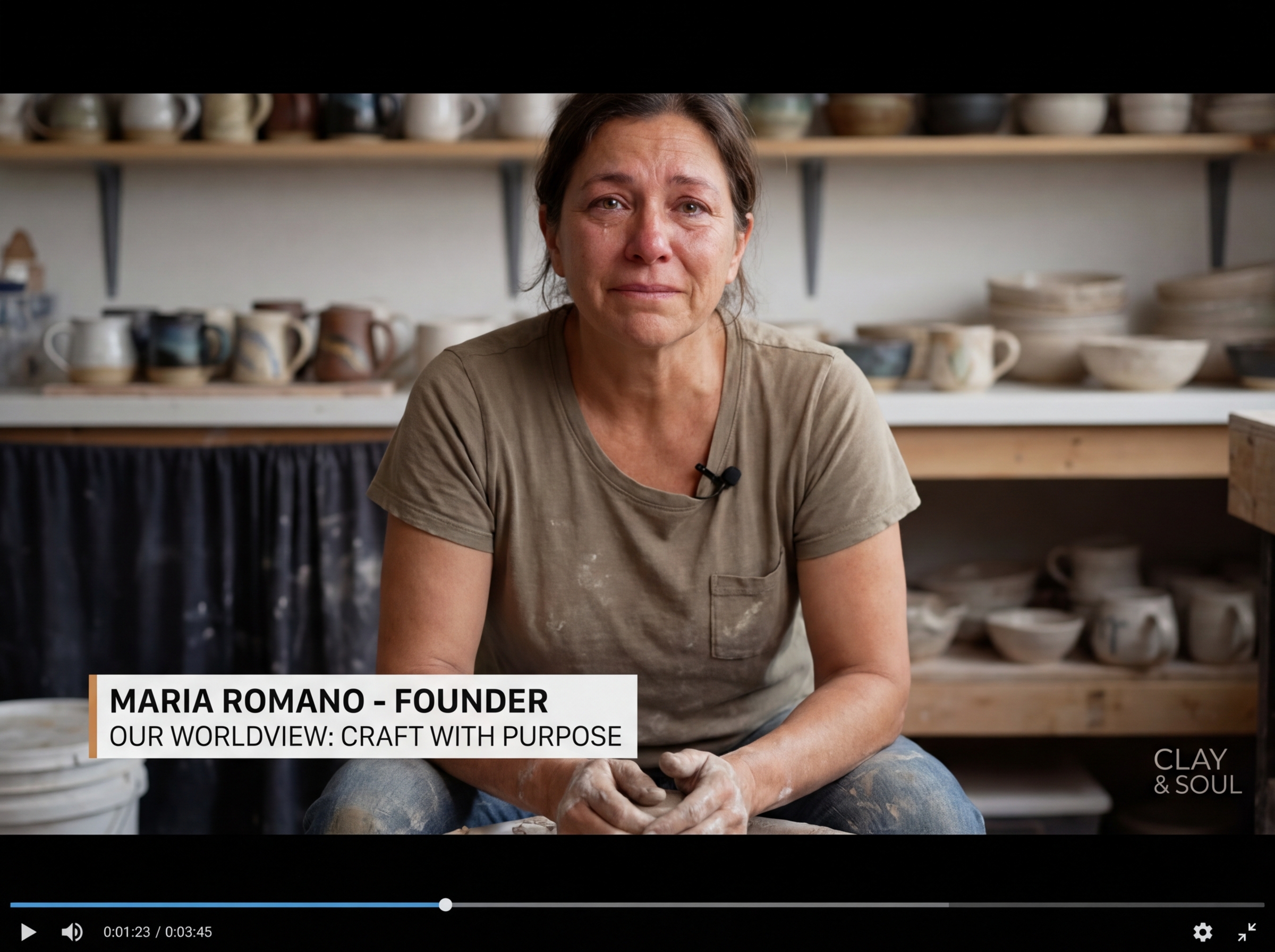
Once you have a show format working and your audience is growing, branded storytelling is the next level — and it operates by different rules. Where a marketing story video moves a specific viewer toward a specific action, a branded story video builds something slower and more durable: it makes people feel something about your company that they can’t fully articulate but can’t shake.
The Dollar Shave Club launch video is the case study everyone references for good reason. It didn’t explain what a razor subscription was. It made you feel like you were already the kind of person who gets it. That emotional shortcut — making the viewer feel like a member of something before they’ve bought anything — is what branded storytelling does that no ad can replicate.
For small businesses, this means one thing practically: stop selling your service and start selling your worldview. What do you believe about your industry that most people in it won’t say out loud? That belief, stated directly and illustrated with a story, is more persuasive than any testimonial you’ll ever collect.
Ad Stories and the Art of Short, Silent, and Specific
Social media ad videos operate in a completely hostile environment. The viewer didn’t ask to see your ad. Their thumb is already moving. You have about two seconds to make them pause, and if your first frame is a logo or a title card, you’ve already lost.
The rule that keeps getting proven right is this: short and silent works best. Not because depth doesn’t matter, but because the platform’s default behavior — autoplay without sound — means your ad must communicate clearly without audio before it earns the right to be heard. On-screen text that matches what you’re showing (not transcribes what you’re saying) is the fastest way to bridge that gap.
Landing page video stories follow a different compression: longer is acceptable because the viewer chose to be there, but the opening still needs to name their problem before their attention drifts. A sixty-second landing page story that opens on the viewer’s frustration and closes on a specific transformation converts better than a three-minute explainer that starts with company history.
What You Can Do Immediately
Looking back at what actually moved the needle in video storyselling, the technical stuff fades into the background. What stays is the structure — the discipline of building every video around a viewer’s experience rather than your own expertise. Here’s what to act on now:
- Write your next video brief starting with the viewer’s frustration, not your offer. One sentence describing exactly what your ideal client feels before they find you — that’s your opening beat.
- Film one video this week on your phone and publish it unpolished. Perfectionism costs you reps, and reps are what build confidence on camera.
- Watch the last three videos you published and note where you start talking about yourself instead of the viewer. That’s the exact moment you lose them.
- Choose one platform and commit to a weekly show format for six weeks before adding a second platform. Consistency on one channel beats irregular presence on five.
- Build your call to action before you write the rest of the script. Every story beat should be pointing toward that final ask — if it isn’t, the beat doesn’t belong in the video.
- Watch the first thirty seconds of your competitors’ best-performing videos and identify whether they open on a problem or a product. The ones opening on a problem will almost always have better engagement metrics.
- Write a one-paragraph worldview statement for your brand — something you believe that most in your industry won’t say. That statement is the foundation of your branded storytelling.
- Before distributing any new video, decide whether it’s a search-intent video (YouTube/blog), a scroll-stop video (Instagram/Facebook), or a credibility video (LinkedIn/email) — then optimize the opening for that context specifically.
Leave a Reply