


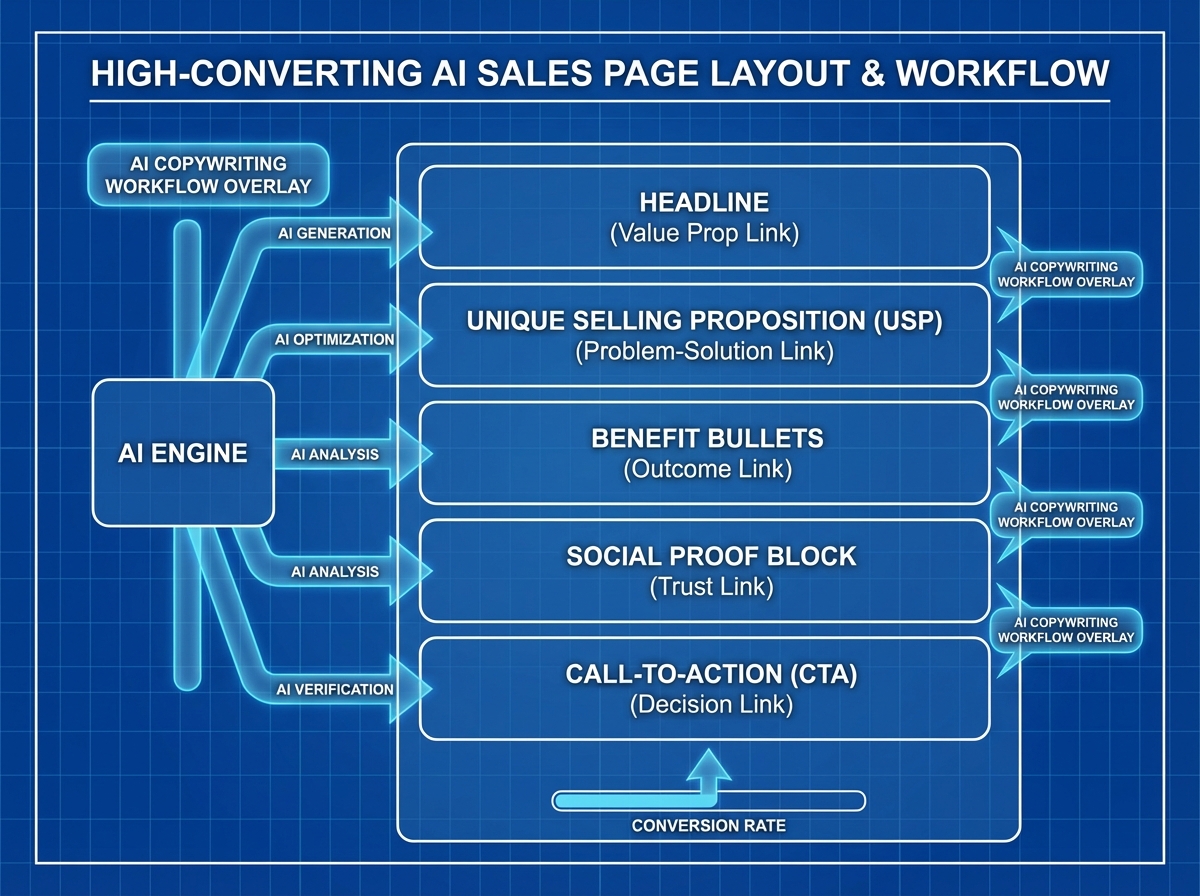
Most sales pages fail before the visitor even reads the second sentence. Not because the product is bad. Because the page was written like a product spec sheet instead of a conversation with someone who desperately needs a solution.
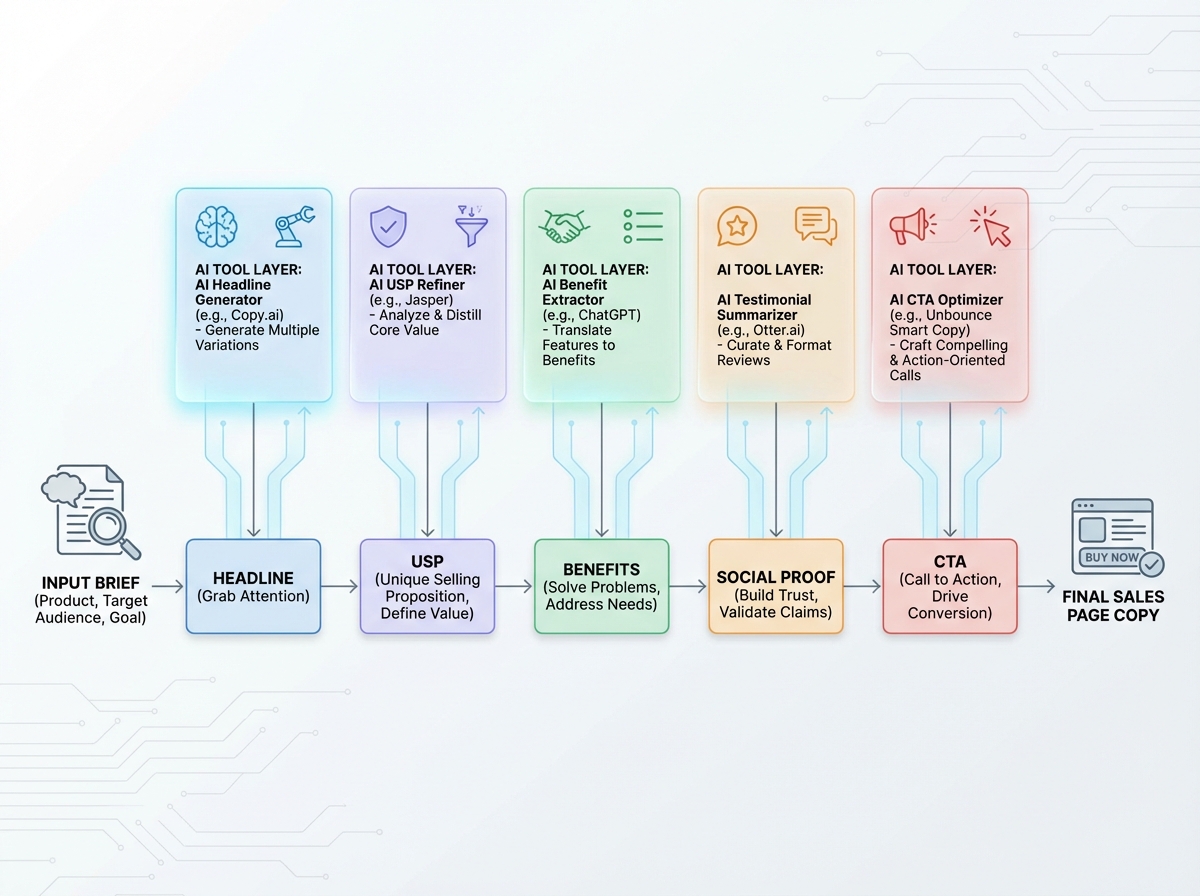
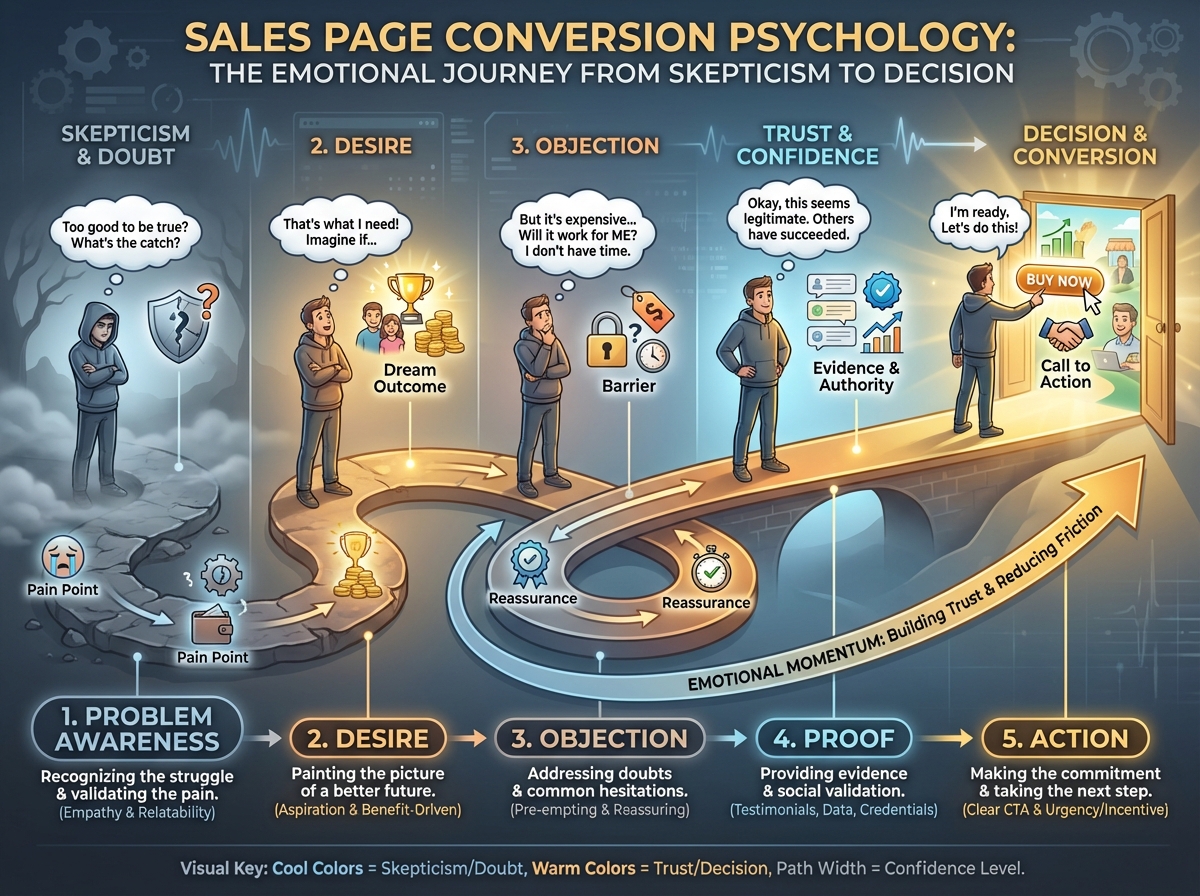
If you’re looking to learn AI sales page copywriting, the fastest path is understanding the underlying psychology first — then using AI to execute it at speed. A great sales page isn’t a list of features. It’s a structured emotional argument that leads a skeptical stranger to a confident decision. AI compresses the time it takes to build that argument, but only if you already know what the argument should contain.
- AI saves the most time when you already know your headline angle, core benefit, and customer objection — without that clarity, the output is generic
- The difference between a 1% and 6% conversion rate almost always comes down to the headline, the USP statement, and the first CTA placement
- Freelancers and business owners who use AI as a drafting layer — not a replacement layer — produce copy that sounds human and converts
What Is an AI Sales Page?
An AI sales page is a conversion-focused landing page where the copy — headline, body, benefits, call to action — is drafted, refined, or optimized using large language model tools like ChatGPT, Claude, or Jasper. The structure itself hasn’t changed since the era of direct mail. What changed is how fast you can fill that structure with language that sounds right for your specific audience.
| Approach | Time to Draft | Personalization | Revision Speed |
|---|---|---|---|
| Manual copywriting | 4–12 hours | High (if skilled) | Slow |
| AI-assisted copywriting | 20–60 minutes | Medium–High | Fast |
| Pure AI with no brief | 5–10 minutes | Low | Irrelevant |
The middle row is where the money is. AI-assisted, not AI-replaced.
Sharp Insights
- Your headline decides 80% of whether anyone reads the next line
- Listing features before benefits is the most common reason pages lose sales
- Social proof placed before the CTA outperforms proof placed after it
How Long Does It Actually Take to Learn This?
| Stage | What You’re Doing | Time |
|---|---|---|
| Foundation | Understanding why sales pages work, psychology behind conversion | 1–2 hours |
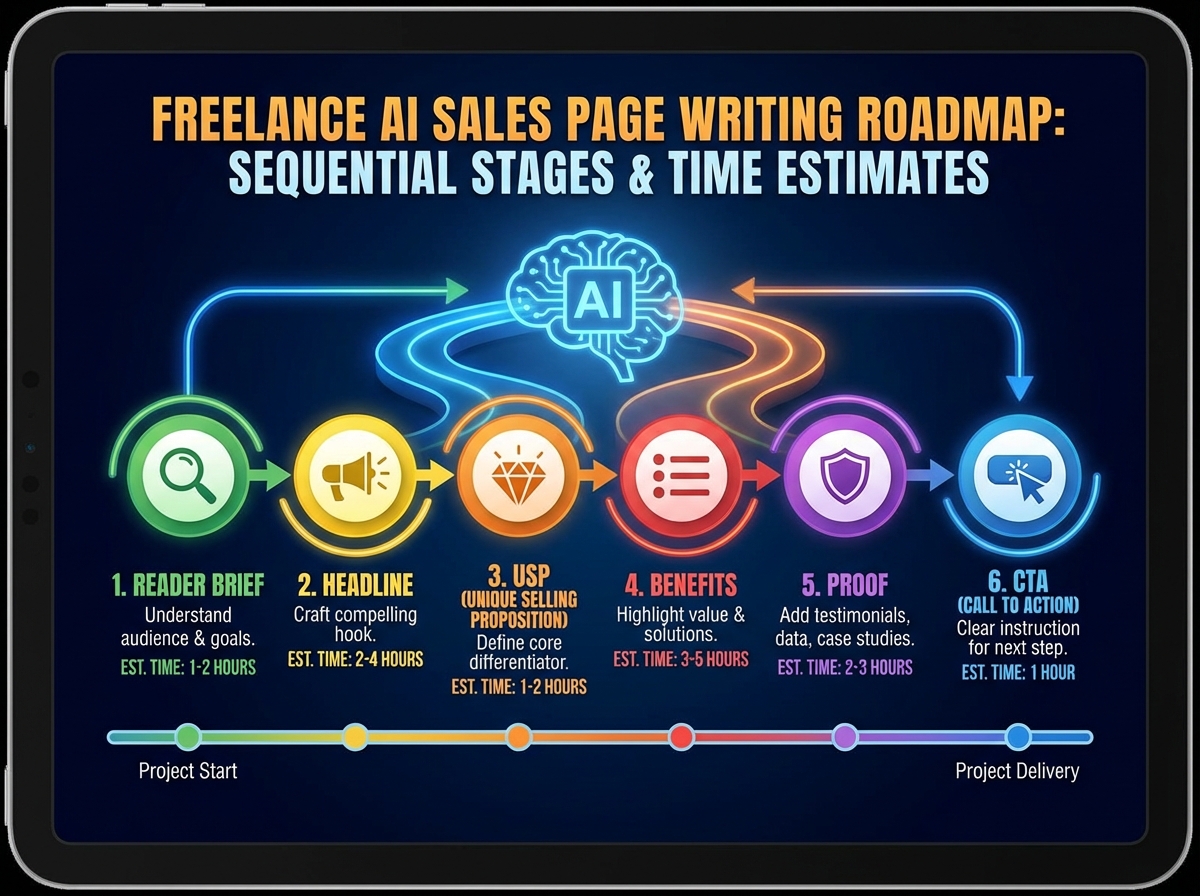
| Structure | Learning the key elements: headline, USP, benefits, proof, CTA | 2–3 hours |
| AI Integration | Prompting AI tools, reviewing and editing outputs | 2–4 hours |
| First Draft | Writing your first complete sales page using AI assistance | 1–2 hours |
| Refinement | Improving copy, testing CTAs, reading it aloud | 1–2 hours |
| Total | First publishable AI-assisted sales page | 7–13 hours |
The order you learn these stages in matters more than how fast you move through them — skipping straight to AI prompts before you understand conversion psychology produces copy that sounds like everyone else’s page. And if you take longer than two weeks to finish your first page, that’s completely normal. The slowdown almost always happens at the USP stage, which is also the most important stage.
Why Most People Start From the Wrong Place
The single biggest mistake people make when learning sales page copywriting is starting with the tool. They open an AI interface, type “write me a sales page for my product,” get three paragraphs that sound plausible, and wonder why no one buys. The AI gave them structure without signal. It didn’t know who the buyer was, what they were afraid of, or what had already failed to convince them.
Before you write a single line — with or without AI — you need one thing: a clear picture of the person reading. Not a demographic. A moment. The specific Tuesday afternoon when your ideal buyer searches for what you sell, what they’ve already tried, and why they’re still looking. That mental image is what makes your headline land like it was written just for them.
Once you have that picture, everything else gets easier. AI becomes genuinely useful because it has something real to work with. Without it, you’re just producing plausible-sounding noise.
The Headline Is Not Where You Start — It’s Where You Arrive
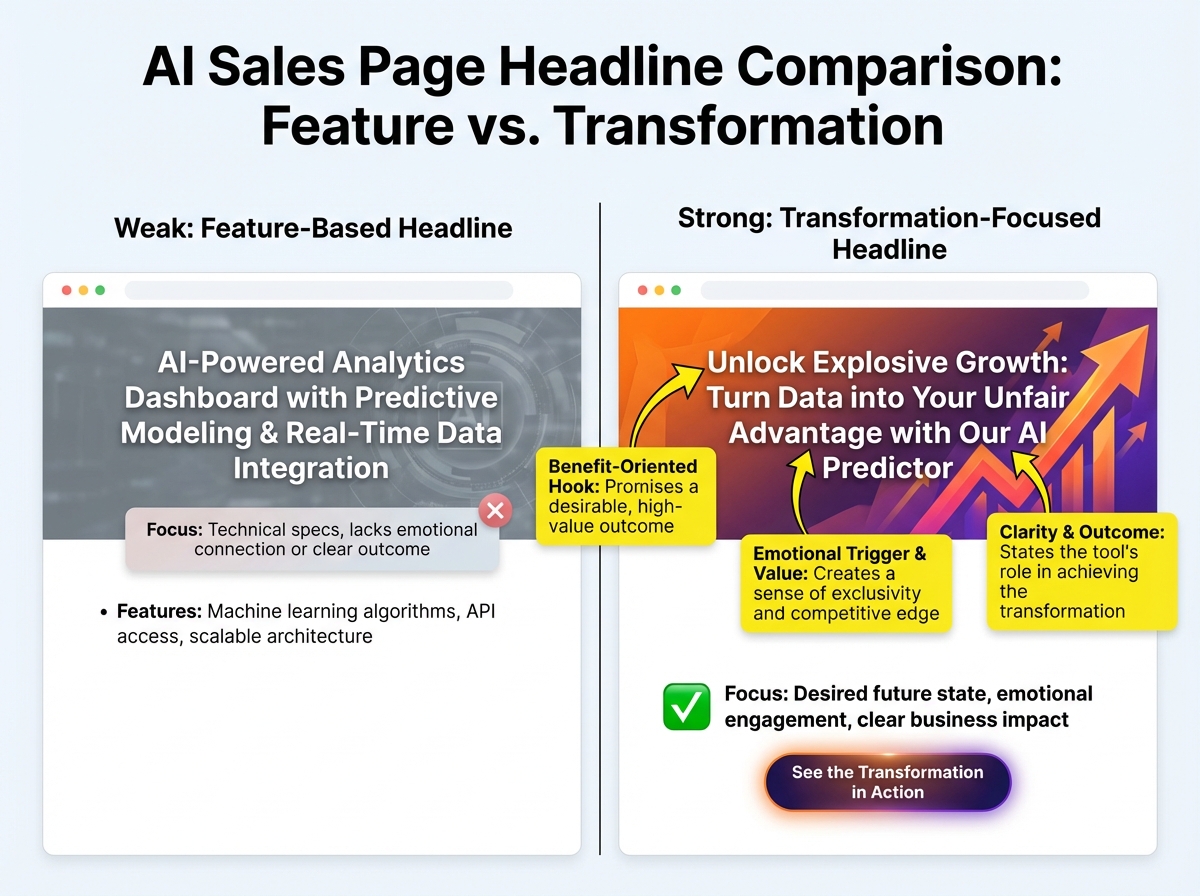
Every first-timer writes the headline first. That’s not how good headlines get written. A headline is a conclusion — it’s the single most compressed version of your most powerful argument. You can only write that after you’ve listed every benefit, mapped every objection, and found the angle that makes everything else feel secondary.
AI is actually excellent for headline work, but only at that later stage. Feed it your benefit list, your target reader description, and three draft angles you’re already considering. Ask it to generate twenty variations. Then read them against each other and pick the one that creates a specific feeling — not just clarity, but a slight pull of “that’s exactly my problem.” That pull is what gets someone to keep reading.
The headline you almost never want is the one AI generates first. That one is usually a complete sentence that explains the product. What you want is a headline that implies the transformation, names the problem, or breaks a belief. Those take iteration — and AI speeds up iteration dramatically once you know what you’re iterating toward.
The USP Section Is Where Most Pages Quietly Die
Unique selling proposition is one of those phrases that gets repeated so much it loses meaning. In practice, what it means is: why should this skeptical person choose your offer over the three alternatives they already know about? That’s it. Not why your product is great. Why it’s the right choice for them specifically in this moment.
Most people write a USP that’s actually a tagline — something smooth and forgettable. “The fastest way to grow your business.” “Copy that converts.” These aren’t USPs. They’re sounds. A real USP contains a specific mechanism, a specific audience, and a specific outcome. “Sales copy written in under 5 minutes using AI prompting — for freelancers who bill hourly and can’t afford to spend a day on a single deliverable” is a USP. It includes who, what, and why now.
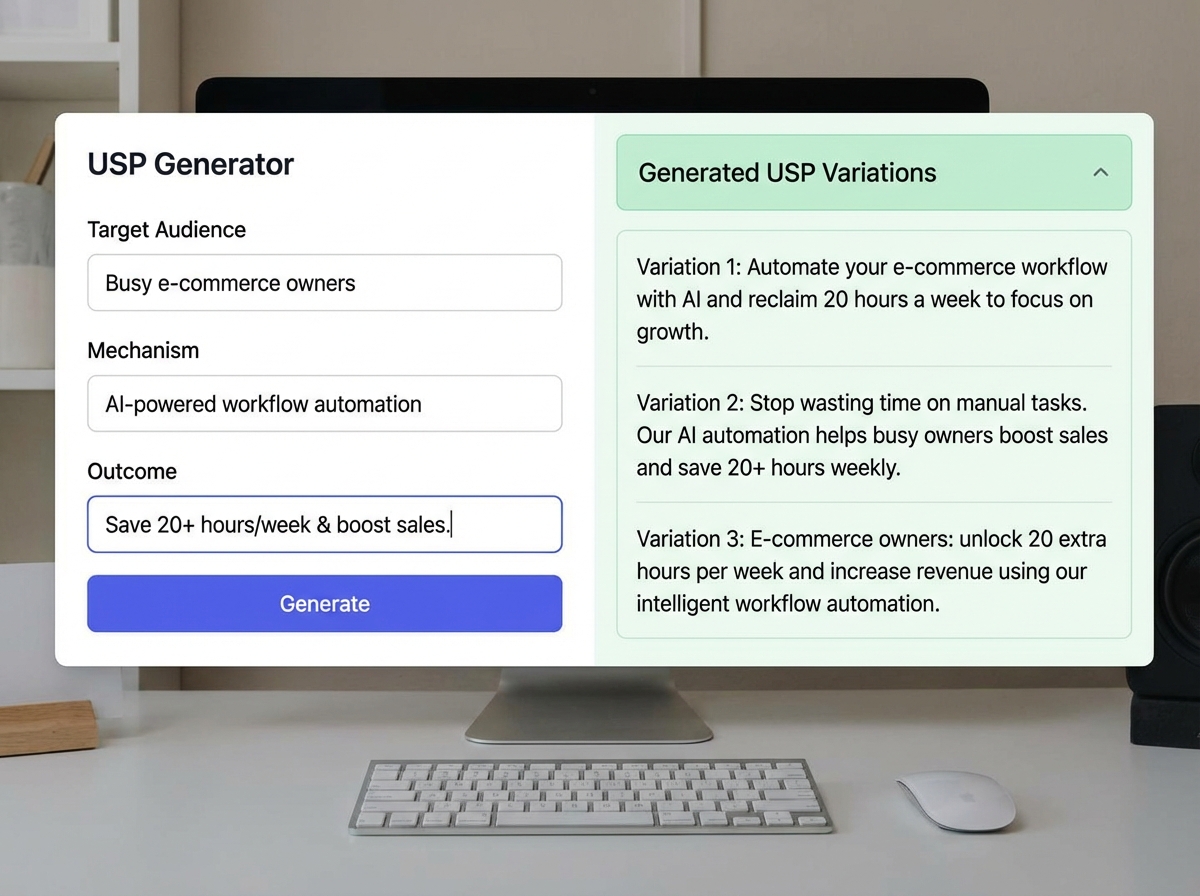
When you prompt AI to help with your USP, give it those three inputs explicitly. Tell it exactly who the buyer is, exactly what makes your approach different mechanically, and exactly what outcome they get. Then have it write fifteen variations. The one that makes you slightly uncomfortable because it’s so specific is usually the right one.
Benefits vs. Features: The Distinction That Changes Everything
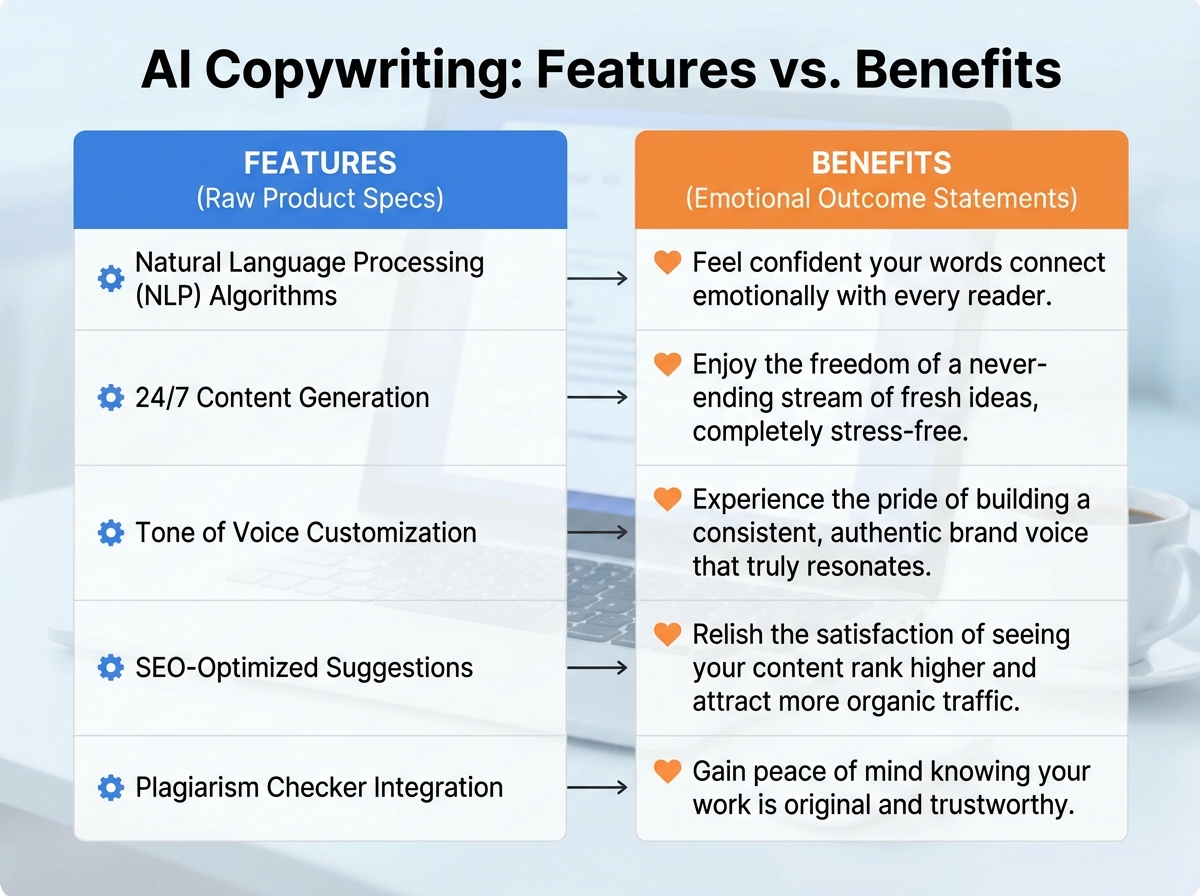
Features are what your product is. Benefits are what your buyer gets. This is the most cited copywriting principle in existence — and also the most consistently violated one. “14 video lessons” is a feature. “You can draft your first sales page in an afternoon” is a benefit. “AI-powered prompts” is a feature. “You stop staring at a blank page” is a benefit.
The way to get AI to generate real benefits instead of dressed-up features is to append a simple prompt to every feature you list: “which means that my customer can now…” The completion of that sentence is your benefit. Sometimes it takes two or three levels: the feature → the direct outcome → the emotional payoff. That third level — the thing that makes someone feel relieved or proud or finally capable — is where the most persuasive copy lives.
Don’t bury benefits inside paragraphs. Scan-friendly formatting matters on a sales page because most visitors scan before they commit to reading. Bullet points with benefit-first structure (not bold labels followed by features) are what keep a scanner’s eyes moving down the page instead of toward the back button.
Social Proof Is Not About Volume — It’s About Specificity
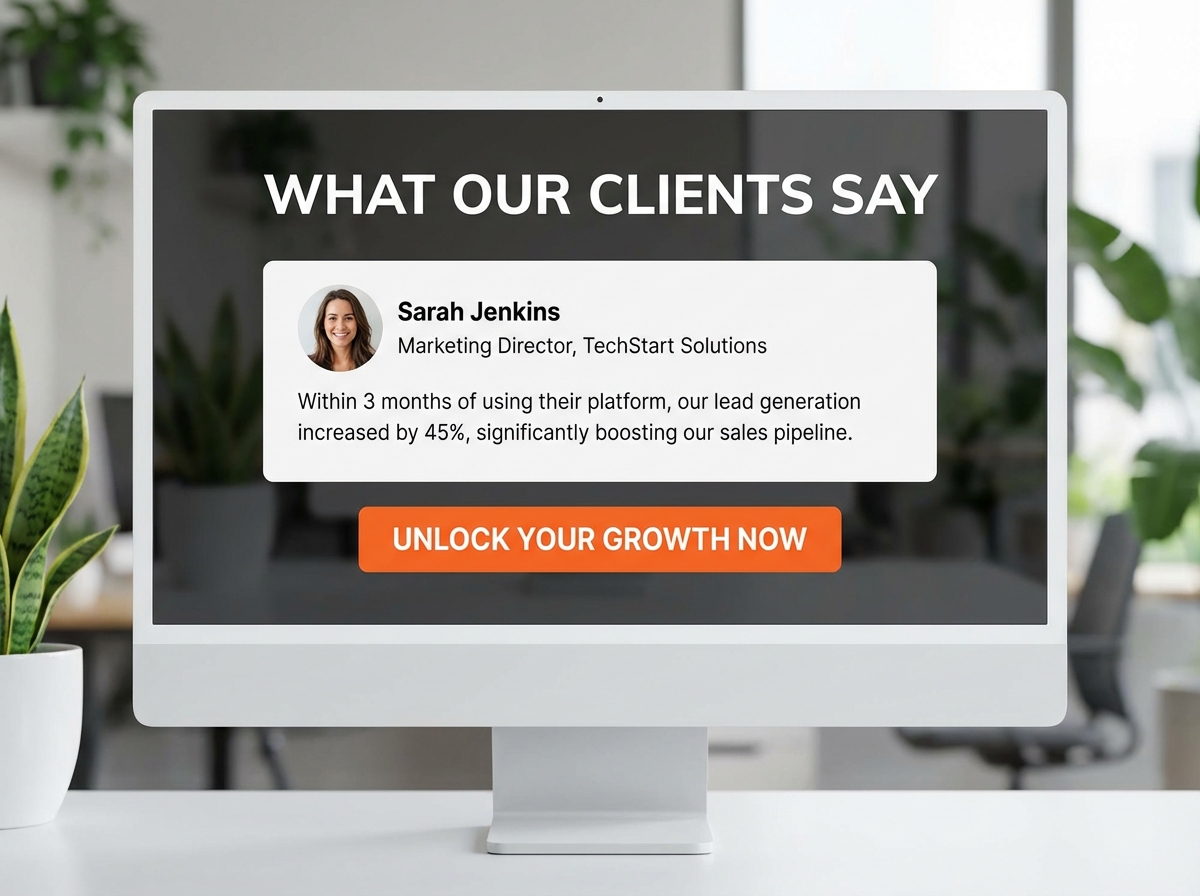
One specific testimonial outperforms five vague ones every time. “This course changed my life” does nothing. “I used the AI prompting method from section two and had a complete sales page draft in 40 minutes — I’d been stuck on the same page for three weeks” is the kind of proof that makes a skeptic pause.
When you’re building your sales page, place your strongest piece of social proof immediately before your first call to action. Not at the bottom of the page. Not in a carousel. Right before the moment you ask someone to click. That positioning converts because it addresses the final objection — “but does this actually work for someone like me?” — at exactly the moment the buyer needs reassurance most.
For building a customer conversion system that works beyond a single page, the same psychology applies: specificity beats volume, and timing beats placement. Get the right proof in front of the right person at the right moment in their decision process.
Writing the Call to Action That Doesn’t Feel Like a Demand
Most CTAs read like commands. “Buy Now.” “Sign Up.” “Get Access.” These aren’t wrong, but they’re neutral — they don’t do any persuasive work. A CTA that converts carries the benefit of the click inside the button text. “Start Writing My First Sales Page” is better than “Enroll Now” because it continues the transformation narrative. The reader clicks the button and can already imagine being on the other side of the friction they’ve been feeling.
AI can generate thirty CTA variations in ninety seconds. Run that prompt. Then read each one and ask: does this sound like the buyer’s internal voice, or does it sound like a marketing team? The best CTAs sound like something the buyer would say to themselves — “yes, I want this” phrased as an action.
Multiple CTAs on a long page are fine as long as they all point to the same single action. Giving someone two different things to click is a conversion killer. One offer, one button, multiple placements.
Putting the Full Page Together with AI Without Losing Your Voice
Here’s what the full workflow looks like once you’ve done the thinking: brief the AI with your target reader description, your USP, your top three benefits, your strongest piece of social proof, and your CTA action. Ask it to draft the page in a specific format — headline, subheadline, opening hook, three benefit bullets, proof block, CTA. Review each section not for polish but for accuracy. Does the headline reflect the real transformation? Does the proof feel specific? Does the CTA carry benefit language?
Then rewrite every line that sounds like AI wrote it. This is the step most people skip and then wonder why their page feels flat. AI gives you structure and speed. You give it the specific language that sounds like it was written for one person in one moment. The combination is what makes a sales page feel both professional and human.
For copywriters looking to expand beyond sales pages into full social media audience growth, the same principle holds — AI drafts at scale, but human specificity is what makes content resonate with a real audience.
What You’ll Know After Your First Page That You Can’t Learn Before It
The gap between understanding the framework and publishing a page is where most people stall. Not because the task is hard, but because every section forces a decision about specificity that feels risky. What if the headline is too narrow? What if the USP excludes people who might buy? What if the CTA sounds pushy?
Every single one of those fears resolves the moment you see the page live and measure what happens. A page that’s too specific to the right audience converts better than a page trying to speak to everyone. A CTA that feels slightly bold outperforms one that hedges. The fear of being too direct is the thing that makes most first pages forgettable — and that’s a lesson you only internalize after you’ve published something specific and watched it work.
Here’s what to do the moment you finish reading this:
- Write your reader’s frustration in one sentence before you open any AI tool. That sentence is your headline brief — it tells the AI what emotional register to work in.
- List five features of your offer, then convert each to a benefit using the “which means my customer can now…” prompt. The resulting five benefit statements are your bullet points.
- Prompt your AI tool for twenty headline variations using your USP, target reader, and top benefit. Read them out loud and cut any that could apply to a competitor’s page.
- Place your single strongest testimonial immediately before your first CTA. Move it there even if it feels early — that placement consistently outperforms the testimonials section at the bottom.
- Write your CTA button text in the buyer’s voice, not the seller’s voice. “Start Building My First Sales Page” converts higher than “Get Instant Access” because it speaks the outcome, not the transaction.
- Read the full page aloud before publishing. Every sentence that makes you pause is a sentence an AI wrote that you haven’t humanized yet — fix those before a real visitor sees them.
- Run one A/B test on the headline first, not the design. Headline changes account for the majority of conversion rate differences between similar pages — start there, not with button color.
Leave a Reply