


Starting a mastermind group sounds deceptively simple. You gather smart people, set a meeting time, and the magic happens. That’s not what actually happens.
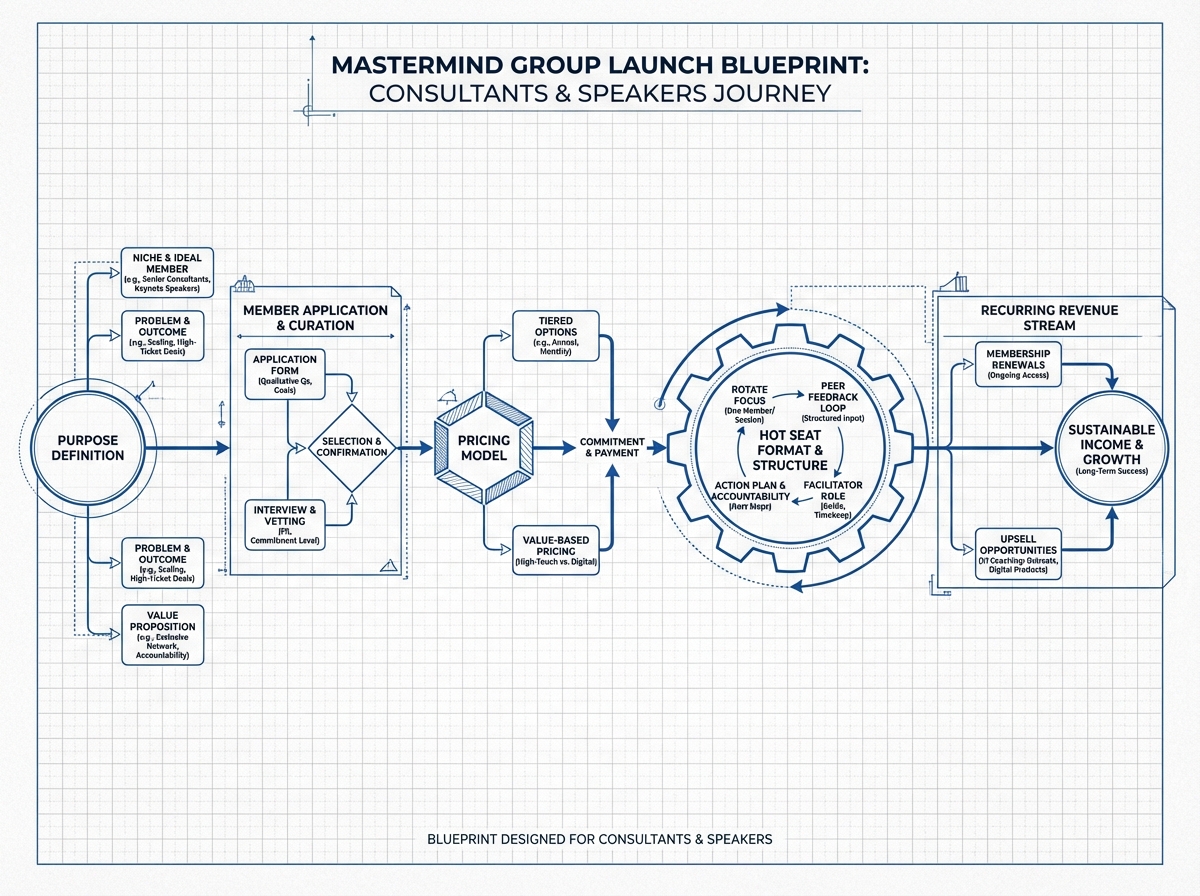
If you’re looking to learn how to start a mastermind group, the honest answer is that the mechanics are not the hard part — the architecture is. Who gets in, what they’re committing to, what the group is actually for, and how you charge for it without it feeling transactional. Get those four things wrong and you’ll run two sessions, lose momentum, and quietly dissolve something that could have been your highest-leverage business asset.
A well-run mastermind group is a recurring revenue stream, a leadership platform, and a referral engine built into one structure. The people who make them work aren’t the ones with the biggest audiences — they’re the ones who understood the model before they recruited the first member.
- A mastermind group only works if the purpose is specific enough to attract aligned members and structured enough to hold them.
- Pricing too low signals low commitment; pricing too high without a clear value proposition kills enrollment.
- The hot seat format — where one member gets focused group attention per session — is what separates a mastermind from a glorified group call.
What a Mastermind Group Actually Is
A mastermind group is a structured peer advisory circle where members meet regularly to challenge each other, share expertise, and hold each other accountable toward specific goals. It is not a workshop, a coaching group, or a community forum — though it borrows elements from all three.
The original concept came from Napoleon Hill’s Think and Grow Rich, where he described the mastermind principle as the coordination of knowledge and effort between two or more people for a definite purpose. What that looks like in practice today has evolved significantly, particularly with virtual formats making global curation possible.
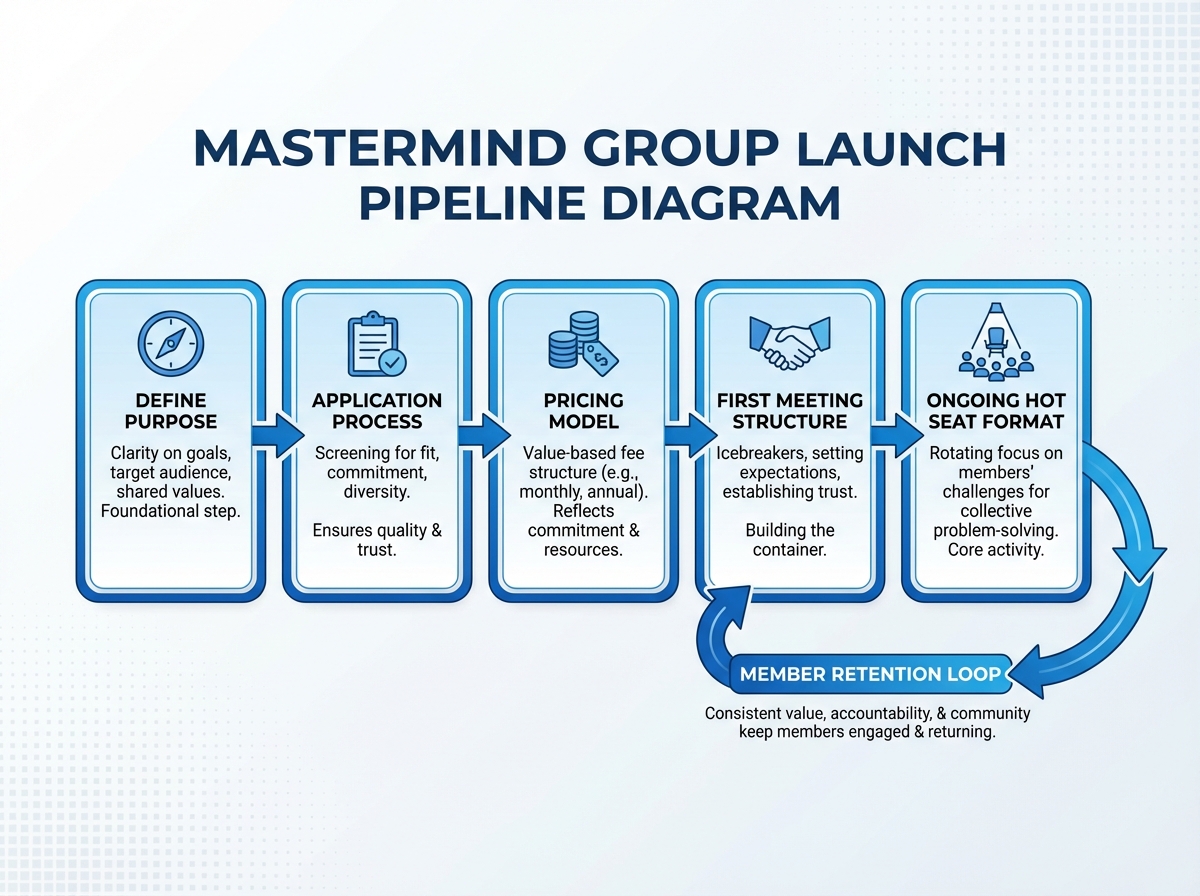
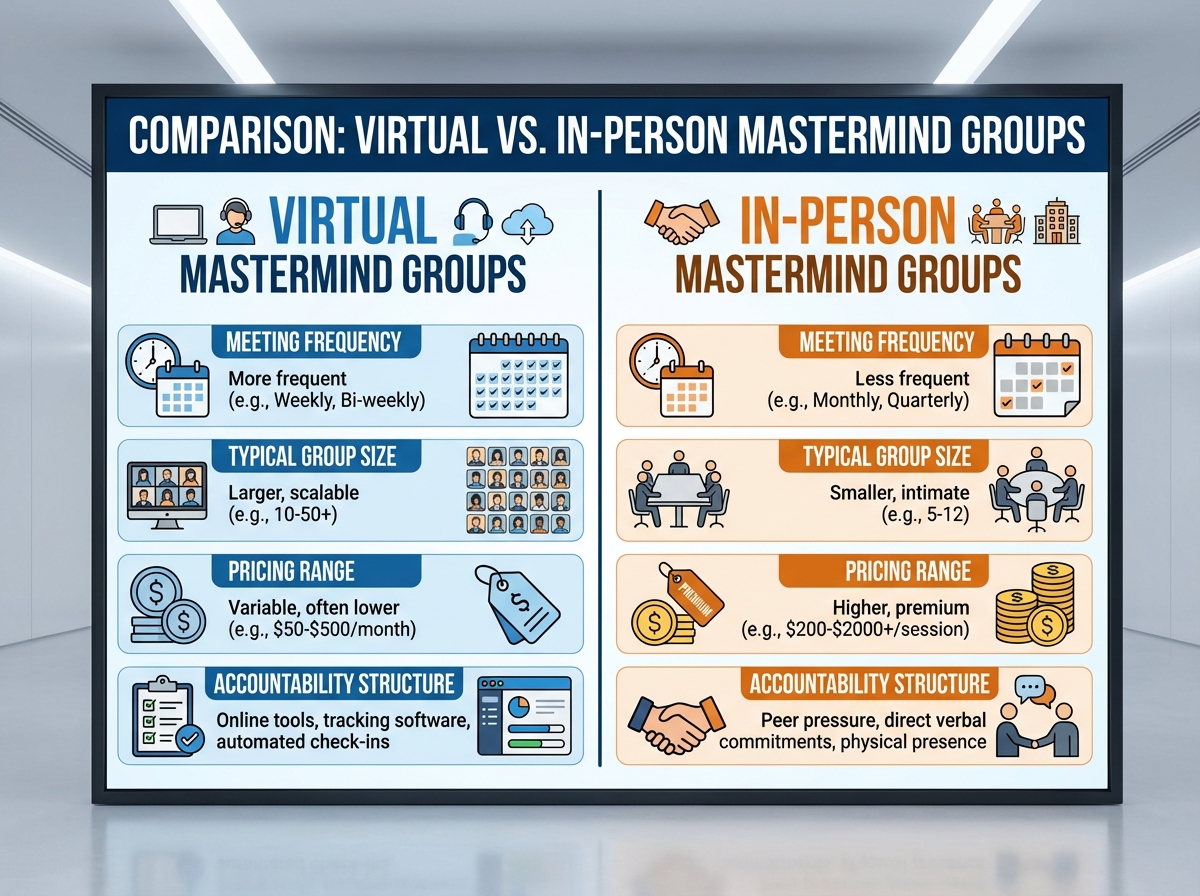
| Format | Structure | Best For |
|---|---|---|
| Virtual weekly | 60–90 min Zoom calls, rotating hot seats | Consultants with distributed networks |
| Virtual monthly | Deeper dives, async accountability between calls | High-level executives, senior influencers |
| In-person intensive | Quarterly retreats, high-touch bonding | Premium-priced, relationship-first groups |
| Hybrid | Monthly calls + one annual live event | Scaling thought leaders building community |
Three Things Nobody Tells You Before You Start
- The wrong member at the right price costs more than an empty seat.
- Your mastermind’s reputation is set in the first meeting, not the application process.
- Members don’t leave because the content is weak — they leave because the energy is uneven.
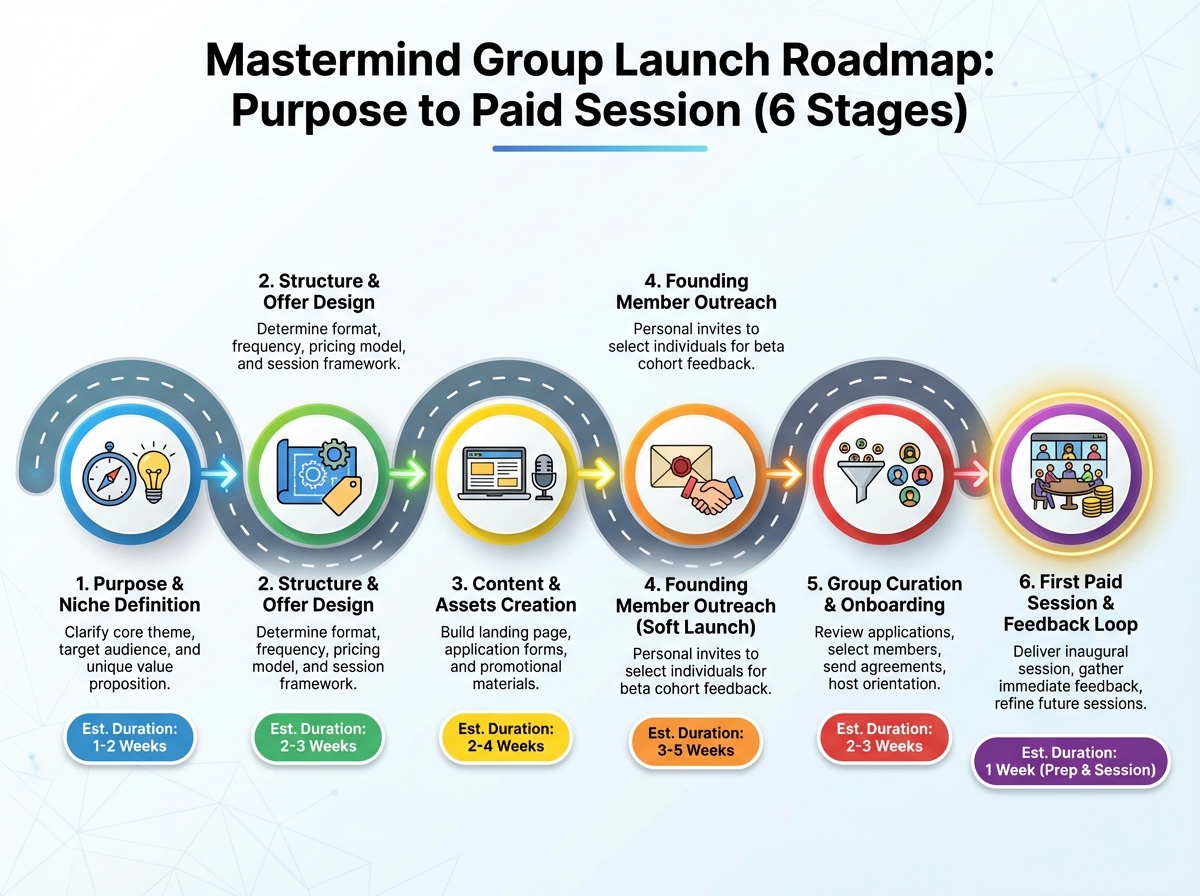
How Long It Actually Takes to Launch
| Stage | What You’re Doing | Time |
|---|---|---|
| Clarity | Define purpose, format, and ideal member profile | 1–2 days |
| Positioning | Set pricing model, write application criteria | 2–3 days |
| Outreach | Find and vet founding members | 2–4 weeks |
| Preparation | Build first meeting structure, set rules and roles | 3–5 days |
| Launch | Run first session, gather feedback, iterate | Week 5–6 |
| Total | From blank page to first paying session | 6–8 weeks |
The order matters more than the speed — skipping the clarity stage and jumping straight to outreach is the single fastest way to attract the wrong people. If six weeks feels slow for you, it’s not. Many successful mastermind facilitators spent three months on founding member curation alone and called it time well spent.
Why You Need a Purpose Before You Need Members
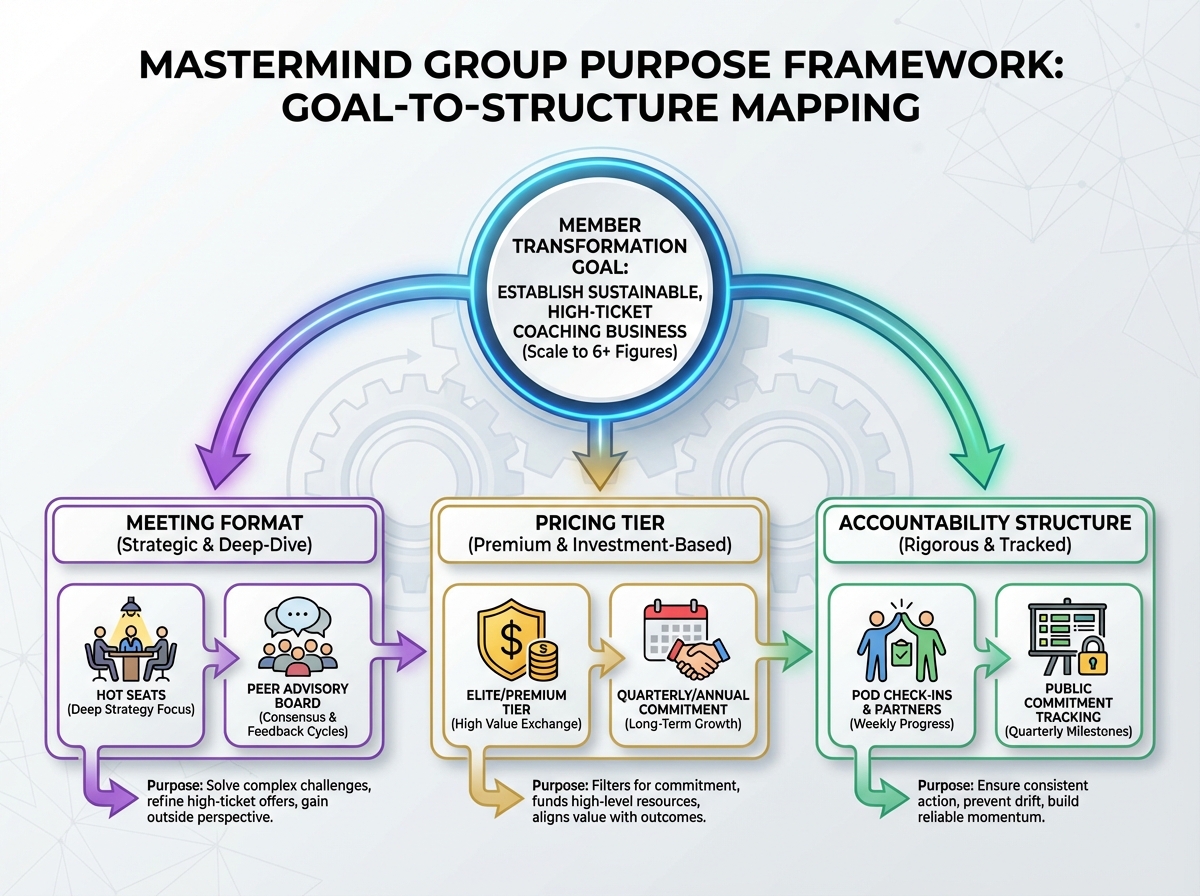
The first instinct most people have is to think about who should be in the group. That’s backwards. The purpose of your mastermind determines everything downstream — who qualifies, what they pay, how meetings run, and whether people stay.
Spend real time here. Not a tagline — an actual answer to the question: what does a member’s business or career look like six months after joining this group? If you can’t answer that clearly, your recruitment message will be vague, your application process will be inconsistent, and you’ll end up with a group of smart people who don’t actually belong together.
The tightest masterminds tend to be organized around a specific stage of growth (scaling past $500K in services revenue, for example) or a specific transformation (moving from practitioner to thought leader). Generic positioning — “a group for entrepreneurs who want to grow” — fills seats but kills retention.
Once the purpose is locked, the format choice becomes obvious. A group built around accountability needs weekly or biweekly touchpoints. A group built around peer advisory works better monthly with deeper pre-work. Choosing the format before the purpose is putting the calendar before the container.
The Application Process Is Your First Filter — Use It
The single biggest mistake people make when learning how to start a mastermind group is skipping the application process because it feels too formal for a small group. It isn’t. The application isn’t bureaucracy — it’s the mechanism by which you protect every member who joins after it.
An application screens for three things: commitment level, peer quality, and alignment with the group’s purpose. Someone who won’t fill out a one-page application won’t do the pre-work before meetings, won’t show up when the hot seat gets uncomfortable, and won’t renew when the first cycle ends. The friction is the point.
Your application should ask about current revenue or role (depending on your context), what they’re specifically trying to solve in the next six months, and what they believe they can bring to the group. That last question tells you more than anything else. Members who join only to receive will drain the group. The best founding members join because they have something to give and they want an environment that demands reciprocity.
Conduct a short call with every applicant before accepting them. Not to sell them — to evaluate fit. Is this someone the rest of the group would genuinely want a hot seat from? That’s the question.
Pricing Your Mastermind Without Undervaluing It
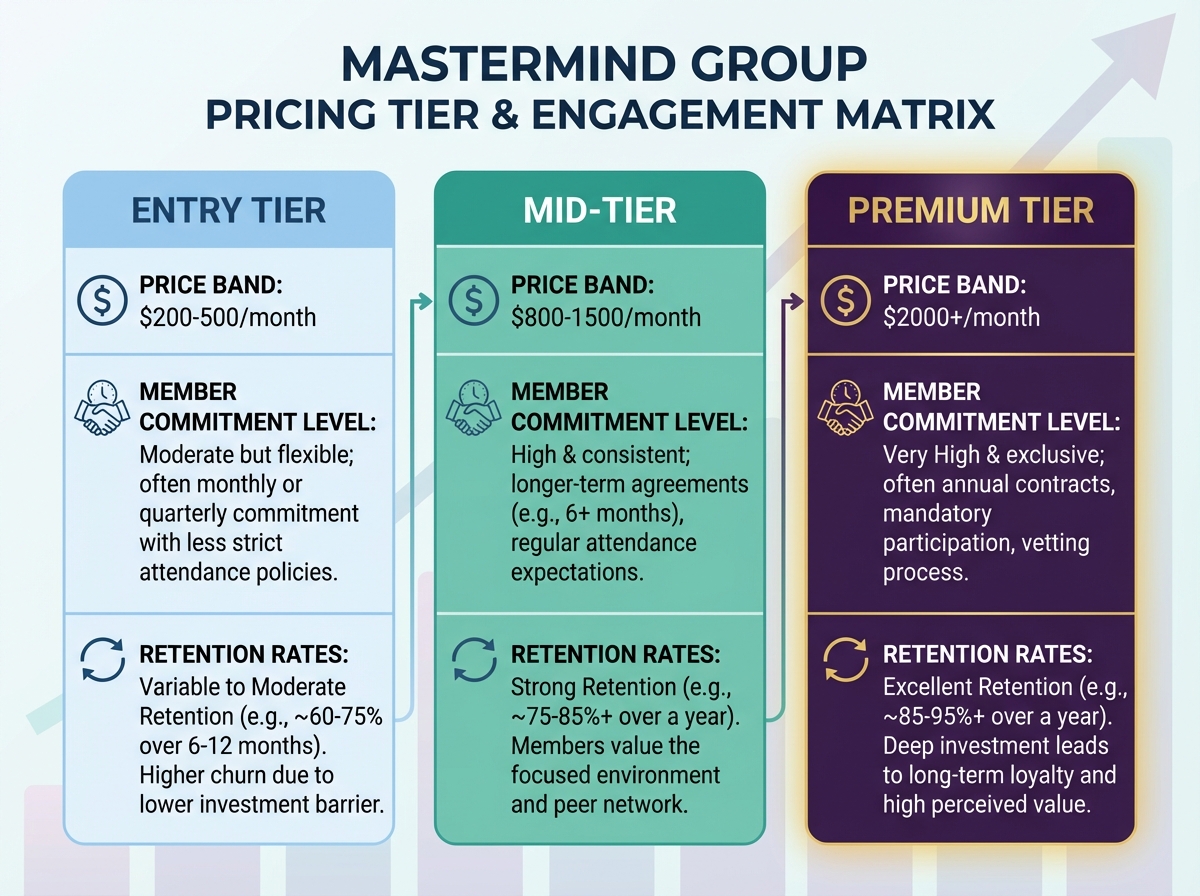
Pricing a mastermind group for consultants and speakers is one of the places where people consistently leave money behind — not because they price too high, but because they price based on what they’d personally pay rather than what the outcome is worth to their specific member profile.
A mastermind priced at $200/month sends a signal. It says: this is casual, optional, a nice-to-have. A mastermind priced at $1,500–$3,000/month says: you will show up, you will prepare, and you will treat this like the investment it is. The commitment level of your members is downstream of your price point, not the other way around.
The most sustainable pricing model at launch is a founding-member rate that is below your intended ongoing price — but only if you communicate that clearly. “You’re locking in at $1,200/month for 12 months because you’re a founding member; this group will be $2,000/month for future cohorts” is honest, creates urgency, and rewards early commitment. What doesn’t work is launching at full price before the group has proven its value, or launching at a low price with no path to increase it without disrupting the relationships you’ve built.
For a deeper look at how to package your expertise for premium pricing as a consultant or solopreneur, the pricing decision exists within a broader positioning stack — mastermind groups are most powerful when they sit at the top of a tiered offer ecosystem, not as a standalone product.
Rules, Roles, and the One Conversation Everyone Avoids
Rules feel uncomfortable to set before the group has chemistry. Everyone wants to wait until there’s a problem, and by then the precedent has already been set. The first meeting is the only time you have full group attention and zero history — use it.
The rules that matter most are around confidentiality, participation, and consequences for chronic absence. Confidentiality means what’s said in the group stays there — not just sensitive business information but also vulnerability, failure, and uncertainty. Without that agreement stated explicitly, members will self-censor and your hot seats will stay shallow.
The facilitator’s role is not to teach. That’s the trap most consultants fall into — they run a mastermind like a workshop because that’s what they know. Your job in the room is to protect the process: keep hot seats on time, redirect advice-giving that isn’t useful, surface connections between members that they don’t see themselves, and make sure the quietest person in the group gets heard. The moment you become the smartest voice in the room, you’ve turned a mastermind into a coaching session.
Set a penalty for repeated no-shows — even something symbolic like a charitable donation — because the consequence isn’t really about the money. It’s about signaling that every seat in the room was chosen carefully, and an empty chair has a cost for everyone.
Finding the Right Members (Not Just Available Ones)
Finding members for a mastermind group is where most people default to their existing network and call it done. That works for a first cohort, but it creates a ceiling. Your network is people who already know you — which means they already see you through a fixed lens. Recruiting beyond your existing audience is how you build a group that challenges you as much as it challenges them.
The most effective sourcing channels for mastermind members are: speaking engagements (people who heard you live are pre-qualified for your perspective), existing clients and alumni (they know the quality of your thinking and have social proof to share), and other people’s communities where your ideal member hangs out. The last one is underused. A well-placed recommendation from someone trusted inside a relevant community is worth ten LinkedIn connection requests.
For speakers and online entrepreneurs building scalable models, the mastermind is often the most natural next step after an audience exists — because the audience already contains your best potential members. The application process converts passive followers into paying peers.
Aim for six to eight members for a first cohort. Fewer than five and the group loses energy when someone is absent. More than ten and hot seats become rushed, accountability dilutes, and the intimacy that makes the format work starts to break down.
The Hot Seat Is Where the Real Work Happens
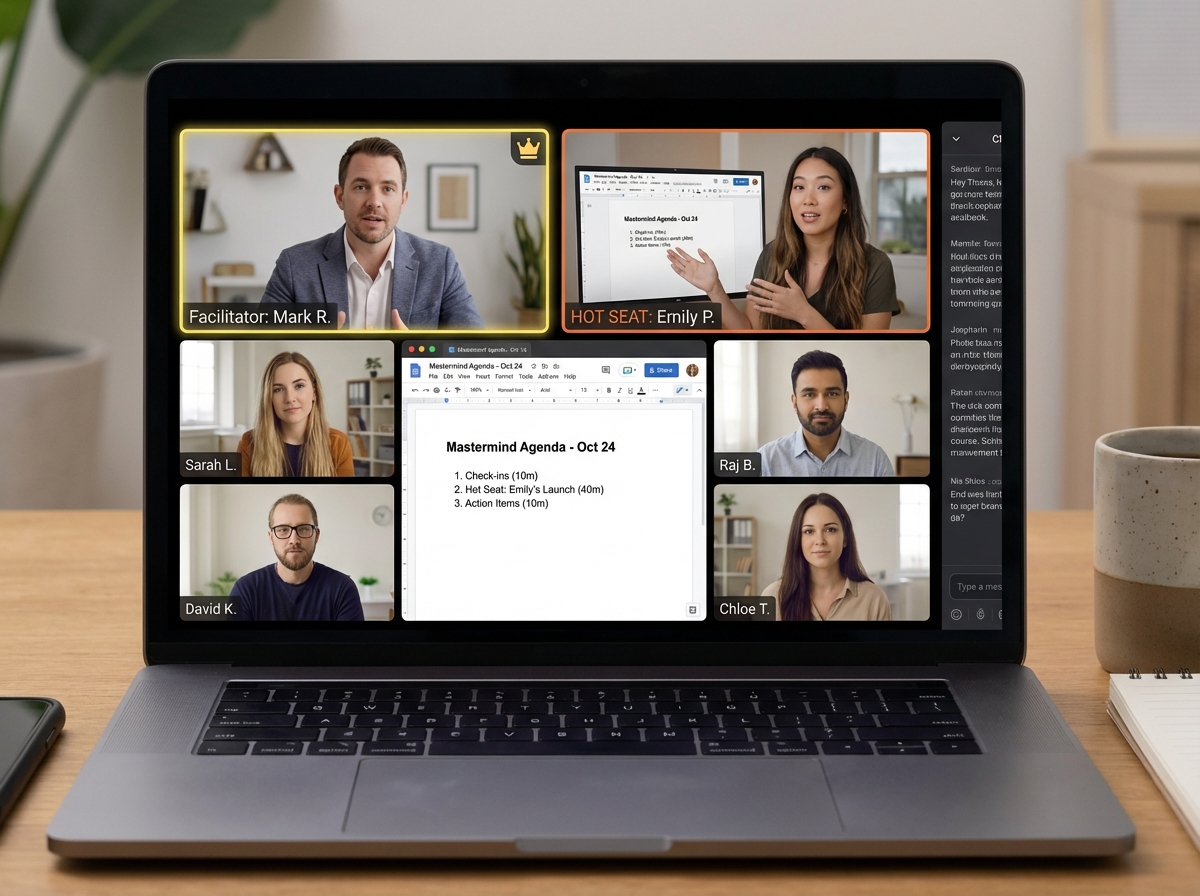
If you’ve been in a well-run mastermind, you know the hot seat is the most valuable twenty minutes in the room. If you haven’t, it looks like this: one member brings a specific, pre-prepared challenge — a pricing decision, a partnership opportunity, a strategic pivot. The rest of the group listens without interrupting, then spends a focused block of time giving their honest, unfiltered perspective.
The hot seat only works if the person on it comes prepared. A vague challenge (“I’m trying to grow my business”) produces vague feedback. A specific challenge (“I have two offers — a $12K consulting retainer or a $3K/month group program — and I need to decide which to pursue first given my current client load”) produces specific, actionable, peer-quality thinking that the person couldn’t buy anywhere else.
As the facilitator, your job during the hot seat is to push for specificity before the group responds. Ask the member: “What would a successful outcome look like for you in this conversation?” That one question transforms the feedback session from a general brainstorm into a focused problem-solving exercise where every contribution lands.
Rotate the hot seat every session so every member gets the experience at a similar pace. Nothing erodes group trust faster than two or three members dominating the focus while others feel like supporting cast.
Your First Meeting Sets the Tone for Everything After
The first meeting is the hardest one to run and the most important one to prepare for. Not because the content is complex — because the dynamic is being written in real time and everyone is watching how you handle it.
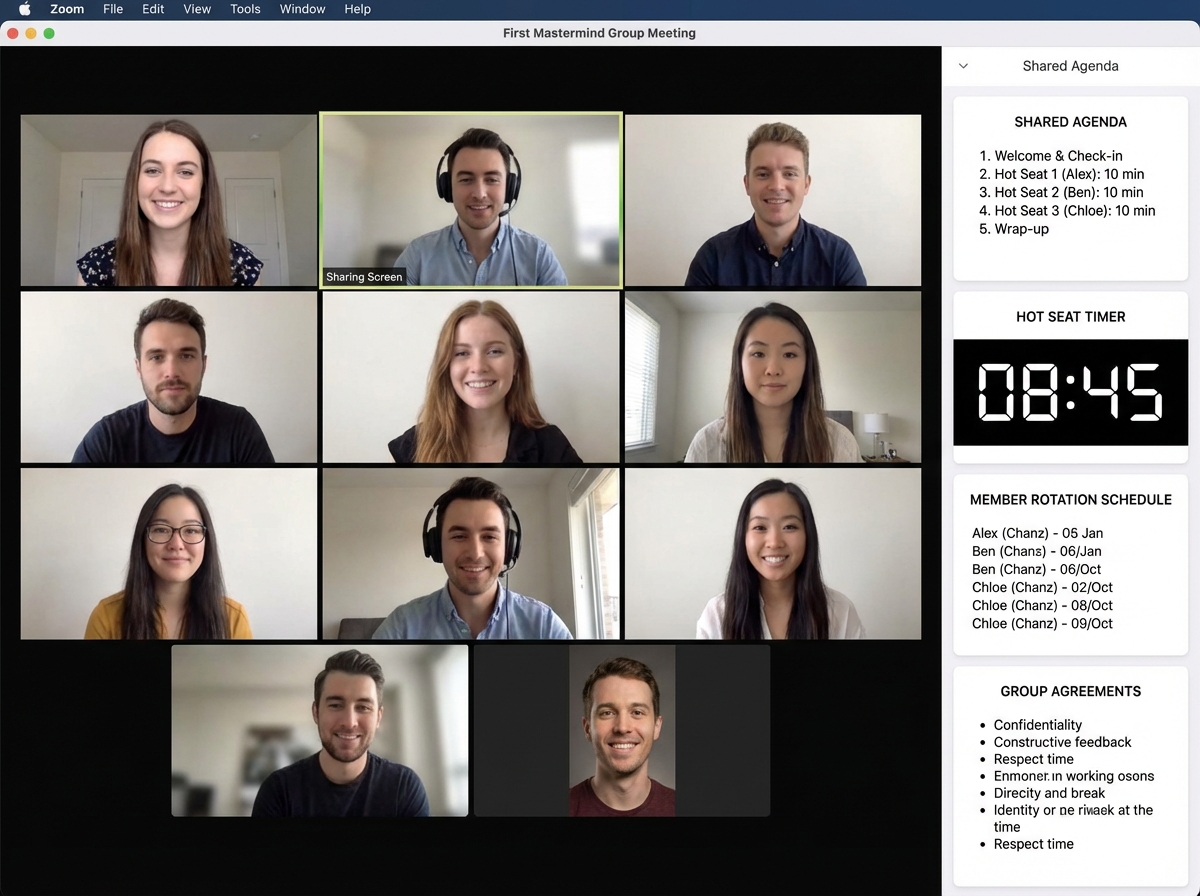
Prepare a clear agenda and send it forty-eight hours in advance. The act of sending pre-work signals to members that this group requires preparation, and the ones who don’t do it will self-identify immediately. Start the session by establishing the group agreements out loud — not reading from a document but stating them conversationally, with brief context for why each one exists.
Keep the first meeting shorter than you think it should be. Sixty to seventy-five minutes, not ninety. Leave people wanting more. The worst outcome of a first session is running long, losing energy at the end, and sending people away with a lingering feeling of fatigue instead of momentum. One abbreviated hot seat in the first meeting is enough — the goal isn’t to solve problems yet, it’s to show people how the container works so they trust it enough to bring their real challenges next time.
Use technology that removes friction. Zoom with a consistent meeting link everyone has saved. A shared document for the agenda that members can contribute to in advance. A dedicated group channel — Slack or a simple WhatsApp group — for accountability and wins between sessions. The technology should be invisible. If members spend any attention managing it, you’ve already lost some of the room.
Looking back at what it actually took to run a mastermind group that people paid for, stayed in, and referred others to — the mechanics were never the issue. The model is not complicated. What takes real work is the willingness to be specific: specific about who belongs, specific about what you’re building together, specific about what you expect from every person in the room including yourself.
Here’s what you can do immediately:
- Write your one-sentence purpose statement before you recruit anyone. “A mastermind for X-type professional to achieve Y outcome in Z timeframe” — if you can’t fill in those variables, you’re not ready to fill seats.
- Build a two-page application that includes a short-answer question about what the applicant brings to the group. Answers reveal givers versus takers faster than any interview.
- Set your pricing based on outcome value, not comparable group pricing. What is one solved problem worth to your ideal member? Start there.
- Prepare your first meeting agenda with a timed hot seat and send it 48 hours in advance. The pre-send is the first test of member commitment.
- Assign roles in the first session — timekeeper, note-taker, even if you rotate them. Shared ownership reduces facilitator burden and increases member buy-in.
- Define your no-show policy before it’s needed. State it in the first session as a group agreement, not as a rule you enforce reactively.
- Keep your founding cohort to six to eight members. The intimacy of a small group is the product — protect it before you think about scaling.
- Schedule a 30-minute debrief with yourself after every session. Write down what worked, what fell flat, and one specific thing you want to change for the next meeting. The facilitator who iterates fastest builds the best group.
Leave a Reply