


There’s a version of you that has a business idea and has already talked yourself out of it three times. You’ve read the blog posts, maybe even watched a few videos, but the frameworks feel abstract — things smart people invented to describe what they already did, not tools you can actually pick up and use.
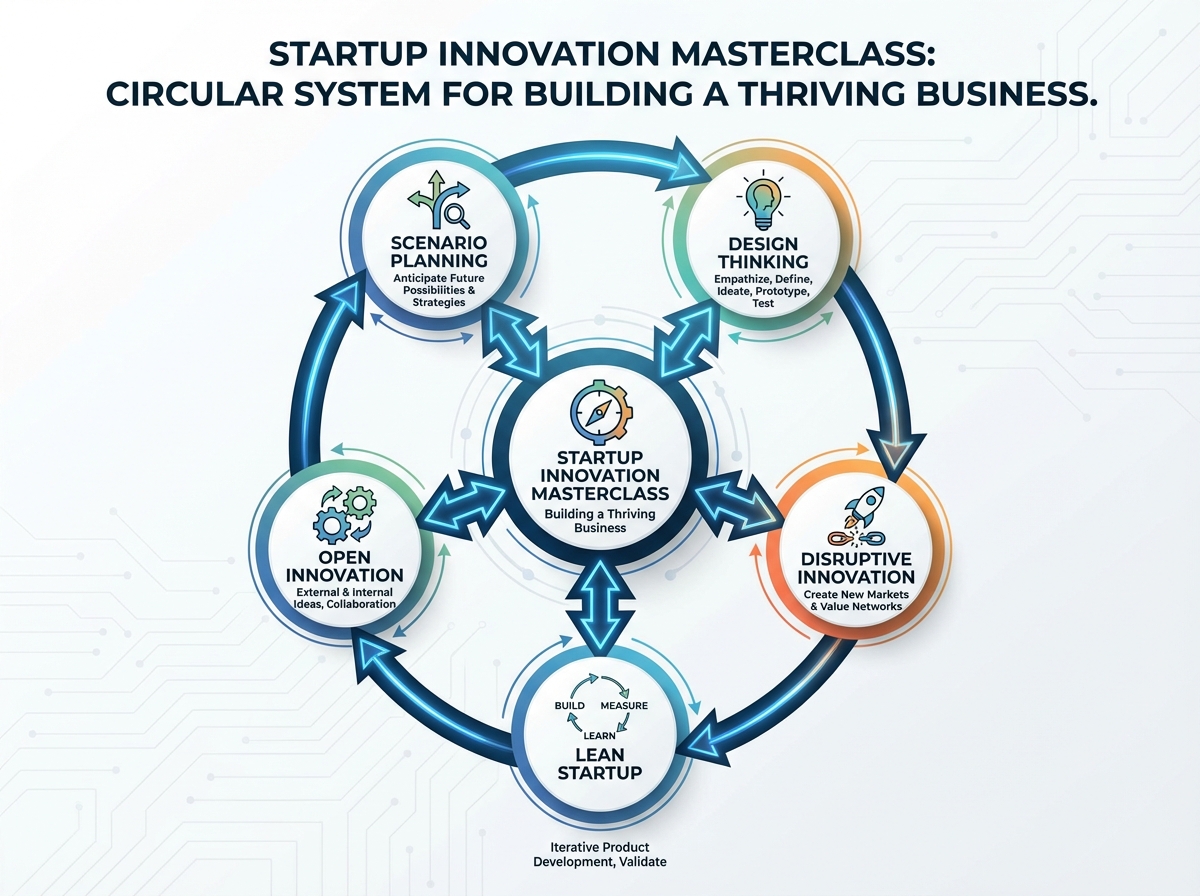
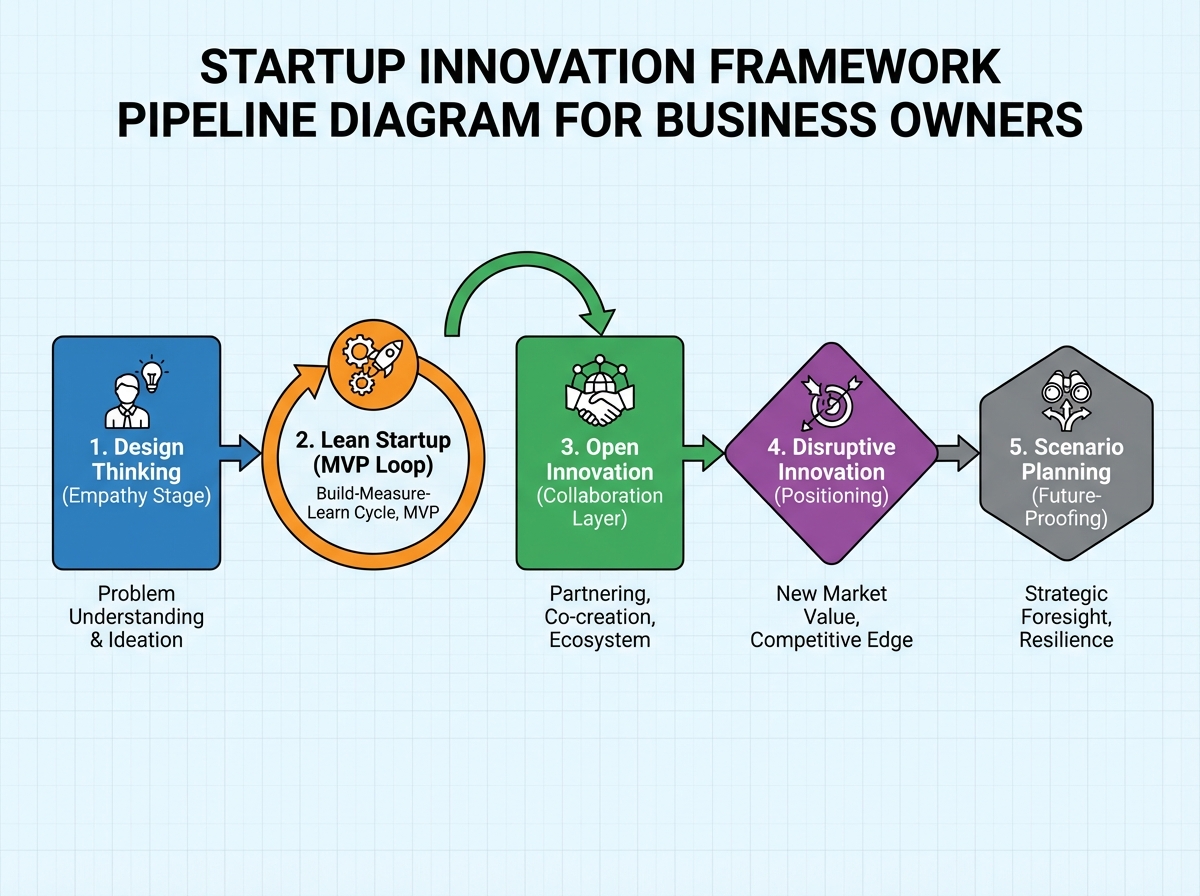
If you’re looking to learn startup innovation, the honest answer is that the methodology isn’t the hard part — the sequence is. Design Thinking, Lean Startup, Open Innovation, and Scenario Planning are each powerful in isolation, but most people who fail at building something new do so because they used the right framework at the wrong stage. The art of startup innovation is knowing which lens to pick up, and when to put it down.
- The frameworks matter less than the order you apply them — using Lean Startup before you’ve done real empathy work is how you build the wrong thing very efficiently.
- Disruptive innovation isn’t about attacking the market leader directly — it’s about finding the customer they’ve stopped serving.
- Scenario Planning done early doesn’t slow you down; it removes the 3 a.m. anxiety of “what if everything changes tomorrow.”
What “Innovation” Actually Means for a Business Owner
Most people hear “innovation” and picture Silicon Valley pitch decks or billion-dollar pivots. That’s not what it means at the level where most businesses actually operate. Innovation, in its most practical form, is the deliberate process of identifying an unmet need and building a solution that fits reality — not just your imagination of it.
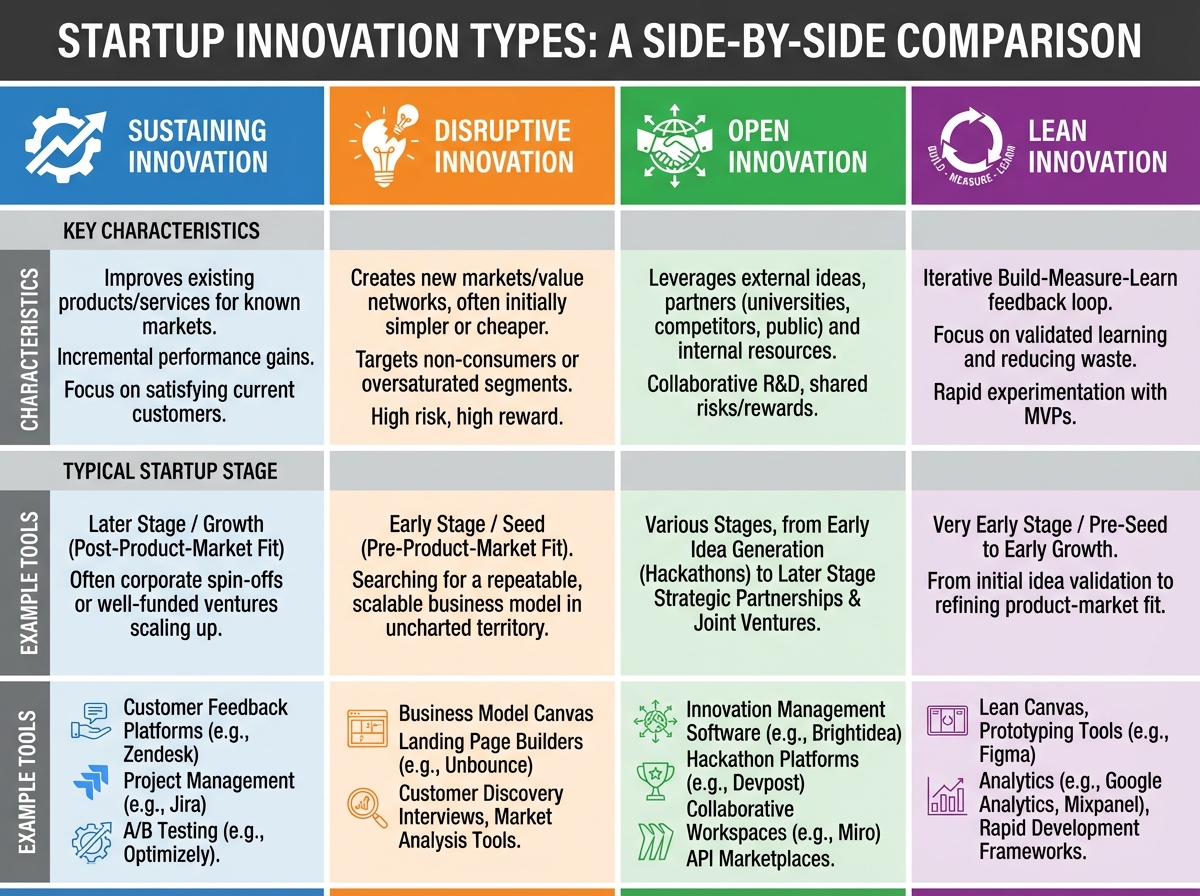
There are a few distinct types worth separating early, because they require completely different moves:
| Type | What It Means | When to Use It |
|---|---|---|
| Sustaining Innovation | Improving what already exists | When you have a working product and want to grow |
| Disruptive Innovation | Targeting overlooked customers with simpler, cheaper alternatives | When entering a market dominated by incumbents |
| Open Innovation | Collaborating with external talent, partners, or users to build faster | When internal resources are the bottleneck |
| Lean Innovation | Building minimum versions and testing before scaling | When assumptions are unvalidated and risk is high |
For business owners and entrepreneurs who are earlier in their journey, the distinction between these types is the first real unlock. Trying to sustain something that doesn’t yet exist, or disrupting before you’ve confirmed anyone wants what you’re building — that’s where most energy goes to waste.
Three Things That Surprised Me About Innovation Frameworks
- Design Thinking is not a creativity exercise — it’s a structured method for finding the real problem before you solve any problem.
- The MVP isn’t your product’s first version; it’s a question you’re asking the market with the smallest possible investment.
- Open Innovation works in both directions — the most underused direction is inward, licensing your own assets to others.
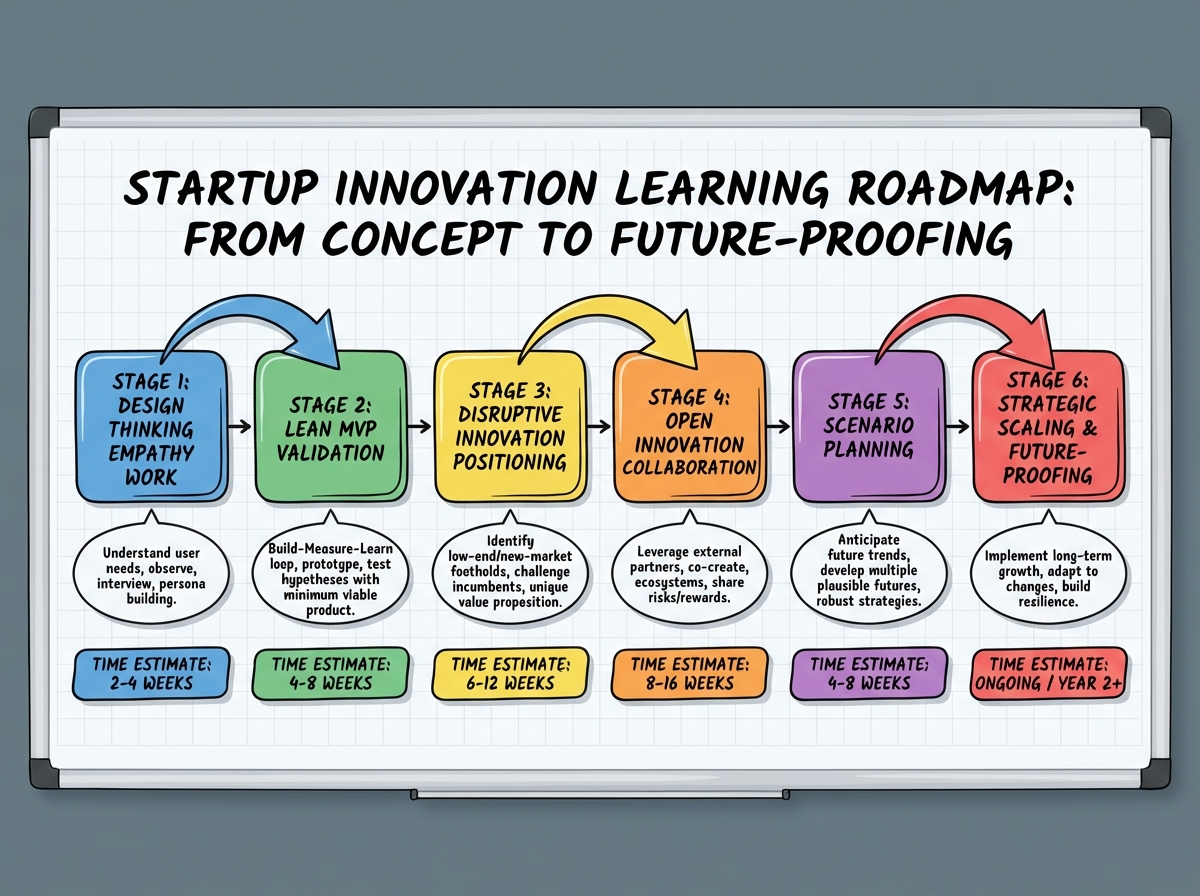
How Long Does It Take to Actually Use These Frameworks?
| Stage | Content | Time |
|---|---|---|
| Empathy & Problem Definition | Design Thinking: user interviews, observation, insight synthesis | 1–2 weeks |
| Ideation & Prototyping | Generating solutions, building low-fidelity tests, user feedback rounds | 1–2 weeks |
| MVP Build & Validation | Lean Startup: define riskiest assumption, build minimum test, measure | 2–4 weeks |
| Market Positioning | Disruptive Innovation: map competitive landscape, identify non-consumers | 1 week |
| External Collaboration | Open Innovation: identify external partners, structure knowledge flow | 1–2 weeks |
| Future-Proofing | Scenario Planning: map 2–3 futures, build contingency logic | 3–5 days |
| Total | Full first innovation cycle | 6–12 weeks |
The order here matters far more than the speed — someone who takes 16 weeks and keeps the sequence intact will outperform someone who rushes through in 4 and skips the empathy stage. If you’re slower than this estimate, that’s not falling behind — that’s doing the real work.
The Mistake Almost Everyone Makes at the Beginning
The single biggest mistake people make when learning startup innovation is skipping the empathy stage because they believe they already understand the customer. You’ve been the customer. You’ve felt the frustration. Surely you know what needs fixing. But that assumption — that your experience generalizes — is the most expensive shortcut in entrepreneurship.
Design Thinking exists precisely because the gap between what users say they want and what they actually need is almost always wider than you expect. The empathy stage isn’t about collecting opinions. It’s about sitting in someone else’s workflow long enough to see what they don’t mention — the workarounds, the quiet frustrations, the tasks they’ve stopped trying to solve. Those invisible problems are where real product opportunities live.
The realization that hit hardest: problem definition is not the same as problem identification. You can identify a problem in five minutes. Defining it — understanding its root cause, its trigger conditions, the people it affects, and why existing solutions haven’t fixed it — takes days of deliberate observation. When you rush that stage, everything downstream is built on sand.
For business owners, this often means turning the lens inward first. Your customers aren’t experiencing your product the way you designed it to be experienced. Starting with empathy interviews — even just five conversations — before you change anything will surface more useful insight than a month of analytics.

Why Disruption Isn’t What You Think It Is
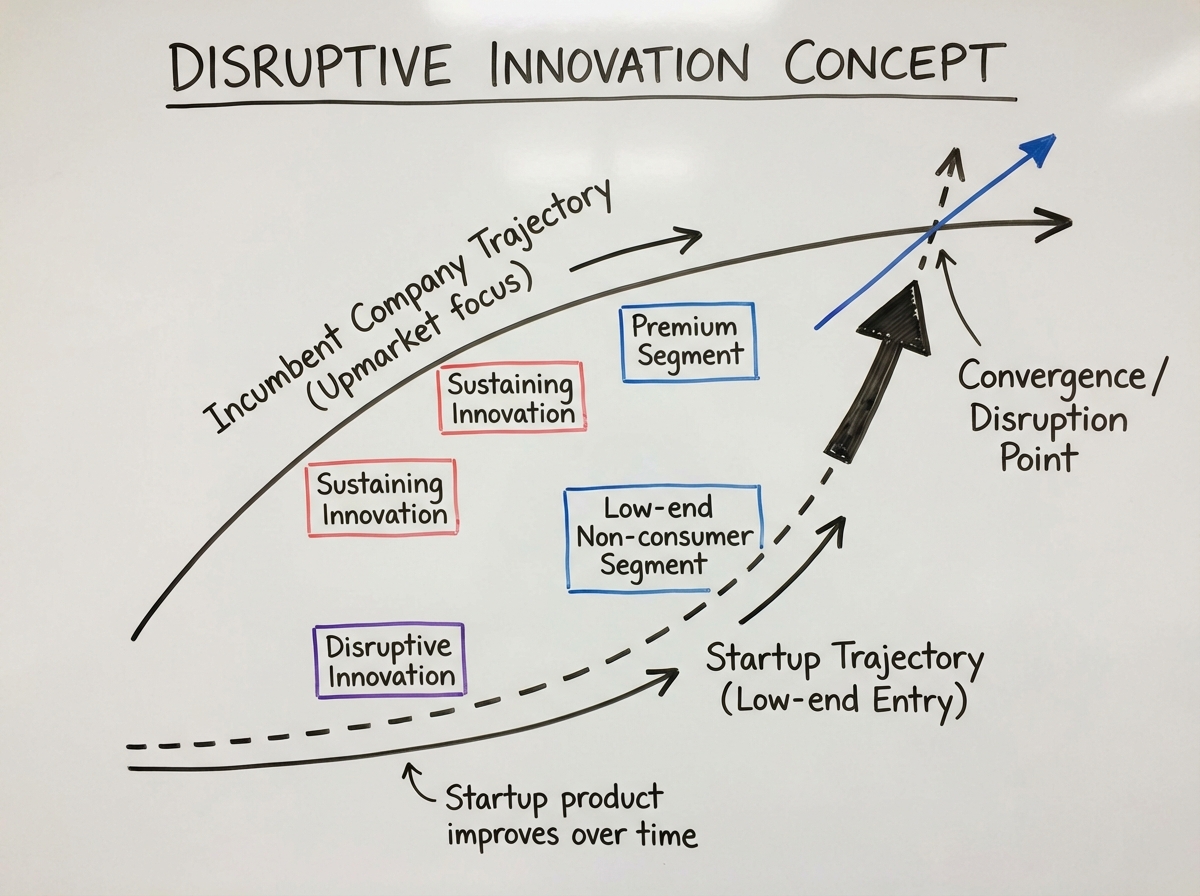
Disruptive innovation has been so over-used as a buzzword that most people assume it means “doing something dramatic.” Christensen’s original insight was far quieter and more precise: disruption happens when an incumbent company becomes so focused on serving its best customers that it stops being accessible or relevant to everyone else.
The opportunity isn’t to attack the market leader. The opportunity is to serve the customer the market leader no longer notices. That customer is usually underserved, price-sensitive, or locked out of the existing solution entirely. You build something simpler and cheaper for them first, and you improve it over time — by which point the incumbent has moved so far upmarket that catching up becomes their problem, not yours.
For business owners already operating in a market, this reframes the entire competitive question. Instead of asking “how do we beat X,” the more useful question becomes “who is X ignoring, and why?” That’s where white space lives. That’s where you can build something without needing to out-resource anyone.
This connects directly to why online entrepreneurship principles matter as a foundation — understanding market positioning and value creation before you get tactical about tools or channels.
The Lean Startup Loop and Why “Fail Fast” Is Only Half the Advice
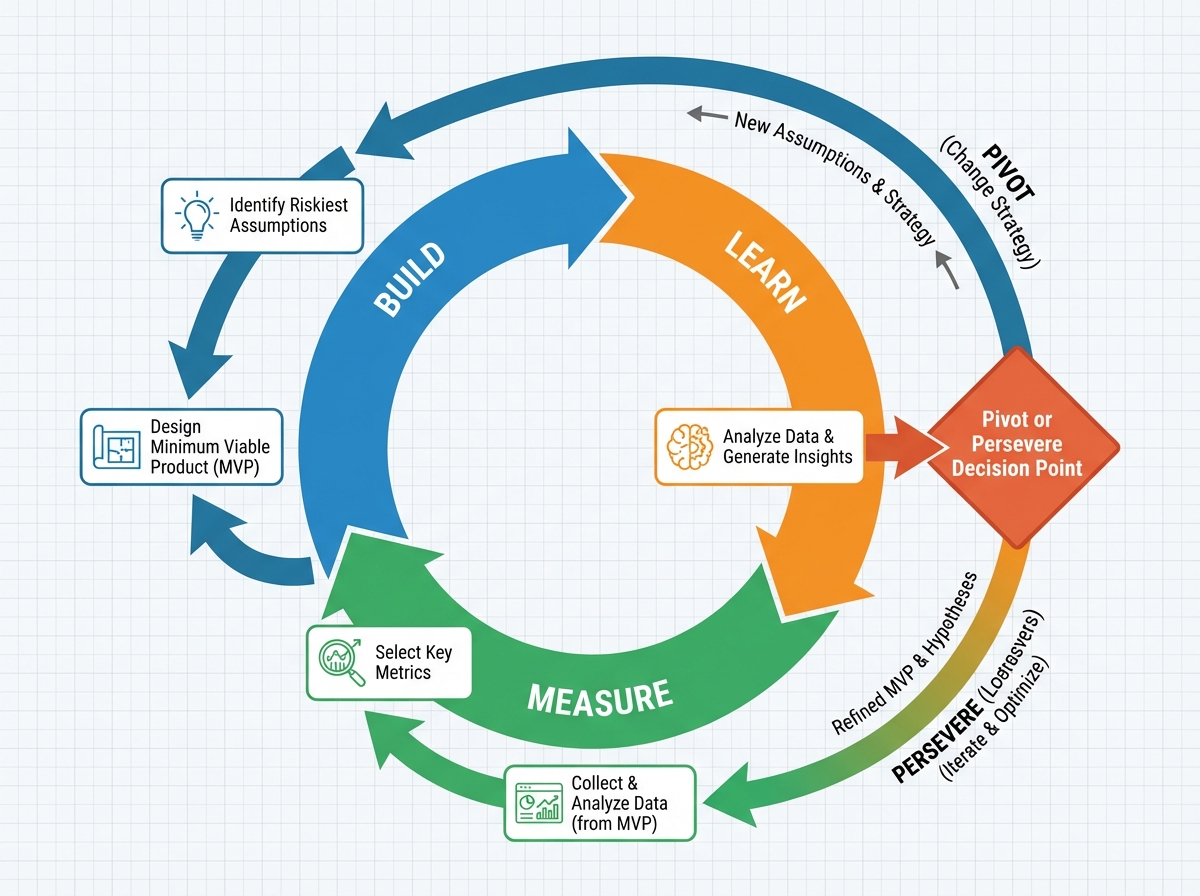
The Build-Measure-Learn loop sounds simple until you’re inside it, and then it reveals a hidden trap: most people build too much before they measure anything. The MVP — Minimum Viable Product — doesn’t mean “quick first version.” It means the smallest possible test of your riskiest assumption. That’s a different thing entirely.
Your riskiest assumption is almost never the technology. It’s usually the customer behavior. Will people actually change their routine? Will they pay for this, or just say they would? Will they come back after the first use? These are the questions the MVP needs to answer, and the fewer features it contains, the faster you get a real answer. A landing page that doesn’t exist yet is a better MVP than a product built on assumptions about demand that haven’t been tested.
The moment things shift is when you realize that “learn” is the operative word in Build-Measure-Learn, not “build.” Every iteration isn’t just another version — it’s a hypothesis confirmed or killed. That mental shift changes how you allocate time. You stop building features and start designing experiments.
Open Innovation: The Asset You’re Probably Not Using
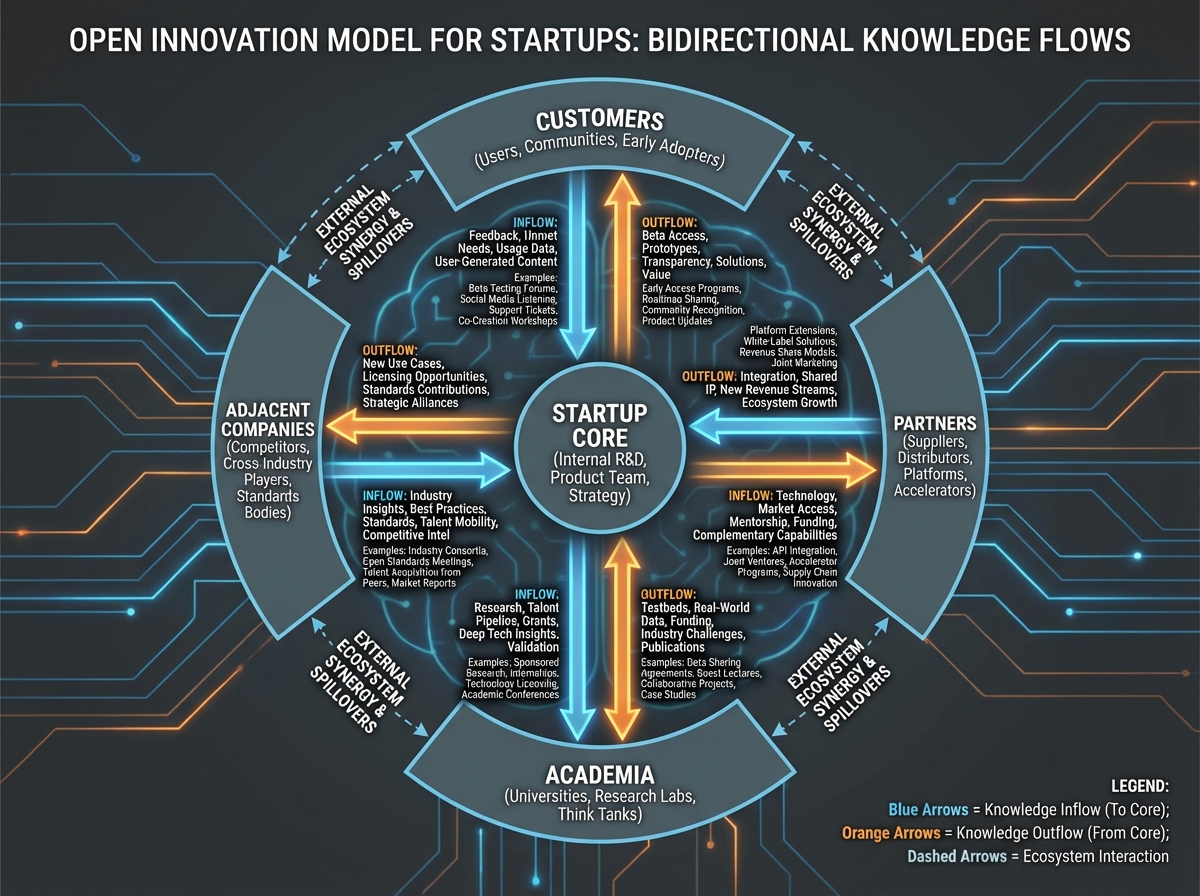
Most solo founders and small business owners think Open Innovation is for large corporations running R&D labs. The framing that makes it immediately useful for everyone else is simpler: you have knowledge others need, and others have knowledge you need, and there’s no reason the transaction has to happen internally.
In practice, this looks like building with external contributors before you’ve hired a team, running a challenge or co-creation process with your existing customers, licensing a tool or methodology you’ve developed rather than building a product around it, or partnering with a company in an adjacent space to share distribution. The common denominator is that the boundary between “inside the company” and “outside the company” becomes deliberately porous.
The practical friction here is control. There’s a real discomfort in letting external people shape something you built. But the tradeoff is speed and signal quality. Customers who co-create with you don’t just give you feedback — they become invested in the outcome, which changes your acquisition economics entirely.
How Startup Innovation Frameworks Work Together Under Uncertainty
Scenario Planning is the framework that gets added last and dropped first, usually because it feels like planning for problems that don’t exist yet. But if you’ve done the other work — empathy research, MVP testing, market positioning, open collaboration — you’ve built something real enough to lose. That’s when future uncertainty stops being abstract and starts being personal.
Scenario Planning doesn’t ask “what will happen.” It asks “what would we do if these three very different futures each turned out to be real?” You build 2–3 plausible futures based on the most uncertain and impactful variables in your environment — regulatory shifts, technology changes, demand collapses — and you stress-test your current strategy against each one. The goal isn’t prediction. It’s flexibility.
What becomes clear when you do this rigorously: most business plans have one implicit scenario baked in — the optimistic one. Scenario Planning forces you to design a strategy that survives the realistic one and remains functional in the pessimistic one. That’s what investor-ready actually means. Not a beautiful deck. A logic that holds under pressure.
This kind of forward-looking strategic thinking connects directly to how to start a nonprofit thinking — even mission-driven ventures benefit from scenario-proofing their assumptions about funding, regulation, and external conditions before they’re locked into commitments.
What Stayed With Me After Doing All of This
Looking back at the full arc — from Design Thinking through Scenario Planning — the thing that surprised me most wasn’t any individual framework. It was how much each one was designed to solve the mistake the previous one creates. Empathy work surfaces real problems, but without Lean methods you’ll over-build solutions to those problems. Lean methods keep you small, but without disruption thinking you’ll optimize in the wrong market segment. Disruptive positioning is powerful but inward-looking — Open Innovation breaks that insularity. And all of it is brittle without some version of future-awareness baked in.
They’re not five separate tools. They’re one continuous discipline for building things that last in markets that change.
Map your riskiest assumption before you write a single line of code or plan a single feature — write it as a testable hypothesis, not a belief, and design the cheapest possible experiment that would prove it wrong.
Run five empathy interviews before changing or building anything — ask people to walk you through what they actually do, not what they think they should do, and listen for the workarounds they’ve normalized.
Draw your competitive landscape twice: once with current customers, once with people who don’t use any solution — the second map is where disruptive opportunity usually lives, and most people never draw it.
Set a strict definition of your MVP that names what question it’s answering — if you can’t state the hypothesis it’s testing, you’re building a product, not an experiment.
Identify one external partner, community, or customer segment that could co-create with you — even a small, structured open innovation pilot changes how fast you learn and how invested early users become.
Write out three futures for your market over the next three years — one optimistic, one flat, one disruptive — and check whether your current strategy still makes sense in all three.
Before you scale anything, confirm you have at least one leading metric that predicts retention, not just acquisition — scaling acquisition without a retention signal is the most expensive way to discover product-market fit doesn’t exist.
Use your scenario planning output as your strategic filter — any major investment of time or money should survive at least two of your three future scenarios before you commit to it.
Leave a Reply