


There’s a specific kind of frustration that comes from setting up a Shopify store, running some ads, and watching nothing happen. You did everything the blog posts said. You picked a niche. You found a supplier. You launched. And then — silence. That was the moment I stopped following generic ecommerce advice and started paying attention to how the funnel actually worked.
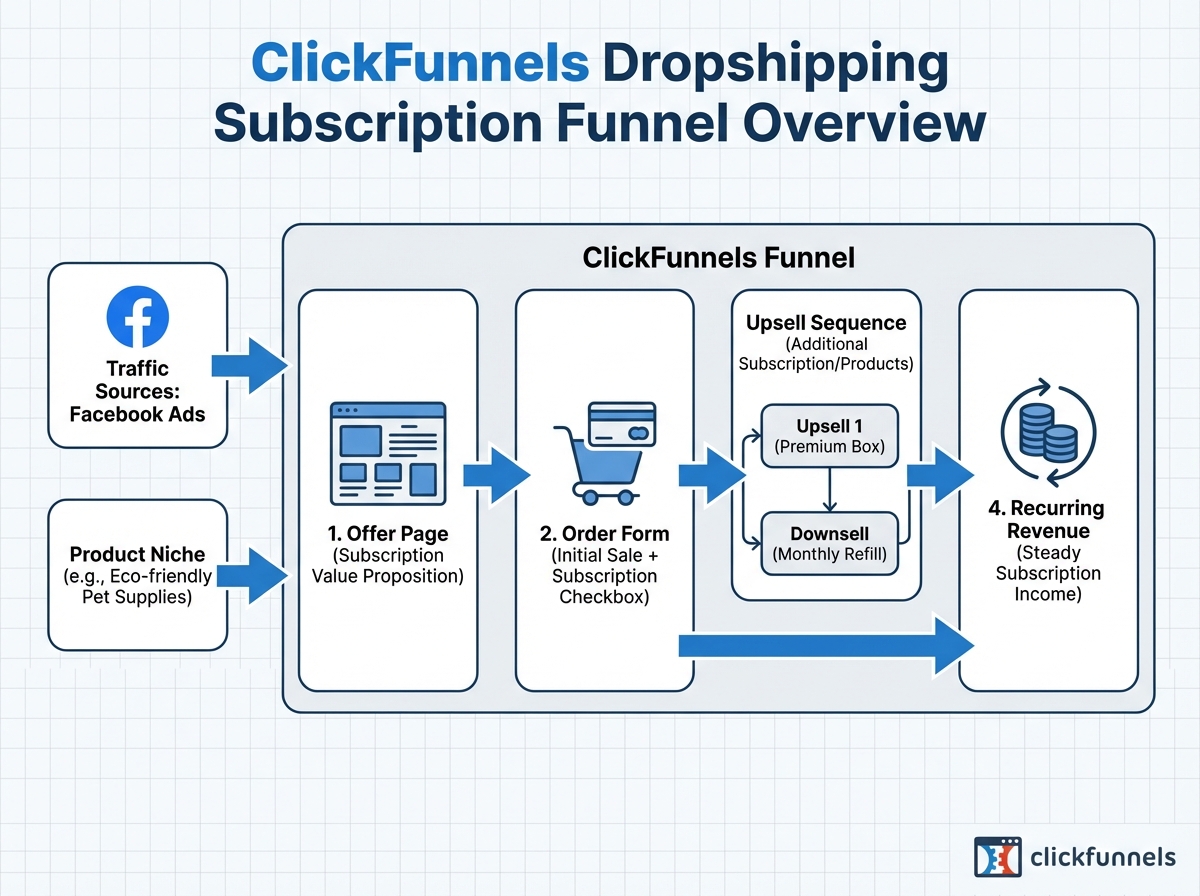
If you’re looking to learn ClickFunnels dropshipping, the core idea is simpler than most people make it sound: instead of sending cold traffic to a product page and hoping someone buys, you build a structured sales funnel that walks a stranger from curiosity to purchase — and then to a subscription. ClickFunnels dropshipping works because the funnel does the selling, not the store. When it’s built right, every click has somewhere meaningful to go.
- The funnel model converts better than a standard store because it removes distraction and controls the buying sequence
- Subscription-based offers create recurring revenue, which makes scaling with paid ads far more predictable
- Niche selection and offer design come before any funnel building — getting those wrong makes the rest irrelevant
What ClickFunnels Dropshipping Actually Means
Dropshipping through ClickFunnels is different from running a Shopify store in one fundamental way: you’re not building a browsable catalog. You’re building a conversion path — one product, one offer, one decision. A visitor lands on a page, sees a compelling offer, and either buys or doesn’t. There’s no navigation menu pulling them away, no related products distracting them, no checkout abandonment from a clunky cart.
The subscription element takes it further. Instead of a one-time purchase, you structure your offer so customers receive products on a recurring basis. That changes your unit economics completely.
| Model | Traffic Needed | Revenue Pattern | Funnel Type |
|---|---|---|---|
| Standard Shopify Store | High (constant) | One-time per customer | Browse-based |
| ClickFunnels One-Time Offer | Medium | One-time per conversion | Linear |
| ClickFunnels Subscription Funnel | Lower (compounding) | Recurring monthly | Sequential upsell |
Three things that make this model work — and that most people skip:
- Offer design matters more than product selection
- The funnel sequence (OTO, upsell, downsell) multiplies average order value
- Subscription retention depends on niche fit, not just product quality
Sharp Insights
- A bad offer inside a perfect funnel still converts at zero.
- Your niche determines your ad costs more than your bidding strategy does.
- Most funnels fail at the upsell page, not the front-end offer.
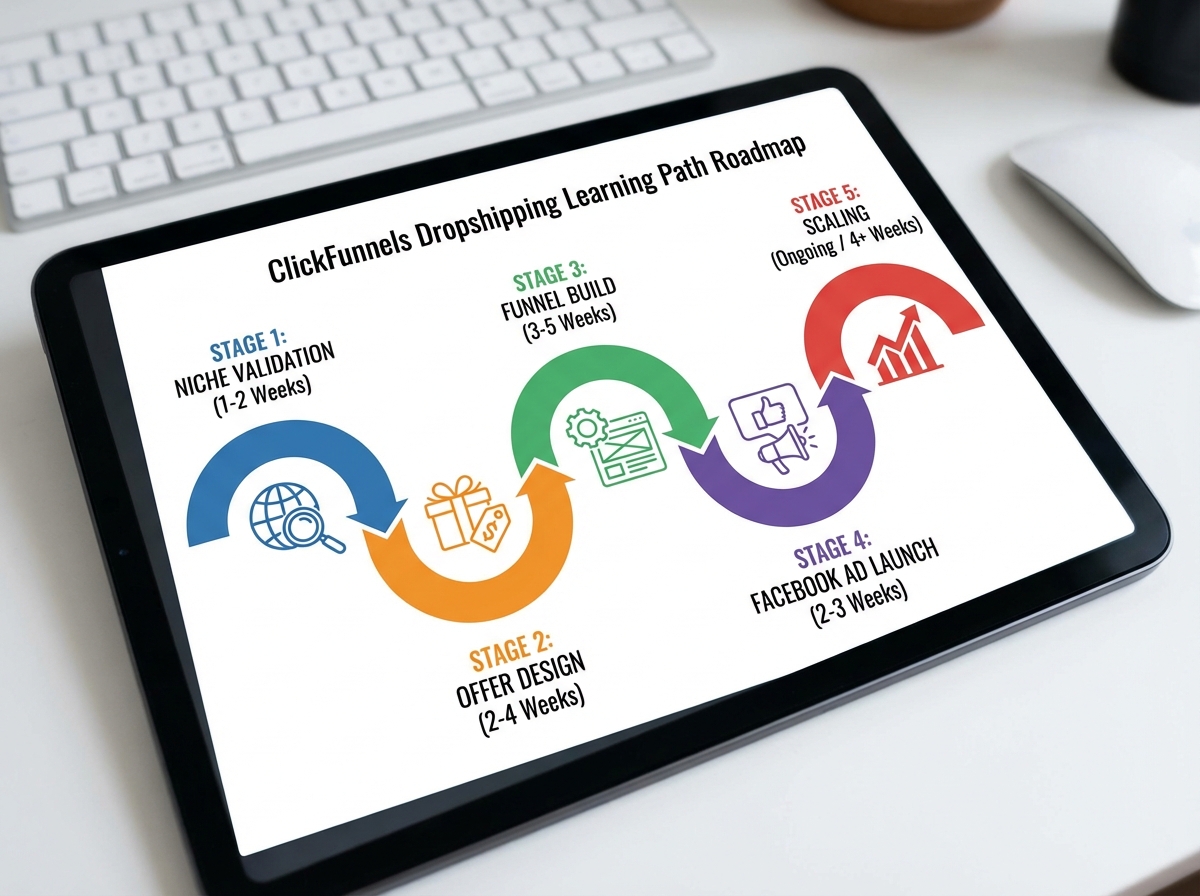
How Long This Actually Takes to Build
| Stage | Content | Time |
|---|---|---|
| Niche validation | Research, competitor analysis, demand signals | 3–5 days |
| Offer crafting | Positioning, pricing, subscription structure | 2–3 days |
| Funnel build | Pages, copy, order form, upsell/downsell | 4–7 days |
| Traffic setup | Facebook Ads account, pixel, first campaign | 2–3 days |
| First data cycle | Running ads, reading stats, first optimizations | 7–14 days |
| Scaling phase | Lookalike audiences, budget increases, funnel tweaks | Ongoing |
| Total to first real data | 3–5 weeks |
The order you build in matters more than how fast you move — a funnel launched before the offer is solid will teach you nothing useful. If it takes you six weeks instead of three, that’s not falling behind; that’s the difference between a funnel you understand and one you just copied.
The Niche Problem Nobody Talks About Honestly
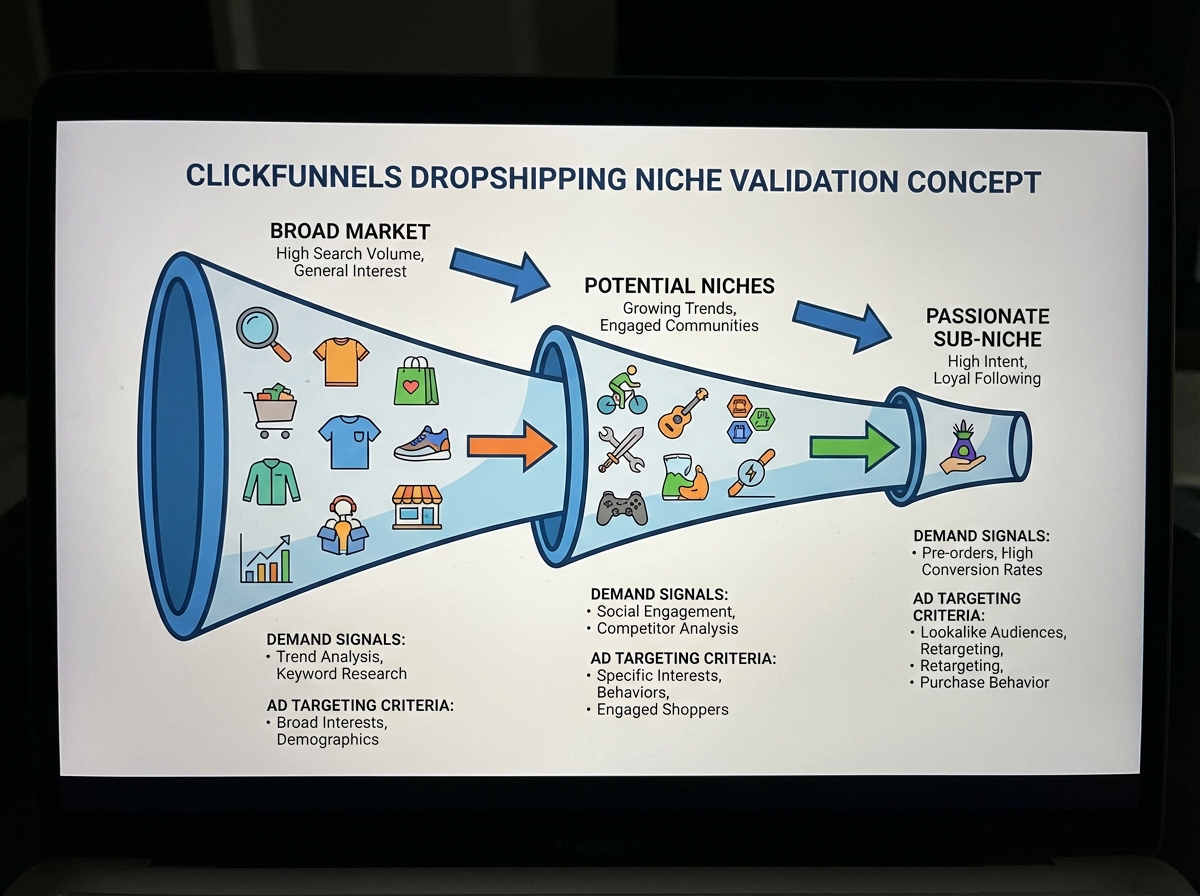
Most people pick a niche based on what they’re personally interested in, or worse, what they’ve seen someone else sell. Neither of those is a validation method. The question isn’t whether you like the niche — it’s whether there’s a passionate, identifiable audience already spending money in it, and whether you can reach that audience at a cost that makes the funnel math work.
The validation process has two layers. The first is demand: are people actively searching for, buying, and talking about products in this space? The second is targeting: can you reach these people on Facebook with enough precision that your ad spend isn’t wasted on people who’ll never convert? A niche like “tactical gear for hunters” works not because it’s obvious, but because the audience is definable, passionate, and already buying.
Picking a niche that’s too broad — “fitness,” “pet products,” “home décor” — is the single most common reason funnels stall early. Not because broad niches don’t have buyers, but because your ad targeting becomes expensive and your offer becomes generic. The narrower your niche, the more specific your offer can be, and the more your funnel feels like it was built for exactly that person.
Building an Offer That Doesn’t Need a Discount to Convert
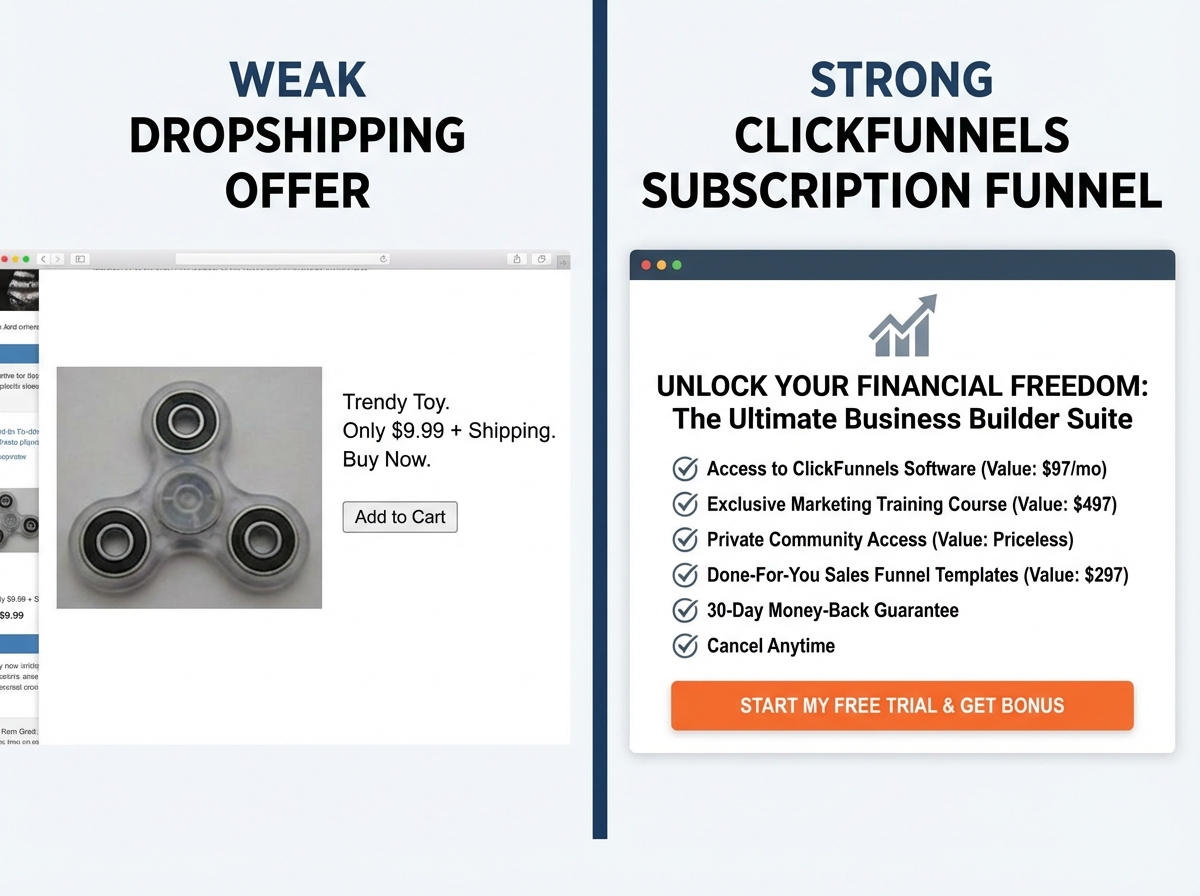
This is where most dropshippers get it completely wrong: they treat the offer as the product. The product is just the vehicle. The offer is everything around it — what you’re promising, how it’s packaged, what the subscription includes, and why buying today makes more sense than waiting. When someone lands on your funnel page, they’re not evaluating a product; they’re evaluating whether the outcome you’re describing is worth the risk of their money.
Crafting an unbeatable funnel offer means stacking value in a way that feels irrational to refuse. A physical product subscription paired with a digital bonus, a guarantee that removes the downside risk, and a price point that feels like a deal relative to the perceived value — that combination does more work than any ad creative ever will. The ad gets the click; the offer closes the sale.
I spent two weeks tweaking a product page that was getting decent traffic and zero conversions. The product was fine. The supplier was reliable. The problem was that my offer sounded exactly like every other offer in the niche. The moment I repositioned around a specific outcome — not just “get this product” but “solve this specific problem every month, automatically” — the conversion rate changed.
What Building the Funnel in ClickFunnels Actually Feels Like
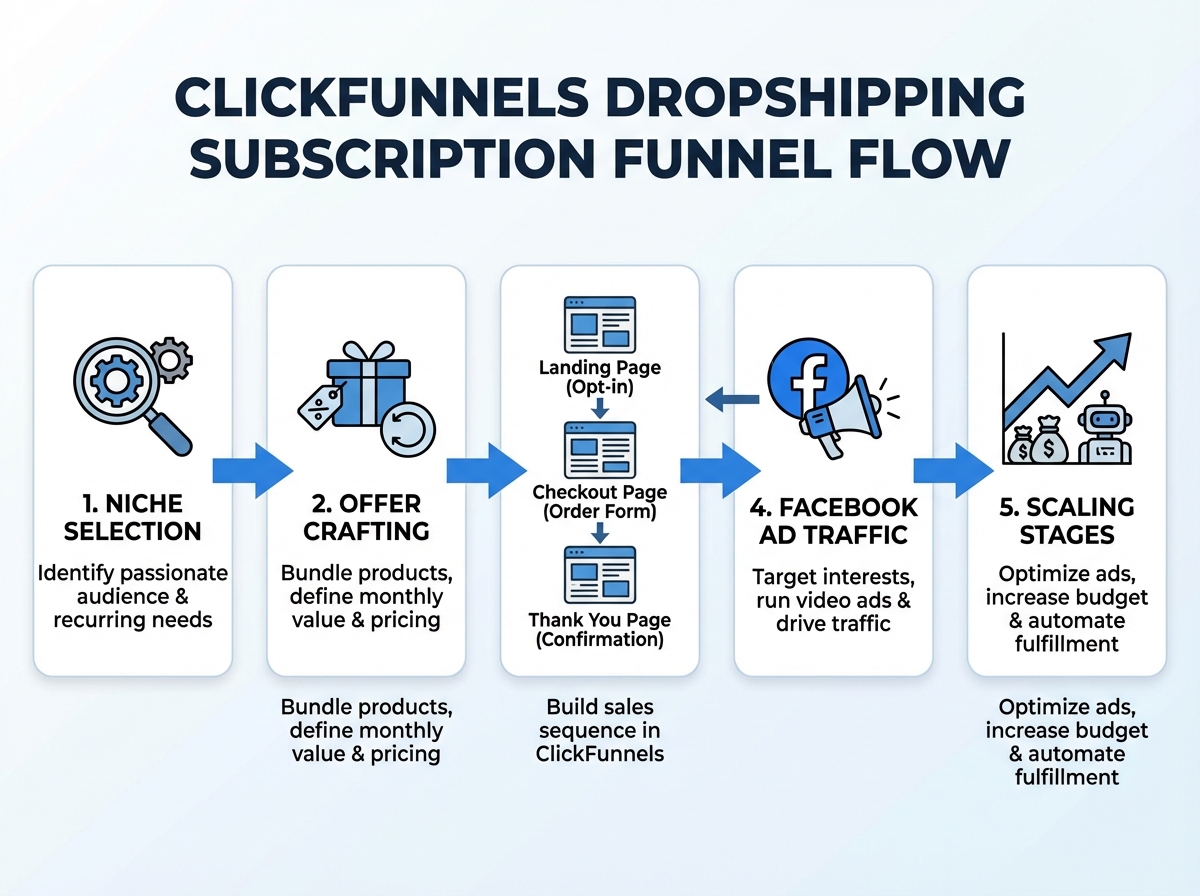
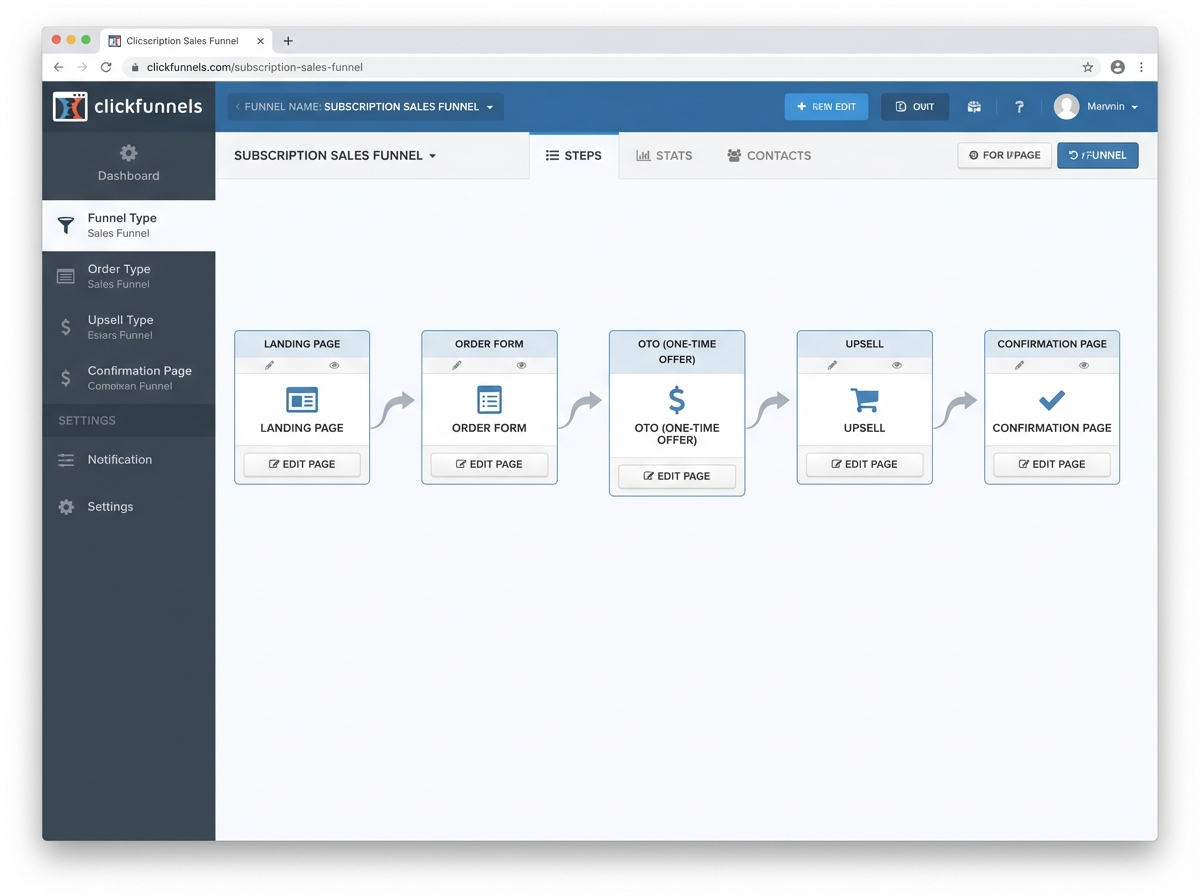
The first time you open ClickFunnels and look at a blank funnel, it feels like too much. There are opt-in pages, sales pages, order forms, one-time offers, upsell pages, downsell pages, confirmation pages — and they all have to connect in the right sequence. The good news is that once you understand the logic, the builder itself is the easy part.
The sequence matters more than the design. Your front-end page needs one job: get the click. Your order form needs to feel safe and fast. Your OTO (one-time offer) page needs to hit immediately after purchase, while the buyer’s momentum is highest. Your upsell should add to what they just bought, not introduce something entirely new. Get that sequence right, and you can use a basic template and still outperform a beautiful funnel with a broken flow.
For building an ecommerce dropshipping sales funnel that converts consistently, the subscription model is what separates this approach from standard one-and-done dropshipping. When you set up recurring billing correctly inside ClickFunnels, every new customer becomes a compounding asset, not just a single transaction.
Driving Traffic With Facebook Ads and Influencers
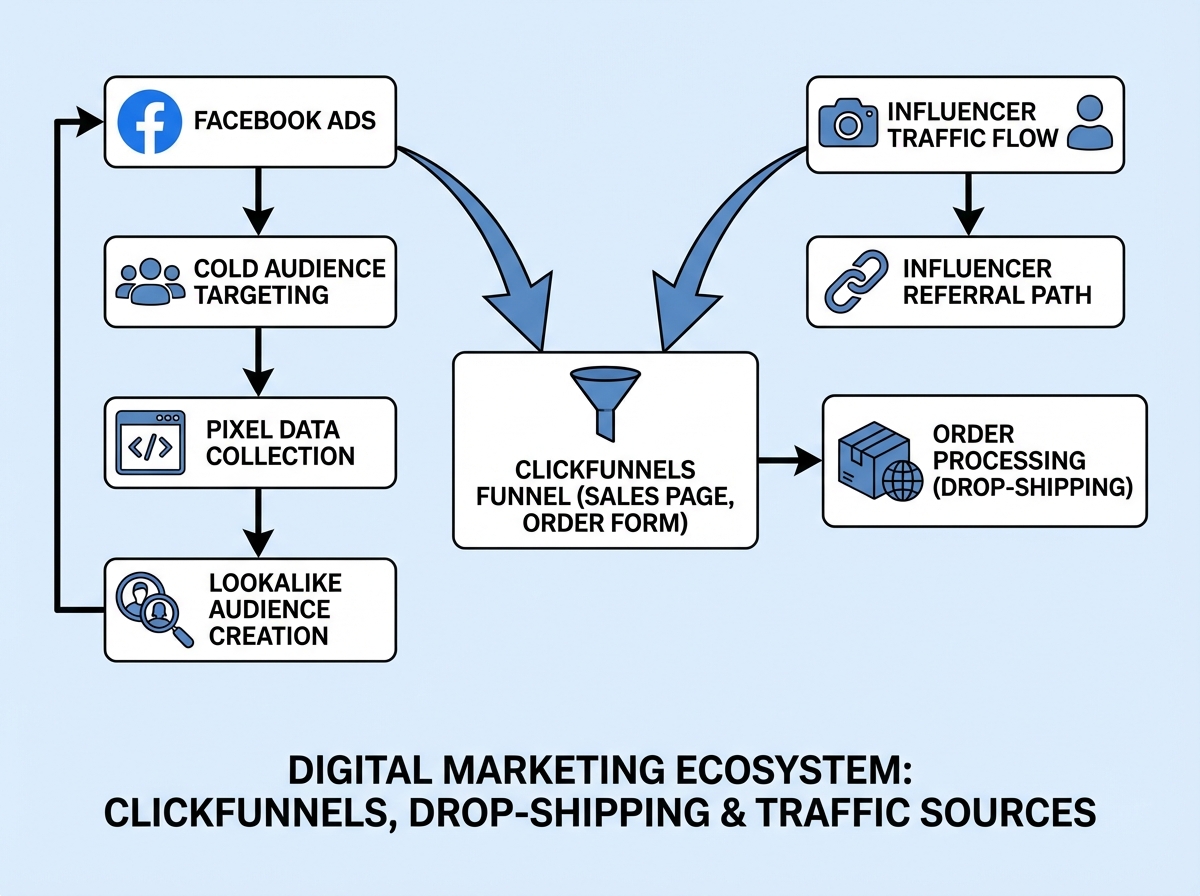
Facebook ads for a ClickFunnels dropshipping funnel work differently than ads for a general store. You’re not driving traffic to browse — you’re driving a specific person to a specific offer. That means your targeting has to be tight and your creative has to speak directly to the pain or desire your offer addresses. The pixel does its best work when you give it clean, consistent signals from a well-defined audience.
The biggest mistake people make with Facebook ads at this stage is scaling too early. They get a few sales, get excited, triple the budget, and watch the cost-per-purchase spike. Scaling on Facebook is about expanding audiences and creatives gradually, not just spending more on what’s already running. Lookalike audiences built from your buyer list are almost always more efficient than cold interest stacks — but you need enough purchase data before they perform reliably.
Influencers add a dimension that paid ads can’t replicate: social proof from a trusted voice in the niche. An influencer post in a tight niche — someone with 50,000 highly engaged followers who actually use products like yours — can send converting traffic at near-zero cost compared to cold ads. The key is matching the influencer’s audience to your niche with the same precision you’d use for ad targeting. Broad reach with low relevance is worthless; narrow reach with high trust converts.
Reading Your Stats Before You Scale Anything
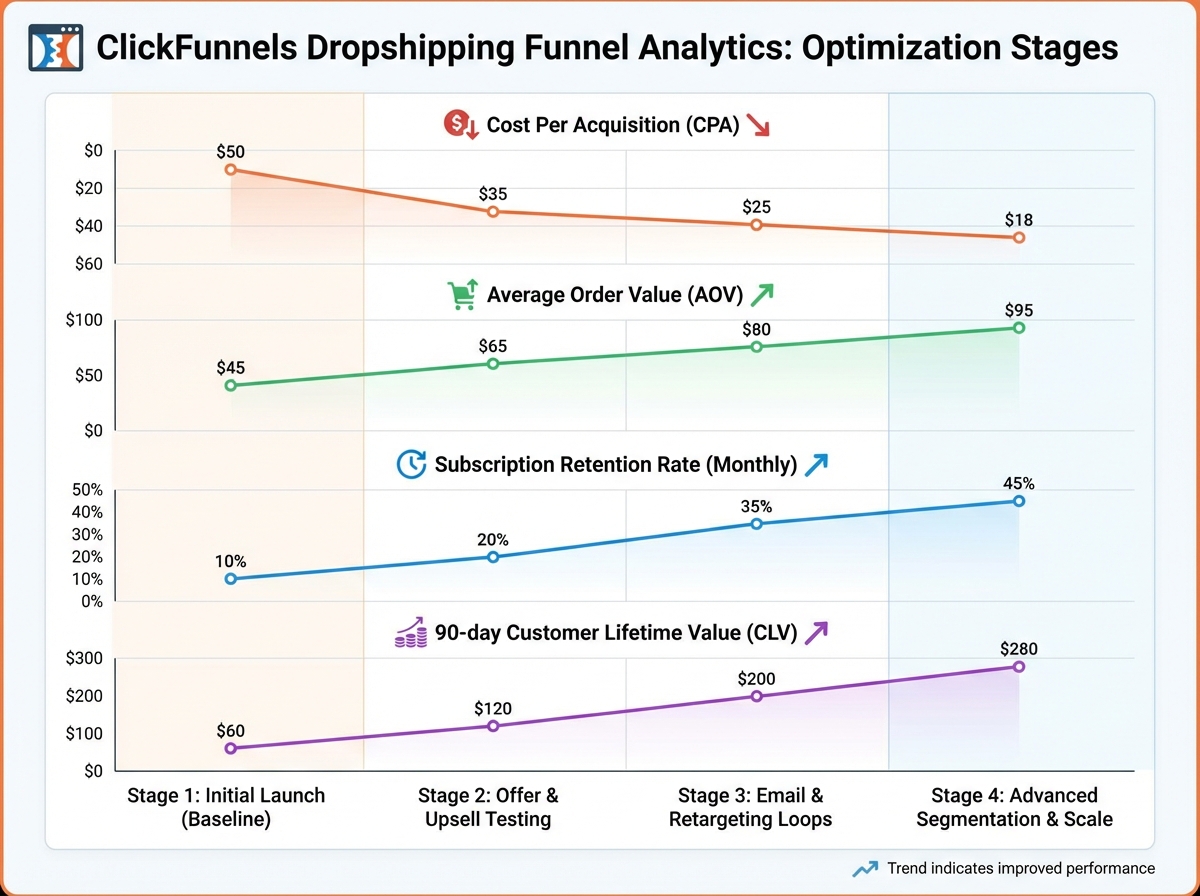
This is the stage where most people either give up or make expensive mistakes. The funnel is live, ads are running, some sales are coming in — and now you’re staring at a dashboard full of numbers that seem contradictory. Your cost per click looks good but your cost per purchase is high. Your conversion rate on the front-end is decent but almost nobody takes the upsell. These numbers are telling you something specific, and learning to read them correctly is what separates a funnel that breaks even from one that scales profitably.
The most important metric at this stage isn’t ROAS — it’s your funnel’s average order value versus your cost to acquire a customer. If your AOV is $47 and your customer acquisition cost is $44, you’re barely profitable upfront. But if that same customer is on a $29/month subscription, your second month is almost pure margin. The whole model depends on understanding your numbers across a 30–60–90 day window, not just at the point of first purchase.
Analyzing stats honestly also means being willing to kill things that aren’t working — a specific ad set, a particular audience, even a funnel page that’s getting traffic but not converting. Optimization at this stage is mostly subtraction: removing what’s bleeding spend and doubling down on what’s showing early signal.
Scaling to $10K/Month Without Breaking What Already Works
Scaling a ClickFunnels dropshipping funnel is not the same as scaling ad spend. By the time you’re thinking about $10K/month, the funnel itself should be close to finalized — copy tested, offer validated, upsell sequence dialed in. What scaling actually means at this point is expanding your customer acquisition while keeping your unit economics intact.
Horizontal scaling — new audiences, new ad creatives, new influencer partnerships — is almost always safer than just raising budgets on existing campaigns. New creatives targeting the same validated audience often outperform the original, especially as your pixel accumulates more data. Email marketing adds another compounding layer: a subscriber who didn’t buy on the first visit can convert on the third touchpoint at nearly zero incremental cost.
For Facebook marketing and paid ads in the context of a subscription funnel, the goal at scale is to reduce your payback period — the time it takes to recoup your customer acquisition cost through subscription revenue. The faster you get paid back, the faster you can reinvest in new traffic without straining cash flow. Automating your order fulfillment pipeline at this stage is what makes growth sustainable rather than chaotic.
What I’d Do Differently From Day One
Looking back, the funnel wasn’t the hard part. The hard part was the sequence of decisions before the funnel existed: niche, offer, positioning. Everything downstream flows from those three. When those are right, the funnel almost builds itself. When they’re wrong, no template or ad budget fixes it.
Here’s what actually matters — in the order it matters:
- Validate demand before you build anything. Search competitor Facebook ad libraries, check if people are actively buying in the niche, and confirm you can target this audience affordably — before you spend a single hour on funnel pages.
- Write your offer before you design your funnel. The copy drives the design, not the other way around. Know exactly what you’re promising, at what price, with what guarantee, before you open the funnel builder.
- Use a proven template and customize the copy. Funnel design is not where you add value in the early stages. Save the custom design work for after you’ve validated your offer converts.
- Set up your Facebook Pixel on day one. Even if you’re not running ads yet, the pixel starts collecting data the moment you have any traffic. That data is worth more than any targeting you can manually set up later.
- Build your upsell sequence around adding to the purchase, not starting a new sale. The OTO should feel like a natural continuation of what the customer just decided — not a pivot to something unrelated.
- Track AOV and subscription retention separately from ROAS. A funnel that looks unprofitable on day one can be highly profitable by day 60 if retention is strong. Know your 30/60/90-day LTV before you make any scaling decisions.
- Start email marketing from the first purchase. Every buyer is a warm lead for your next offer, your subscription continuation, and your upsell sequence. LinkedIn social selling and job search strategies aside, email is still the highest-ROI retention channel for ecommerce — don’t treat it as optional.
- Automate order fulfillment before you scale. Manual order processing that works fine at 10 orders per day becomes a bottleneck at 100. Set up automation early and scale into it, not out of it.
Leave a Reply