


There’s a moment most senior PR managers recognize — you’re writing another press release, tracking another media mention, and somewhere in the back of your mind a voice asks: is this actually moving anything?
Not traffic. Not impressions. Something real. Something the CEO cares about.
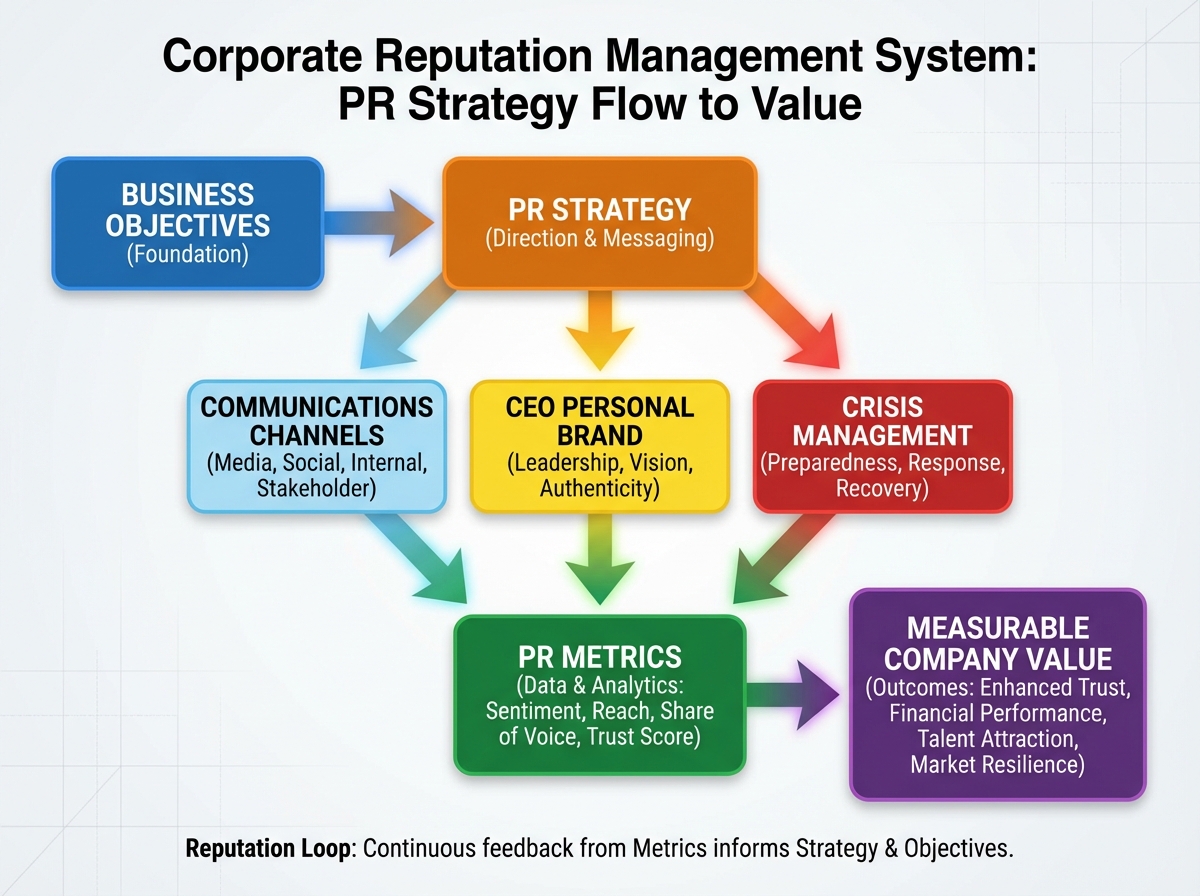
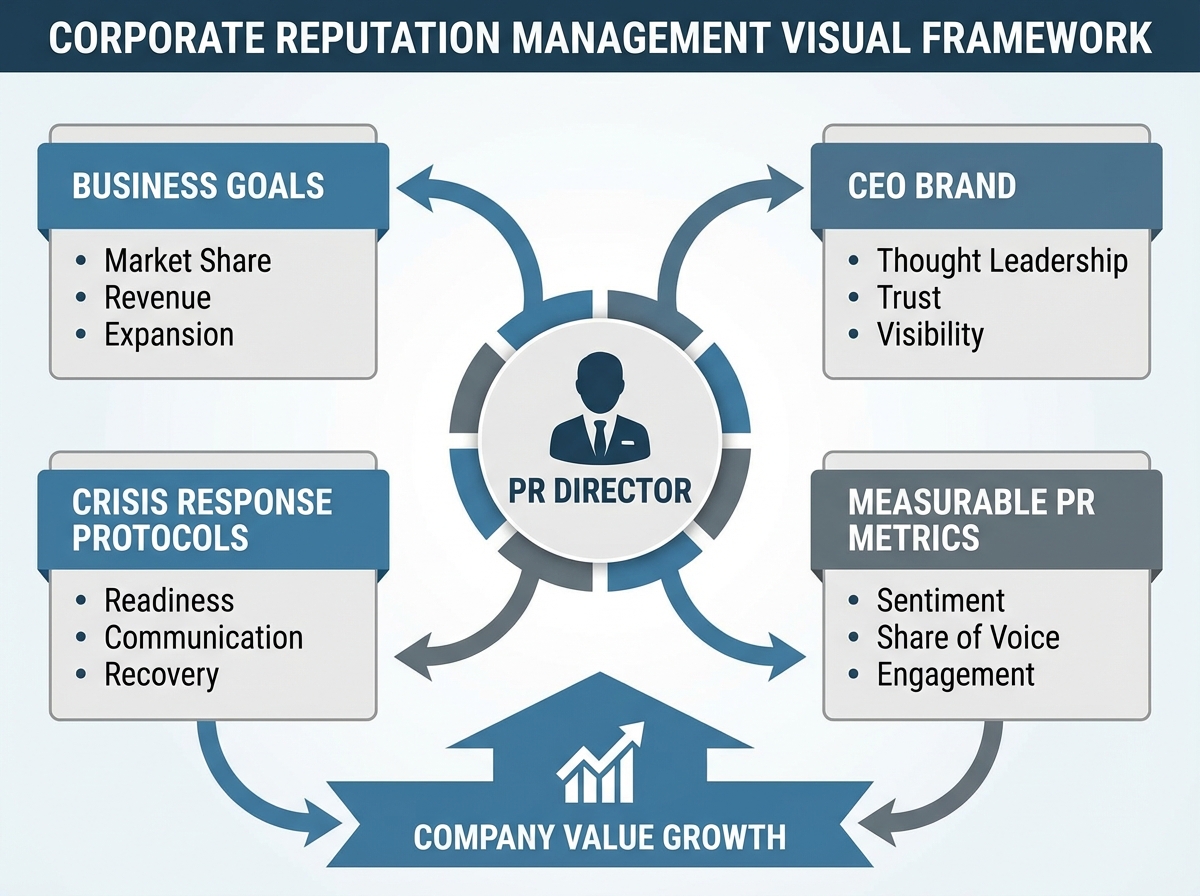
If you’re looking to learn corporate reputation management at a strategic level, the honest answer is that it demands a complete shift in how you think about PR — not as a communications function, but as a business asset you actively manage. Corporate reputation management means building the systems, narratives, and risk protocols that protect and grow how a company is perceived by investors, employees, customers, and the market at large. It is the difference between PR as output and PR as influence.
- You need this if you’re a PR manager who already handles day-to-day communications but keeps hitting a ceiling when it comes to strategic decisions.
- The gap between “good at PR” and “trusted by the CEO” is almost never about skill — it’s about how you frame what PR actually does for the business.
- This article covers the full arc: from understanding your strategic role, to building the system, to defending your budget in a boardroom.
What Corporate Reputation Management Actually Means
Most definitions make it sound passive — like reputation is something you monitor and react to. That framing keeps PR professionals stuck at the operational level.
Corporate reputation management is the active, ongoing discipline of shaping how stakeholders — investors, regulators, employees, media, and the public — perceive and trust a company over time. It encompasses PR strategy, crisis communications, executive personal branding, and measurable communications ROI, all aligned to business objectives.
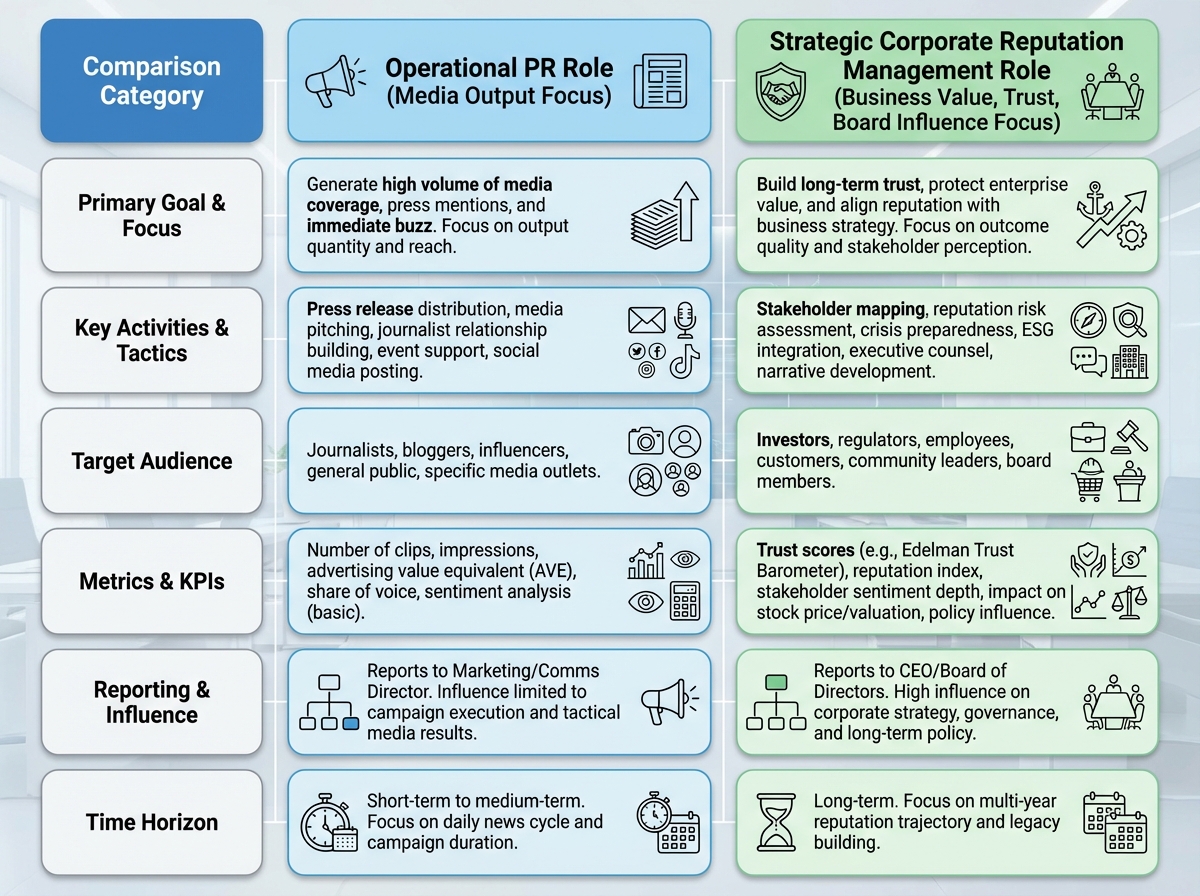
| Function | Operational PR | Strategic Reputation Management |
|---|---|---|
| Focus | Media coverage, press releases | Trust, perception, company value |
| Owner | PR Manager | PR Director / CCO |
| Reports to | Marketing lead | CEO / Board |
| Measured by | Mentions, reach | Reputation score, business impact |
| Time horizon | Campaign-level | Long-term brand equity |
Three Things That Surprise Even Experienced PR Professionals
- Reputation is a balance sheet item — companies with stronger reputations attract capital at lower cost.
- Crisis communications failure almost always begins six months before the crisis, not during it.
- The CEO’s personal brand can account for nearly half of a company’s perceived reputation.
How Long It Actually Takes to Think Like a PR Director
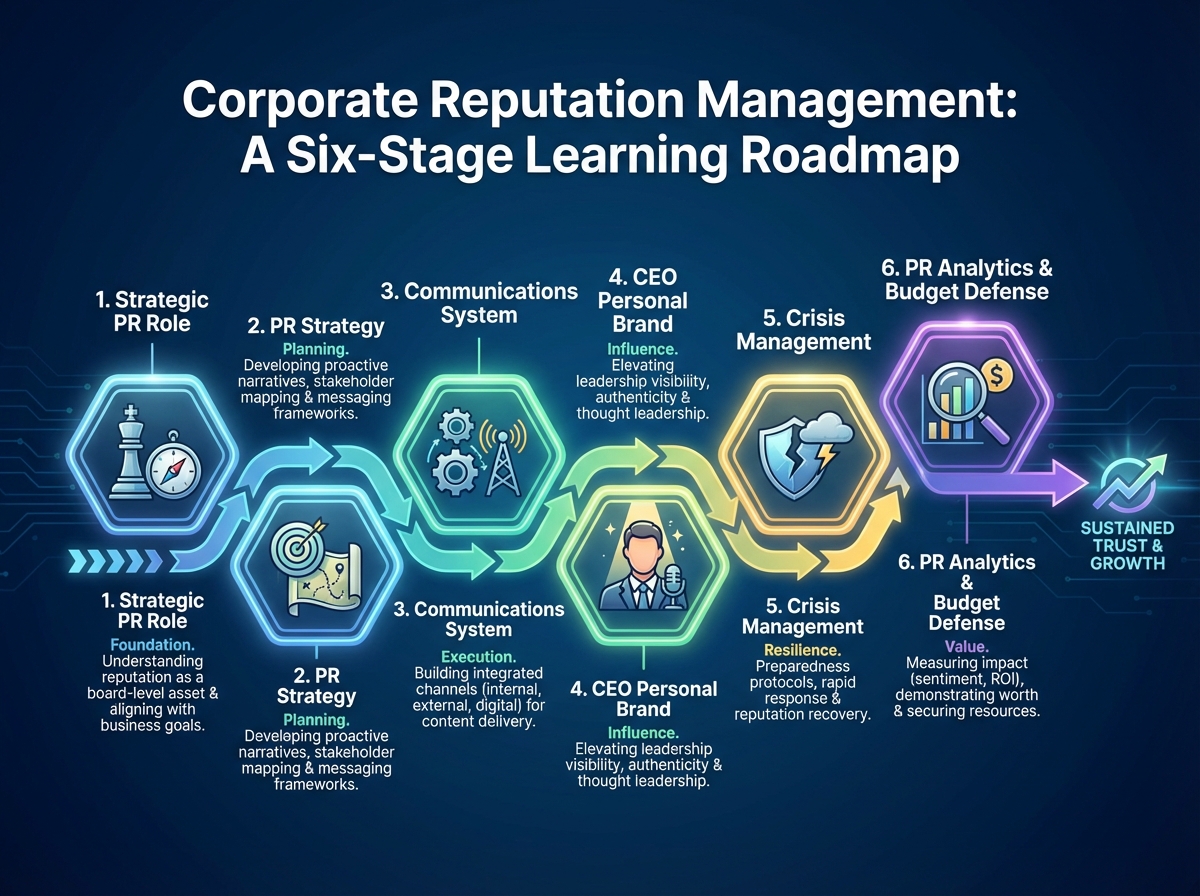
| Stage | What You’re Working On | Estimated Time |
|---|---|---|
| Strategic foundation | Role clarity, PR’s place in governance | 1–2 weeks |
| PR strategy building | Business alignment, positioning, KPIs | 2–3 weeks |
| Communications system | Channels, team structure, processes | 2 weeks |
| Executive personal branding | CEO narrative, thought leadership systems | 1–2 weeks |
| Crisis preparedness | Risk mapping, response protocols | 1–2 weeks |
| PR analytics and budget defense | Metrics frameworks, CFO-ready reporting | 1–2 weeks |
| Total | Full strategic PR director mindset | 8–13 weeks |
The order matters more than the speed — you cannot build a crisis communications system before you have a positioning narrative, because you won’t know what you’re protecting. If you’re slower than this estimate, that’s usually a sign you’re applying it in real work, which is exactly the right way to go.
Why Your Title Changes Before Your Role Does
The most disorienting part of moving from PR manager to PR director isn’t the workload — it’s realizing that the entire frame shifts. As a manager, your job is execution: place the story, manage the journalist relationship, hit the media target. As a director, your job is architecture: what story does the company need to own in the market, and what system will consistently produce that outcome?
This isn’t a soft transition. It requires you to stop asking “what are we publishing this week” and start asking “what do we want to be known for in three years, and are we building toward that or away from it?” The first time you sit in a leadership meeting and someone asks about investor perception during a product recall, you realize very quickly that reactive communications is not a strategy — it’s a liability.
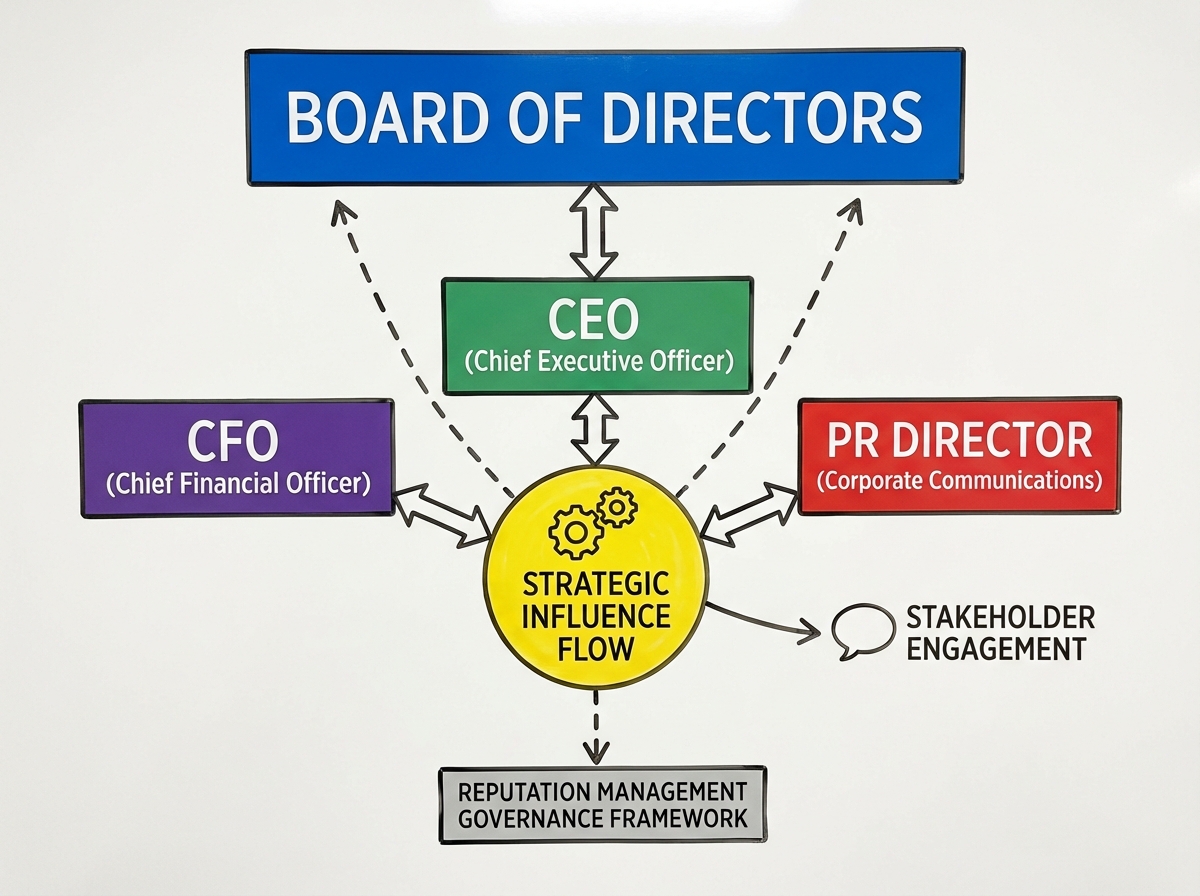
The PR director’s role sits inside corporate governance, not beneath marketing. That distinction changes everything about how you build relationships with the CEO, the CFO, and the board. Your stakeholders are not editors. They are decision-makers who need PR to behave like a managed function with clear inputs, outputs, and measurable contribution to company value.
Building a PR Strategy That the CFO Will Actually Respect
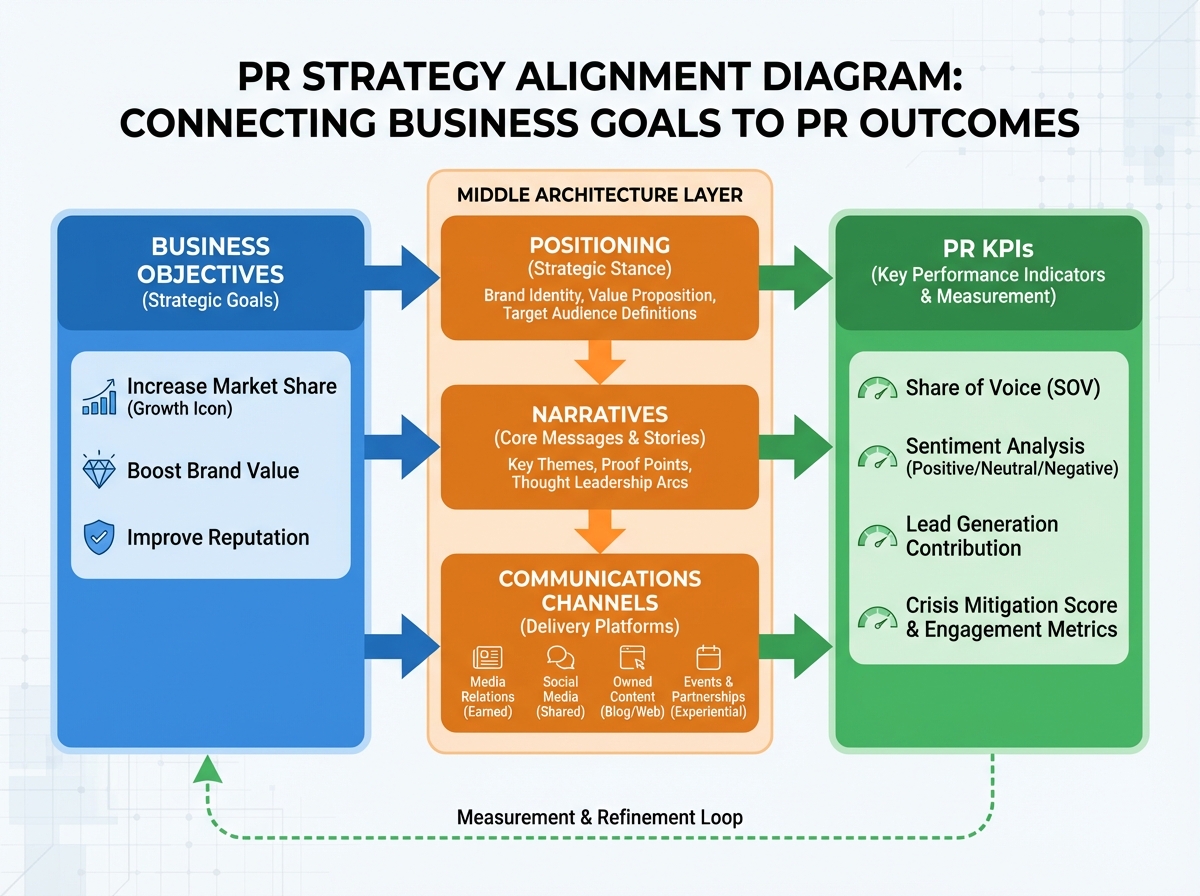
The single biggest mistake people make when building a PR strategy is writing it for the communications team instead of the business. It becomes a list of channels, a content calendar, a media outreach plan — all legitimate, all completely unanchored from anything the company’s leadership actually cares about.
A real PR strategy starts with the business objective and works backward. If the company is preparing for a Series B, the reputation work is about investment attractiveness and founder credibility. If the company is navigating a market contraction, the work is about resilience signaling and stakeholder trust. The channel is the last decision you make, not the first.
KPIs are where this either becomes real or falls apart. “Share of voice” is a marketing metric. “Reputation score among institutional investors” is a business metric. Learning to build PR KPIs that connect to the things the CFO already tracks — customer acquisition cost, retention rate, talent pipeline quality — is what earns the communications function a place at the strategy table instead of a budget cut.
The Architecture of a Communications System That Doesn’t Break
Most communications functions are not systems — they’re collections of habits. Someone handles media, someone handles social, someone drafts executive statements, and it all roughly works until something goes wrong. The moment a reputational risk event hits, the absence of a real system becomes immediately visible.
A corporate communications system has defined channels with ownership, a message architecture that everyone on the team can navigate from, escalation protocols that don’t require the director to be physically present, and reporting cadences that surface problems before they become crises. Building this is less glamorous than writing a CEO op-ed, but it is the actual job.
Team structure matters here in ways that are rarely discussed. A communications team organized by channel (one person owns media, one owns internal comms, one owns social) creates silos that produce inconsistent narratives. A team organized around stakeholder groups — investors, employees, customers, regulators — produces coordinated reputation management because the message architecture stays consistent across the same audience regardless of the channel it travels through.
The CEO Personal Brand Is a Business Asset, Not a Vanity Project
This is where a lot of PR professionals feel uncomfortable, because building an executive’s personal brand can feel like it’s serving the individual rather than the company. The discomfort disappears when you understand what the research actually shows: a CEO with a credible, visible thought leadership presence materially increases the company’s perceived trustworthiness among customers, partners, and prospective employees.
Building the personal brand of top management starts with identifying the intersection between what the executive genuinely believes and what the market needs to hear from a credible voice. That intersection is narrow, and it takes real conversation with the executive to find it. Generic leadership content — the kind that fills LinkedIn feeds with “here’s what I learned from failure” posts — is the opposite of what you’re after. You’re after specificity: the executive who has a coherent, defensible view on something the industry is actively debating.
The distribution architecture matters as much as the content. Speaking at the right conferences, being quoted in the publications where your investors read, publishing in forums where your future talent pool pays attention — this is deliberate, not accidental. It requires the PR director to own the narrative strategy and hold the executive accountable to a consistent positioning, which is a different kind of relationship than most PR professionals have been trained to build.

Crisis Communications Only Works If You Built the System Before the Crisis
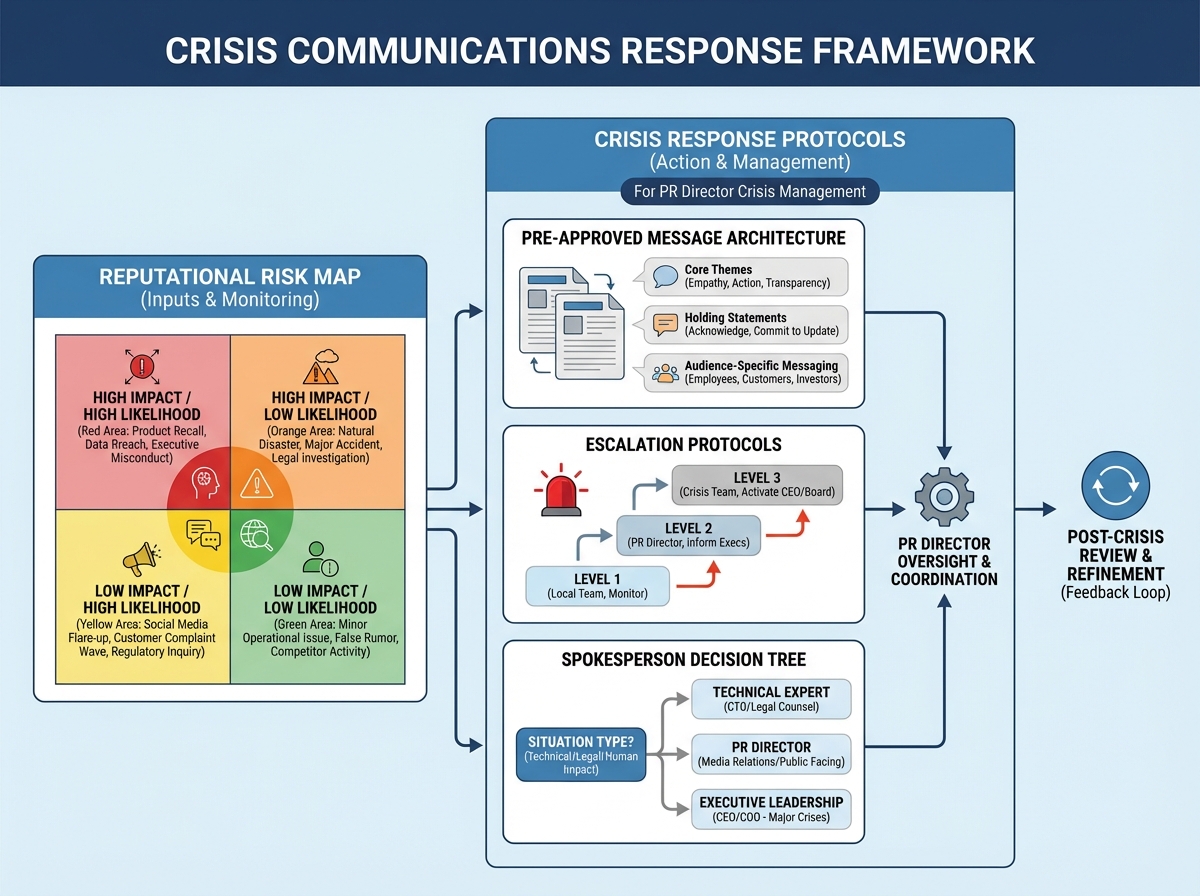
Every crisis communications failure follows roughly the same pattern: the company had no message architecture in place, so they improvised. The improvised message contradicted something that had been said publicly six months earlier. The contradiction became the story. The story ran for three days longer than the original incident would have.
Crisis communications and reputational risk management is not primarily a response skill — it’s a preparation discipline. The companies that navigate reputational threats well almost always have three things already in place before anything happens: a reputation risk map that identifies the specific vulnerabilities the company carries, a pre-approved response framework for the most likely scenarios, and a decision-making protocol that doesn’t require consensus under pressure.
The hardest part is getting leadership to invest time in crisis preparation when there is no crisis. The argument that works is not “what if something goes wrong” — it’s a financial one. Reputation damage at the moment of a product launch, an IPO, a major hiring cycle, or a regulatory review can cost multiples of what the preparation would have cost. When you frame crisis readiness as risk-adjusted cost reduction, CFOs listen.
Measuring PR in a Language the Board Actually Uses
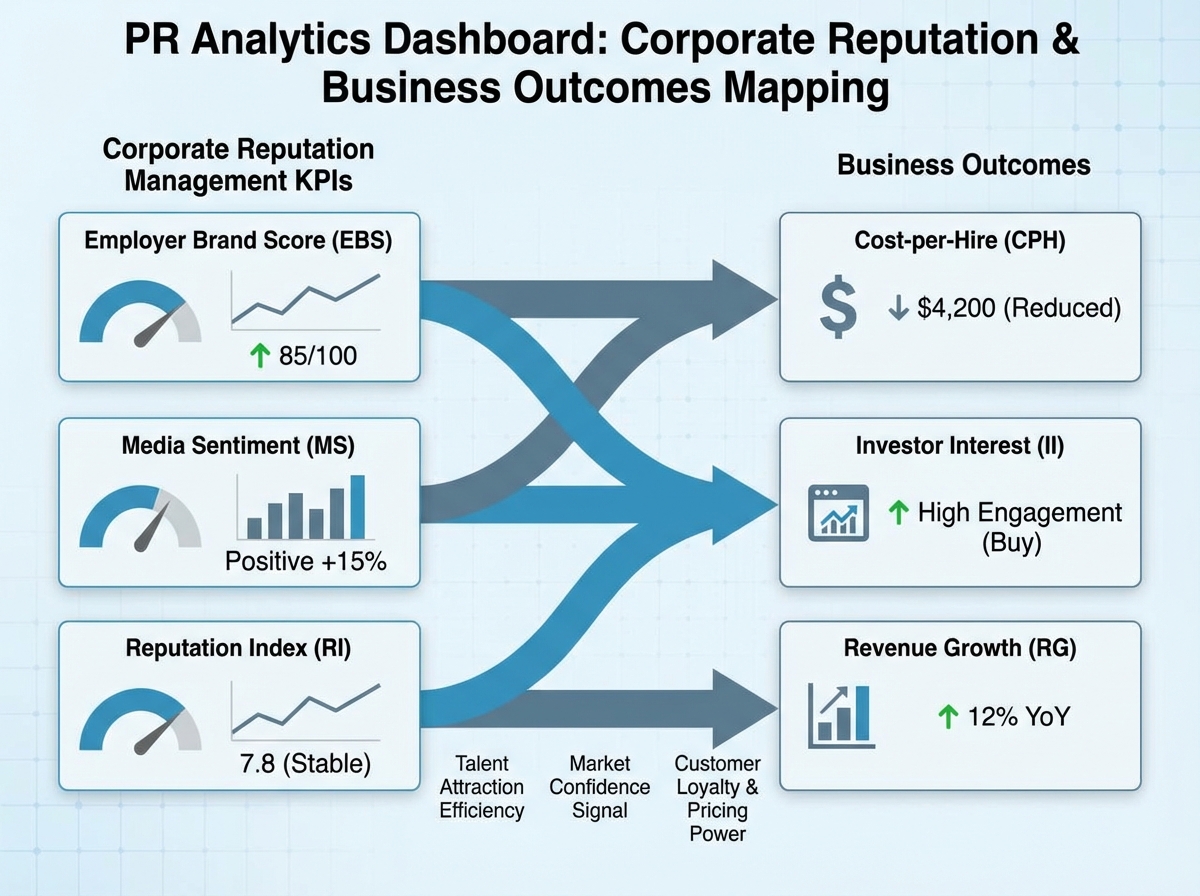
PR analytics is the area where the profession has historically been its own worst enemy. We invented metrics that sound impressive to other communications professionals — AVE, share of voice, sentiment percentage — and then wondered why finance never took us seriously.
The shift is learning to map PR outcomes to business indicators the company already tracks. Employer brand strength maps to cost-per-hire and offer acceptance rate. Investor relations coverage maps to cost of capital and analyst coverage depth. Customer-facing reputation maps to net promoter score and word-of-mouth acquisition share. None of these are perfect proxies, but all of them speak the language of business outcomes, which is what separates a PR function that gets budget cuts from one that gets budget increases.
Defending a PR budget before a CEO or CFO is a presentation skill built on an analytical foundation. You need a clear model that shows what the budget produced last year in measurable business terms, what the next investment will produce, and what the downside looks like if the budget is reduced. That model takes time to build, but once it exists, the conversation changes completely. You are no longer asking for money to do communications — you are presenting a risk-adjusted case for protecting and growing an intangible asset that appears on no balance sheet but affects every line of the P&L. For those building out this kind of analytical thinking across strategic functions, the frameworks used in video marketing for small business share similar ROI-to-outcome logic that translates well into PR budget defense.
What You Can Do with This Starting Tomorrow
Looking back at what actually moved the needle — not what felt productive, but what changed how leadership perceived the communications function — it was almost never a campaign. It was a system decision. A framing shift. A metric that finally made sense to the CFO.
- Map your current PR activity to a business objective — for each thing your team does regularly, write one sentence connecting it to a specific company goal. Anything that can’t be connected is a candidate for elimination.
- Audit your CEO’s public positioning for consistency — read the last ten things your top executive said publicly and identify whether a coherent point of view emerges. If it doesn’t, that’s your first CEO personal brand project.
- Build a reputation risk register — list the five scenarios most likely to damage the company’s reputation in the next 12 months, ranked by probability and potential impact. This document alone will change how you’re perceived in leadership conversations.
- Rewrite your three core KPIs in business language — replace reach, impressions, and share of voice with metrics that map to talent, investor, or customer outcomes your CFO already tracks.
- Identify your escalation protocol gap — find the scenario where your current crisis response would require you to make a real-time decision without a pre-approved framework. Draft that framework now, before you need it.
- Request one hour with your CFO or CEO to present a PR-to-business-value model — even an imperfect model presented proactively positions you as a strategic partner rather than a budget line.
- Redesign one team meeting around stakeholder groups instead of channels — restructure how you report and plan so that the conversation centers on investor perception, employee sentiment, or customer trust rather than which platforms are performing.
- Write your company’s three-year reputation position statement — one paragraph describing specifically what the company will be known for, trusted for, and associated with. If it doesn’t exist yet, you just identified your first strategic deliverable as a PR director.
Leave a Reply