


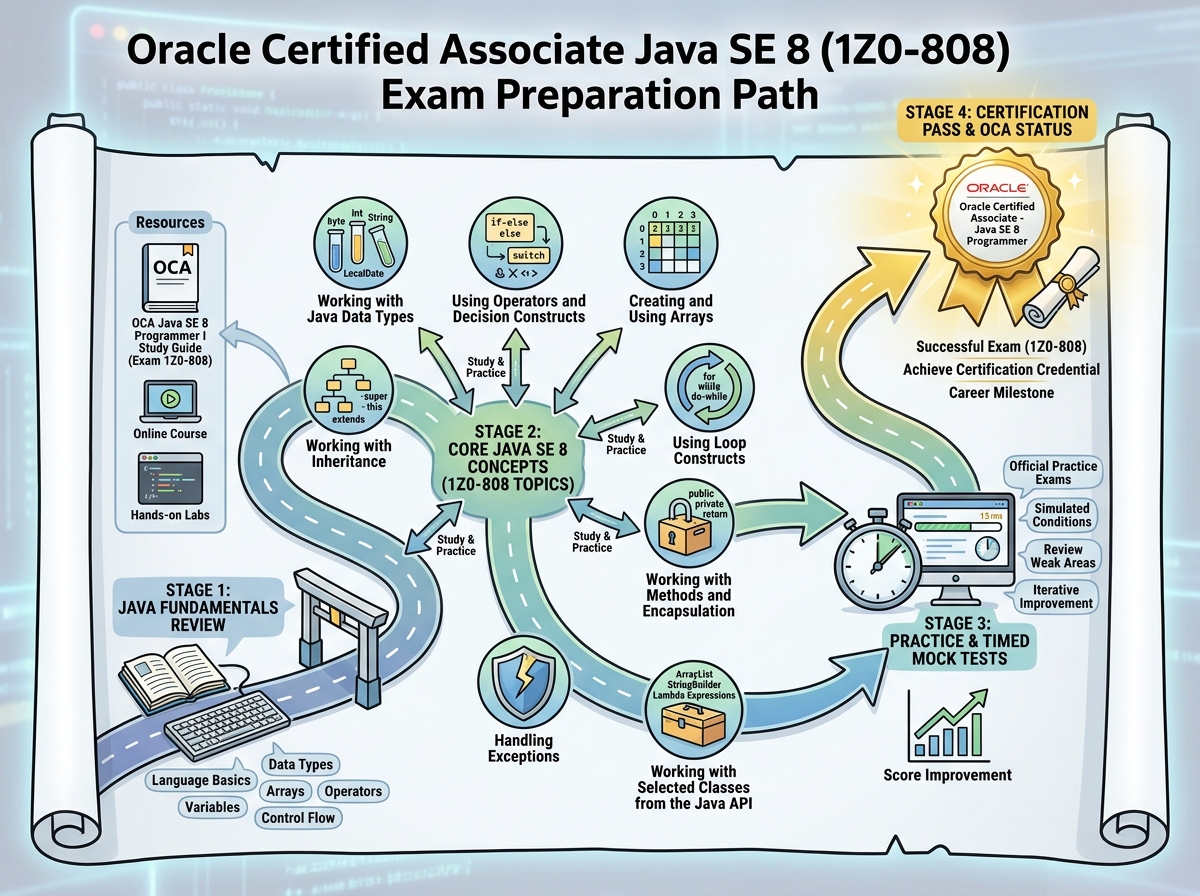
The first time you sit down with a full 1Z0-808 practice test, something uncomfortable happens — you realize how differently Oracle asks questions compared to how most people learn Java. You’ve written the code. You’ve read the docs. But the exam has a way of exposing every assumption you never knew you were making.
If you’re looking to learn how to pass the Oracle Certified Associate Java exam, the honest answer is that raw Java knowledge isn’t enough on its own. The 1Z0-808 exam tests a specific layer of the language — one that most working programmers skip because it never blocked them from shipping code. Passing it requires relearning familiar things from a much more precise angle, and doing enough timed practice to stop second-guessing yourself when the clock is running.
- You need to score 65% or more on 54+ questions answered within 120 minutes — time pressure is a real factor, not just a formality.
- The hardest questions aren’t on complex algorithms; they’re on edge cases in basic Java constructs that look obvious until they aren’t.
- Drilling full mock exams — not just flashcards — is the single most reliable way to close the gap between knowing Java and passing the OCA.
What the OCA Java SE 8 Exam Actually Measures
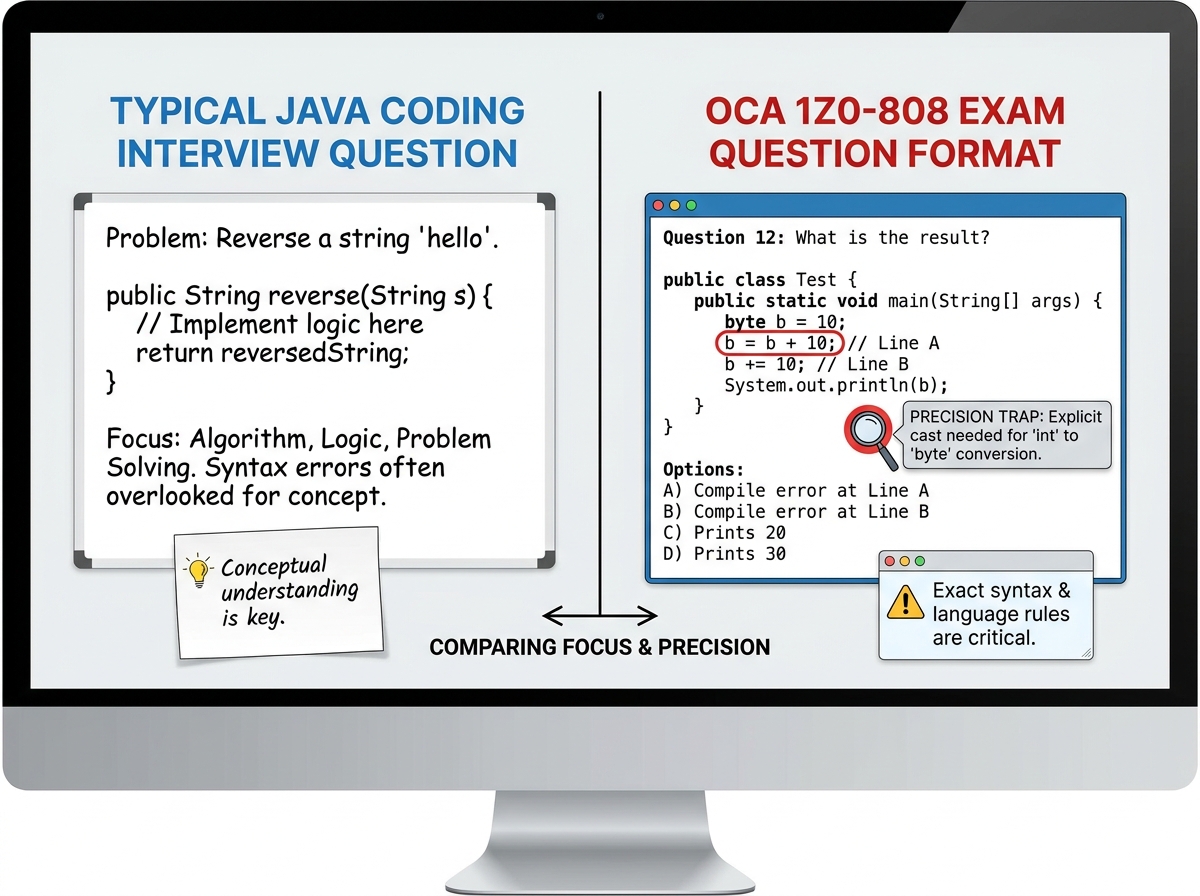
The OCA (Oracle Certified Associate) for Java SE 8, exam code 1Z0-808, tests foundational Java competency at a depth that surprises most developers who consider themselves intermediate or above. It’s not a test of whether you can build an app — it’s a test of whether you know exactly what Java does at the language level. That means operator precedence, scope rules, inheritance behavior, exception handling flow, and object lifecycle — all evaluated through code snippets that are deliberately written to be tricky.
The difference between this and a typical coding interview is precision. In an interview, close is fine. On the OCA, one wrong character in a snippet changes the answer entirely.
Three Things That Surprise Everyone
- Autoboxing behavior changes how
==works, and most developers never notice until the exam. - A
finallyblock runs even when areturnstatement is already in flight — and the exam will ask about it. - Overloading and overriding look identical in some snippets; the distinction is tested repeatedly.
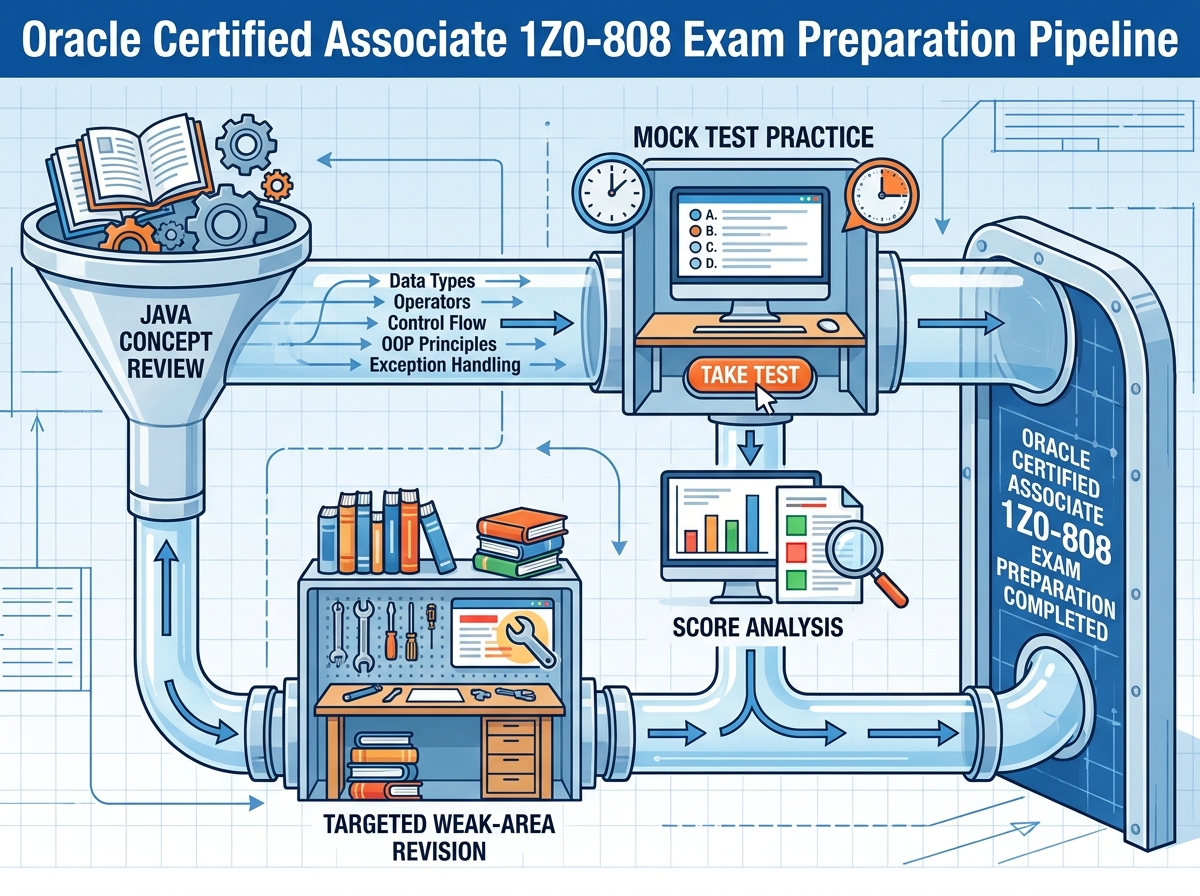
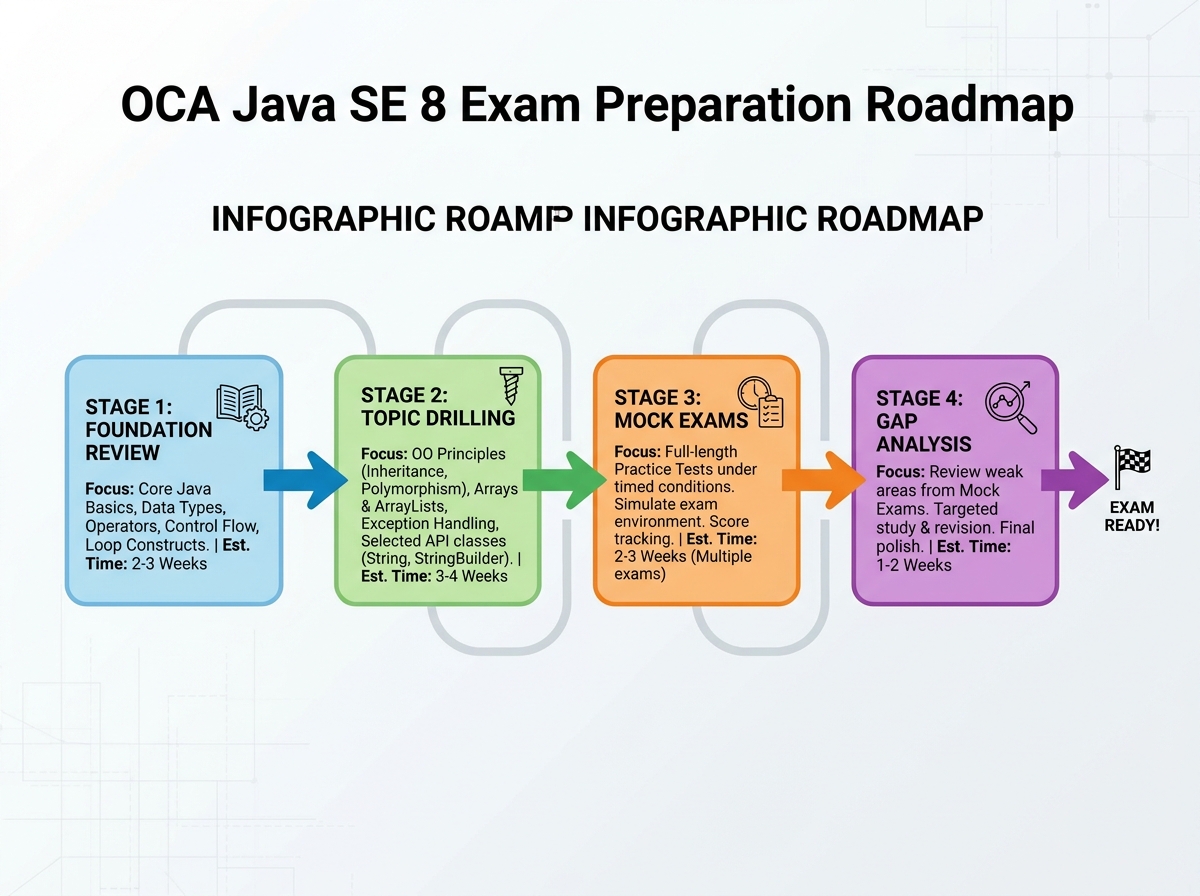
How Long OCA Java Exam Prep Actually Takes
| Stage | Content | Time |
|---|---|---|
| Java Foundation Review | Core language: types, operators, control flow, OOP | 2–3 weeks |
| Exam-Style Topic Drilling | Scope, inheritance, exceptions, arrays, ArrayList | 2–3 weeks |
| Full Mock Exam Practice | Timed full-length tests under exam conditions | 1–2 weeks |
| Review and Gap Closing | Analyzing wrong answers, retesting weak areas | 1 week |
| Total | End-to-end preparation | 6–9 weeks |
The order matters more than the pace — skipping foundation review to jump straight into mock tests creates false confidence that falls apart on actual tricky questions. If you take longer than nine weeks, that’s completely normal; most people underestimate how many subtle Java behaviors the exam covers until they’re already halfway through.
The Foundation Stage Everyone Rushes
Most programmers who’ve been writing Java for a year or two walk into OCA prep thinking the foundation stage is something they can skim. That’s the single biggest mistake people make when preparing for the Oracle Certified Associate exam — treating review as a formality when it’s actually where the exam is won or lost.
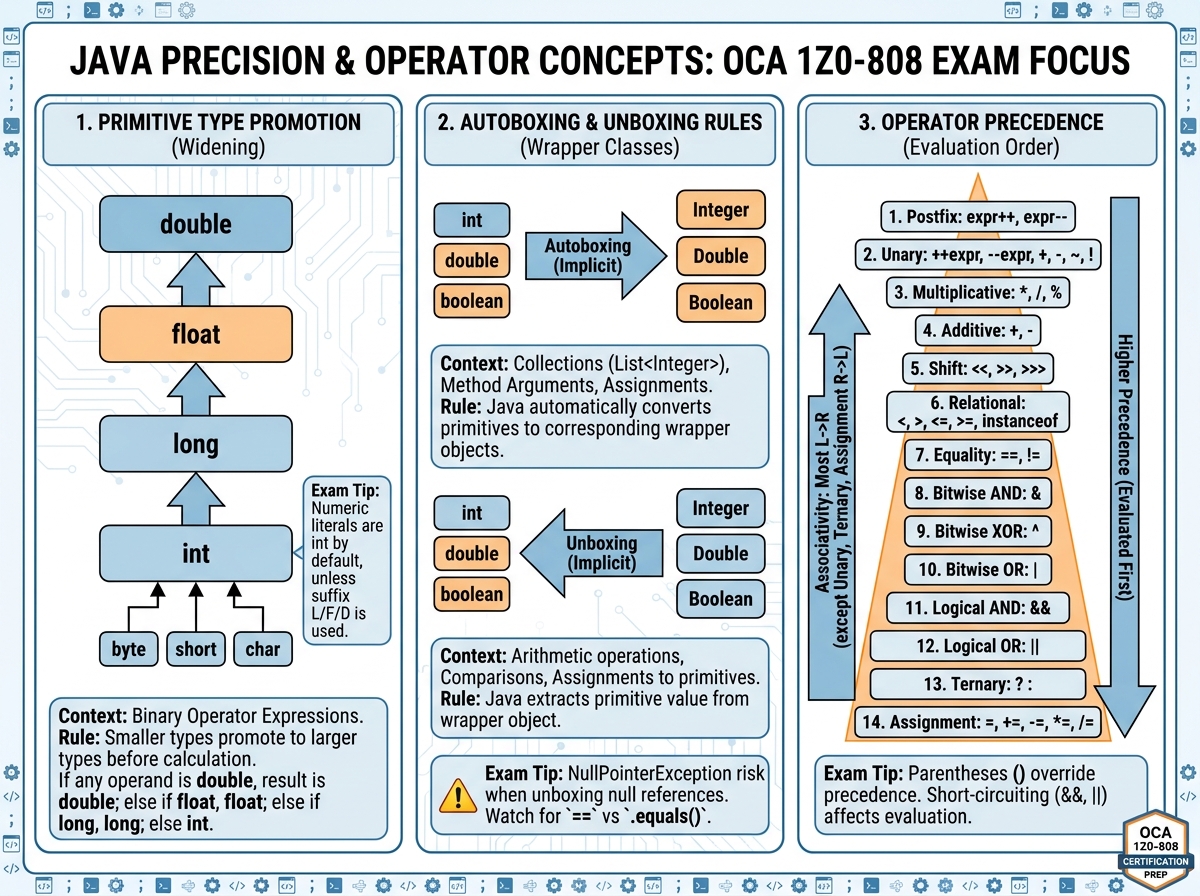
The 1Z0-808 reaches into corners of the language that production code rarely exercises. Primitive widening conversions, integer literal formats, the exact behavior of break and continue inside nested loops — these aren’t things most developers have had to think about precisely since they first learned Java. The exam thinks about them very precisely.
Spending two full weeks just on the language specification, not on writing programs but on understanding what the compiler and runtime do in edge cases, fundamentally changes how the rest of prep feels. You stop guessing and start reasoning.
What Happens When You Sit With Your First Mock Exam
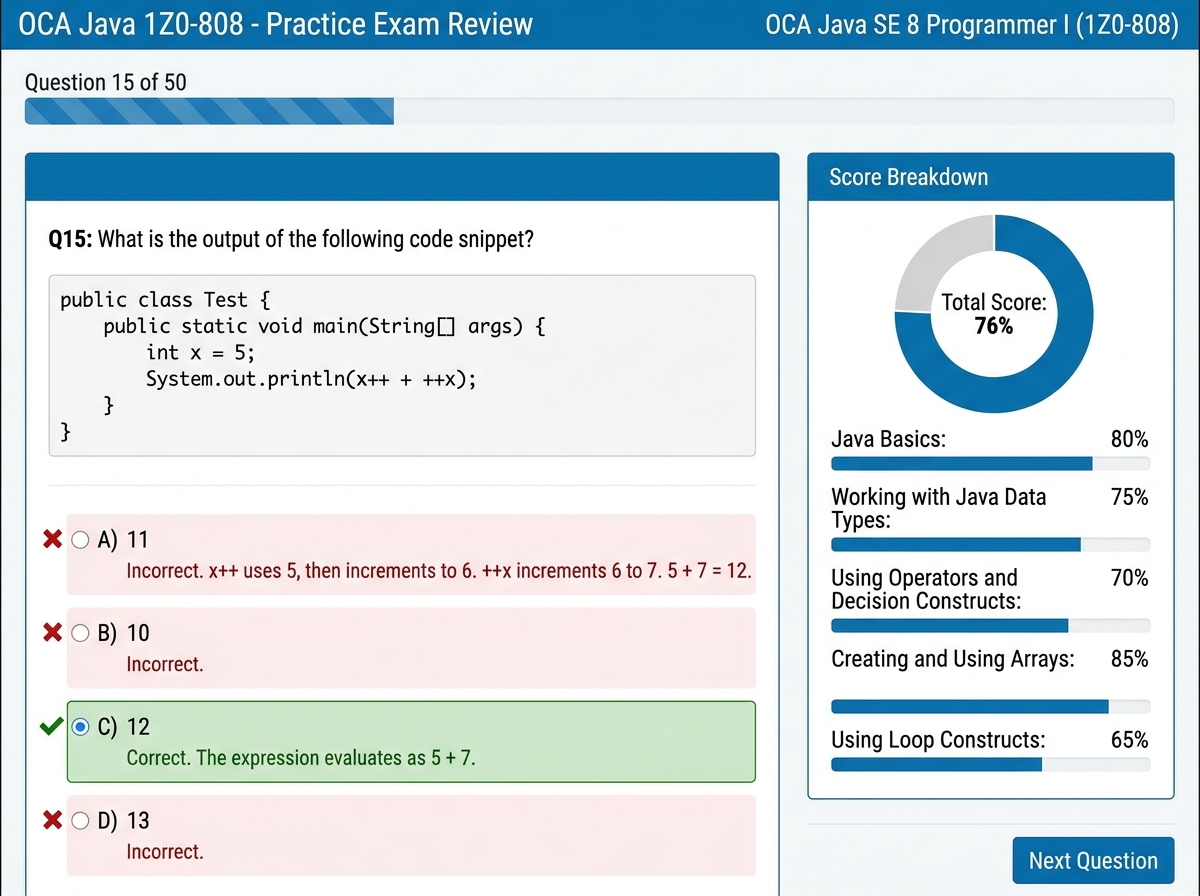
The first full practice test hits differently from any study session. You’re 20 questions in, you’ve already changed two answers, and you’re watching the clock eat into your margin faster than expected. Sixty-five percent sounds manageable until question 35 has three plausible answers and you genuinely can’t eliminate two of them.
This is the friction that mock exams are designed to create. The questions in a proper 1Z0-808 practice test aren’t just knowledge checks — they’re designed to trigger the same cognitive load as the real exam. A question about ArrayList isn’t really about whether you know what ArrayList is. It’s about whether you can track what a snippet does across three method calls under time pressure.
The most useful thing you can do after any mock exam isn’t retaking it. It’s spending more time on the explanation for every wrong answer than you spent on the question itself. That’s where the real learning happens — not in getting the answer, but in understanding exactly why the other options don’t work.
The OCA Java Topics That Actually Determine Your Score
Every person who’s worked through serious Java programming preparation eventually notices a pattern: certain topic areas generate a disproportionate share of wrong answers. On the 1Z0-808, those are inheritance and polymorphism, exception handling, and the behavior of Java operators on different types.
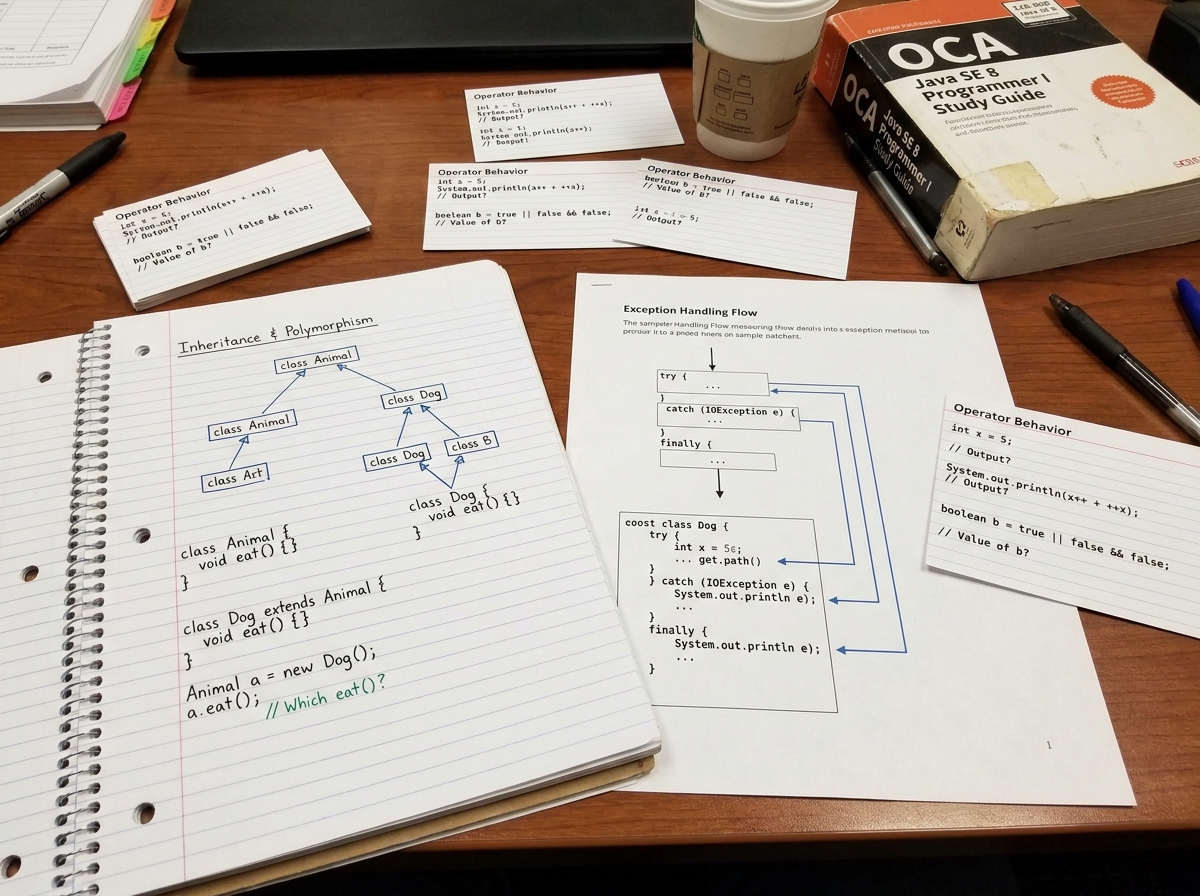
Inheritance questions test whether you can trace method resolution in multi-level class hierarchies, often in code that’s been deliberately written to obscure which version of an overridden method runs. Exception handling questions test whether you understand control flow through try, catch, and finally blocks when exceptions are thrown and caught at different levels. These two areas alone account for a significant portion of the exam’s difficulty.
The way to work through them isn’t to read explanations — it’s to write the code, run it, see what actually happens, and then deliberately introduce variations that change the output. That process of controlled experimentation is what turns understanding into instinct.
Timed Practice and What It Reveals
Once you’re past the foundation phase, the biggest variable in Java OCA exam preparation isn’t knowledge — it’s time management under pressure. A hundred and twenty minutes for 54+ questions sounds comfortable until you’re re-reading a complex snippet for the third time and the mental accounting of “I have to get through 30 more” starts making every question feel harder.
Taking full timed mock exams — not just topic quizzes, but complete tests — trains a specific mental habit: committing to an answer and moving. The exam rewards people who can make a confident decision in under two minutes per question, flag the uncertain ones, and return with a fresh perspective instead of cycling through doubt. That habit doesn’t develop from reading. It develops from doing it repeatedly until the pacing becomes automatic.
Three full mock exams, taken at exam conditions and reviewed carefully afterward, is roughly the threshold where most people stop feeling caught off-guard by the format. Before that, the format itself is a variable that eats into performance. After it, the format disappears and the questions become the only thing you’re thinking about.
When Reviewing Wrong Answers Becomes More Important Than New Material
There’s a point in 1Z0-808 prep where you’ve covered the syllabus, you’ve done a couple of mock tests, and adding new material stops helping. That’s the moment to shift entirely into review mode — and it’s a shift most people make too late.
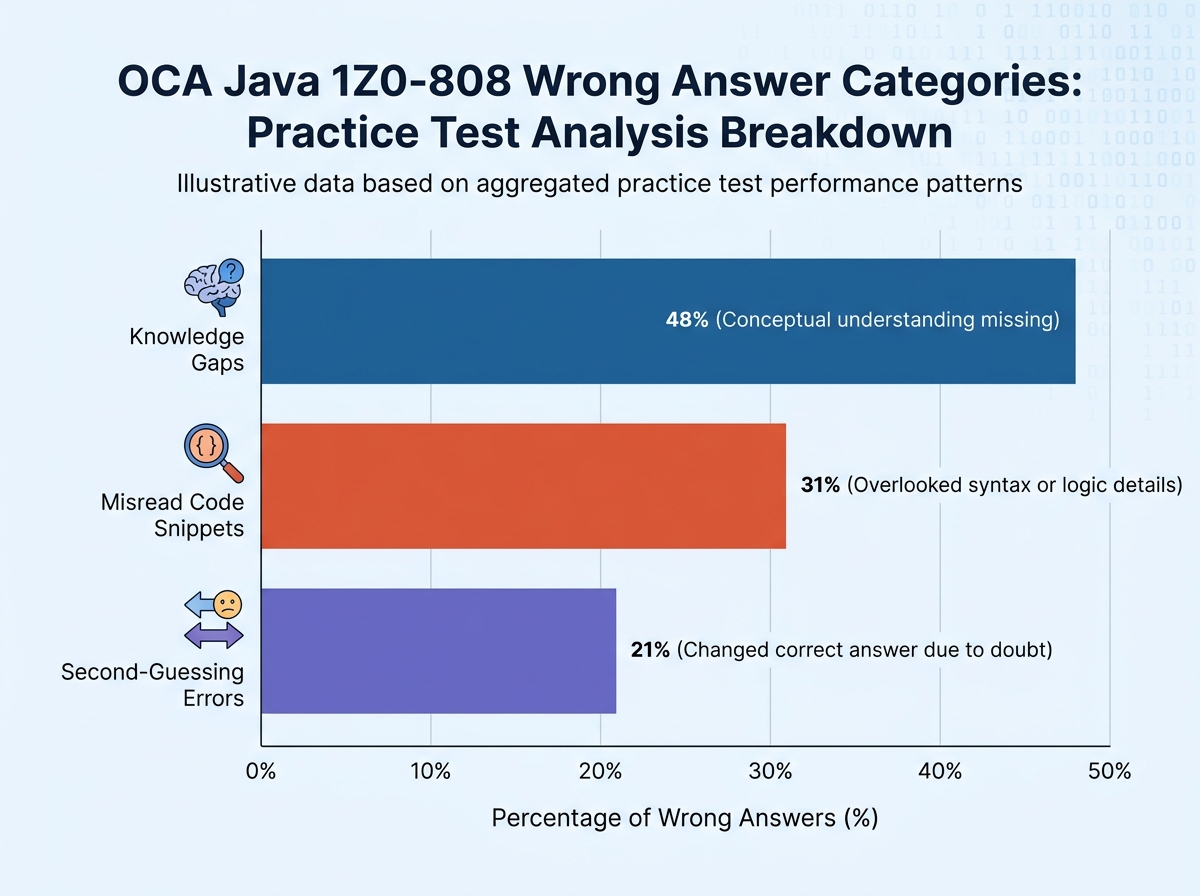
Every wrong answer in a practice test is a data point. If you missed a question because you didn’t know the topic, that points to a study gap. If you missed it because you misread the code, that points to a pacing problem — you moved too fast. If you missed it because you knew the concept but second-guessed yourself, that’s a confidence problem that only more timed reps will fix. Those three categories need different responses, and conflating them leads to prep that feels busy but doesn’t improve your score.
A practical approach: after each mock exam, sort your wrong answers into those three buckets before you do anything else. The pattern that emerges will tell you exactly where your next hour of prep should go. For many people preparing for the OCA Java certification, this analysis phase is when progress starts feeling real.
If you’re working on broader Java skills alongside exam prep, the approach of learning Python from scratch through deliberate, structured practice offers a useful mental model for how language fundamentals need to be built before higher-order application can stick.
The Week Before the Exam
The week before you sit the real 1Z0-808 is not the time to discover new material. Everything you encounter in that final week should feel like something you’ve already worked through. If a practice question genuinely surprises you with a concept you haven’t seen, make a note, understand it, and move on — but don’t spiral into a new study track.
What matters in the final week is consolidating what you know. That means one more full timed mock exam, a clean review of your weakest topic areas based on your wrong-answer tracking, and making sure you’ve internalized the format well enough that no part of the exam feels unfamiliar. The goal isn’t to learn more — it’s to reduce the cognitive load on exam day so your brain can work on the questions instead of the environment.
People who pass the Oracle Certified Associate Java exam consistently describe the same experience: the exam felt manageable, not because it was easy, but because nothing on it felt unexpected. That familiarity is what all the mock testing builds toward.
What to Do Now
- Audit your Java fundamentals before touching a single practice question — take a diagnostic test on just primitives, operators, and control flow; the results will tell you whether you actually have the foundation the exam requires.
- Build a wrong-answer log from your first mock exam — categorize each miss as a knowledge gap, a reading error, or a confidence issue, because each one needs a different fix.
- Set a 2-minute-per-question rule during every practice session — not because the exam demands it, but because consistent pacing under self-imposed pressure is what makes real time pressure feel normal.
- Focus on inheritance and exception handling first in your topic drilling — these two areas generate more exam questions than any other part of the OCA syllabus and reward deep understanding over surface review.
- Write code to verify what you think you know — when an explanation says a snippet produces a specific output, type it out, run it, then change one variable and predict the new output before running it again.
- Treat the 65% threshold as a floor, not a target — aiming to pass by the minimum margin means one bad session on exam day puts you under; drilling until you’re consistently hitting 75–80% on mocks gives you actual safety margin.
- Review every question in a practice test, not just the ones you got wrong — the ones you got right by reasoning through them are worth reinforcing; the ones you got right by luck are worth catching before exam day.
- Don’t schedule the real exam until you’ve passed at least two full mock exams in a row — not almost passed, not passed one of three — two consecutive clean passes is the signal that you’re ready.
For those who want to extend their programming credentials beyond Java, understanding how to learn Python basics fast can complement your Java OCA foundation by exposing you to how similar concepts behave differently across languages — which in turn sharpens your precision when reading Java-specific exam questions.
Leave a Reply